

Table of Contents
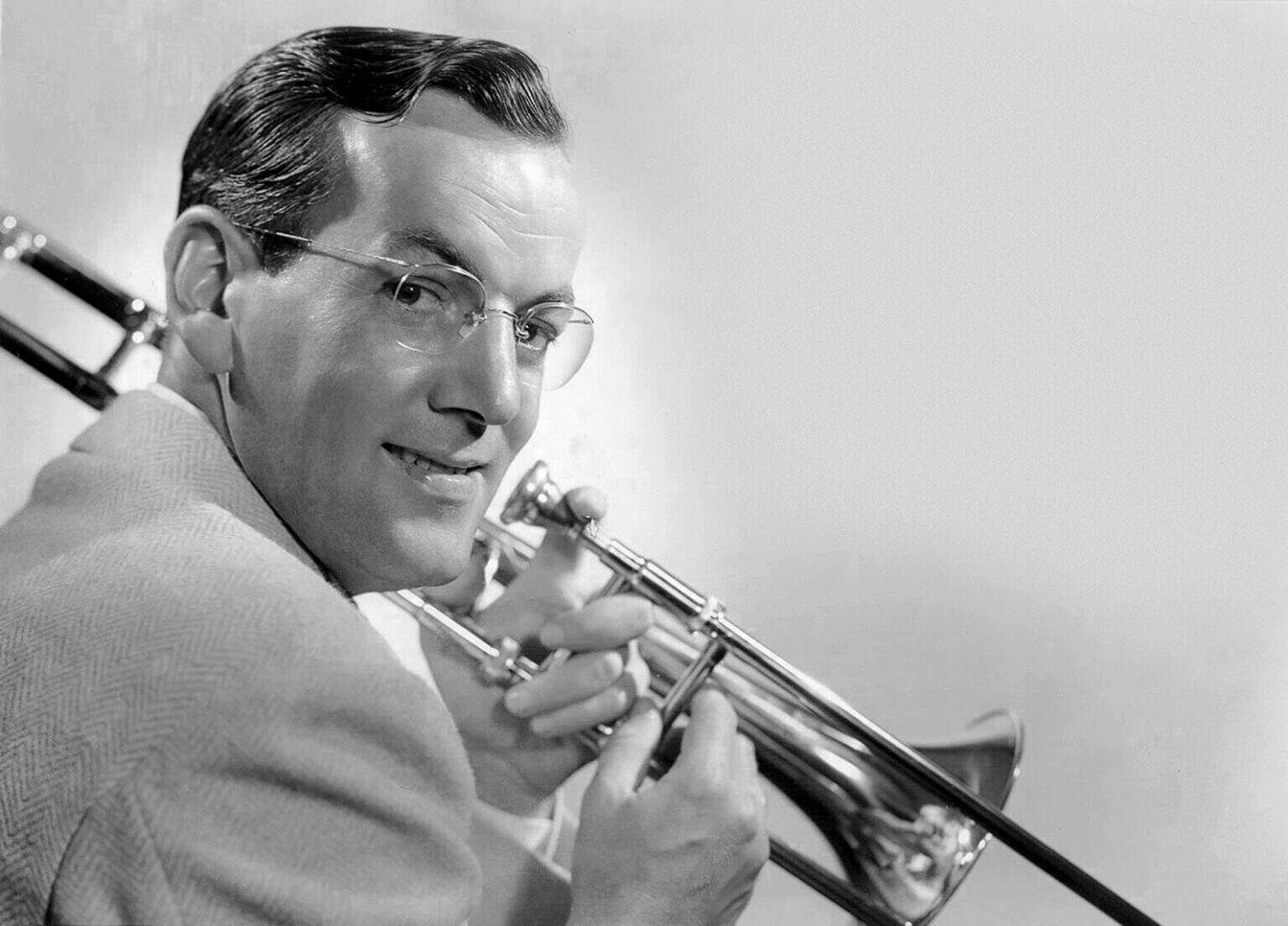
On the afternoon of December 15, 1944, a single-engine UC-64A Norseman took off from Twinwood Field near Bedford, England, bound for France, and was never seen again. Three men were aboard: the pilot, Flight Officer John R. S. Morgan, and two passengers, Lieutenant Colonel Norman F. Baessell and Major Glenn Miller, one of the most popular bandleaders in America.
The story is usually told as a crash in fog, followed by a search that found nothing. The Army’s own paperwork is far emptier than that. Its report enters the weather as “Unknown,” the cause as “Unknown,” and the search as “None,” and the earliest written notice of the loss in its file is dated five days after takeoff.
This article is built from that document: Missing Air Crew Report No. 10770, dated December 23, 1944, held by the US National Archives in Record Group 92 and digitized in full. Where later investigations and researchers add to it, they are named.
December 13 and 14, 1944
Two flights fall through. Miller is on standby to fly to France ahead of his band. The December 13 flight is canceled for weather in France, and his December 14 reservation is canceled too.
Before December 15
An offer of a seat. Lt. Col. Norman Baessell of the Eighth Air Force Service Command is flying to France the next day in a Norseman assigned to him, and invites Miller along.
December 15, 1:45 p.m.
Twinwood Field. Flight Officer John Morgan lands the Norseman at the RAF airfield near Bedford to collect his two passengers.
December 15, 1:55 p.m.
Takeoff. The time and place the Missing Air Crew Report gives as the airplane’s last known whereabouts.
December 16
The Battle of the Bulge begins in the Ardennes, and the Allied command has its attention elsewhere.
December 18
The band lands in Paris without him. The Eighth Air Force and the Allied headquarters, SHAEF, realize the airplane is missing.
December 20
First written notice. A teletype confirms the airplane “missing and unreported since departure Twinwood Field.”
December 23
The report is dated, and Miller’s wife Helen is told in person at home by two senior officers.
December 24, 6 p.m.
SHAEF announces that Miller is missing. His orchestra plays its Christmas Day broadcast under Jerry Gray.
January 20, 1945
An Eighth Air Force board of inquiry concludes the Norseman went down over the English Channel.
December 1945
Finding of death. All three men are officially declared dead a year and a day after they disappeared.
What happened
By late 1944, Major Glenn Miller led the Army Air Forces band that broadcast to troops across Europe. With the band due to move to liberated Paris, Miller wanted to fly ahead and make the arrangements, and two days of canceled flights left him frustrated.
Baessell, a mutual acquaintance, offered him a seat on a Norseman the next day. Miller’s travel orders did not authorize him to board a “casual” flight like this one, and he did not tell his chain of command, so the Allied headquarters had no idea which airplane he was on.
The airplane was a Noorduyn UC-64A Norseman, Army serial 44-70285, a rugged Canadian bush plane the Army Air Forces used as a light utility transport. It was assigned to the repair squadron of the 35th Air Depot Group at Abbotts Ripton, part of the 2nd Strategic Air Depot of the Eighth Air Force Service Command.
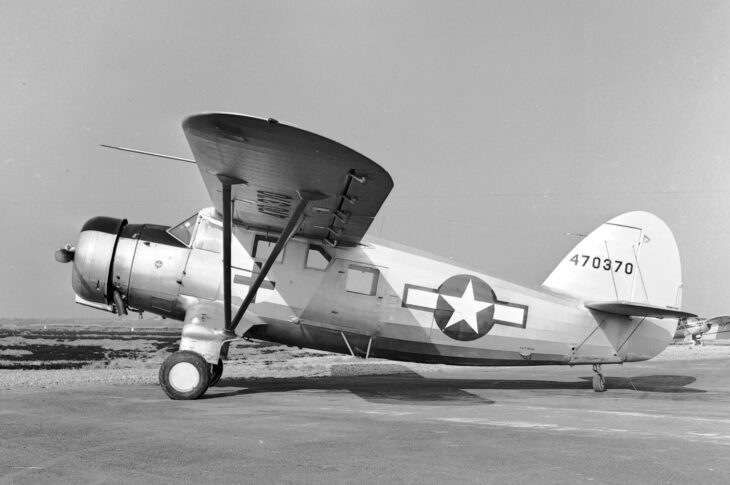

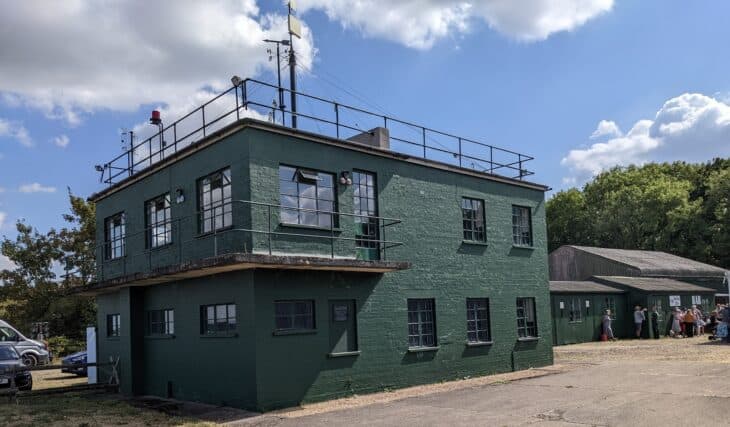
Morgan flew it down from Abbotts Ripton, picked up Baessell and Miller at Twinwood, and took off at 1:55 p.m. local time. The RAF training unit at Twinwood had stood down that day, though the airfield was open.

The intended route followed the cross-Channel transport corridor, leaving the English coast near Beachy Head toward Villacoublay, the airfield outside Paris where Miller was headed. Nobody on the ground in France ever reported the airplane, and no wreckage or remains have ever been identified.
What the Missing Air Crew Report records
The Army Air Forces filed a Missing Air Crew Report, or MACR, for every aircraft that failed to return. The printed form asked for one “within 48 hours of the time an air crew member is officially reported missing,” and it is the closest thing this loss has to an accident report.
MACR 10770 was prepared by Captain Ralph S. Cramer, adjutant of the 2nd Strategic Air Depot. It lists the UC-64A, serial 44-70285, nickname “Norseman,” with a Pratt & Whitney R-1340 radial engine and no installed weapons. Three men are named, all as missing: Morgan as pilot, Baessell and Miller as passengers, recorded as a “Non Battle Casualty.”
Then come the blanks. Weather and visibility: “Unknown.” Lost as a result of enemy aircraft or anti-aircraft fire? Neither box is checked, and the line reads “Other circumstances as follows: Unknown.” Persons with last knowledge of the aircraft: “Unknown.”
Whether the airplane was last sighted, last heard by radio, or neither is answered “Information not available.” The officer in charge of the search, “if any,” is entered as “None.” The remarks and eyewitness statements section reads “None.”
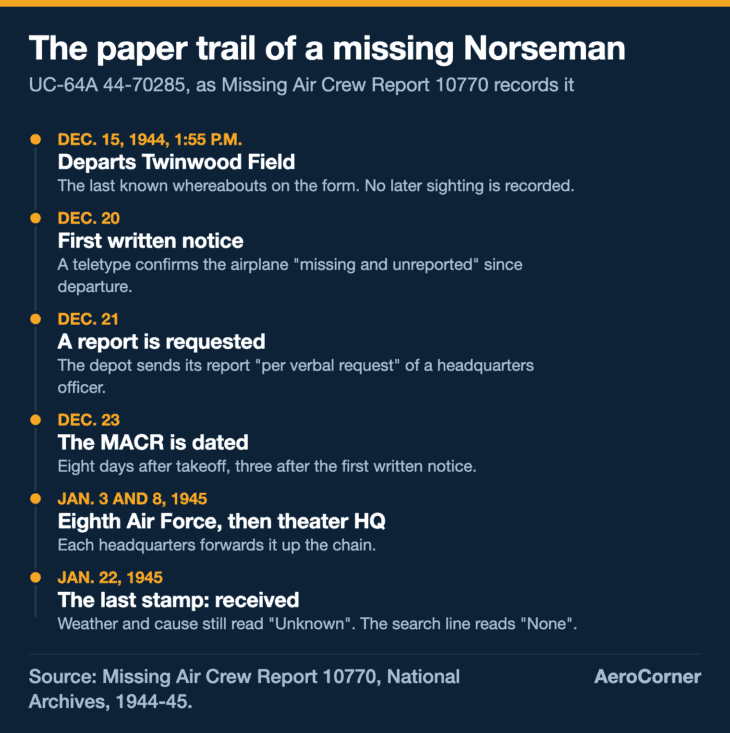
The cover letter shows how the report came to exist. The depot sent it on December 22 “per verbal request” of a headquarters officer made the day before, and attached a December 20 teletype that confirmed the airplane “missing and unreported since departure Twinwood Field 1355 hours 15 December for France.”
From there it climbed the chain of command: Eighth Air Force Service Command on December 23, Eighth Air Force on January 3, 1945, and the European theater headquarters on January 8, addressed to the Commanding General of the Army Air Forces in Washington. Its last stamp reads received, January 22, 1945.
The one formal finding came later, from an Eighth Air Force board of inquiry on January 20, 1945. It concluded that the Norseman went down over the English Channel through a combination of human error, mechanical failure and weather.
Dennis M. Spragg, of the Glenn Miller Archive at the University of Colorado, who published the board’s findings in his 2017 book Glenn Miller Declassified, sums up its probable cause this way: “Pilot disorientation and icing leading to carburetor heater failure are the probable reasons.”
What most accounts get wrong
Most retellings describe a plane lost in fog and a search that came up empty. The Army’s own report records neither. It enters the weather and the cause as unknown, names no witness, and lists the officer in charge of the search as “None.” The earliest written notice in the file is dated December 20, five days after takeoff, and the report itself is dated December 23. Even the destination is different on paper: the form gives the airplane’s course as “Bordeaux via A-42,” the USAAF designation for Villacoublay outside Paris, the stop Miller was headed for. Every cause you have read, from carburetor icing to RAF bombs, was worked out afterward, by the board and by later researchers, without a single piece of the airplane.
How carburetor ice can stop an engine above freezing
The Norseman’s engine breathed through a carburetor, as most piston engines of the era did. Its R-1340 Wasp was the same nine-cylinder radial family that powered the T-6 Texan trainer, rated at 600 horsepower in the Norseman.
A carburetor mixes fuel into air as it passes through a narrow throat, the venturi. The FAA explains that fuel vaporizing there, combined with the air expanding as it speeds through, causes sudden cooling, “sometimes by a significant amount within a fraction of a second.”
That is why carburetor ice does not need freezing weather. The FAA warns that it can form “at temperatures well above freezing temperatures when there is visible moisture or high humidity,” and its icing chart shows the risk is serious in cool, damp air near saturation.
Ice in the throat chokes off the airflow, and the engine loses power and runs rough. The cure is carburetor heat, a valve that routes warmed air into the intake, and the FAA’s advice is to apply full heat immediately at the first sign. If the heat fails, the ice keeps building.
December 15 offered those conditions. Accounts of the day describe a heavy overcast with drizzle and temperatures just above freezing, the first day in several that flights in the area were not fully grounded by fog.
The board’s other word, disorientation, is the second half of the problem. A pilot forced low under cloud over a gray winter sea, with no visible horizon, can lose track of which way is up within minutes.
AeroCorner’s guide to spatial disorientation explains why the inner ear cannot be trusted there, the same trap the NTSB later found in the JFK Jr. crash off Martha’s Vineyard.
An engine faltering at low altitude leaves little time to troubleshoot it. None of this can be proven for 44-70285, because nothing from the airplane has ever been recovered, but it is the chain the board settled on, and the one Spragg’s research supports.
Was Glenn Miller’s plane hit by RAF bombs?
The best-known alternative is friendly fire. The same afternoon, 138 RAF Lancaster bombers headed for the rail yards at Siegen, Germany, had their raid called off and dumped their bombs in a designated jettison area in the Channel south of Beachy Head.
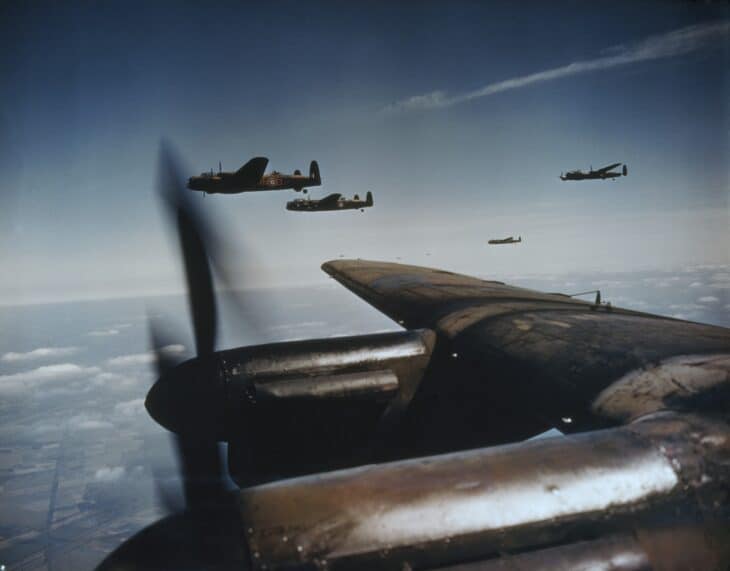

A Lancaster navigator, Fred Shaw, later said he saw a small single-engine aircraft go down beneath the falling bombs. A 2001 Channel 4 documentary featured his account and argued that the two flight paths crossed.
The problem is the record. Shaw said he did not connect what he saw to Miller until he watched the film The Glenn Miller Story in 1954, and the bombing mission produced no report of the sighting because it had been scrubbed.
The timing is disputed. Spragg puts the jettisons between 1 p.m. and 1:30 p.m., more than an hour before the Norseman reached the coast by his reckoning. Others, citing the RAF historian Roy Nesbit, argue the times line up once the RAF’s use of GMT against British local time is allowed for.
What can be said plainly: the MACR checks neither enemy aircraft nor anti-aircraft fire, the January 1945 board found an accident, and no physical evidence supports a bomb strike. Spragg, who worked with the Miller estate and US and British authorities on the files, rejects both friendly fire and foul play.
What changed
Honestly, very little. AeroCorner found no rule, aircraft modification or procedure that traces back to this loss, and the Missing Air Crew Report system that recorded it was already in place. One more light transport vanishing over the Channel in the winter of 1944 was, to the Army, a routine non-battle casualty.
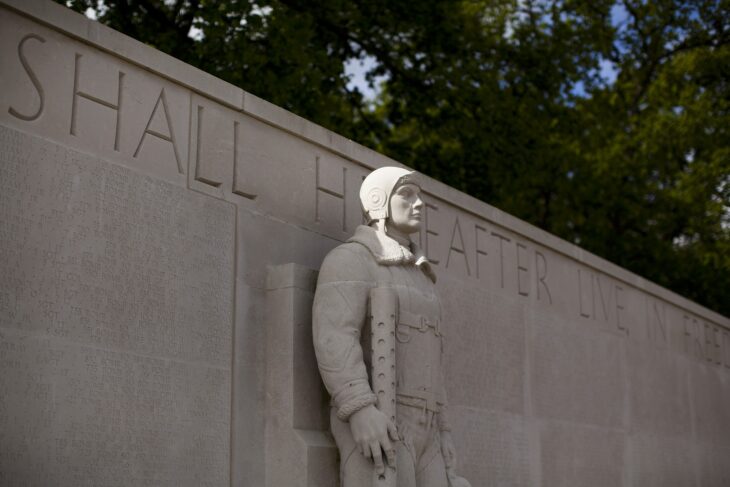
What it left was a memorial and a mystery. Miller’s name is carved as Alton G. Miller on the Tablets of the Missing at the Cambridge American Cemetery in England, alongside John R. S. Morgan and Norman Baessell. A government memorial headstone was placed for him at Arlington National Cemetery in 1992, at his daughter’s request.

The search never formally ended. In 2019 the aircraft recovery group TIGHAR was reported to be looking into a possible find west of the expected route, but nothing has been confirmed. Like the 1959 Buddy Holly crash, the music outlived the airplane, and the Army band he built played on through V-E Day.
FAQ
Sources and references used for research and fact-checking.
- US National Archives, Record Group 92, NAID 305258, Missing Air Crew Report for Flight Officer John R. S. Morgan, Lieutenant Colonel Norman F. Baessell, and Major Alton Glenn Miller (MACR 10770)
- Dennis M. Spragg, Glenn Miller Disappearance, The Definitive Facts
- Dennis M. Spragg, Inside Glenn Miller Declassified
- The National WWII Museum, Major Glenn Miller: The Loss of an Icon
- Wikipedia, Glenn Miller
- Skeptoid, The Disappearance of Glenn Miller
- FAA Aircraft Certification Service, Special Airworthiness Information Bulletin CE-09-35, Carburetor Icing Prevention
- Wikipedia, Noorduyn Norseman
- American Air Museum in Britain, Villacoublay (A-42)
Get the Newsletter
The latest aviation news and stories sent to your inbox.
About the Author

Tim is the owner and lead editor of AeroCorner since 2019, overseeing aviation content covering aircraft, airlines, airports, and the broader aviation industry. Through years of researching, writing, editing, and publishing aviation-focused content, he has developed extensive practical knowledge of commercial aviation and air travel. Based in Asia and a frequent traveler himself, Tim also brings firsthand passenger experience to AeroCorner’s coverage. Outside of publishing, he has also explored aviation firsthand through hands-on flight training in New Zealand.