Military Trainers
NAA T-2 Buckeye
ICAO: T2
The advanced trainer that made a generation of fighter pilots
Updated: by Tim de Vries
The latest aviation news and stories sent to your inbox.
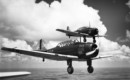
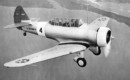
The North American T-6 Texan is the single-engine advanced trainer that took Allied student pilots the last step before a fighter cockpit, and 15,495 were built between 1938 and 1945. The same airframe served as the AT-6 with the US Army Air Forces, the SNJ with the US Navy and the Harvard with British Commonwealth air forces. It flew as a forward air controller in Korea, as a counterinsurgency aircraft into the 1990s, and it is still the most common radial-engine warbird flying today.
Live Fleet Activity (T6)
Fetching live data…
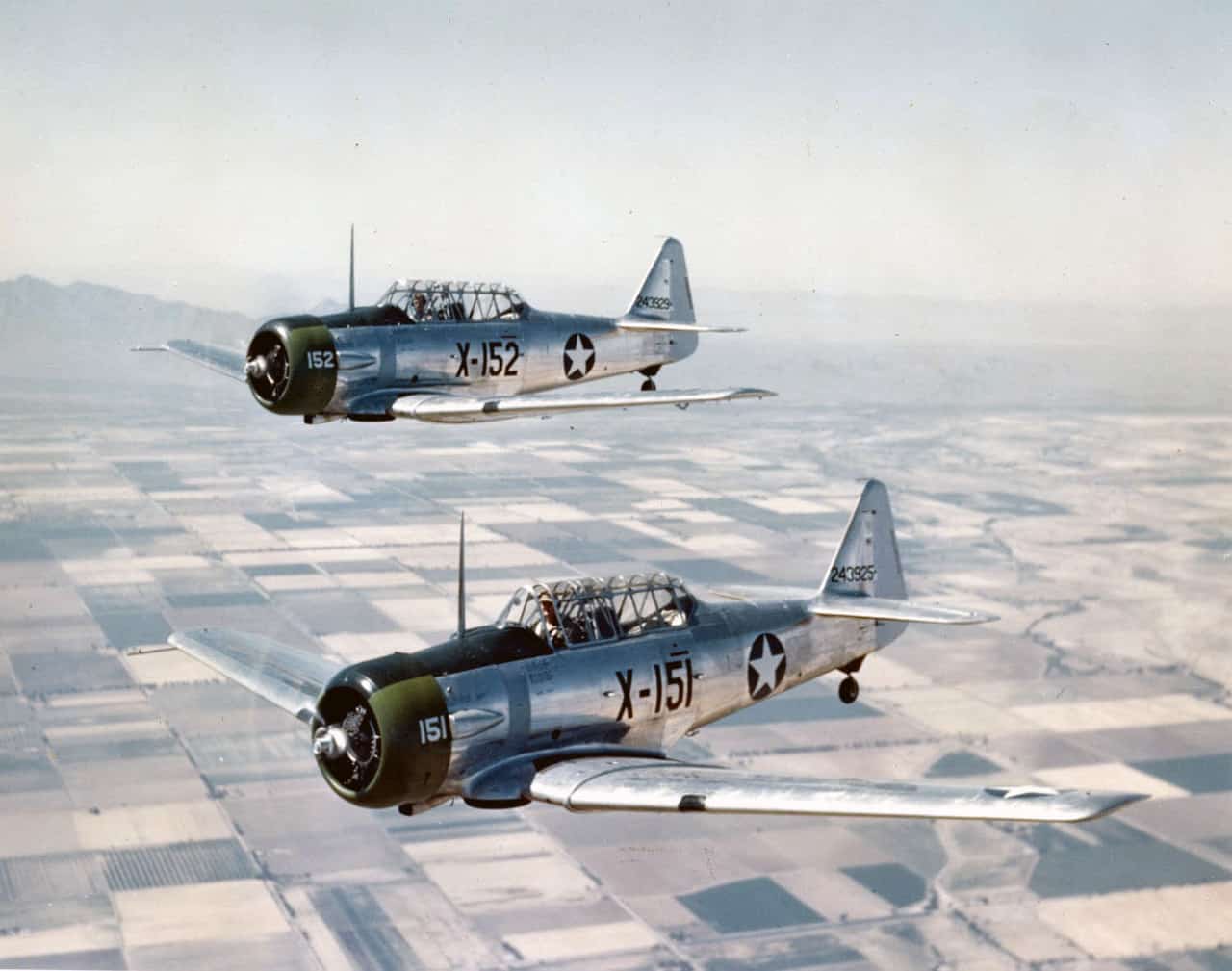


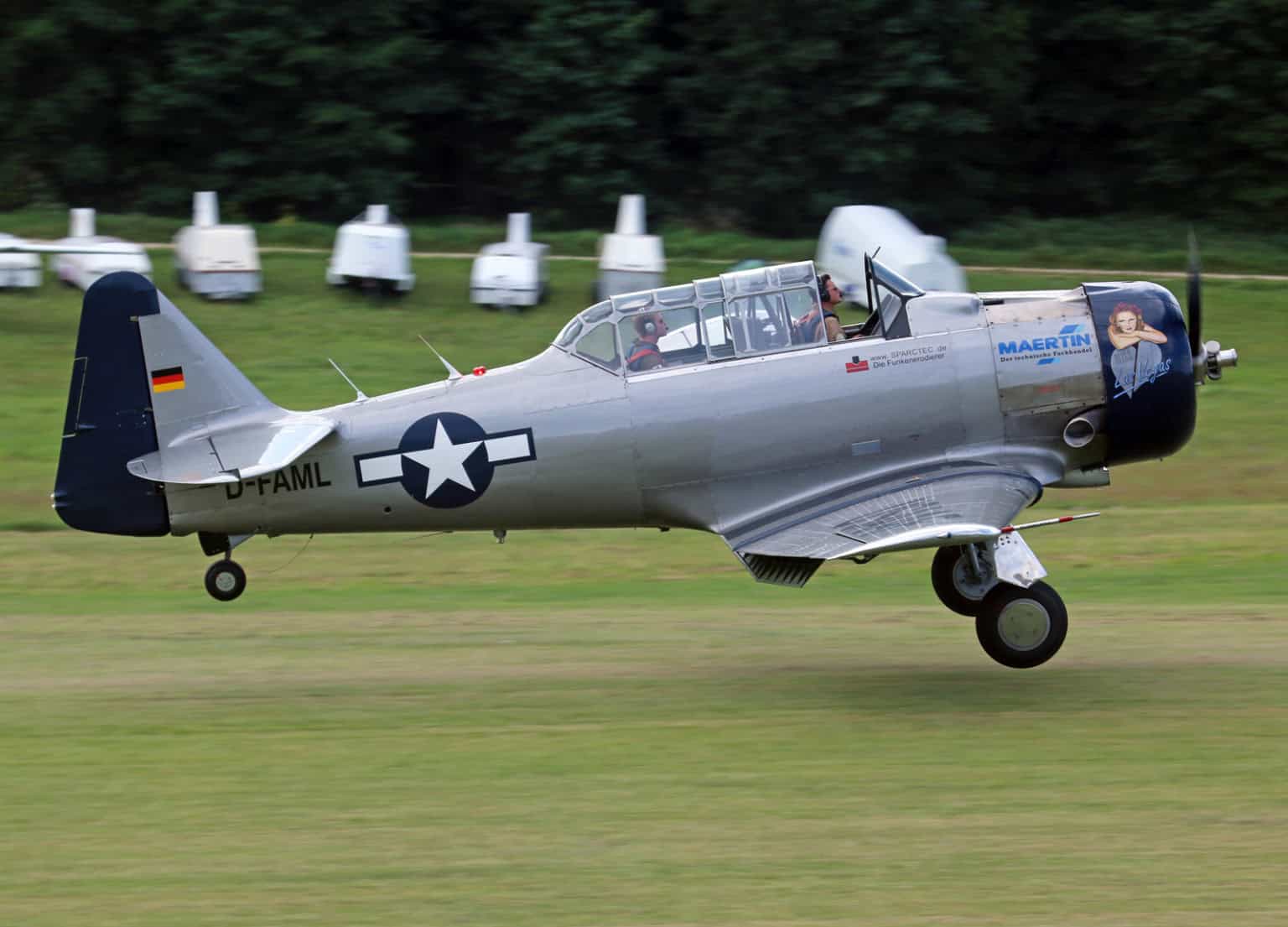


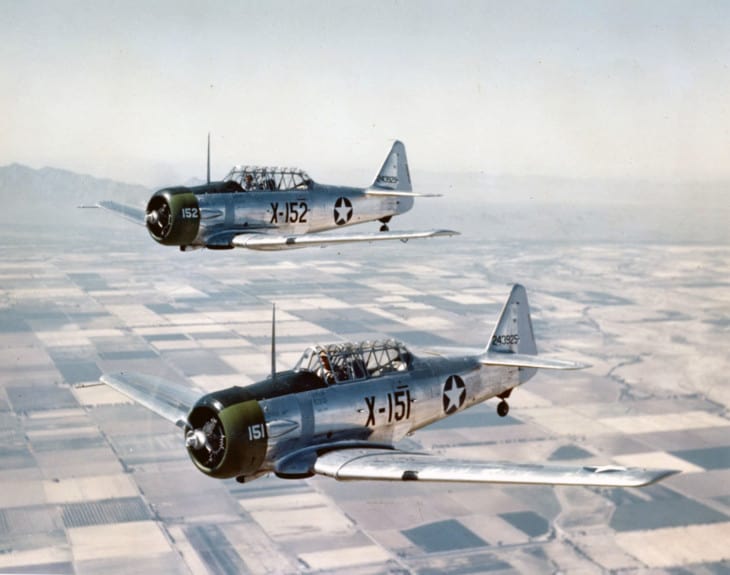
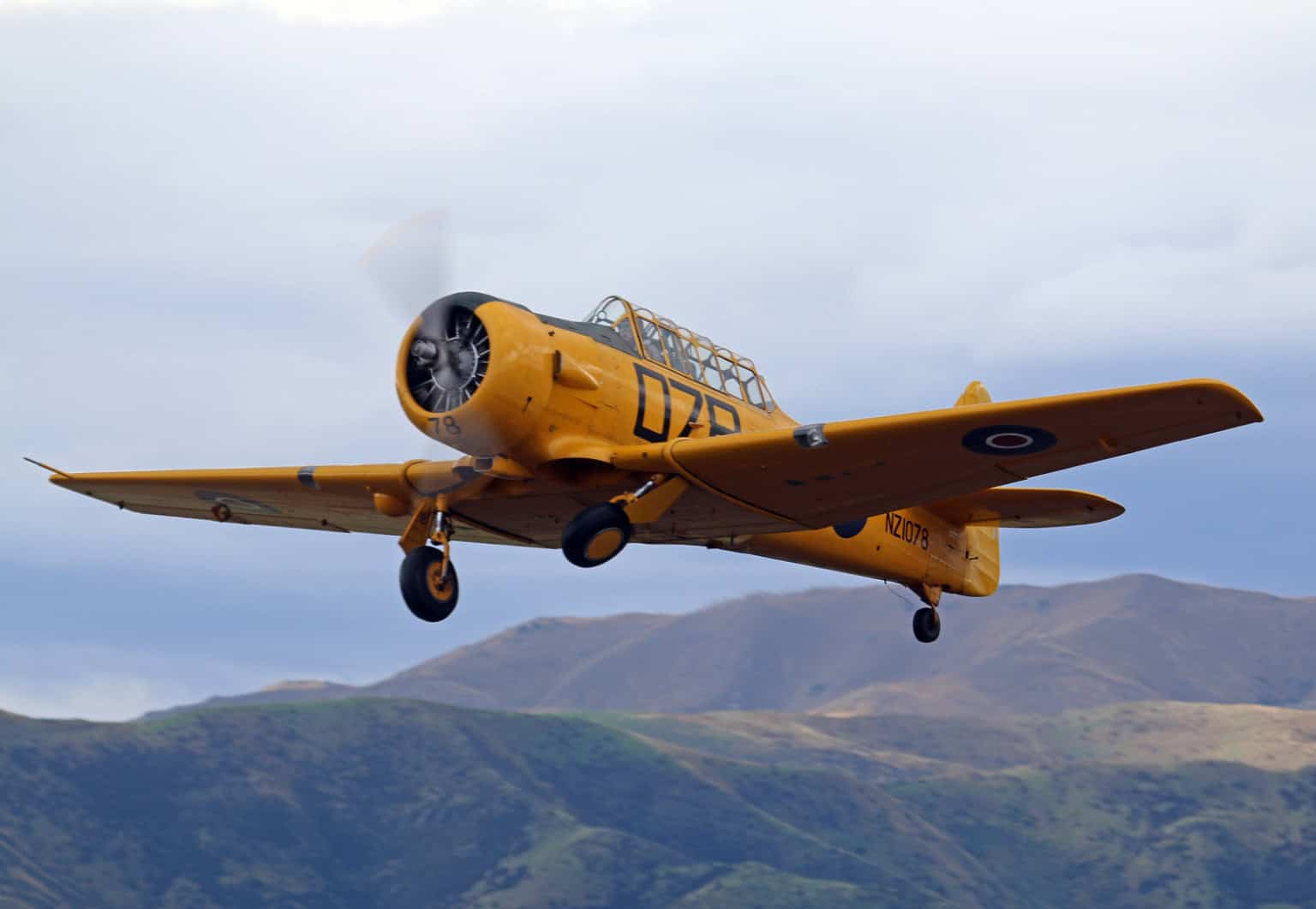
The North American T-6 Texan is a single-engine, two-seat advanced trainer, and it was the aircraft that stood between a student pilot and a fighter cockpit. It was the last and hardest step in the Allied training pipeline of the Second World War.
No single airplane carries more names. The US Army Air Corps and Army Air Forces called it the AT-6, the US Navy called it the SNJ, and British Commonwealth air forces called it the Harvard, which is still the name most of the world uses.
The USAF standardized on T-6 in 1948 and the Navy followed in 1962. Pilots simply called it the Pilot Maker, and that nickname explains the design better than any specification does.
A total of 15,495 were built, according to the National Museum of the United States Air Force, which dates production between 1938 and 1945. That puts it among the most-produced military aircraft in history.
The Texan’s ancestry starts with the North American NA-16 prototype, which first flew on April 1, 1935. North American submitted it to a US Army Air Corps basic trainer competition that same year and went after the export market at the same time.
Modified as the NA-26, it was entered in a USAAC Basic Combat Trainer competition in March 1937. It was the first of the NA-16 family with retractable landing gear, and it carried a larger engine than the fixed-gear BT-9 it resembled.
The first 177 production aircraft entered service as the BC-1 from June 9, 1937. An armed version, the BC-1A, followed for Air Corps Reserve and National Guard units, and 83 were built.
Export orders arrived before the American ones did. Australia’s Commonwealth Aircraft Corporation bought a license in 1937 and built 755 Wirraways, and Britain began receiving the first of 400 Harvard Mark Is in December 1938.
Wartime production ran through a series of letters that mostly changed equipment rather than the airframe. The AT-6A introduced the Pratt and Whitney R-1340-49 Wasp in USAAC service, with 1,847 built alongside 270 Navy SNJ-3s.
The AT-6B, 400 of which were built, was an armament trainer powered by the 600 hp R-1340-AN-1. It could mount a .30 in machine gun on the nose cowl, in the right wing and in the rear cockpit, and carry a light bomb rack.
The biggest single batch was the NA-88 design, which produced 2,970 AT-6Cs, 2,401 SNJ-4s, 2,604 AT-6Ds and 1,357 SNJ-5s. The AT-6D’s important change was electrical: the 12-volt system became 24 volts to match the rest of the fleet.
The last wartime build, the NA-121, added 800 more AT-6Ds and 956 AT-6Fs, and these could carry a 20 US gal centerline drop tank. Canada built in parallel, with Noorduyn producing 2,557 Harvard IIs from 1942 under Lend-Lease funding.
The naming is not trivia, because it decides which aircraft you are actually looking at on a ramp. A Harvard is a T-6 built for or transferred to a Commonwealth air force, and 747 AT-6Cs became Harvard IIAs while 537 AT-6Ds became Harvard IIIs.
The SNJ is the same aircraft in US Navy service, and many came straight off Army contracts. The Navy took 630 AT-6Ds directly from the USAAF and redesignated them SNJ-5s, bringing that mark alone to 1,987 aircraft.
The Wirraway is the outlier. Built in Australia from an NA-16 license, it diverged into a general-purpose combat aircraft, and one shot down a Japanese Zero over New Guinea in January 1943.

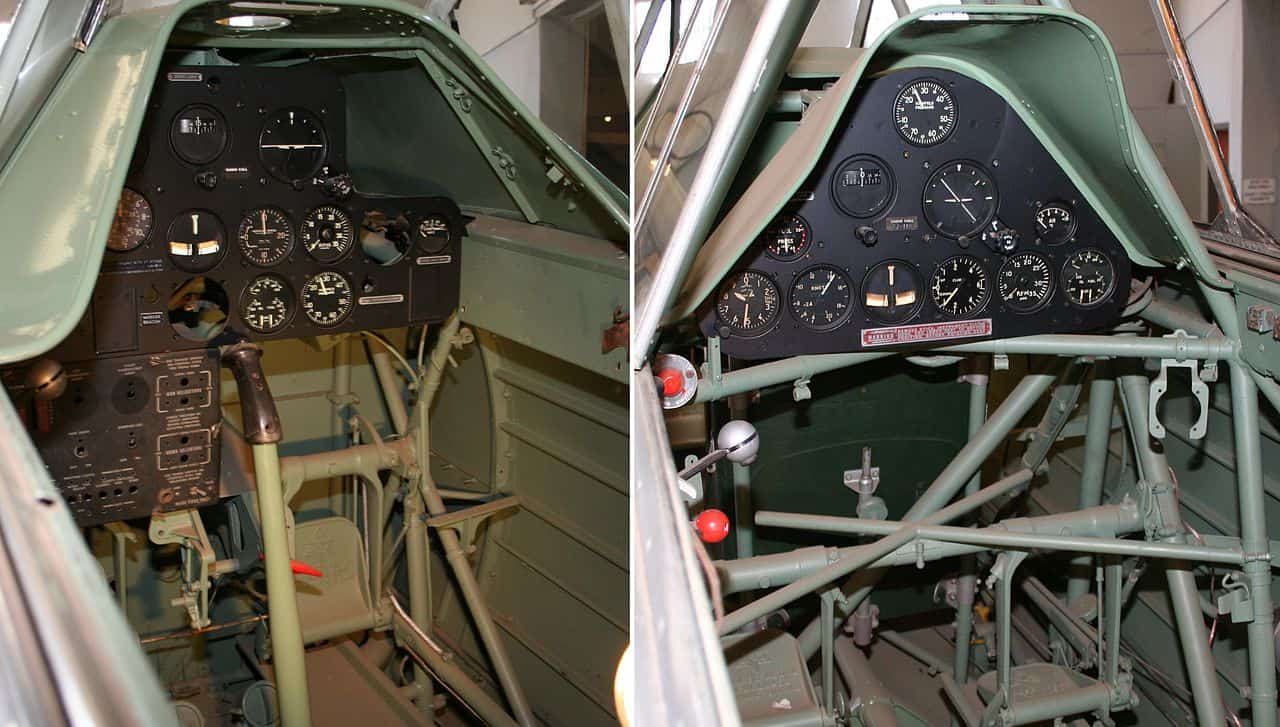
The T-6 has two cockpits in tandem under a long greenhouse canopy, student in front and instructor behind. The rear seat is a real working position rather than a jump seat, and on a T-6G it carries the same instruments as the front one.
The T-6G rebuild improved the back office in two specific ways. It lowered the rear instrument panel and raised the instructor’s seat, which is a direct fix for the instructor’s view forward over the student’s head.
Everything in the cockpit is manual and deliberate. There is a constant-speed propeller to manage, retractable landing gear, flaps, a mixture control and a fuel selector, and the student has to coordinate all of it while flying the airplane.

The USAF did not design a new piston trainer after the war. It rebuilt the ones it had, starting in 1949 under the NA-168 designation, and the result was the T-6G.
Air Training Command received 641 of them, National Guard units took 50 more, and 824 additional T-6Gs were ordered in 1951. Hundreds went overseas under the Military Assistance Program.
The changes were practical rather than glamorous. Fuel capacity rose from 110 to 140 US gal with bladder cells in the outer wings, the electrical system went to 24 volts, and a P-51 tailwheel made the tailwheel steerable when engaged and fully swiveling when released.
One change was aerodynamic. Aileron up-travel was cut from 30 degrees to around 15 degrees to stop the stick snatching at the stall, at the cost of slightly less crosswind authority on landing.
The T-6 was chosen to be demanding. A student arriving from a primary or basic trainer met retractable landing gear, a constant-speed propeller, real engine torque and a wing that stalls with some authority.
Wing loading runs around 20 to 23 lb per square foot, high for a training aircraft, so the airplane has to be flown at a speed rather than floated onto the runway. The North American Trainer Association describes the type as unforgiving of any inattention or incompetence in pilot technique.
The tailwheel makes ground looping a live risk on every takeoff and landing, and that is exactly the point. The same association positions the T-6 as the transition between lower-performance basic trainers and fighters like the P-51 Mustang.
American pilots spent roughly 100 hours in the T-6 during the war, according to Stallion 51, which operates the type today. It trained aircrew for the USAAF, the USAF, the US Navy, the RAF, the RCAF and other Commonwealth air forces, and went to numerous US allies under Lend-Lease.
The T-6’s second career was not training. In Korea, airborne forward air controllers needed something that could work from small rough strips, take punishment and still outrun a light liaison aircraft, and the T-6 was the best thing available.
Fifty-nine aircraft were converted to LT-6G standard for the role. They could carry two detachable .30 in machine gun pods plus four high-velocity aircraft rockets or four 100 lb bombs, or gun pods with twelve 2.25 in marking rockets.
The marking rockets were the real weapon. A Mosquito crew found a target, put a smoke rocket on it and called in the jets, and in 1952 alone LT-6G crews flew 11,063 sorties. The same mission logic carried into Vietnam, and the aircraft that replaced them are covered in our roundup of Korean War fighter jets.
Because it was cheap, everywhere and easy to arm, the T-6 became a counterinsurgency aircraft for air forces that could not afford anything better. The RAF used it against the Mau Mau rebellion, France flew it in Algeria, Portugal in its colonial wars and Spain in the Ifni War.
It also fought in conventional wars. Multiple operators flew T-6s during the 1948 Arab-Israeli War, and the type saw action in the Ecuadorian-Peruvian War, the Greek Civil War, the India-Pakistan war of 1971 and the South African Border War.
South Africa kept its Harvards longest, retiring them in the mid-1990s and closing out nearly sixty years of front-line military service for the design.
The full specification table for the aircraft is on this page, and the figures below are the ones that need context rather than repetition. They describe a T-6G, the postwar rebuild standard that most surviving airframes conform to.
Published top speeds disagree, and the reason is the measuring condition. The commonly cited 208 mph (181 kt) is measured at 5,000 ft, the official USAF museum figure for a wartime T-6D is 206 mph, and Stallion 51 quotes 240 mph at sea level for a clean T-6G. All three can be true of the same design.
Range moves the same way. The 730 miles (630 nm) in the panel is the standard internal-fuel figure, while the USAF museum quotes 1,000 miles for a T-6D carrying a 55 US gal drop tank, and the 140 US gal capacity itself only applies to rebuilt T-6Gs. Earlier AT-6s and SNJs carried 110 US gal.
Empty weight is the one figure worth treating as a range rather than a number. Published values run from about 4,000 lb to 4,425 lb for a fully equipped T-6G, because the rebuild added radios, fuel cells and structure.
Maximum takeoff weight is the steadiest number on the page. Wikipedia, Skytamer and the USAF museum all give 5,617 lb (2,548 kg).
Length splits the sources as well. The 29 ft 6 in in the panel is Skytamer’s T-6G figure and matches the USAF museum’s T-6D, while Wikipedia and SKYbrary publish 29 ft 0 in (8.84 m) for the same variant.
Search for “T-6 Texan” today and you will find two unrelated airplanes. The Beechcraft T-6 Texan II is a modern turboprop trainer, a license-built Pilatus PC-9 modified by Beechcraft, and it shares a name and a mission with the Texan but no parts and no lineage.
The Texan II is the aircraft US Air Force and Navy student pilots fly now. It has been manufactured since 2000, currently by Textron Aviation, and the armed AT-6 Wolverine derivative is sold to governments such as the Royal Thai Air Force, not to private owners.
If you want a Texan you can buy, it is the 1940s North American airplane. It is also worth comparing against the other piston trainers in our guide to the best training aircraft.
Roughly 500 T-6s are in airworthy condition, according to Stallion 51, which makes it one of the most numerous warbirds still flying and a fixture of the airshow circuit.
The support network is a large part of why. Parts, engine overhauls, type-experienced instructors and a deep owner community all exist for the T-6 in a way they do not for rarer American fighter planes of WWII.
The fleet is aging and it has known weak points. A fatal accident in Finland in October 2024 involved an SNJ-3 whose fuel selector valve shaft had developed enough play to drift into a position that restricted fuel to the engine.
That failure mode was already known. A 1997 supplemental type certificate offered a fix by reducing the selector to On and Off, taking in-flight tank switching out of the pilot’s hands.

Yes, by light-aircraft standards. The T-6 was deliberately built to be demanding, with a wing loading of 20 to 23 lb per square foot, real engine torque, retractable landing gear and a constant-speed propeller to manage.
The tailwheel makes ground looping a genuine hazard on takeoff and landing, and the North American Trainer Association describes the type as unforgiving of inattention or poor technique. Type-specific checkout courses typically run five to ten hours of dual instruction.
Recent asking prices sit in the low to mid six figures. Flying Magazine featured a 1941 AT-6D with upgraded avionics listed at $210,000, and condition, engine time, avionics and provenance move the price substantially in both directions.
The historical cost was far lower in the dollars of the day. The USAAF paid an average of $25,672 per AT-6 in 1942 and $22,952 in 1944, down from $29,423 for the 1939 to 1941 contracts.
Yes. Privately owned T-6s are flown by civilian pilots every weekend in the United States, and unlike some higher-performance warbirds the type needs no type rating and no FAA letter of authorization.
What it does need is three logbook endorsements: high-performance, complex and tailwheel. Insurers typically add their own dual-instruction requirements on top.
Not in practice. The Beechcraft T-6 Texan II and its armed AT-6 Wolverine derivative are current military aircraft sold to governments through defense contracts, not offered on the civil market.
The 1940s North American T-6 Texan is the one available to private buyers, and examples change hands on the civil warbird market regularly.
A single Pratt and Whitney R-1340 Wasp, a nine-cylinder air-cooled radial, driving a two-blade Hamilton Standard constant-speed propeller. The standard late-war and postwar fit is the R-1340-AN-1 rated at 600 hp.
Around 181 kt (208 mph) maximum at 5,000 ft, with a normal cruise near 126 kt (145 mph). It is a trainer, not a fighter, and the speed was chosen to be manageable rather than impressive.
Yes. Harvard is the British Commonwealth name for the same North American design, and SNJ is the US Navy name. Differences between them are equipment and build standard, not airframe.
15,495 of all variants, according to the National Museum of the United States Air Force, built between 1938 and 1945 across North American’s own plants and licensed production in Canada.
Sources and references used for research and fact-checking.