Light Passenger Jets
Bombardier CRJ 705
ICAO: CRJ9
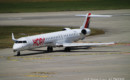
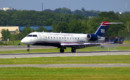
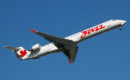
The Bombardier CRJ900 is the stretched 76-seat regional jet that became the backbone of Delta Connection, Air Canada Express and American Eagle feeder flying, and the last CRJ model ever delivered.
Updated: by Tim de Vries

The latest aviation news and stories sent to your inbox.
The CRJ900 stretched the CRJ700 to carry up to 90 passengers, first flew on 21 February 2001 and entered service in 2003. It is the most common regional jet on US feeder routes, flown in 76-seat form to fit pilot-contract scope clauses. Production ended with a CRJ900 delivered to SkyWest on 28 February 2021.
Live Fleet Activity (CRJ9)
Fetching live data…


The Bombardier CRJ900 is a twin-engine regional jet, the stretched version of the CRJ700 and a descendant of the original Canadair Regional Jet. Airlines can fit up to 90 passengers in it.
It first flew on 21 February 2001, about five months ahead of schedule. The first aircraft was delivered in April 2003, and Mesa Air Group was the launch customer.
The design aim was simple. Give airlines more seats on busy regional routes without stepping up to a narrowbody.
CRJ stands for Canadair Regional Jet. Canadair was the Canadian manufacturer that launched the family.
The program later passed to Mitsubishi Heavy Industries. That deal was announced on 25 June 2019 and closed on 1 June 2020, which is why the type certificate now reads MHI RJ Aviation, formerly Bombardier.
The CRJ series was built by Bombardier in Canada. Production is over.
The last CRJ ever built was a CRJ900, delivered to SkyWest Airlines on 28 February 2021. About 487 CRJ900s had been delivered by 1 January 2021.

Most US regional flying is done on contracts that cap the size of the aircraft a partner airline can operate. That is called a scope clause, and it is why the CRJ900 matters so much in North America.
The 76-seat layout is the common answer. Delta describes its CRJ-900 in two layouts, 70 seats and 76 seats, both with 12 First and 20 Delta Comfort seats.
The difference is in the main cabin, where Delta lists 38 seats in the 70-seat layout and 44 in the 76-seat layout. The seat row on the spec panel above reflects the 70-seat arrangement.
The base CRJ900 was followed by the ER and the long-range CRJ900LR. The LR carries the 84,500 lb (38,300 kg) maximum takeoff weight and the longest range of the three, about 1,828 nautical miles (3,385 km) according to Wikipedia.
In 2007 Bombardier launched the CRJ900 NextGen. It borrowed improvements from the CRJ1000, including roughly 5.5% better fuel economy, a redesigned cabin with larger overhead bins and longer maintenance intervals.
Mesaba Aviation, now Endeavor Air, was the NextGen launch customer and remains the largest CRJ900 operator.
This is the aircraft behind many Delta Connection flights, operated by Endeavor Air and SkyWest. The cabin is two seats on each side, with a single seat on one side of First, so there are no middle seats.

Delta lists Delta First seats at 19.6 in (50 cm) wide and Delta Comfort and Main seats at 17.3 in (44 cm) wide. Comfort has a 34 in (86 cm) pitch, against 30 to 34 in in the 70-seat Main cabin and 31 in in the 76-seat one.
Delta advertises Wi-Fi, USB power and in-seat outlets on the type. A January 2026 Delta update says the CRJ-700 and CRJ-900 have in-seat power in First and Comfort.
Amenities vary by tail number, so check the seat map for your flight. Delta has no wheelchair-accessible lavatory on this type.
The flight deck uses a two-pilot crew with a Rockwell Collins Pro Line 4 glass cockpit. Engine data comes up on an EICAS display.

Two General Electric CF34-8C5 turbofans sit on the rear fuselage, which keeps the wings clean. Both have full authority digital engine control.

The full specification table for the aircraft is on this page. A few points need context.
Range depends on the variant. The base CRJ900, the ER and the LR carry different fuel and weights, so quoted ranges run from about 1,350 to 1,828 nautical miles. The panel shows a typical figure, not the LR maximum.
Speed is quoted differently by different sources. Delta publishes a cruising speed of 515 mph (829 km/h), while the panel’s legacy cruise row stores a maximum cruise figure.
The CRJ900 has a good overall record, but it is no longer accident free. Two serious accidents have involved the CRJ900LR in the past two years.
On 17 February 2025, a Delta Connection CRJ900LR landed upside down at Toronto Pearson, shearing off its right wing. All 80 people aboard were evacuated and no one died, but about 21 were injured. The Transportation Safety Board of Canada is leading that investigation.
On 22 March 2026, an Air Canada Express CRJ900, operated by Jazz Aviation, collided with a fire vehicle on Runway 4 at New York LaGuardia after arriving from Montreal. The captain and first officer were killed, according to the NTSB, which says its investigation is ongoing and the information is preliminary.
Wikipedia calls it the first fatal accident of a CRJ900. The January 2025 Washington midair collision involved a CRJ701, a different variant.
Deliveries stopped in 2021, but the CRJ900 will fly for years. SkyWest, Endeavor Air, PSA Airlines and Mesa are among the biggest operators of the CRJ700 series.
For similar jets, compare the Bombardier CRJ 1000, the Bombardier Q400 and the Bombardier CS300. You can also browse every Bombardier Aerospace model.
It is a regional jet that is a stretched CRJ700, built by Bombardier and seating up to 90 passengers. Most airlines fly it with 70 to 76 seats.
CRJ stands for Canadair Regional Jet, after the Canadian company that launched the family.
Delta’s aircraft page lists Wi-Fi, USB power and in-seat outlets for the CRJ-900, and one seat guide says there are no seatback screens. Plan to stream to your own device, and check your flight’s seat map for what is installed.
Bombardier built them in Canada, near Montreal. The last CRJ, a CRJ900, was delivered to SkyWest on 28 February 2021.
No. Production of the CRJ series ended in 2020 and the final delivery came in February 2021.
Yes. On 22 March 2026, Air Canada Express Flight 8646 hit a fire vehicle while landing at LaGuardia and both pilots died, per the NTSB. The February 2025 Toronto crash of a Delta Connection CRJ900LR had no fatalities.
Sources and references used for research and fact-checking.