Cargo Airplanes
Airbus A380 Cargo
ICAO: A388
Airbus's new-generation freighter, built to take on the Boeing 777F.
Updated: by Tim de Vries
The latest aviation news and stories sent to your inbox.
The Airbus A350F is the freighter member of the A350 family, derived from the A350-1000 on a shortened fuselage and built around a main deck cargo door behind the wing. Airbus quotes a payload of up to 111 tonnes and a range of 4,700 nautical miles on two Rolls-Royce Trent XWB-97 engines. The order book stood at 115 aircraft in August 2026, and entry into service is targeted for the second half of 2027.


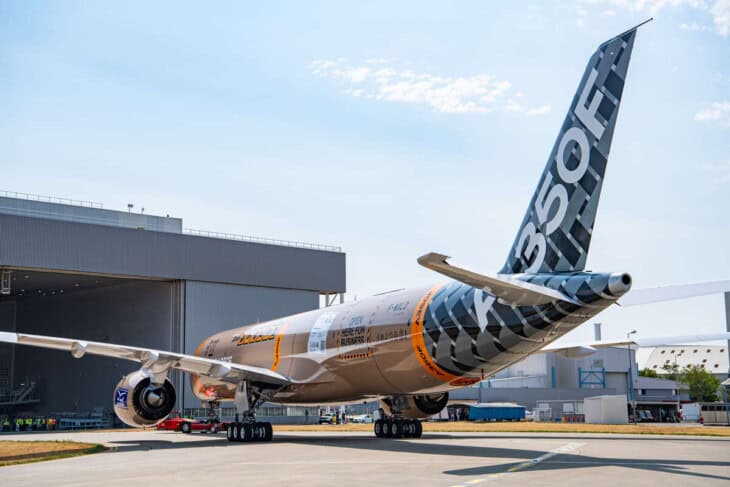
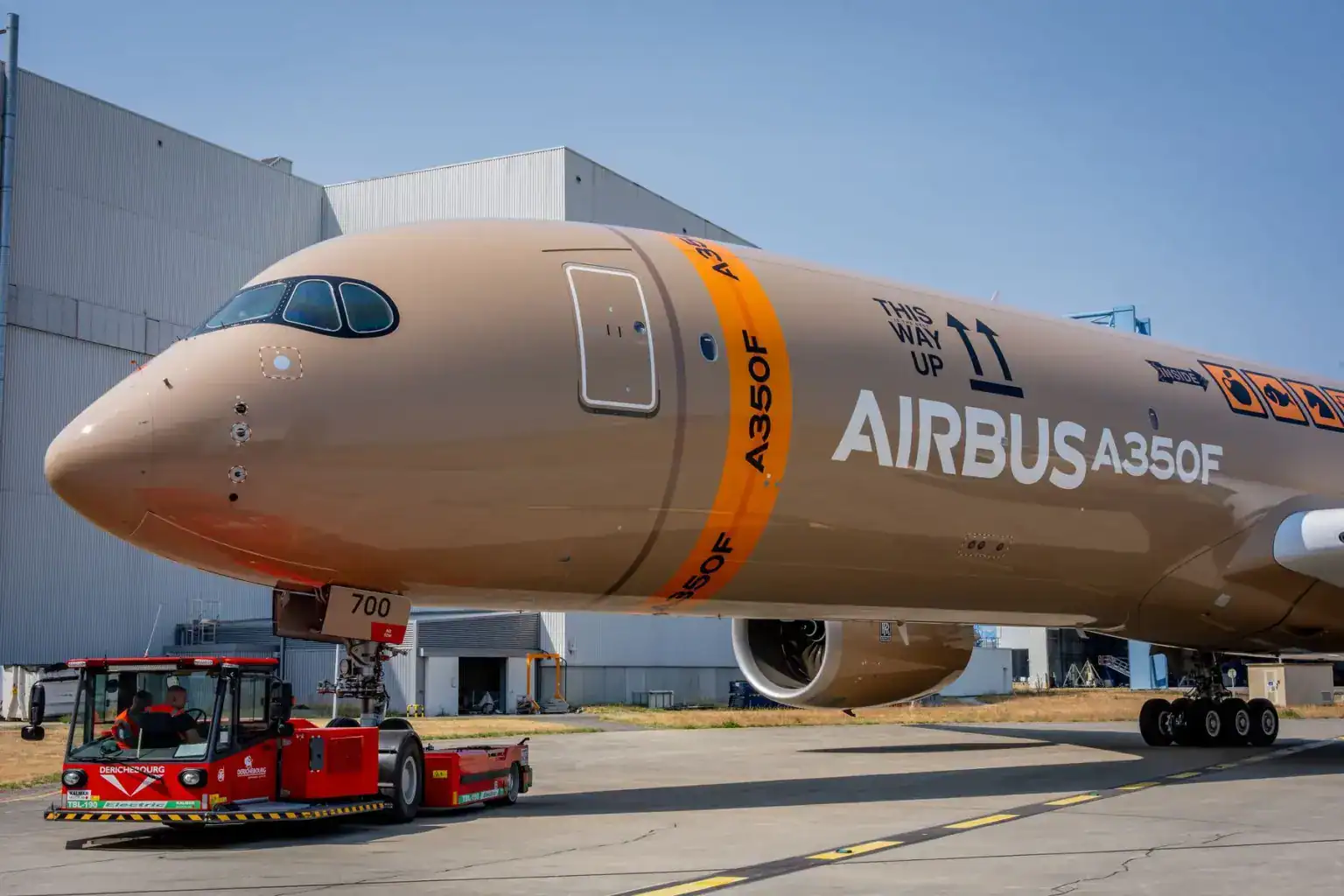
The Airbus A350F is a dedicated long-range freighter built on the A350 widebody platform. It is the aircraft Airbus has aimed at the large-freighter market that the Boeing 777F has dominated for years.
Airbus launched the program in July 2021, after its board approved development. The aircraft is derived from the A350-1000, not the smaller A350-900, and Airbus also refers to it internally as the A350-1000F.
It is not a passenger jet with the seats taken out. The main deck is designed around freight from the start, with a reinforced floor, a large cargo door behind the wing, and a fuselage length chosen to suit standard pallet sizes rather than seat rows.
As of mid-September 2026 the A350F has not yet flown. It sits among the biggest types of cargo planes in development, and once it enters service it will be one of the heaviest lifters in commercial operation.
The A350F shares its wing, engines and systems with the A350-1000, but the fuselage is shorter. The freighter measures 232 ft 4 in (70.80 m) against the passenger model’s 242 ft 1 in (73.79 m).
Shortening the fuselage while keeping the same wing and the same maximum takeoff weight is what buys the payload. The structure carries less of itself, so more of the weight allowance is available for freight.
The most visible change is the main deck cargo door, set behind the wing on the port side. A passenger A350 has nothing comparable, and cutting an opening that size into a carbon fiber fuselage is one of the harder parts of the design.
Airbus also states the airframe is more than 70 percent advanced materials. That composite-heavy structure is the reason the freighter’s empty weight comes out roughly 30 tonnes below the A350-1000 and about 20 tonnes below the 777F.
The full specification table for the aircraft is on this page. Three of its figures need context, because Airbus publishes them in pairs and they are frequently quoted against each other in ways that do not compare.
The first is payload against range, which is a single trade rather than two independent numbers. Airbus quotes up to 244,700 pounds (111 tonnes) over 4,550 nautical miles, or 240,300 pounds (109 tonnes) over 4,700 nautical miles.
The specification panel stores the higher figure from each pair, so the maximum payload and the maximum range shown there are not achievable on the same flight. Airbus benchmarks the aircraft on the Hong Kong to Anchorage run, the most flown cargo route in the world, at full payload.
The second is speed. The A350F cruises at the same Mach 0.85 as the rest of the A350 family, and the panel converts that to knots, because no freighter-specific speed schedule has been published ahead of certification.
The third is volume rather than weight. The A350F holds about 24,500 cubic feet (695 m³) of freight, which is roughly 10 percent more than the 777F, and long-haul cargo often fills the hold before it reaches the weight limit.
Capacity breaks down as 30 pallets of 96 by 125 inches on the main deck, plus 40 LD3 containers or 12 pallets on the lower deck. Two flight crew fly the aircraft, with a small courier area behind the cockpit.
The cargo door is the feature Airbus talks about most, and it is the one that decides what the aircraft can physically swallow. The clear opening measures 14 ft 1 in (4.3 m) wide by 10 ft 4 in (3.15 m) high.
Airbus describes it as the largest main deck cargo door in the industry, and puts it at 15 percent wider than the equivalent door on the 777F. Width matters more than it sounds, because it sets the largest single item that can be loaded rather than just the throughput.
The door is built at Airbus’s plant in Illescas, Spain, which specializes in large composite structures. Airbus completed the first one in April 2026, a milestone worth noting mainly because the door had been one of the program’s harder engineering problems.
The Boeing 777F is the aircraft the A350F was designed to displace, and the comparison is close enough that cargo operators have treated it as a genuine contest.
On payload the A350F leads, at up to 244,700 pounds (111 tonnes) against 228,600 pounds (103.7 tonnes) for the 777F. The A350F is also about 22 ft 8 in (6.9 m) longer than the 777F, which is where most of the extra volume comes from.
Airbus claims at least 20 percent lower fuel burn and CO2 emissions than the competing aircraft, a claim that rests on the composite airframe and the Trent XWB-97 engines. That figure is the manufacturer’s own and has not yet been demonstrated in airline service.
The other pressure on the 777F is regulatory. Under the ICAO carbon dioxide standard adopted by the FAA, the 777F and the 767-300ERF cannot be produced from January 1, 2028, which is a large part of why a new-generation freighter had a market to walk into at all.
That deadline also explains the timing. Boeing’s own answer is the 777-8F, while operators still flying the 747-8F and older widebodies have a replacement decision to make in the same window.
The A350F order book stood at 115 firm orders in Airbus’s August 2026 orders and deliveries report. The program entered 2026 with 81, so it added 34 aircraft in eight months without having flown.
Atlas Air is the largest customer, with a firm order for 20 placed in March 2026. That order was notable beyond its size, because it was the first time in the carrier’s history that it had ordered a non-Boeing aircraft.
Air China Cargo holds 10 after adding four in May 2026, and Cathay Pacific holds eight. A further eight were booked to an undisclosed customer on August 31, 2026.
The launch customer history is less tidy. Air Lease Corporation took that title at the 2021 Dubai Air Show with an order for seven, then cancelled in August 2025, after which CMA CGM Air Cargo said it would be the launch operator.
The first flight test aircraft is MSN700, assembled at Toulouse through 2025 and kept in ground testing during 2026. Its wing was completed in May 2025 and the fuselage sections reached the final assembly line that August. Ground vibration testing was completed in June 2026.
Airbus handed MSN700 to the flight test team in September 2026 and was targeting a first flight in late September, with reports pointing at around September 24. That date was a target rather than a commitment, and weather or a technical finding could move it.
Two aircraft will fly the test campaign. MSN700 covers aerodynamic performance, handling and autopilot work, while MSN701 takes systems testing including air conditioning and fire and smoke certification.
The campaign is planned at roughly 400 flight hours, inside a certification effort Airbus expects to run about nine months. EASA pilots and flight test engineers are scheduled to fly as onboard witnesses, with the formal certification phase planned for 2027.
Entry into service is targeted for the second half of 2027. That is the third date the program has carried: it was originally 2025, moved to 2026, then slipped again in February 2025 because of supply chain problems, particularly at Spirit AeroSystems, which supplies the center fuselage.
Yes. Airbus’s board approved the program in July 2021, the first aircraft was assembled at Toulouse during 2025, and 115 firm orders were on the books by the August 2026 orders and deliveries report. Entry into service is targeted for the second half of 2027.
Not as of mid-September 2026. The first flight test aircraft, MSN700, completed ground vibration testing in June 2026 and was handed to the flight test team in September, with Airbus targeting a first flight in late September 2026. That target was not fixed, so the date may have moved by the time you read this.
Yes, 115 firm orders as of Airbus’s August 2026 report. Atlas Air is the largest customer with 20, Air China Cargo has 10, and Cathay Pacific has eight, with further orders from operators including CMA CGM Air Cargo, Singapore Airlines, Etihad Airways, Silk Way West Airlines and MNG Airlines. Air Lease Corporation, the original launch customer, cancelled its order for seven in August 2025.
Up to 244,700 pounds (111 tonnes). That maximum payload is quoted over 4,550 nautical miles; stretch the range to 4,700 nautical miles and the payload comes down to 240,300 pounds (109 tonnes). By volume it holds about 24,500 cubic feet (695 m³), taking 30 main deck pallets plus 40 LD3 containers below.
It depends which pair you compare. On the freighter side the Airbus is bigger: the A350F is about 22 ft 8 in (6.9 m) longer than the 777F and carries a heavier maximum payload.
Against the passenger 777-9 it goes the other way. The A350-1000 is shorter, at 242 ft 1 in (73.79 m) versus 251 ft (76.73 m), and lighter, at 319 tonnes maximum takeoff weight against 351.5 tonnes.
Two Rolls-Royce Trent XWB-97 turbofans, the same engines as the A350-1000, each rated at 97,000 lbf (431.5 kN) of takeoff thrust. Rolls-Royce describes the XWB-97 as the highest thrust engine in the Trent family.
Entry into service was first planned for 2025, then moved to 2026, and in February 2025 Airbus pushed it to 2027. The stated cause was supply chain difficulty, particularly with Spirit AeroSystems, which builds the center fuselage section. The certification schedule now has relatively little margin left in it.
Airbus states the aircraft will be capable of using up to 50 percent sustainable aviation fuel at entry into service. That is the same ceiling Airbus quotes across its current commercial range, so it is not a capability unique to the freighter.
Sources and references used for research and fact-checking.