Cargo Airplanes
The whale-shaped A300 that flew Airbus wings and fuselages around Europe for 30 years.
Updated: by Tim de Vries
The latest aviation news and stories sent to your inbox.
The Airbus A300-600ST Beluga is an outsize freighter built from the A300-600 to fly wings, fuselage sections and tail surfaces between Airbus factories. Five were built, the first flying in 1994, and they carried Airbus production for about 30 years. Airbus is now retiring the fleet in favor of the larger BelugaXL, with one aircraft already in a Toulouse museum and another turned into a STEM center in Wales.
Live Fleet Activity (A3ST)
Fetching live data…
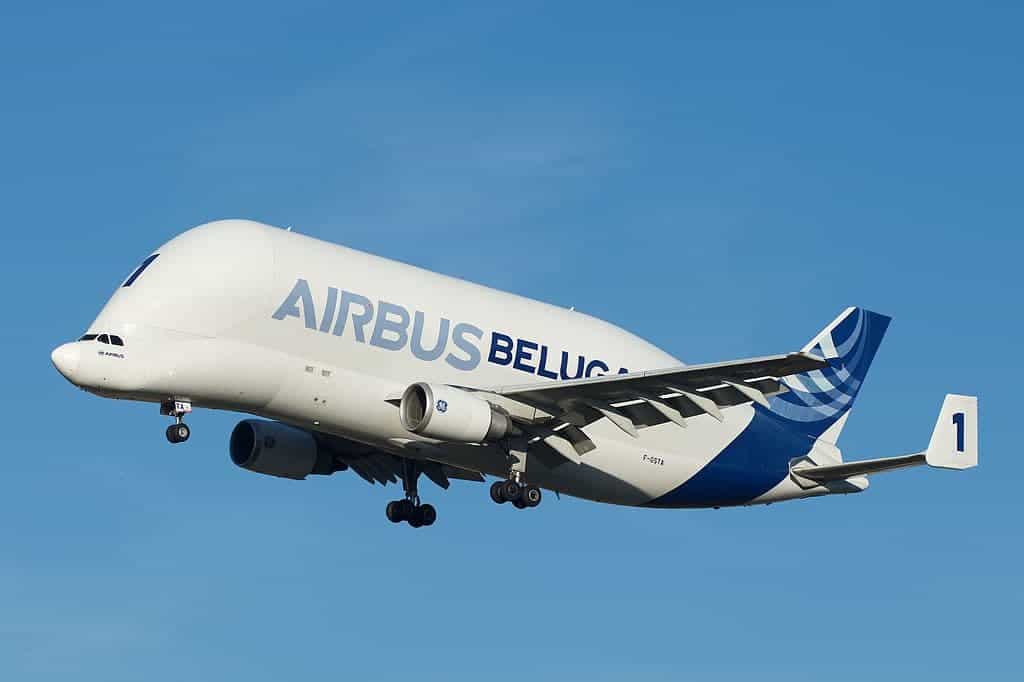
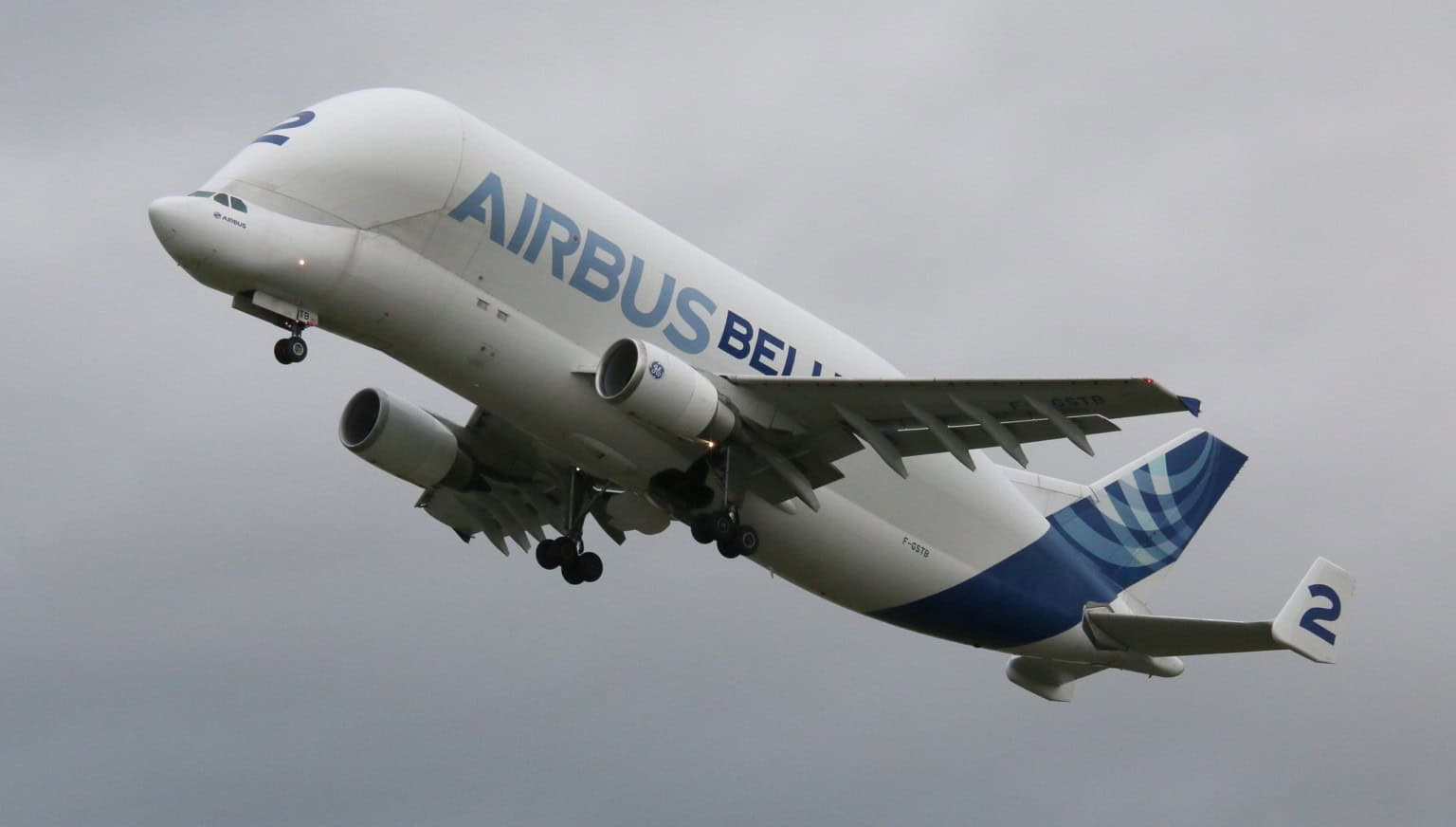


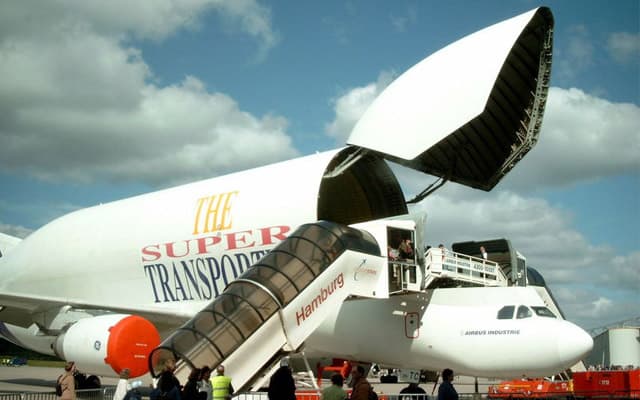


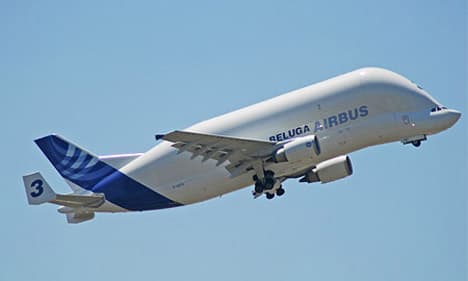

The Airbus Beluga is an outsize cargo aircraft built to fly whole sections of airliners between Airbus factories. Its official name is the A300-600ST, for Super Transporter, but the nickname taken from the beluga whale stuck, and Airbus later adopted it.
Underneath the bulge it is an Airbus A300-600. The wings, landing gear and lower fuselage are standard A300 parts, and the giant cargo hold sits on top where the passenger cabin would have been.
Only five were built. For about 30 years they carried wings, fuselage sections and tail surfaces across Europe to Airbus final assembly lines, and Airbus is now retiring them in favor of the larger BelugaXL.
Airbus has always been built in pieces. Traditionally the wings came from the UK, the tail and doors from Spain, the fuselage from Germany, and the nose and center section from France, with everything meeting at a final assembly line.
From 1972 that work was flown by a fleet of four Super Guppy freighters, a design that grew out of Boeing Stratocruisers converted to haul space hardware for NASA. The arrangement gave rise to the joke that every Airbus was delivered on the wings of a Boeing.
By the early 1990s the Guppies were old, expensive to run and too small for rising production. Airbus studied existing aircraft including the Antonov An-124 and An-225, the Boeing 747 and 767, the Lockheed C-5 Galaxy and the C-17, and ruled them all out for lack of the right internal space.
In August 1991 Aérospatiale and DASA, two of the main Airbus partners, formed a 50/50 joint venture called SATIC to build a new aircraft instead. The A300 was chosen as the starting point.
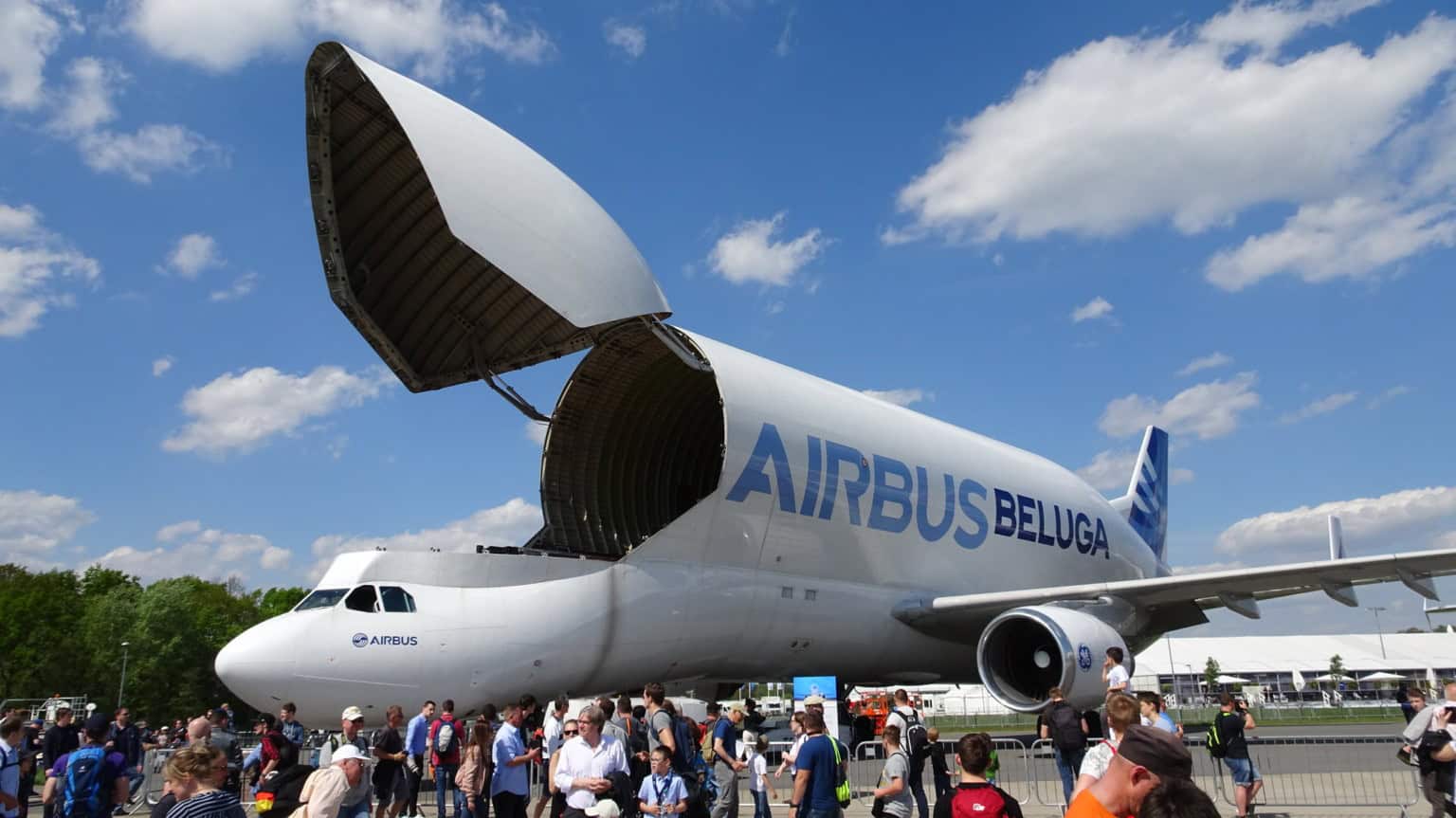
The defining change is the cockpit. The standard A300 flight deck was moved down below the level of the cargo floor, so the whole upper nose could swing up and open the hold from the front.
That fixed the Super Guppy’s biggest problem. To load a Guppy, crews had to disconnect its electrical, hydraulic and flight control connections and then carry out lengthy recalibrations before it could fly again.
Moving the cockpit halved loading times compared with the Guppy, and roll-on, roll-off loading plus the ability to unload in winds of up to 40 knots sped things up further. Airbus’s cost of moving components fell to about a third of what the Guppies had cost.
Above the lower fuselage sits a horseshoe-shaped upper structure about 25 ft (7.7 m) across. Compared with the Super Guppy it more than doubled the payload and added over 30 percent more volume.
The tail was reworked to keep the aircraft stable. The fin is a modified A340 unit with a 3 ft 8 in (1.12 m) base extension, the tailplane was strengthened and given auxiliary fins for directional stability, and the A300’s tailplane trim tank was deleted.
The flight deck is pressurized, but the cargo hold is not. The hold is heated to keep loads within a safe temperature range, and loads that need pressure have occasionally flown inside a pressurized container.
The usual crew is three: two pilots and a loadmaster. A 2015 AirlineReporter tour found the flight deck little changed from a standard A300-600 apart from its lower position, and the type certificate calls for only the two pilots.
The engines are General Electric CF6-80C2A8 turbofans, slightly uprated from those on the standard A300. Their takeoff rating is flat rated to 86°F (30°C), which means full takeoff thrust is available up to that temperature.
The full specification table for the Beluga is on this page. A few of its figures are worth explaining, because they are often quoted without the condition that goes with them.
The first is range. The 1,500 nm figure is Airbus’s range with an 88,200 lb (40 t) load. With the full 103,500 lb (47,000 kg) payload it falls to about 900 nm, and with a light 57,300 lb (26 t) load it stretches to 2,500 nm.
The second is payload. Airbus lists 103,500 lb (47,000 kg) as the typical volumetric payload, meaning a hold full of bulky aircraft sections rather than dense freight.
The third is speed. The type certificate limits the Beluga to 295 knots indicated airspeed and Mach 0.70, and EUROCONTROL’s performance data puts its normal cruise at 400 kt, about 460 mph (741 km/h), at Mach 0.69.
The 420 kt maximum speed in the table, about 483 mph (778 km/h), comes from Doc8643’s performance data for the type. The higher top speeds that circulate online would take the aircraft past its certified speed limits at any altitude.
The fourth is fuel. Some published spec sheets, including an archived Airbus page, give a much lower figure of about 6,300 US gallons (23,860 L). The table uses the type certificate’s figure of about 16,400 US gallons (62,000 L) of usable fuel across the outer, inner and center tanks.
The last is weight. Four of the five Belugas are certified at a 341,500 lb (155,000 kg) maximum takeoff weight, but the first aircraft, serial number 655, is certified about 4,400 lb (2,000 kg) lower at 337,300 lb (153,000 kg).
Construction of the first Beluga began in September 1992, and it made its first flight on September 13, 1994. After a 335-hour flight test program, France’s civil aviation authority certified it on October 25, 1995, and it formally entered service in January 1996.
The original plan was four aircraft plus an option on a fifth, which Airbus later firmed up. The fifth and last Beluga was certified in January 2001, and although SATIC offered new-build Belugas to other operators during the 1990s, no one else ordered one.
The last Super Guppy retired on October 24, 1997, leaving the whole job to the Belugas. In 1997 the fleet flew more than 2,500 hours across more than 1,400 flights, and by 2012 it was logging around 5,000 hours a year.
The network linked Toulouse and Hamburg with nine other sites, at a rate of about 60 flights a week. Airbus names Bremen, Saint-Nazaire and Broughton in Wales among the regular stops, with Broughton supplying wings.
There were limits to what it could carry. The Beluga could not take most A380 fuselage sections, which travel by ship and road instead, although some A380 components did go by Beluga.
The last aircraft built, BelugaST 5, shows the scale of the work. By the time it retired it had flown about 13,300 journeys between Airbus sites and carried 1,700 wings out of Broughton alone.
Airbus Transport International, the Airbus subsidiary that flew the fleet, also hired Belugas out for charter work. In 1997 it turned down eight of every ten charter requests because it could spare only 130 flight hours, but as more aircraft arrived that rose to about 1,000 hours in 1999.
In June 1997 a Beluga set a world record for the most voluminous payload carried by an aircraft, flying a chemical tank for a ship from Clermont-Ferrand to Le Havre. The tank was 57 ft 9 in (17.6 m) long and 21 ft 4 in (6.5 m) across.
In 1999 a Beluga flew Delacroix’s painting Liberty Leading the People from Paris to Tokyo inside an insulated, pressurized container, a trip of about 20 hours. The canvas was too large to fit in a Boeing 747.
Space programs used it too. A Beluga carried the Raffaello logistics module for the International Space Station from Italy to Florida in 1999, and in 2006 F-GSTC delivered Europe’s Columbus laboratory module to Kennedy Space Center.
In February 2003 one aircraft flew two NH90 helicopters and a Tiger attack helicopter from Marseille to Melbourne for the Avalon Airshow, spending 25 hours in the air not counting refueling stops. That July a Beluga took vintage aircraft to an airshow in Wisconsin, where it stayed on static display.
By the 2010s Airbus needed more capacity for A350 work and rising production. In November 2014 it launched a successor based on the A330-200, the BelugaXL, which first flew in 2018 and entered service in January 2020.
The XL’s fuselage is 22 ft 8 in (6.9 m) longer and 5 ft 7 in (1.7 m) wider than the ST’s. Its hold takes about 78,000 cu ft (2,209 m³) against the ST’s 52,972 ft³ (1,500 m³), and it can carry two A350 wings at once where the ST could take one.
Airbus quotes the XL’s payload at 51 tonnes, about 112,400 lb, and its transport capacity at 30 percent more than the ST’s.
Airbus looked at the A330-300 and A340-500 first, but each needed too much of the 5,456 ft (1,663 m) runway at Hawarden, the airfield beside the Broughton wing plant. The A330-200 was chosen instead.
Six XLs now fly the internal network. Airbus has said that from mid-2027 the XL fleet will be its only transporter of components.
As the XLs took over internal logistics, Airbus looked for another use for the STs. In January 2022 it announced Airbus Beluga Transport, an airline offering outsize cargo flights to outside customers.
The timing looked good. Sanctions after Russia’s invasion of Ukraine had cut off Russian-operated Antonov An-124 services, the only An-225 had been destroyed, and the company expected more than 150 flights a year.
In September 2022 Airbus tested a new loading system for military cargo by loading a CH-53 helicopter for the German armed forces. The airline announced its own French air operator’s certificate in January 2024, having recruited around 60 staff.
It did not last. In January 2025 Airbus confirmed it would close the operation, telling FlightGlobal that all flights by the fleet were suspended, three years after the airline began its charter work.
Airbus gave no reason in its first statement, though later coverage said it had cited a lack of demand.
The end of the charter airline did not ground the STs straight away. In July 2025 F-GSTB was flying from Bordeaux to Bremen on an Airbus flight when a cargo smoke warning diverted it to Cologne, and after nothing was found it continued to Bremen the same day.
Airbus announced the retirement of the ST fleet in 2025. By the end of that year it was looking for permanent homes for all five aircraft, from museums and exhibition spaces to educational placements.
BelugaST 5, registered F-GSTF, made its final flight on January 29, 2026, from Bordeaux to Airbus Broughton in North Wales. It is being turned into a STEM education facility for UK schools and community groups.
BelugaST 4, F-GSTD, followed in June 2026 to the Aeroscopia museum in Toulouse. The museum also displays a Super Guppy, the aircraft the Belugas replaced.
That leaves three. In late January 2026, Aerospace Global News, citing Planespotters data, listed No. 1 as retired, No. 2 as parked and No. 3 as still flying scheduled trips between Airbus sites in Germany and France.
Airbus’s latest statement, in its June 2026 release, is that the BelugaXL becomes its sole component transporter from mid-2027. That plan puts the end of the original Beluga’s flying career at mid-2027.
The Beluga is not the biggest plane in the world, but it is one of the most voluminous. Its main deck holds more than the Lockheed C-5 Galaxy or the An-124, though less than the An-225 did before it was destroyed.
Weight is where the twin-engine Beluga falls behind. Its 103,500 lb (47,000 kg) payload compares with about 270,000 lb (122.5 t) for the C-5 and about 330,700 lb (150 t) for the An-124.
Boeing’s answer to the same problem, the 747 Dreamlifter, is bigger again, with 65,000 cu ft (1,840 m³) of cargo space and a payload of 250,000 lb (113 t). The BelugaXL now tops the Dreamlifter on volume.
Our ranking of the largest cargo planes in the world puts all of these side by side.
No Beluga ST has been lost in an accident. All five airframes were accounted for in early 2026, and two of them have since gone to permanent homes in Toulouse and Broughton.
Incidents have included the July 2025 F-GSTB diversion to Cologne, where emergency crews found no trace of fire, heat or smoke and the aircraft flew on to Bremen that evening.
Yes. Airbus’s six BelugaXLs fly its component network across Europe. The original five BelugaSTs are being retired: two have gone to a museum and a STEM center, and Airbus plans for the XL to be its only component transporter from mid-2027, which ends the ST’s flying career.
You can check on a flight tracker. The original Beluga uses the ICAO type code A3ST, so searching that code shows any BelugaST in the air. Airbus’s June 2026 statement is that the STs are being phased out, with the XL taking over entirely from mid-2027.
Fairly rare. Only five Beluga STs and six BelugaXLs have been built, and they mostly shuttle between Airbus sites such as Toulouse, Hamburg, Bremen, Saint-Nazaire and Broughton. Trips beyond that network, such as the 2003 flights to Melbourne and to an airshow in Wisconsin, were charter work rather than routine.
No. By main-deck volume it beats the C-5 Galaxy and An-124, but it trails the destroyed An-225, Boeing’s 747 Dreamlifter and Airbus’s own BelugaXL. By weight it is far behind: its 103,500 lb (47,000 kg) payload is less than a third of the An-124’s.
Five of the original A300-600ST Belugas were built, all for Airbus, and no other customer ever ordered one. Airbus also operates six of the newer, larger BelugaXL, which is based on the A330-200.
The original Beluga is based on the Airbus A300-600 airliner. Its wings, landing gear and lower fuselage are standard A300 components, its engines are slightly uprated A300 engines, and a huge unpressurized cargo hold is built on top with the cockpit lowered beneath it.
Two General Electric CF6-80C2A8 turbofans, slightly uprated from the engines on a standard A300. Each is certified for 57,866 lbf (257 kN) of takeoff thrust, flat rated to 86°F (30°C).
It normally cruises at about 400 kt, roughly 460 mph (741 km/h), at Mach 0.69. Its certified limits are Mach 0.70 and 295 knots indicated, and published data puts its maximum speed at 420 kt, about 483 mph (778 km/h).
Four of the five aircraft are certified at 341,500 lb (155,000 kg). The first Beluga built, serial number 655, is certified slightly lower, at 337,300 lb (153,000 kg).
There is no official price, because the Beluga was never offered in Airbus’s sales catalogue and only Airbus ever bought one. The engineering firm AERTEC estimated its cost at about 183 million euros.
It was developed by SATIC, a Toulouse-based joint venture of France’s Aérospatiale and Germany’s DASA, with major sections built by suppliers in Spain, Germany and the UK. All five aircraft carry French registrations.
Below the cargo deck. Airbus lowered the standard A300-600 flight deck so the nose section above it could swing open for loading, and a 2015 AirlineReporter tour found the cockpit itself little changed from an ordinary A300-600.
No Beluga ST has been lost in an accident, and all five airframes were accounted for in early 2026. Reported incidents include a July 2025 cargo smoke warning that diverted F-GSTB to Cologne, where no fire was found.
Construction of the first aircraft began in September 1992, and it first flew on September 13, 1994. It formally entered service in January 1996, and the fifth and last Beluga was certified in January 2001.
No. Its type certificate does not authorize passenger transport, and it allows no more than five people on board, flight crew included. The usual crew is two pilots and a loadmaster.
The original Beluga’s ICAO type designator is A3ST, and its IATA code is ABB. It is classed in the heavy wake turbulence category.
Sources and references used for research and fact-checking.