


Investigators digging out the crater left by the Learjet 60 that crashed near Greenacres, Florida, have recovered a portion of one of its engines, the NTSB said on Thursday, November 5, 2026. The jet, which tracking and registry data identify as N722BD, killed all nine people aboard when it came down on Military Trail on November 1.
In the same update, the NTSB said wreckage has turned up away from the impact site, including on the roofs of nearby homes and buildings, and it asked anyone who has picked up a piece not to keep, move or throw it away.
What the NTSB said on Thursday
Excavation of the crash site began late on Wednesday, November 4, and continued through Thursday, the agency said in an update on its investigation page and on X.
All recovered wreckage will go to a secure location for further examination, the NTSB said. It did not say where, or which engine the recovered section came from.
“Even small pieces of the wreckage may contain important evidence that could help investigators determine what happened,” the agency said. It asks anyone holding debris to email [email protected], with a photo if possible, so investigators can arrange to collect it.
Palm Beach County’s daily update on Thursday said its Fire Rescue crews have been on site around the clock since Sunday. They are running elevated rooftop operations to collect and preserve evidence and debris, and supplying equipment and people for the excavation.
The county lists the NTSB, the sheriff’s office, the medical examiner, the Florida Department of Transportation, the South Florida Water Management District, FPL and private contractors as working at the scene.
Why a piece on a roof matters
The NTSB already suspects the jet began coming apart in the air. At its first briefing on November 2, NTSB Member Tom Chapman said, “We do have some indication that the aircraft was breaking up before impact,” and warned that parts could be found some distance from the crater, the Associated Press reported.
A day later, investigators said the jet’s left elevator, the tail surface that controls pitch, had been found in three pieces between about 1.3 and 3.8 miles (2 to 6 km) from the crash site, Yahoo News reported. Our earlier report on the crash covers those briefings and the crew’s radio calls in full.


That is why the debris plea matters. Parts that break away in flight fall on their own paths, so where each one lands, and what it shows at the break, can help investigators reconstruct an in-flight breakup: what came off first, and why.
A fragment moved from a roof or thrown out loses that location. The NTSB has not said what the rooftop debris is, how far it lay from the crater, or whether any of it adds to the elevator finding.
The crater, the road and the residents
Reaching the main wreckage was always going to be the slow part. NTSB senior investigator Timothy Monville said on November 2 that “the biggest obstacle that we’re going to have is recovering the major wreckage from the impacted crater on the roadway,” which had filled with rainwater, the AP reported.
As of the county’s Thursday update, Military Trail remains closed between 10th Avenue North and Cresthaven Boulevard, with a detour via 10th Avenue North, Haverhill Road and Cresthaven Boulevard. A shelter for affected mobile home park residents stays open at the Greenacres Community Center.
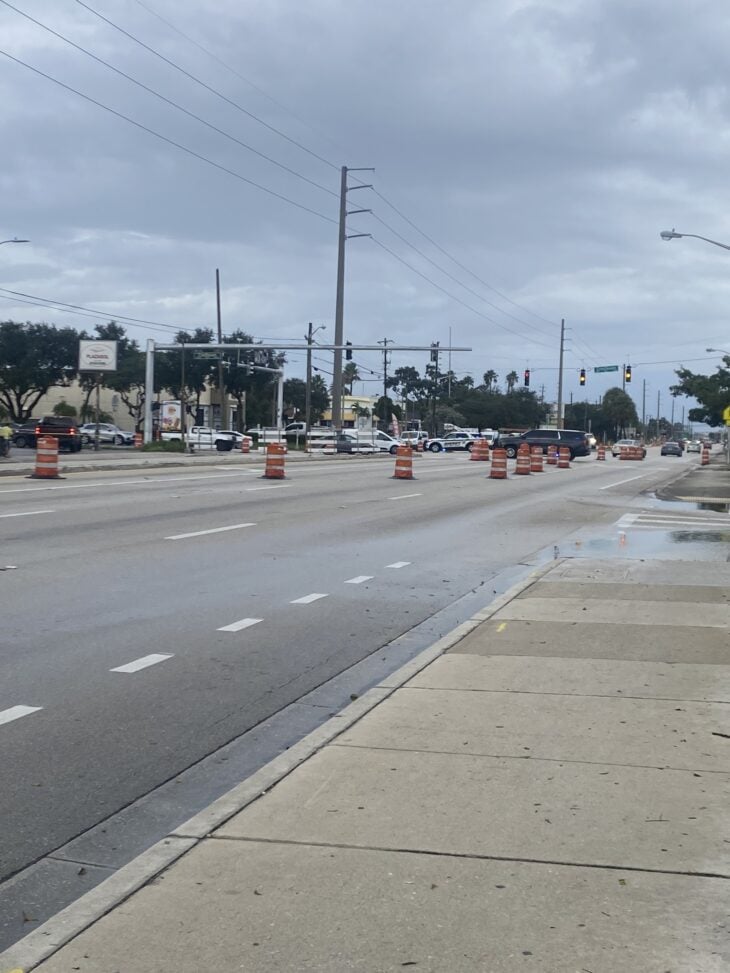

Some residents still cannot get into their homes, and residents and business owners have been told it could be 30 days before things return to normal, WPLG Local 10 reported on Thursday. The county’s update gives no reopening date.
What is still unknown
The Learjet 60 was flying from Austin-Bergstrom International Airport in Texas to North Eleuthera Airport in the Bahamas, operated by Aurora Aviation doing business as Upper Jet, according to the NTSB. The agency has not given a cause.
The NTSB has also not said whether it has found the cockpit voice recorder. Chapman said earlier this week that records show one was installed, but that investigators did not know whether it was still aboard, adding, “Of course we’re very hopeful that we can recover it.”
The next formal step is a preliminary report of the facts gathered so far. On other recent major cases the NTSB has said to expect one within 30 days of the accident, with the probable cause left to a final report 12 to 24 months out.
Sources and references used for research and fact-checking.
Get the Newsletter
The latest aviation news and stories sent to your inbox.
About the Author

AeroCorner News is the aviation news desk of AeroCorner.com. It covers accidents and incidents, safety rulings, airline and airport disruption, and new aircraft. It works from primary sources such as the NTSB, FAA, EASA and the manufacturers' own announcements.