


Table of Contents
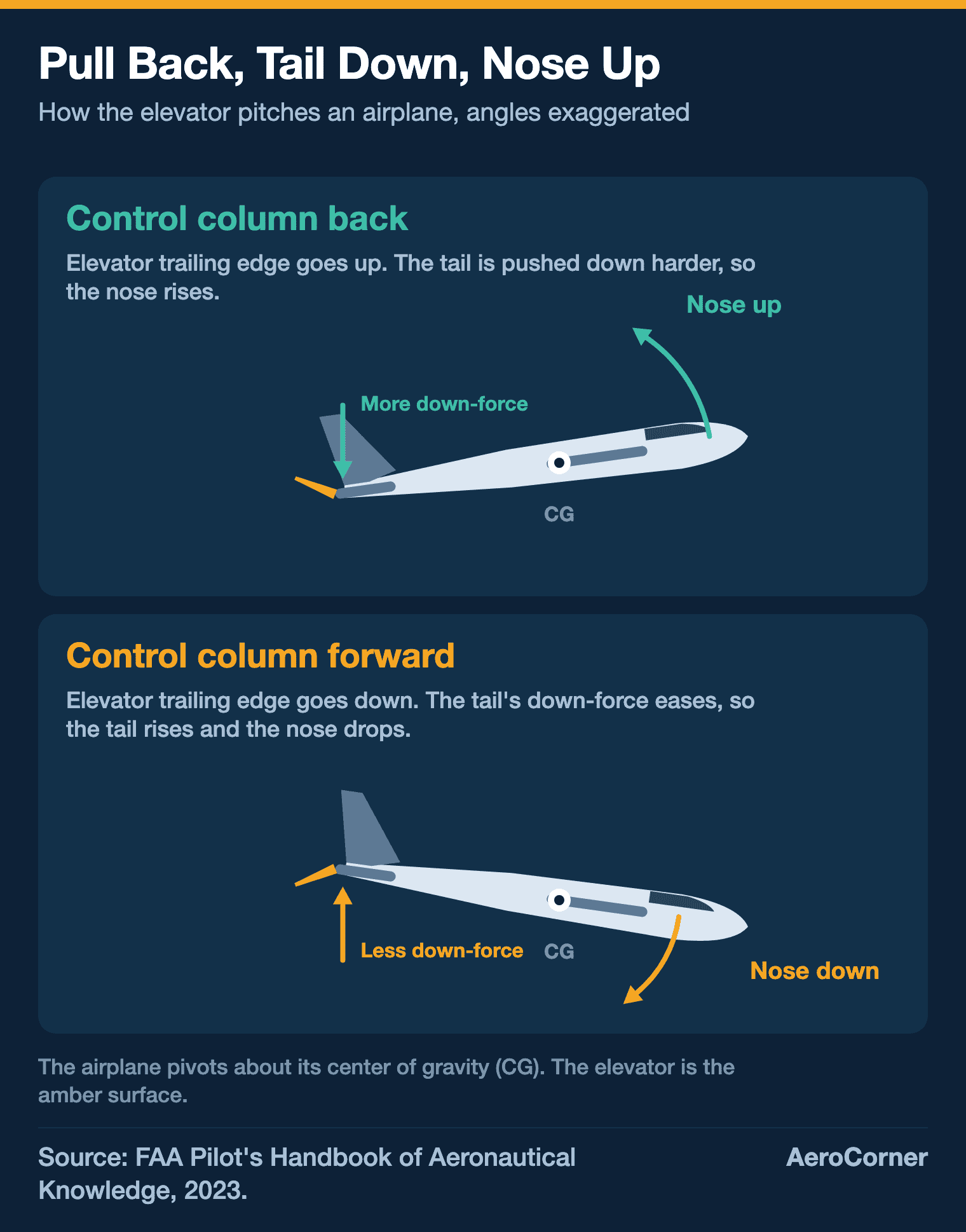
The elevator is the hinged flap on the back edge of an airplane’s horizontal tail, and it controls pitch: whether the nose points up or down. Pull the control column back and the elevator’s trailing edge rises. That pushes the tail down, and the nose comes up.
Push forward and the opposite happens: the trailing edge drops, the tail rises and the nose goes down. Everything else in this article, from trim tabs to canards and V-tails, is a variation on that one idea.
| Pilot input | Elevator trailing edge | Force at the tail | Tail | Nose |
|---|---|---|---|---|
| Control column back | Up | More downward force | Moves down | Pitches up |
| Control column forward | Down | Less downward force | Moves up | Pitches down |
What Is the Elevator on a Plane?
The elevator sits on the empennage, the tail group at the back of the airplane. The FAA describes the empennage as fixed surfaces, the vertical and horizontal stabilizers, plus the movable surfaces hinged to them: the rudder, the elevator and one or more trim tabs.
The elevator is attached to the back of the horizontal stabilizer. It is one of the three primary flight controls, along with the ailerons and the rudder, and the FAA calls those three the controls “required to control an aircraft safely during flight.”

In small general aviation airplanes like the Cessna 172 Skyhawk, the controls are usually mechanical. The FAA’s handbook describes cables, pulleys and push rods running from the control column back to the elevator.
How the Elevator Works: Pull Back, Tail Down, Nose Up
The elevator works like a small wing whose curve the pilot can change. Moving the control column aft deflects the elevator’s trailing edge up, which the FAA calls the up-elevator position.
Up-elevator reduces the camber of the elevator and creates a downward aerodynamic force. The tail moves down, and because the airplane pivots about its center of gravity, the nose pitches up.
Moving the column forward does the reverse. Elevator camber increases, the tail makes more lift (or less down-force), the tail rises and the nose goes down.
The tail is usually pushing down
Most people picture the tail lifting like a small wing. In straight-and-level flight the FAA describes a normal tail-down force instead, which balances the wing’s tendency to pitch the nose down. Pulling back on the controls does not create that force from nothing. It adds to a push that is already there.
How strongly the elevator pitches the airplane depends on two things, according to the FAA: the distance between the center of gravity and the horizontal tail, and how aerodynamically effective the tail is. A long tail arm gives a small surface a lot of leverage.
The elevator also does more than climbs and descents. In a turn the wing has to make extra lift, so the pilot adds elevator back pressure, and the FAA notes that the steeper the turn, the more back pressure it takes.
Elevator vs Horizontal Stabilizer: What Is the Difference?
The horizontal stabilizer is the fixed front part of the horizontal tail, and the elevator is the movable part hinged to its back edge. People often call the whole assembly “the elevator,” but the two do different jobs.
Both surfaces add pitch stability, keeping the airplane from wandering nose up or nose down. Only the elevator gives the pilot pitch control.
Where the Elevator Fits: The Three Axes of Flight
An airplane rotates about three axes, and each primary control works one of them. The elevator moves the airplane about the lateral axis, the line from wingtip to wingtip, and that motion is called pitch.
The ailerons roll the airplane about the longitudinal axis, nose to tail. The rudder yaws it about the vertical axis.

Secondary flight controls do other jobs. Flaps add lift at low speed, spoilers dump lift and add drag, and trim systems take the load off the pilot’s hands.
Elevator Trim: Why the Little Tab Moves the Opposite Way
Look closely at the back of most light-aircraft elevators and you will see a smaller hinged strip: the trim tab. The FAA calls a single trim tab on the elevator’s trailing edge the most common trim installation on small aircraft.
An airplane can only be designed to fly hands-off at a narrow mix of speed, power and attitude. Anywhere else, the pilot would have to hold steady pressure on the controls, and the trim tab exists to relieve it.
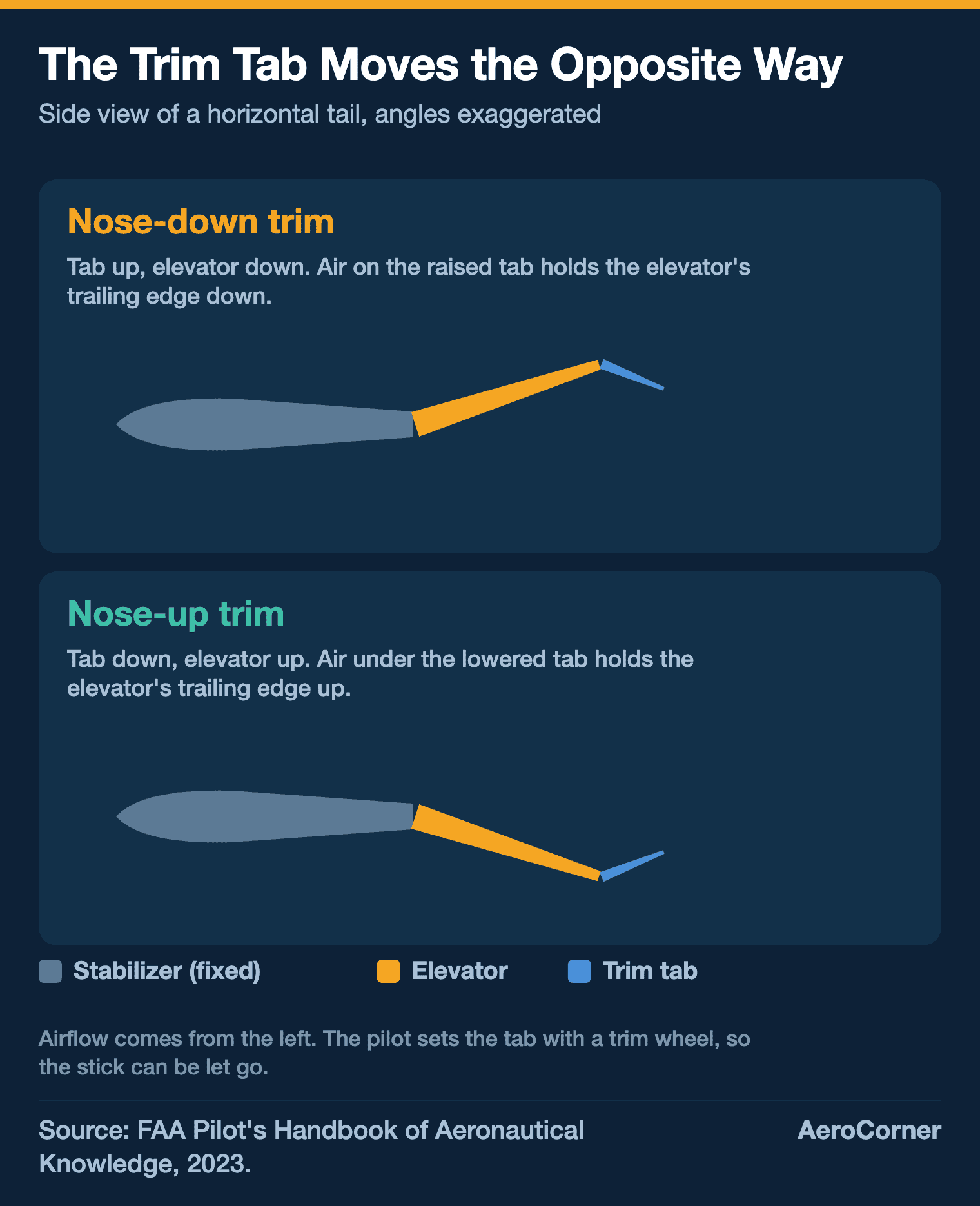
The trick is that the tab moves the opposite way to the elevator. Set nose-down trim and the tab goes up, so the air flowing over the tail forces the elevator’s trailing edge down; nose-up trim puts the tab down and the elevator up.
Pilots rarely think about that reversal. If they are holding back pressure on the yoke, the airplane needs nose-up trim, so they roll the trim wheel until the pressure disappears.
The FAA’s advice is to set power, pitch attitude and configuration first, then trim. Every time one of those changes, the pilot trims again.

How Airliners Handle Pitch: The Moving Stabilizer
Big jets still have elevators, but they trim differently. The FAA notes that most jet transports use an adjustable stabilizer: the whole horizontal stabilizer pivots about its rear spar, driven by a jackscrew that a motor turns on larger aircraft.
The reason is range of movement. A jet transport has a large center-of-gravity range, a large speed range and big trim changes when its flaps and slats extend, and holding all that with the elevator alone would leave little elevator travel to spare.
So the moving stabilizer takes the bulk of the pitch trim, and the elevator handles the rest with its full travel up and down. The FAA calls the variable incidence stabilizer “enormously powerful” compared with the other flight controls.
The forces are also too big for human arms. On large, fast aircraft the surfaces are moved by hydraulic or electric power units, and in fly-by-wire aircraft the pilot’s controls send an electrical signal instead of pulling a cable, with control feel simulated for the pilot.
T-Tails, Deep Stalls and the Elevator
Where the horizontal tail sits changes how the elevator behaves. On a T-tail, mounted on top of the fin, the elevator works in air mostly undisturbed by the propeller, the fuselage and the wings, so its feel stays consistent.
The trade-off shows up at low speed. A conventional tail gets help from propeller downwash pushing on it, so the FAA notes a T-tail’s elevator must move farther, with more force, to raise the nose on takeoff and landing.
The bigger risk is the deep stall. At a very high angle of attack, low airspeed and an aft center of gravity, the stalled wing’s turbulent wake can blanket the tail and leave the elevator with little or no authority to lower the nose.
Designers fight this with control stops, elevator down springs and, on transport jets, stick pushers. A down spring loads the elevator toward nose-down, so if the trim tab loses effectiveness the nose drops, speed builds and the stall is prevented.
Other Elevator Designs: Stabilators, Canards and V-Tails
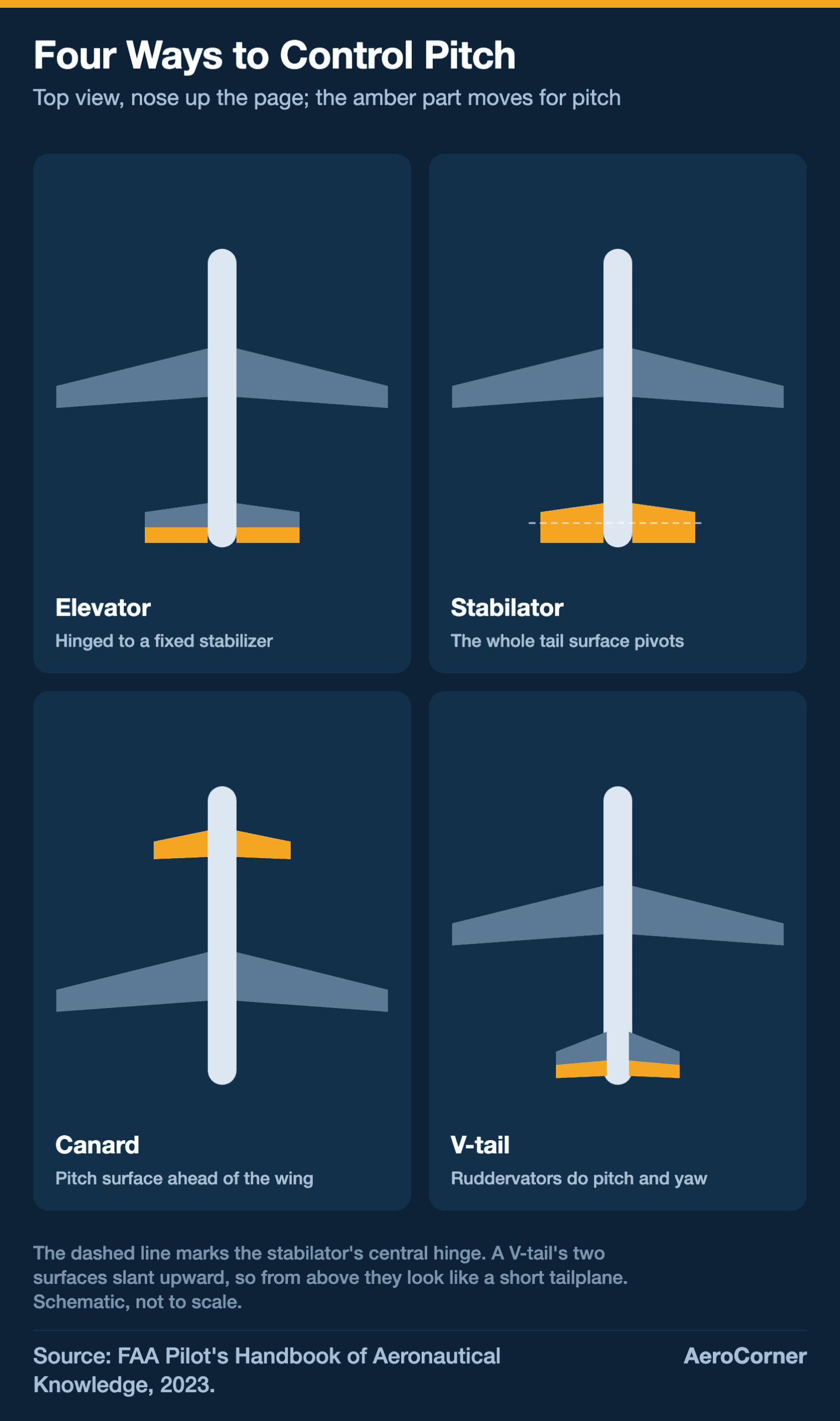
Not every airplane has a separate stabilizer and elevator. There are four common ways to control pitch, and the table below sums them up before the details.
| Design | What moves for pitch | Examples |
|---|---|---|
| Conventional elevator | A flap hinged to a fixed horizontal stabilizer | Cessna 172, most airliners (with a moving stabilizer for trim) |
| Stabilator | The whole horizontal tail, on a central hinge | Piper Cherokee, F-16 |
| Canard | A horizontal surface ahead of the wing | Wright Flyer, Beechcraft Starship, Rutan Long-EZ |
| V-tail | Ruddervators on two slanted tail surfaces | Beechcraft Bonanza V35, Cirrus Vision Jet |
Stabilator: the whole tail moves
A stabilator is a one-piece horizontal stabilizer that pivots from a central hinge, so it does the stabilizer’s job and the elevator’s at once. The name is a blend of the two words, and it also goes by all-moving tail or all-flying tail.
Because the whole surface pivots, the FAA calls stabilators extremely sensitive to control inputs. An antiservo tab on the trailing edge, which moves the same way as the stabilator, adds control force so the pilot is less likely to overcontrol, and it doubles as the trim tab.

Light aircraft such as the Piper PA-28 Cherokee use them, and so do fast jets like the F-16. On supersonic aircraft, shock waves on the horizontal tail sharply cut the effectiveness of a hinged elevator, so an all-moving tail is the usual answer.
Canard: the elevator in front
A canard puts the horizontal surface ahead of the main wing. The Wright Flyer used one, and the layout returned on designs like the Beechcraft Starship and the Rutan Long-EZ homebuilt.
The difference is in which way the force points. The FAA explains that a canard makes lift and holds the nose up, while a conventional aft tail pushes down to keep the nose from dropping.

V-tail: ruddervators do two jobs
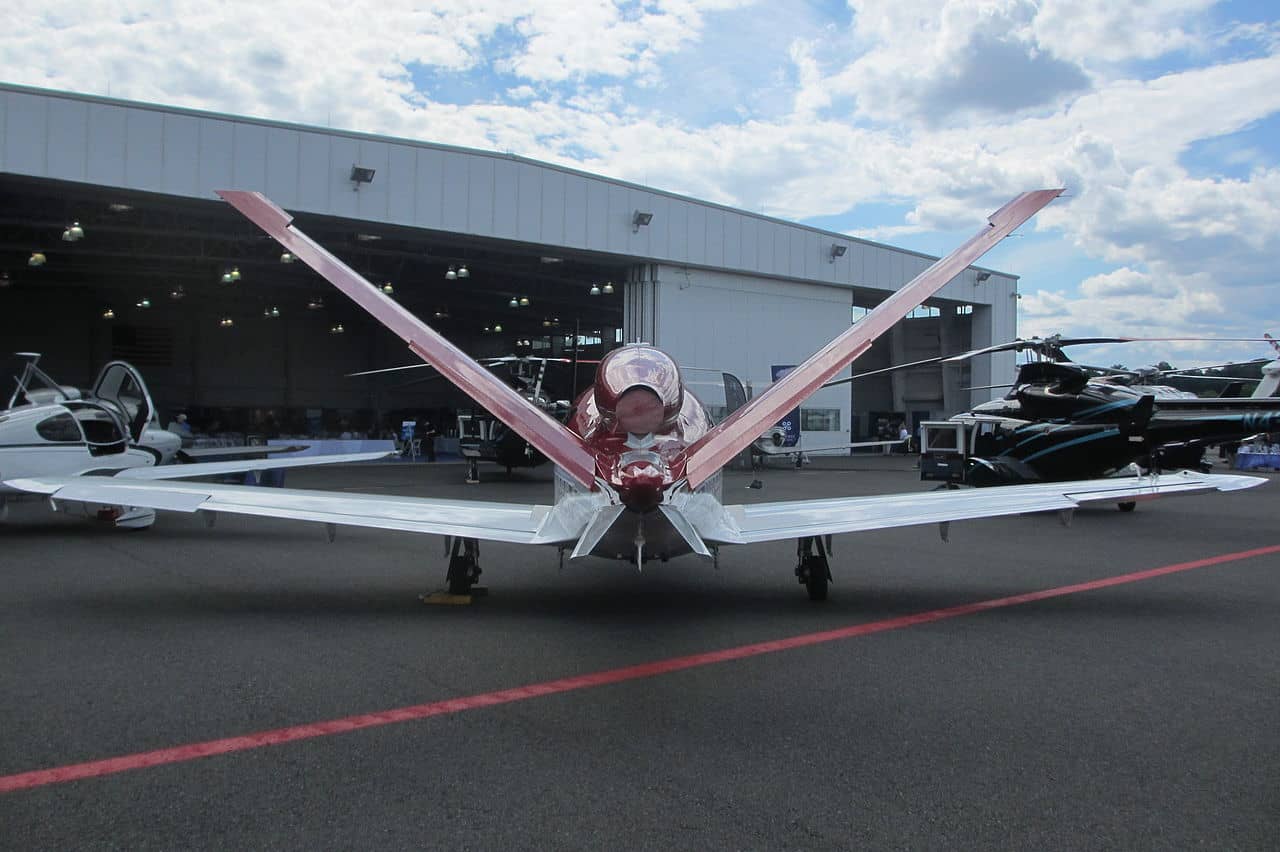
A V-tail replaces the separate horizontal and vertical tails with two slanted surfaces. Their movable parts, usually called ruddervators, move together when the pilot pulls or pushes on the wheel, and move differentially when the pilot presses the rudder pedals.
The Beechcraft Bonanza V35 is the classic example, and the Cirrus Vision Jet takes the “V” in its name from its V-tail. The FAA notes the mixing linkage is more complex than a conventional tail’s, and that V-tails are more prone to Dutch roll.

Delta-wing aircraft go one step further. They merge the ailerons and elevators into single surfaces called elevons, which handle both roll and pitch.
The Other Elevator on a Plane: Cabin Lifts
Some people searching for an elevator on a plane mean the kind that carries things. A few widebodies have had exactly that, mostly to move galley carts between decks.
The Lockheed L-1011 TriStar offered a lower-deck galley, and Simple Flying reports that lifts linked it to the main cabin. The same report names lifts for food trolleys or galley containers on the DC-10, the Boeing 747 and the Airbus A380.
FAQ
Sources and references used for research and fact-checking.
- Federal Aviation Administration, Pilot's Handbook of Aeronautical Knowledge (FAA-H-8083-25C), Chapter 3: Aircraft Construction and Chapter 6: Flight Controls
- Smithsonian National Air and Space Museum, How Things Fly, What are elevators and what do they do?
- Wikipedia, Elevator (aeronautics)
- Wikipedia, Stabilator
- Wikipedia, General Dynamics F-16 Fighting Falcon
- Wikipedia, Beechcraft Starship
- Wikipedia, Rutan Long-EZ
- Wikipedia, Cirrus Vision SF50
- King Air Magazine, Ask the Expert: Elevator Trim Tab Alignment
- Wikipedia, Lockheed L-1011 TriStar
- Simple Flying, Which Passenger Aircraft Have Elevators In The Cabin?
Get the Newsletter
The latest aviation news and stories sent to your inbox.
About the Author
Matt Claiborne is an FAA Airline Transport Pilot and Certified Flight Instructor with more than two decades of experience in flight training. He has served as an assistant professor and FAA Part 141 Assistant Chief Instructor for a university aeronautics program in Florida. His background in professional flying, flight instruction, and aviation education gives him firsthand expertise in aircraft operations, pilot training, flight procedures, and aviation safety.