

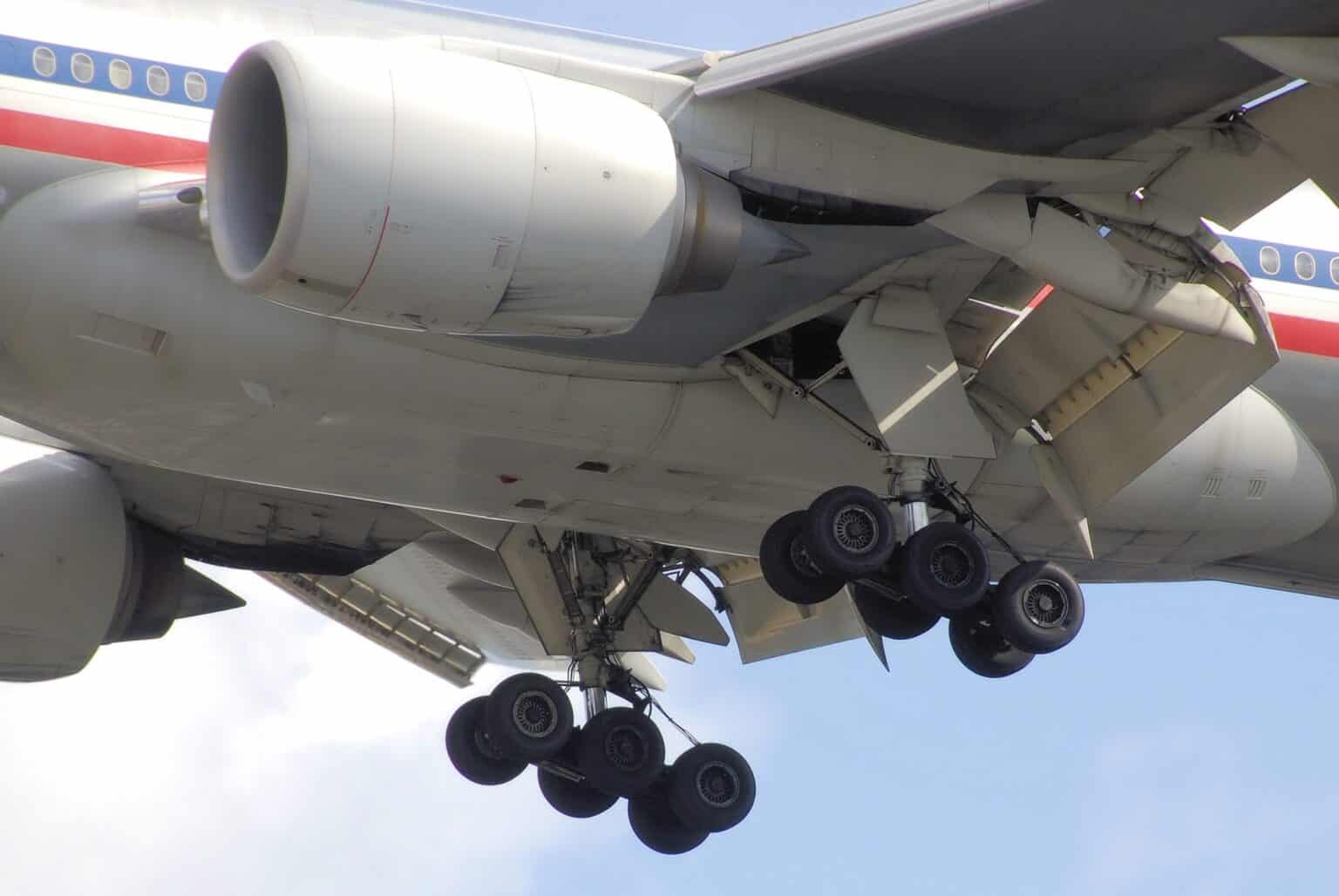
The FAA published an airworthiness directive on September 28, 2026, that bans a Boeing 777 hydraulic pump after one overheated and started a fire in a main landing gear wheel well. The rule covers every 777-200, -200LR, -300, -300ER and 777F and takes effect on November 2, 2026.
The part is the alternating current motor pump, or ACMP, with part number 731966. Operators must check their records or inspect the aircraft for it and replace any they find, and from November 2 no one may install one on a 777.
What went wrong on the 777
An operator reported a fire in the main landing gear wheel well of a 777, and a subsequent investigation found that an overheated ACMP had caused it. The directive does not name the airline or say when or where the fire happened.
Investigators found that a lock washer and nut were missing from a moving contact inside the pump’s electrical load control unit (ELCU), the unit that controls its electrical power. With them gone, the contact bar sat loose in a position that sent power to the pump on only two of its electrical phases.
The pump overheated, leaked hydraulic fluid, and the fire started in the wheel well, according to the directive. The FAA warns that the same failure could damage the airplane, prevent continued safe flight and landing, or injure people.
The deeper problem is the design of the old pump. The manufacturer found that part number 731966 can overheat and ignite a fire when it runs on continuous two-phase power, and that a single ELCU failure can create exactly that condition with no way to switch the power off.
The redesigned pump adds fusible links, which the FAA says prevent the overheat if one electrical phase fails. In other words, the new pump is meant to protect itself when its power supply fails, rather than depend on the load control unit.
What the directive requires
| Item | Detail |
|---|---|
| Directive | AD 2026-19-04, Docket FAA-2025-3997 |
| Applies to | All 777-200, -200LR, -300, -300ER and 777F |
| Effective | November 2, 2026 |
| Action | Records check or inspection for ACMP P/N 731966, per Boeing Alert Requirements Bulletin 777-29A0047 RB |
| Approved replacements | P/N 3033115-100, 66133-06 or 66068-08 |
| Deadline for installed pumps | Within 60 months of the effective date |
| Parts ban | No P/N 731966 may be installed on a 777 from November 2 |
| US fleet | 334 airplanes; the check is required on 290 |
| Cost per airplane | $170 for the check; up to $77,099 if the pump is replaced |
The FAA says the work can be done during regularly scheduled maintenance, so it expects no extra downtime. According to the manufacturer, warranty may cover some or all of the cost.
The 60-month deadline applies only to pumps already fitted. If a 777 needs a replacement pump after November 2, even in an emergency, a serviceable 731966 cannot go on, the FAA said in reply to a question from Air Canada.
What an ACMP does on a 777
The 777 has three separate 3,000 psi hydraulic systems, left, center and right, that move the flight controls, flaps, landing gear and brakes. Engine-driven pumps are the main source for the left and right systems, and an ACMP in each switches on when demand is high.
The center system works the other way round. Two ACMPs are its primary pumps, backed by two air-driven pumps, so the electric pumps on a 777 are more than a spare.
The directive does not say which of the 777’s ACMP positions caught fire. For a basic look at why jets depend on these systems, see our guide to how airplanes use hydraulics.
The same pump flies on 757s and 767s
The comments filed on the proposal show the problem is bigger than the 777. United told the FAA that its 757, 767 and 777 fleets all use the 731966 pump, and that the new 3033115-100 was applicable only to the 767 and 777, leaving its 757s limited to the old part.
FedEx said it has 433 of the 731966 pumps installed on its 757 and 767 freighters. It asked the FAA to make clear that the parts ban applies only to 777s, and the FAA confirmed that it does.
United asked the FAA to wait until matching rules for the 757 and 767 were ready, and American asked for a six-month grace period before the parts ban. The FAA refused both, saying a delay would leave affected pumps on 777s for longer and a grace period would raise the chance of one being installed.
Boeing released service bulletins for the 757, 767 and 747 in March 2026, according to the directive. The FAA says it may issue further rulemaking to mandate them, which would bring the fix to the older types as well.
For 757 and 767 operators
This directive does not apply to 757s, 767s or 747s. Boeing released service bulletins for those types in March 2026, and the FAA says it may issue further rulemaking to mandate them.
From proposal to final rule
The directive covers the passenger models from the original 777-200 through the long-range 777-300ER, plus the 777 Freighter. Earlier this month, the FAA and EASA ordered airlines to split up Trent engines on older 777s.
The FAA first proposed the rule on November 17, 2025, and adopted it with only minor editorial changes. Boeing and the Air Line Pilots Association supported it without change.
Sources and references used for research and fact-checking.
Get the Newsletter
The latest aviation news and stories sent to your inbox.
About the Author

Tim is the owner and lead editor of AeroCorner since 2019, overseeing aviation content covering aircraft, airlines, airports, and the broader aviation industry. Through years of researching, writing, editing, and publishing aviation-focused content, he has developed extensive practical knowledge of commercial aviation and air travel. Based in Asia and a frequent traveler himself, Tim also brings firsthand passenger experience to AeroCorner’s coverage. Outside of publishing, he has also explored aviation firsthand through hands-on flight training in New Zealand.