


The NTSB has told the US Forest Service to overhaul how it tests fire retardants for corrosion, after a new product ate into the structure of two large airtankers during the 2023 fire season. The findings are in investigation report AIR-26-06, dated November 2, 2026 and published this week.
The aircraft were Neptune Aviation Services’ Tanker 02 (N474NA), a BAe 146-200A, and Aero Air’s Tanker 106 (N296EA), an MD-87. Both flew under Forest Service contract and carried Fortress FR-200, a magnesium chloride retardant made by Fortress North America.
What the NTSB found
The NTSB gave the probable cause as the use of a new retardant “with a chemical composition incompatible with the retardant previously in use” in a field evaluation, without adequate testing and qualification. The Forest Service had asked the board to investigate after the corrosion surfaced in postseason maintenance.
The trial ran in two phases. From June 16 to August 13, 2023, the two jets dropped FR-200 only; from August 14 to November 21 they alternated it with MVP-Fx, an ammonium phosphate retardant sold under Perimeter Solutions’ Phos-Chek brand.
On Tanker 106, which was in its first fire season after conversion, the damage reached primary structure. In January 2024, Aero Air found intergranular corrosion in a doubler on the lower cap of the right wing’s forward spar, and drilling showed it ran through more than half of the part’s thickness.
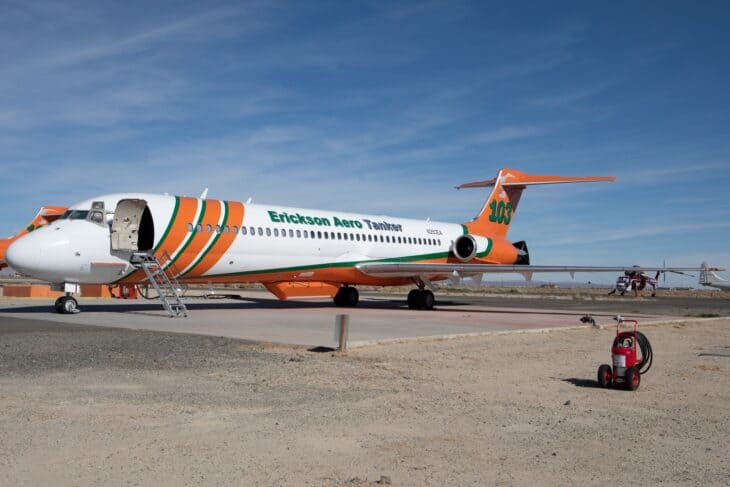

The doubler sits on the belly near the wing root, in the path of the retardant plume, and the manufacturer classes it as primary structure. Aero Air also replaced about 44 inches (1.1 m) of a longeron, repaired two keel-skin panels and swapped out more than 90 electrical connectors and several control cables.
The engines suffered too. Overhaul technicians rejected 61 parts or modules from the right engine and 53 from the engine that started the season on the left, and the auxiliary power unit needed an overhaul.
On Tanker 02, investigators found corrosion throughout the retardant tank’s internal structure, concentrated around fasteners, joints and points where dissimilar metals met. Control aircraft from both operators that had not carried FR-200 showed no comparable corrosion, according to the report.
Why the tests missed it
For decades the retardants the Forest Service qualified relied on phosphate-based salts, and from 2006 Phos-Chek was the only qualified line. In January 2020, at the Department of Agriculture’s direction, the agency dropped the phosphate requirement to bring in more suppliers, and Fortress’s FR-100 and FR-200 became the first new long-term retardants on its approved list in more than 20 years.
The qualification test immersed isolated coupons of four metals in retardant for 90 days at 70°F and 120°F (21°C and 49°C) and measured uniform weight loss. It did not test fasteners, joints, built-up structure, other common aircraft alloys such as 7075 aluminum, or what happens when two different retardant chemistries mix in one tank.
FR-200’s field evaluation before full qualification used one single-engine airtanker with a fiberglass tank, so it never tested the product against the metal tanks and built-up structure of a large airtanker. Large airtanker operators had warned the agency in August 2022 that the testing ignored their alloys and the effects of mixing retardants, and the NTSB found no evidence those concerns were built into the 2023 trial before its mixing phase began.
That gap is the point of the report. Aircraft are full of galvanic and intergranular corrosion risks that a single coupon cannot show: when steel and aluminum touch in a liquid electrolyte, the less resistant metal, usually the aluminum, corrodes preferentially, and corrosion along grain boundaries can weaken a part with little visible surface damage.
Testing by the National Institute of Standards and Technology found exactly that kind of galvanic corrosion on parts from both jets. Follow-up Forest Service tests found a 50-50 mix of FR-200 and MVP-Fx was more acidic than either product and corroded coupled aluminum well beyond the specification’s limits.
Regulation leaves the Forest Service as the main safeguard. The FAA approves an aircraft for aerial dispensing, but not the liquids the agency chooses to load into firefighting airplanes, so Specification 5100-304d is the principal check that a retardant is compatible with the airframe.
The two recommendations
The Forest Service suspended FR-100 and FR-200 on May 5, 2024, limited retardants to phosphate salts again in an interim amendment that October, and removed both products from its list on December 5, 2024. The NTSB called those steps encouraging but said restricting the salts does not fix the qualification process itself.
Recommendation A-26-66 asks the agency to work with aircraft corrosion experts, airtanker operators and retardant makers on test procedures covering real aircraft materials, built-up structures, galvanic coupling and retardant mixing. A-26-67 asks it to write those procedures into Specification 5100-304d, so future qualification decisions rest on them.
The agency has already contracted broader work, including a cyclic-immersion test plan covering 20 aircraft materials, but the NTSB said results were not yet available. The investigation drew attention a year ago, when FlightGlobal reported that the corrosion had been traced to incompatible retardants.
January 2020
Phosphate rule dropped. Specification 5100-304d opens qualification to non-phosphate retardant salts.
December 2022
FR-200 fully qualified. After a field evaluation on one single-engine airtanker with a fiberglass tank.
June to November 2023
Two-phase field trial. Tankers 02 and 106 drop FR-200, then alternate it with MVP-Fx.
March 11, 2024
NTSB notified. The Forest Service reports the corrosion found in postseason maintenance.
May to December 2024
Products pulled. FR-100 and FR-200 suspended, then removed from the qualified products list.
November 2026
Final report. The NTSB issues AIR-26-06 and recommendations A-26-66 and A-26-67.
Sources and references used for research and fact-checking.
Get the Newsletter
The latest aviation news and stories sent to your inbox.
About the Author

AeroCorner News is the aviation news desk of AeroCorner.com. It covers accidents and incidents, safety rulings, airline and airport disruption, and new aircraft. It works from primary sources such as the NTSB, FAA, EASA and the manufacturers' own announcements.