


Table of Contents
| Factor | AH-64D Apache Longbow | AH-1 Cobra |
|---|---|---|
| Role | Army primary attack helicopter | First purpose-built helicopter gunship |
| Builder | Boeing (originally Hughes) | Bell |
| Army service | AH-64A from 1984, AH-64D from 1997 | 1967 to 1999 (reserves to 2001) |
| Gun | 30 mm M230 chain gun, up to 1,200 rounds | 20 mm M197 cannon (AH-1E and AH-1F) |
| Missiles | Up to 16 AGM-114 Hellfire | TOW anti-tank missiles, eight in a typical load |
| Radar | AN/APG-78 Longbow, tracks up to 256 targets | None. Laser rangefinder on the AH-1F |
| Armor | About 2,500 lb (1,100 kg) of crew and system protection | Armored seats and crew body armor |
| Combat debut | Panama, 1989 (AH-64A) | Vietnam, 1967 |
| Built | Close to 2,900 Apaches of all models | 1,116 AH-1Gs for the Army |
Which Is Better: the Apache or the Cobra?
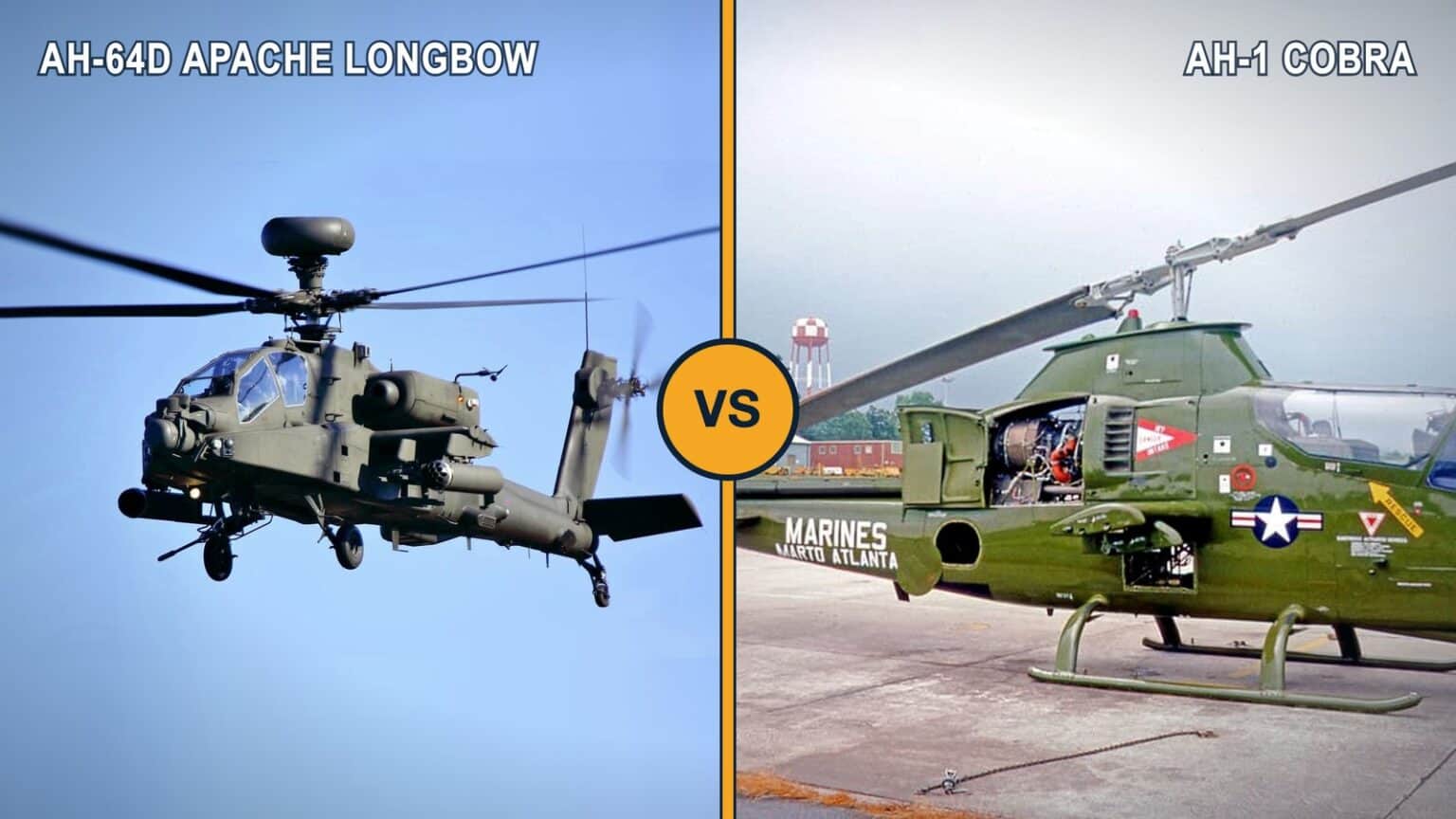
The AH-64D Apache Longbow is the better attack helicopter. It carries a heavier gun, more missiles and a radar the AH-1 Cobra never had, and it has two engines to the Cobra’s one.
They are 20 years apart, so they are not really rivals. The Army retired the Cobra from its active force in March 1999 because the Apache could do its job better.
Which Cobra? Which Apache?
This page compares the AH-64D Apache Longbow with the single-engine Army Cobra line, the AH-1G to AH-1F. The Marine Corps flew a twin-engine Cobra family, the AH-1J, AH-1T and AH-1W, and now flies the AH-1Z Viper. They are covered on the SuperCobra and Viper pages.
Where the Apache Wins
The Apache’s first advantage is firepower. Its 30 mm M230 chain gun holds up to 1,200 rounds, and its four stub-wing pylons carry up to 16 AGM-114 Hellfire missiles, rockets, or a mix of both.
The Cobra’s best gun was the three-barrel 20 mm M197 on the AH-1E and AH-1F. The Federation of American Scientists gives a typical anti-armor load as eight TOW missiles and two rocket pods, with 750 rounds for the gun.
Its second advantage is sensors. The AH-64D Longbow carries the AN/APG-78 radar above its main rotor, which can detect, classify and prioritize up to 256 targets within about 31 miles (50 km). The Apache can then fire without leaving cover.

Its third is survival. The Apache carries about 2,500 lb (1,100 kg) of armor and structural protection, and its fuel cells are self-sealing and built to take 23 mm rounds. It also has two engines, so one hit does not have to end the flight.
The Apache is also the more capable aircraft on paper. Its panel lists a top speed of 158 kt (182 mph, 293 km/h), a ceiling of 21,000 ft (6,400 m) and a climb rate of 2,635 ft/min (13 m/s).

Where the Cobra Wins
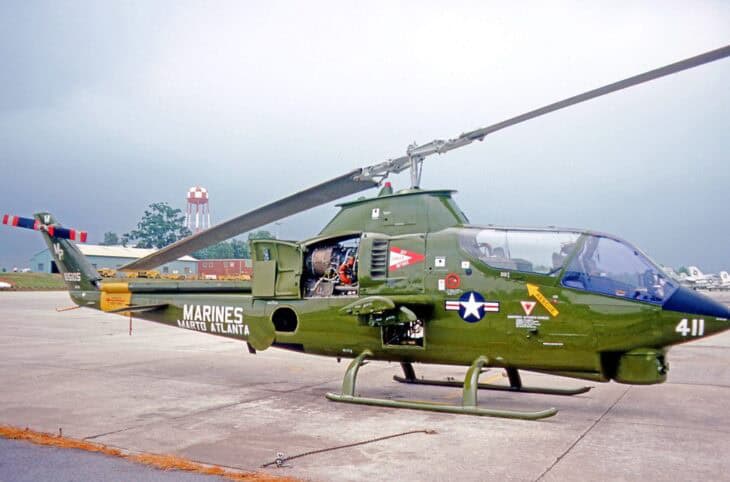
The Cobra’s edge is that it got there first. The Smithsonian’s National Air and Space Museum calls it the first purpose-built helicopter gunship to enter military service, and its layout became the template for every attack helicopter after it.
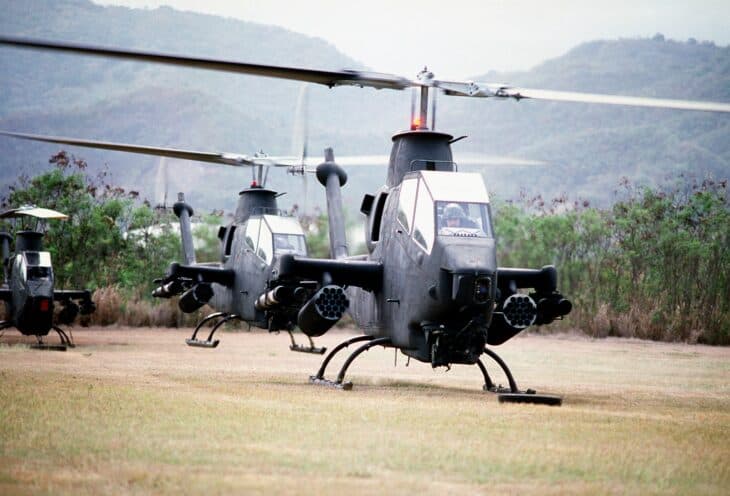
That layout was a narrow body with two crew in tandem, stub wings for weapons and a gun turret under the nose. Seating the crew one behind the other cut the fuselage to 36 inches (0.91 m) wide, a small target for ground fire.
It was also fast to build. Bell funded the design itself in January 1965, rolled out the prototype on September 3 and flew it on September 7, eight months after the go-ahead. Roughly 80 percent of its parts already had Huey part numbers.
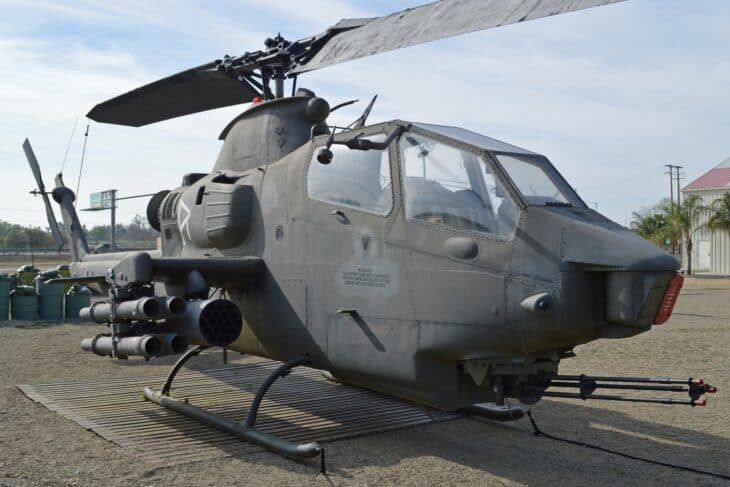
The Cobra is also the lighter, cheaper machine. Its panel lists an empty weight of 5,810 lb (2,635 kg), against 11,387 lb (5,165 kg) for the Apache. The Apache Longbow’s price is $20.2 million (2019), the Department of Defense Inspector General’s figure for remanufacturing an AH-64A.
The Cobra’s war record is the longer one. Bell built 1,116 AH-1Gs for the Army between 1967 and 1973, and they logged more than one million operational hours in Vietnam. It is one of the helicopters that defined the Vietnam War.

Apache vs Cobra Size and Crew
The Apache is the larger helicopter. It is 58 ft 2 in (17.73 m) long with a rotor diameter of 48 ft 0 in (14.63 m), against 53 ft 0 in (16.15 m) and 44 ft 0 in (13.40 m) for the Cobra.
Both carry a crew of two seated in tandem. In the Cobra the gunner sits in front and the aircraft commander behind. Both seats have flight controls, so either crew member can fly.
The power is where they split. The Apache uses two General Electric T700-GE-701D engines at 2,000 shp (1,491 kW) each. The Cobra uses one Lycoming T53-L-13 at 1,100 shp (820 kW).
Apache and Cobra Timeline
The two overlapped for 15 years. They flew side by side in Panama in 1989, and the Apache took over the Army’s attack mission through the 1990s.
Sept. 7, 1965
AH-1 Cobra first flight. Bell flies the Model 209 prototype eight months after the go-ahead.
Aug. 30, 1967
Cobras reach Vietnam. The first six AH-1Gs arrive at Bien Hoa Air Base.
1984
AH-64A enters Army service.
1989
Panama. Army Cobras fight alongside the Apache for the first time.
Apr. 15, 1992
AH-64D first flight. The Longbow upgrade prototype flies.
Mar. 31, 1997
First AH-64D delivered.
Mar. 1999
Army retires the Cobra. The active force stands it down. Reserves follow in September 2001.
2010
Fort Drum program ends. The last four refurbished Cobras ship to Thailand.
Dec. 2022
Japan plans to replace both. Its Cobras and Apaches are slated to give way to unmanned aircraft.
Is the Cobra Still in Service?
Yes, but only just. As of September 2026, South Korea, Japan and Pakistan still fly the single-engine Cobra, and all three are replacing it. A South Korean AH-1S crash in February 2026 killed both pilots and grounded that fleet.
The Apache is the opposite. Boeing says the Apache family has logged more than 5.3 million flight hours, over 1.3 million of them in combat, and the type is still in production.
Why the Marines Fly the Cobra Line, Not the Apache
The Marine Corps never bought the Apache. It ordered a twin-engine Cobra, the AH-1J, in 1968, and that family runs through the AH-1T and AH-1W to today’s AH-1Z Viper.
It is a separate line from the Army Cobra, with a second engine and modern avionics. The Bell AH-1 SuperCobra page covers the AH-1J, AH-1T and AH-1W, and the Viper is what the Marines fly now.
Who Would Win, the Apache or the Cobra?
The Apache would win nearly every time. It sees farther, hits harder, carries more and can take more damage, and the Longbow radar lets it shoot first from behind cover.
The Cobra’s case rests on its era, not a fair fight. It was the first gunship, it fought in Vietnam, Grenada and the Gulf War, and every attack helicopter since, the Apache included, follows its layout. For the wider field, see the best attack helicopters in the world.
FAQ
Sources and references used for research and fact-checking.
- Wikipedia, Bell AH-1 Cobra
- Wikipedia, Boeing AH-64 Apache
- U.S. Army, Vietnam-era AH-1 Cobra ushered in modern attack fleet
- U.S. Army, AH-1 Cobra retirement program at Fort Drum ends, final four helicopters head to Thailand
- Federation of American Scientists, AH-64 Apache
- Federation of American Scientists, AH-1 Cobra
- Smithsonian National Air and Space Museum, Bell AH-1F Cobra
- Boeing, AH-64 Apache
About the Author

Tim is the owner and lead editor of AeroCorner since 2019, overseeing aviation content covering aircraft, airlines, airports, and the broader aviation industry. Through years of researching, writing, editing, and publishing aviation-focused content, he has developed extensive practical knowledge of commercial aviation and air travel. Based in Asia and a frequent traveler himself, Tim also brings firsthand passenger experience to AeroCorner’s coverage. Outside of publishing, he has also explored aviation firsthand through hands-on flight training in New Zealand.