



Table of Contents
Apache vs Black Hawk at a glance
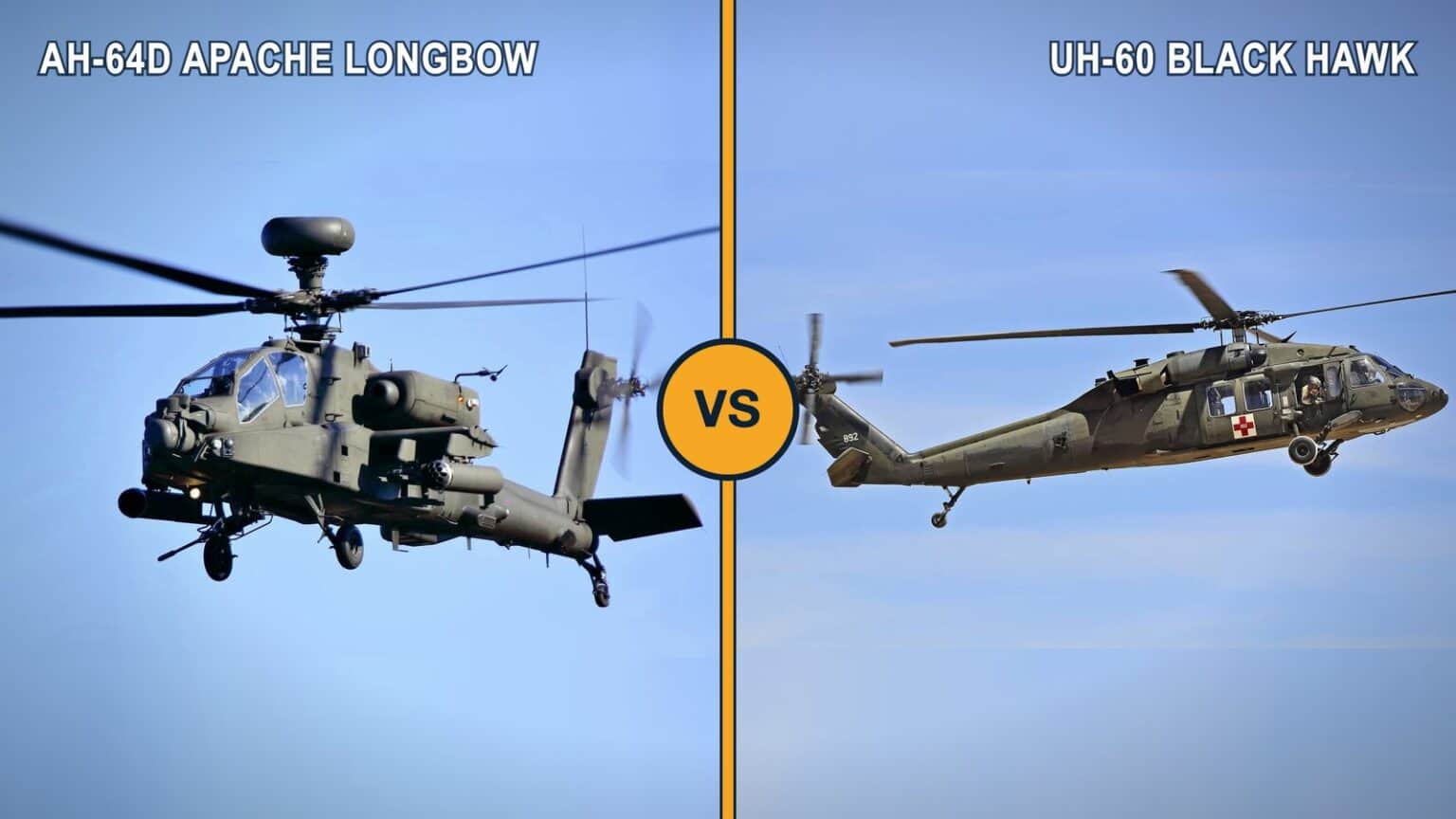
The Apache is an attack helicopter built to destroy targets. The Black Hawk is a utility helicopter built to move soldiers and supplies.
They are both twin-engine US Army helicopters from the 1970s, and they often fly the same missions side by side. But one carries a gun and rockets as its job, and the other carries people.
This page compares the AH-64D Apache Longbow with the UH-60M Black Hawk. The spec widget above sets their size, weight and performance side by side. This table covers what it does not.
| Boeing AH-64 Apache | Sikorsky UH-60 Black Hawk | |
|---|---|---|
| Role | Attack helicopter | Utility and troop transport helicopter |
| First flight | September 30, 1975 (YAH-64) | October 17, 1974 (YUH-60A) |
| Army service | April 1986 (AH-64A) | June 1979 (UH-60A) |
| Replaced | Introduced as the Army’s attack helicopter | The UH-1 Huey as tactical transport |
| Main weapons | Hellfire missiles and Hydra 70 rocket pods on four stub-wing hardpoints, plus a chain gun | Door guns, and optional stub wings that carry up to 10,000 lb (4,500 kg) of armament |
| Built | More than 2,700 delivered by March 2024 | About 5,000 by January 2023 |
| Operators | US Army and 18 international partners | US Army is the primary user |
Built for different jobs
The Apache is an aerial weapons platform. Its two pilots sit in tandem, with the pilot behind and the co-pilot gunner in front, and the whole aircraft is organized around sensors and weapons.
The Black Hawk is a bus with rotors. It carries a crew of four and up to 11 equipped troops, and it replaced the UH-1 Huey as the Army’s tactical transport.
Their first flights were a year apart, in 1974 and 1975, and the Army fielded the Black Hawk first, in 1979. The Apache followed in 1986.
Where the Apache wins: firepower
The Apache has four stub-wing hardpoints that typically carry Hellfire missiles and Hydra 70 rocket pods. A gun sits under the nose.
It was tested in combat quickly. Apaches saw first combat in Panama in 1989. On January 17, 1991, eight AH-64As opened Operation Desert Storm, and 277 Apaches took part in the ground war.
The Longbow upgrade followed. The first production AH-64D flew on March 17, 1997, and the newer AH-64E reached its first Army unit in February 2013.


For the full specs, see the Boeing AH-64D Apache Longbow page.
Where the Black Hawk wins: carrying people and cargo
The Black Hawk can lift what the Apache cannot. It carries up to 11 troops inside, or 2,600 lb (1,200 kg) of cargo, and the UH-60L and UH-60M can sling 9,000 lb (4,100 kg) underneath.
Variants cover medevac too. The HH-60M is the Army’s medical evacuation version.
It is also the more common aircraft. About 5,000 Black Hawks had been built by January 2023, against more than 2,700 Apaches.


For the full specs, see the Sikorsky UH-60M Black Hawk page.
Can a Black Hawk be armed like an Apache?
Yes, partly. The External Stores Support System, in service since 1986, adds stub wings that carry rockets, missiles and gun pods.
The special-operations MH-60 Direct Action Penetrator goes furthest. It drops the troop cabin and carries an M230 30 mm chain gun, Hydra 70 rockets and Hellfire missiles.
Even so, it is a transport helicopter with weapons added. The Apache was designed around its weapons from the start.
Same fight, different jobs
The Apache attacks the target. The Black Hawk lands the soldiers, supplies and medevac crews around it. Armed Black Hawks can add firepower, but the Apache was built as a gunship.
Sensors and cockpit: what the pilots see
The Apache’s Longbow version carries the AN/APG-78 Longbow radar, the TADS/PNVS targeting and night-vision sensors, and the IHADSS helmet-mounted display. These let the crew find and engage targets in the dark.
That is why the Apache has two seats in tandem. One pilot flies, and the other runs the sensors and weapons.
The Black Hawk is built around the cabin instead. Its crew of four includes the pilots and the crew members who handle the passengers and cargo.
Combat record: Panama, Desert Storm and Mogadishu
The Apache was designed to fight, and it fought early. Its first combat came in Operation Just Cause in Panama in 1989, with more than 240 combat hours.
Two years later, eight AH-64As opened Operation Desert Storm on January 17, 1991. In the ground war, 277 Apaches took part, and one was lost.
Black Hawks have a different record. They featured prominently in the Battle of Mogadishu in 1993, and two were shot down there.
That is the cost of carrying people into hostile ground. A transport helicopter has to land where the fighting is.
Which one is built in larger numbers?
The spec widget above lists a unit price for each aircraft, so use it for the cost comparison. Production numbers tell a different story.
The Apache is the specialist, with radar, sensors and weapons to maintain. The Black Hawk is built in far larger numbers, with about 5,000 made by January 2023 against more than 2,700 Apaches by March 2024.
Those numbers show how the Army sees the two jobs. It needs a few attack helicopters and many more transport ones.
The Black Hawk family keeps growing
The Black Hawk has been adapted far more widely than the Apache. The UH-60Q is a UH-60A modified for medical evacuation, and the HH-60L carries medical equipment.
The Army’s current medevac version is the HH-60M. A 2007 full-rate production contract covered 1,227 UH-60Ms.
There are armed export versions too. The Battle Hawk was offered for Australia’s AIR87 project without success, and the UAE ordered Battlehawk armament kits in 2011.
Which versions are being compared?
Neither name is a single aircraft. The Apache family runs from the AH-64A to the AH-64D Longbow and the AH-64E.
The Black Hawk family is larger. It includes the UH-60A, UH-60L and UH-60M, plus medevac, special-operations and export versions.
This page compares the AH-64D Longbow with the UH-60M, both of which the spec widget above covers.
Apache vs Black Hawk: who wins?
It depends on the job. For firepower, the Apache wins easily, because shooting is what it was built for.
For carrying soldiers, cargo and the wounded, the Black Hawk wins. Neither replaces the other, which is why the Army flies both.
FAQ
Sources and references used for research and fact-checking.
About the Author

Tim is the owner and lead editor of AeroCorner since 2019, overseeing aviation content covering aircraft, airlines, airports, and the broader aviation industry. Through years of researching, writing, editing, and publishing aviation-focused content, he has developed extensive practical knowledge of commercial aviation and air travel. Based in Asia and a frequent traveler himself, Tim also brings firsthand passenger experience to AeroCorner’s coverage. Outside of publishing, he has also explored aviation firsthand through hands-on flight training in New Zealand.