



Table of Contents
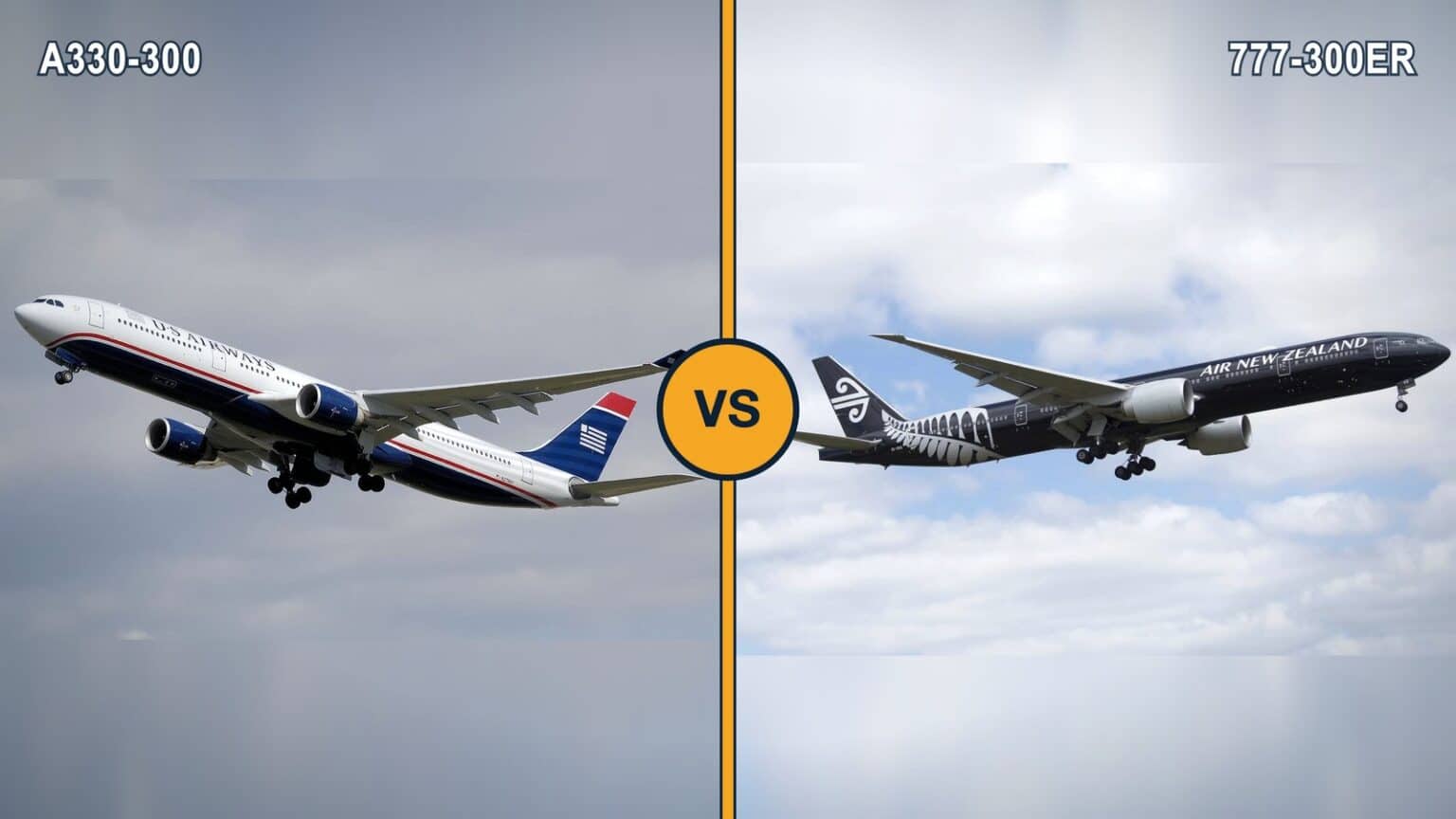
Put the Airbus A330-300 next to the Boeing 777-300ER and the 777 wins on size, power and range. The A330 wins on weight and price. The two are not direct rivals, because Boeing built the 777-300ER for the densest long-haul routes and Airbus aimed the A330 at a wider mix.
This comparison uses the most common version of each family: the A330-300 and the 777-300ER. The specification table above this text shows them side by side.
| Milestone | Airbus A330-300 | Boeing 777-300ER |
|---|---|---|
| First flight | November 1992 | February 24, 2003 |
| Certification | October 21, 1993 | March 16, 2004 |
| Launch customer | Air Inter (service entry January 1994) | Air France (first delivery April 29, 2004) |
| Engine choices | GE CF6-80E1, Pratt & Whitney PW4000 or Rolls-Royce Trent 700 | GE90-115B only |
| Wingtip design | Plain wingtips | Extended raked wingtips |
| Built | 771 delivered against 779 ordered (December 2020) | 833 delivered against 838 ordered (September 30, 2026) |
| Production status | Last delivered to Aer Lingus on March 4, 2020 | Last entered service with Ethiopian Airlines in December 2024 |
| Replaced by | Airbus A330neo | Boeing 777-9 |
Size and Capacity: Where the 777 Wins
The 777-300ER is 242 ft 4 in (73.86 m) long. The A330-300 is 208 ft 10 in (63.66 m). That extra length is what lets Boeing list 350 to 425 seats in two classes, against Airbus’s typical 250 to 290 in three.
Wingspan follows the same pattern: 212 ft 7 in (64.80 m) on the 777-300ER and 197 ft 10 in (60.30 m) on the A330-300. The raked wingtips on the 777-300ER account for part of that, adding 12.8 ft (3.90 m) to each wing.

Cargo is part of the story too. Airbus lists room for 33 LD3 containers under the A330-300’s floor, and that belly freight is a big reason airlines flew it on routes with modest passenger demand.
The size gap in one line
The 777-300ER is roughly 33 ft (10 m) longer than the A330-300, and Boeing lists about 100 more two-class seats than the A330’s typical three-class count.
Engines and Power: Two Very Different Approaches
The A330-300 gave airlines a choice of three engine families: the General Electric CF6-80E1, the Pratt & Whitney PW4000 or the Rolls-Royce Trent 700. That let a carrier match the aircraft to engines already in its fleet.
The 777-300ER has one engine option, the General Electric GE90-115B. It was the largest and most powerful jet engine in service until the GE9X surpassed it. Each one makes 115,300 lbf (513 kN), against 71,100 lbf (316 kN) for an A330-300 engine.
The 777-300ER also has a strengthened structure and a modified main gear to carry its weight. The landing gear uses the largest tires fitted to any airliner.

Range and Weight: Why the Numbers Differ
Boeing publishes 7,500 nm (8,630 mi, 13,890 km) for the 777-300ER. Airbus lists 6,350 nm (7,310 mi, 11,760 km) for the A330-300. Both depend on passenger load and fuel reserves, so a full aircraft flies shorter than its headline range.
Maximum takeoff weight is 775,000 lb (351,500 kg) for the 777-300ER and 534,000 lb (242,000 kg) for the A330-300. The A330 reached that figure only after a series of increases, and the 242-tonne version first reached an airline when Delta took delivery in May 2015.
In plain terms, the 777-300ER can fly transpacific and ultra-long-haul sectors that sit at the edge of what an A330-300 can carry with a full load.
Cabin and Comfort: Closer Than You Would Think
The A330 is a narrower aircraft, and its typical economy layout is eight across in a 2-4-2 pattern. Wikipedia describes that layout as the usual one. In that cabin, no seat is more than one seat from an aisle.
The 777-300ER cabin is wider, and economy is commonly nine or ten abreast. Whether a seat feels roomier depends on the airline’s choice, because carriers set their own pitch and width on both aircraft.
So the cabin edge goes to whichever airline you fly. Check the seat map and the layout, not the aircraft type alone.
Where Each One Flies
Airbus describes the A330-300 as covering every route segment, from short-haul trunk routes to intercontinental ones. That flexibility is unusual in a widebody.
Delta Air Lines is the largest A330 family operator, with 81 aircraft according to Wikipedia. Airlines such as Turkish Airlines and EVA Air also fly the A330-300.

The 777-300ER is a long-haul workhorse. Emirates, the largest 777 operator in 2018 with 163 aircraft across all variants, is the only customer to have flown every 777 variant Boeing produced.

Production and Successors
Both aircraft have now left the assembly line, but each family has a newer replacement. That matters when you compare them, because the choice today is usually between an older, depreciated aircraft and a newer one.
Airbus delivered the last A330-300 to Aer Lingus on March 4, 2020. Wikipedia, citing Airbus data, reports 779 orders and 771 deliveries as of December 2020. The A330neo, with new engines and wings, replaced the original A330 line.
Boeing delivered 833 of the 838 777-300ERs ordered by September 30, 2026. The last one entered service in December 2024 with Ethiopian Airlines, after nearly five years in storage. It was built for China Southern Airlines and first flew in January 2020, but the pandemic halted its delivery. The 777-9 is the successor in the family.
Neither type is gone from the skies. Airlines still fly both, and a growing number of 777-300ERs are being converted to freighters.
Freighter conversions give the 777-300ER a second career. Israel Aerospace Industries launched its 777-300ERSF conversion in October 2019, and the FAA approved it on September 1, 2025. Kalitta Air was the launch operator.
Verdict: Which One Is Better?
Pick the 777-300ER for the biggest crowds on the longest routes. It carries more, flies farther and has far more thrust.
Pick the A330-300 for flexibility and lower cost. It is lighter and cheaper to buy, and it works on routes where a 777 would fly with empty seats.
Not the same job
Airlines rarely choose between these two directly. A carrier needing 777 capacity does not buy an A330, and one that needs A330 economics does not buy a 777.
FAQ
Sources and references used for research and fact-checking.
About the Author

Tim is the owner and lead editor of AeroCorner since 2019, overseeing aviation content covering aircraft, airlines, airports, and the broader aviation industry. Through years of researching, writing, editing, and publishing aviation-focused content, he has developed extensive practical knowledge of commercial aviation and air travel. Based in Asia and a frequent traveler himself, Tim also brings firsthand passenger experience to AeroCorner’s coverage. Outside of publishing, he has also explored aviation firsthand through hands-on flight training in New Zealand.