



Table of Contents
| Boeing 777-300ER | Boeing 767-300 and 767-300ER | |
|---|---|---|
| First flight | February 24, 2003 | January 30, 1986 (767-300) |
| First airline | Air France, first delivery April 29, 2004 | Japan Airlines, in service October 20, 1986 (767-300); American Airlines, in service March 3, 1988 (767-300ER) |
| Built | 833 delivered, the best-selling 777 | 104 767-300 and 583 767-300ER delivered |
| Passenger production | Ended December 2024 | 767-300 ended 2000; freighter still built |
| Economy rows | Up to 10 abreast | Up to 7 abreast |
| Ocean-crossing milestone | ETOPS-180 clearance at entry into service | Opened transatlantic twinjet service after ETOPS rules loosened in 1985 |
| Best at | Long routes with a big load on two engines | Mid-size widebody service on routes that need less capacity |
Which variants this page compares
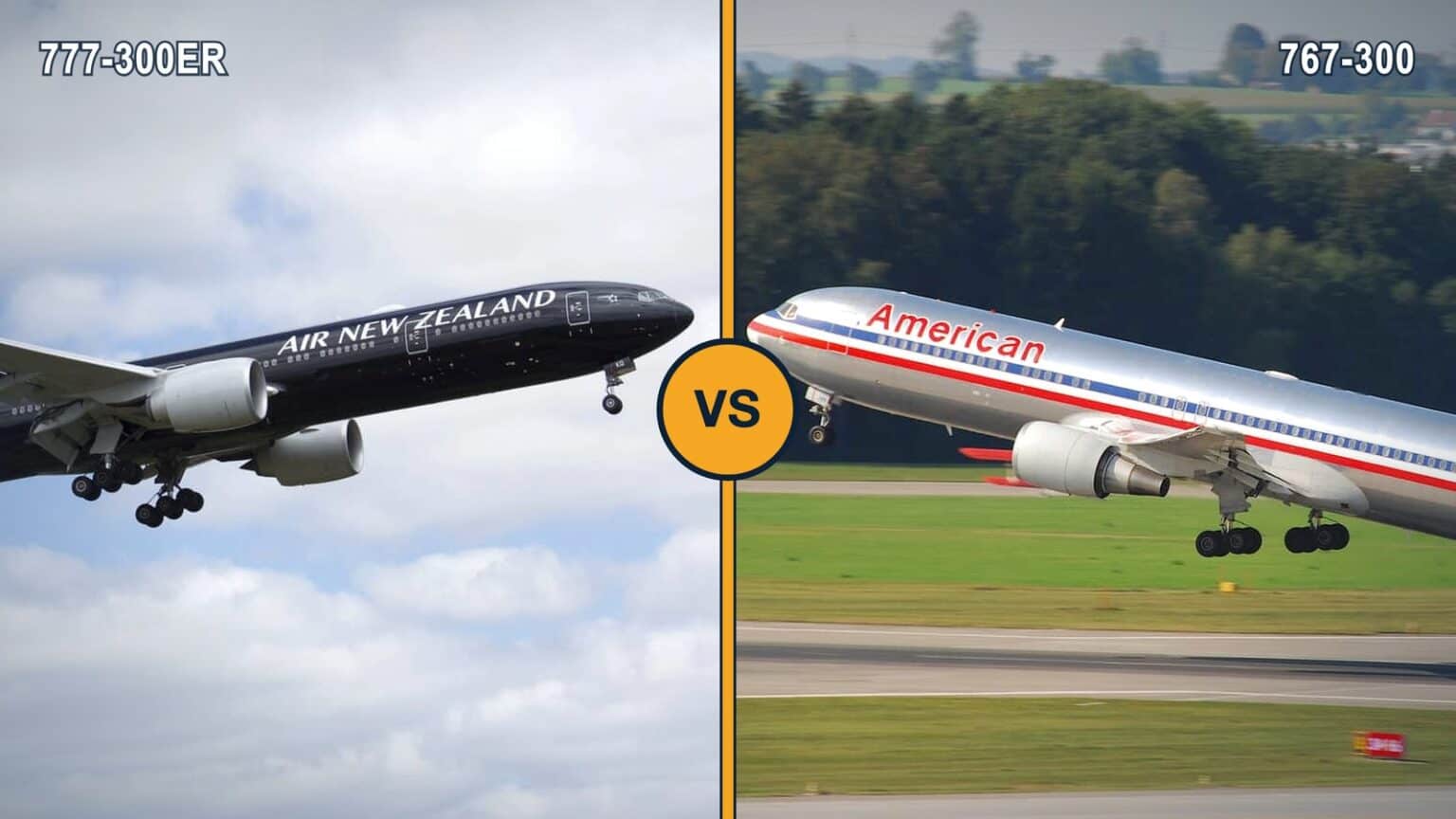
The panel above compares the Boeing 777-300ER with the base Boeing 767-300. The base -300 was built from 1986 to 2000, and Boeing delivered 104 of them. The aircraft most travelers mean by “the 767” is usually the 767-300ER, of which 583 were delivered. It shares the -300’s fuselage and wing but carries more fuel and flies much farther, so this page names which one it means wherever the difference matters.
Size: the 777 wins by a wide margin
Both aircraft are twin-engine, twin-aisle jets, and that is about where the resemblance ends. The 777-300ER is 242 ft 4 in (73.86 m) long. The 767-300 is 180 ft 3 in (54.94 m).
That is a difference of about 62 feet. The wings tell the same story, at 212 ft 7 in (64.80 m) against 156 ft 1 in (47.57 m).
The fuselage is wider too. The 777’s cabin is 19 ft 3 in (5.86 m) across, while the 767’s is 15 ft 6 in (4.72 m).
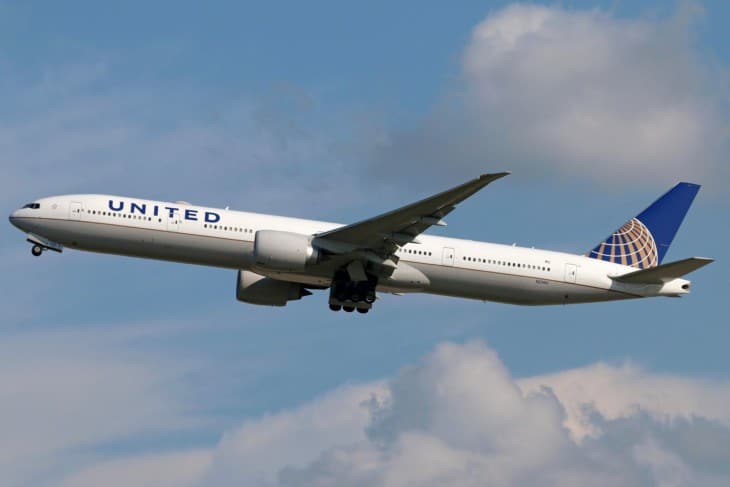
Weight is where the gap becomes dramatic. The 777-300ER has a maximum takeoff weight of 775,000 lb (351,500 kg). The 767-300 is certified at 350,000 lb (159,000 kg), less than half as much.
One twin family, two different jobs
The 777 was never meant to be a bigger 767. Boeing’s early plans in the 1970s included a trijet 767 variant that was later renamed 777, but airlines wanted a wider fuselage and more flexible interiors than any 767 stretch could give. By 1988 Boeing concluded that only a clean-sheet design would do, and the result was the twinjet 777.
Range: the 767-300ER narrows the gap
Here the variant you pick matters more than the family. The base 767-300 typically seats 269 passengers over 3,900 nautical miles (4,500 miles, 7,200 km).
The 767-300ER typically seats 218 in three classes and flies 5,980 nautical miles (6,880 miles, 11,070 km). It has more fuel tankage and a higher takeoff weight, but the same fuselage and wing.
The 777-300ER flies farther still. Boeing publishes 7,500 nautical miles (8,630 miles, 13,890 km), while Wikipedia’s specification block lists 7,370. Sources differ because range depends on the passenger load and reserves assumed.
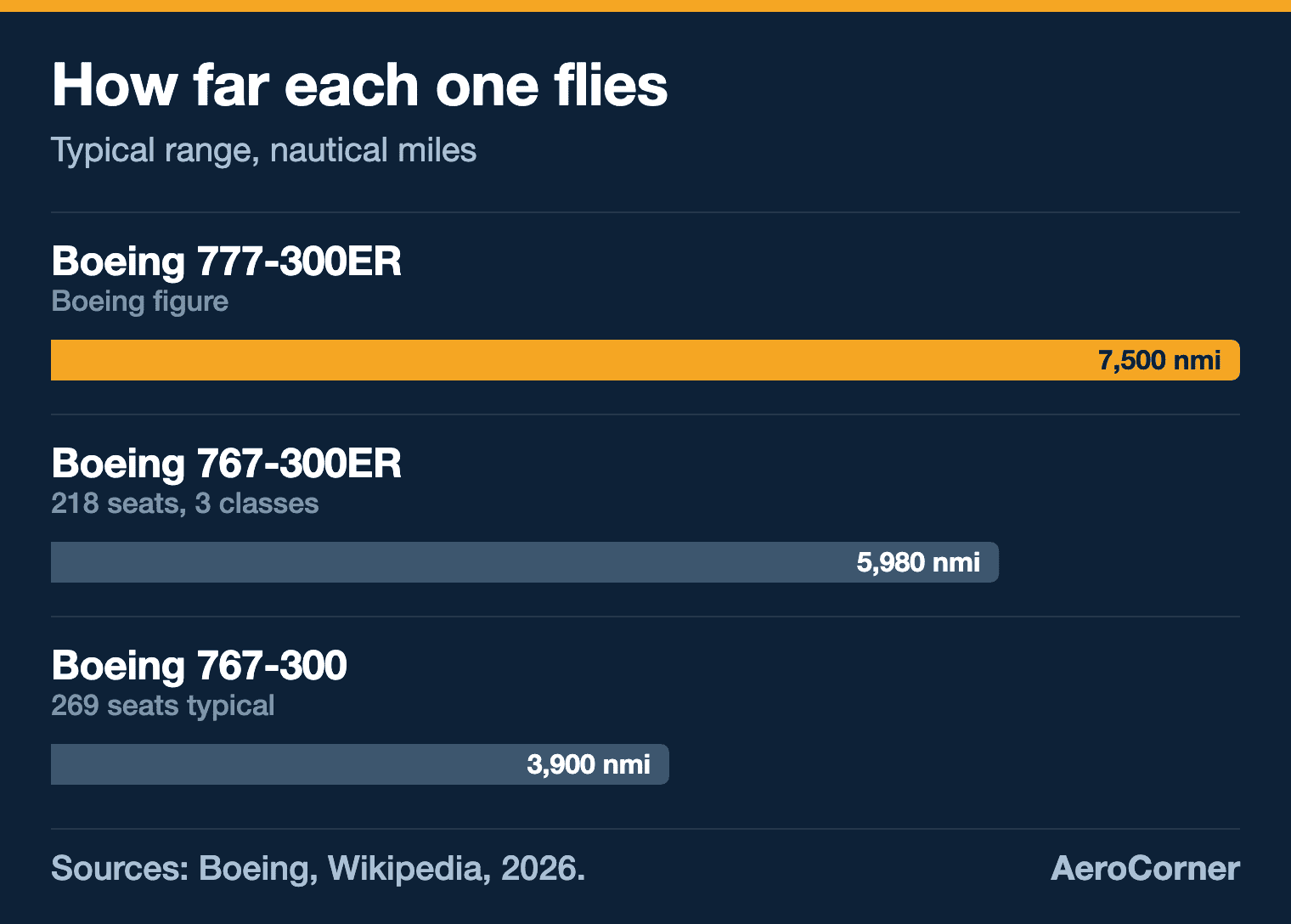
In practice, a 767-300ER can cross the Atlantic or the Pacific, and a 777-300ER can fly the longest routes in an airline’s network. For the very longest, see our ranking of the longest flights in the world.
Engines and power: one giant engine versus a mid-size one
The 777-300ER carries two General Electric GE90-115B turbofans, each rated at 115,300 lbf (513 kN). Each GE90-115B was the most powerful jet engine in service until the GE9X surpassed it.
The 767-300 offered airlines a choice of three engine families: Pratt & Whitney PW4000, General Electric CF6 or Rolls-Royce RB211. Thrust ranges from 48,000 to 60,600 lbf per engine, so the 777’s engines each push roughly twice as hard as the strongest 767 option.

That power is why the 777 became a replacement for four-engine jets. Airlines replaced comparable four-engine jets with the 777-300ER for its lower operating costs.
Capacity: how many people each carries
Seat counts depend on the airline, so treat any single number with care. Wikipedia gives a typical 365 passengers in three classes for the 777-300ER, while Boeing lists 350 to 425 in a two-class layout.
A 767-300ER typically seats 218 in three classes, which puts the 777 roughly 150 seats ahead in a like-for-like layout. Economy rows differ too: the 767’s cabin takes seven abreast, while the 777 can fit ten.
Which is more comfortable depends mostly on your airline’s seat map, not the aircraft type. The 777 does have the wider cabin, but it can fit ten abreast where the 767 fits seven, so the extra width is often spent on seats.
History: why the 767 mattered before the 777 existed
The 767 entered service with United Airlines on September 8, 1982. Its big break came from ETOPS, the rules that let twin-engine jets fly farther from a diversion airport.
A loosening of those rules starting in 1985 allowed the 767 to operate transatlantic flights. By the end of the 1990s, 767s crossed the Atlantic more often than all other aircraft types combined.

The 767-300 stretched the original by about 21 feet and carried roughly 20 percent more passengers. Japan Airlines took the first one in October 1986, and British Airways took the first RB211-powered 767, a -300, in 1990.
The 777 took that idea further. It was the first airliner to carry an ETOPS-180 rating when it entered service in 1995, which meant airlines could fly it on ocean routes from day one.
The 777-300ER arrived later. Air France launched it with an order for ten aircraft, the first flight came on February 24, 2003, and the first delivery followed on April 29, 2004.
Which is still being built?
Neither the 777-300ER nor the base 767-300 is. The last 777-300ER entered service in December 2024 with Ethiopian Airlines, after nearly five years in storage. It had been built for China Southern Airlines and first flew in January 2020.
The base 767-300 left production in 2000. The 767-300F freighter is the model still being built, which is why the design outlived its passenger sales.
The 777’s successor is the 777-9, and the 767’s is the 787 Dreamliner. For how the 777 stacks up against that Dreamliner, see our 777 vs 787 comparison, and for the 777X timeline, our report on the 777X delay.
How to tell them apart on the ramp
Start with the landing gear. The 777 has six wheels on each main landing gear, and the biggest tires ever used on a commercial jet.
Size is the next clue. The 777’s large-diameter engines and long fuselage dwarf the 767 on any shared apron.
The 777-300ER also has raked wingtips that add 12.8 ft (3.90 m) to each wing. A 767 has none unless an operator retrofitted blended winglets, which many 767-300ERs did.
The myth this page used to repeat
“The 767 and 777 are basically the same plane, just different sizes” is wrong. They share a manufacturer and a twin-engine layout, but the 777 is a clean-sheet design and Boeing’s first fly-by-wire airliner. It also has a much wider fuselage than the 767’s seven-abreast cabin.
For where both sit among the biggest passenger jets, see our ranking of the largest commercial airplanes.
FAQ
Sources and references used for research and fact-checking.
About the Author

Tim is the owner and lead editor of AeroCorner since 2019, overseeing aviation content covering aircraft, airlines, airports, and the broader aviation industry. Through years of researching, writing, editing, and publishing aviation-focused content, he has developed extensive practical knowledge of commercial aviation and air travel. Based in Asia and a frequent traveler himself, Tim also brings firsthand passenger experience to AeroCorner’s coverage. Outside of publishing, he has also explored aviation firsthand through hands-on flight training in New Zealand.