



Table of Contents
| Airbus A330-300 | Boeing 767-300 | |
|---|---|---|
| First flight | November 1992 | January 30, 1986 |
| Entered service | January 1994 (Air Inter) | October 20, 1986 (Japan Airlines) |
| Economy rows | Typically 8 abreast | Typically 7 abreast |
| Deliveries | 771 (as of December 2020) | 104 base -300 and 583 -300ER (as of September 2026) |
| Passenger production | Ended 2020 | Ended 2000; freighter still built |
Which variants this page compares
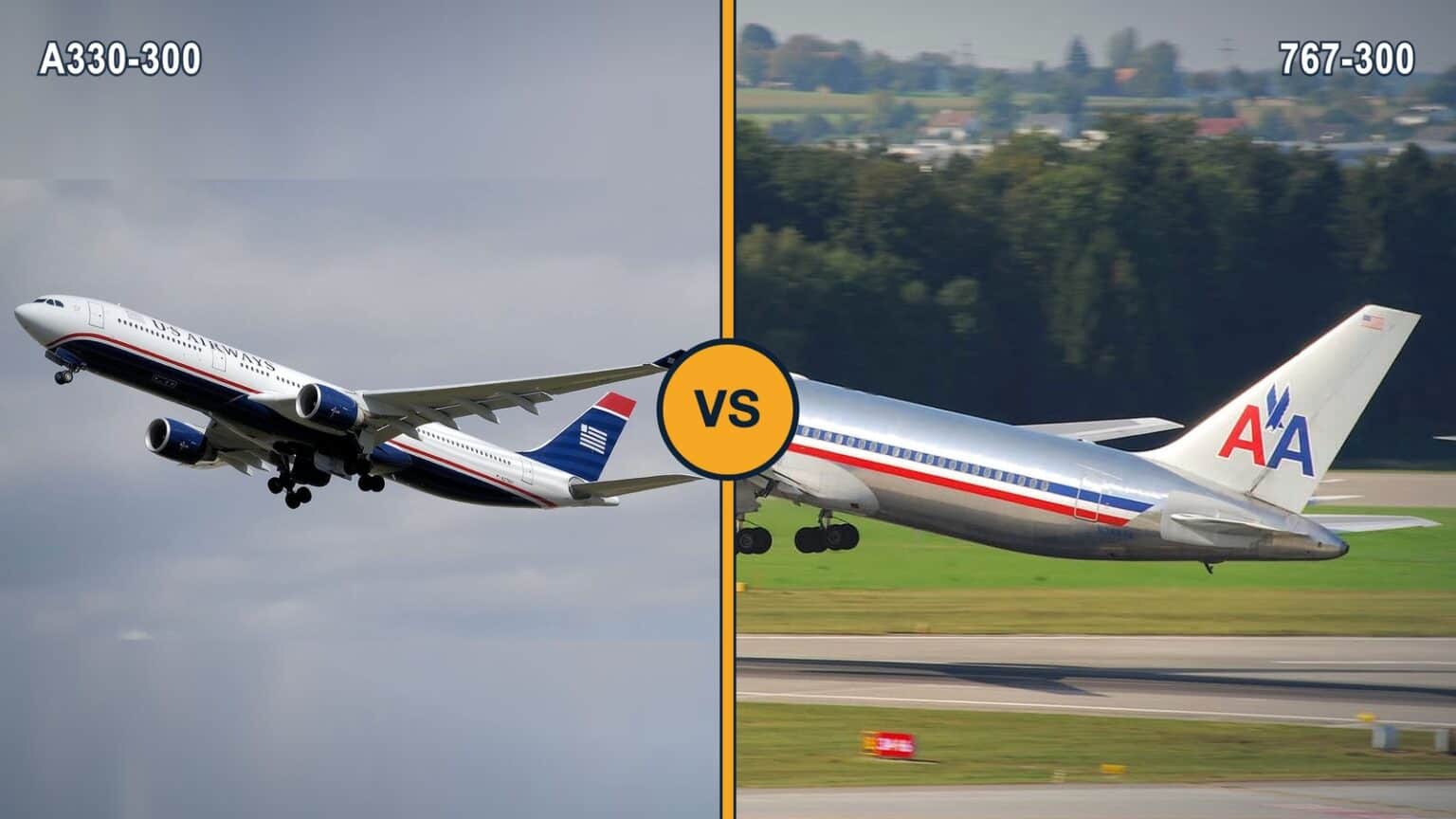
The panel above compares the Airbus A330-300 with the base Boeing 767-300. Many travelers mean the 767-300ER, which flies farther than the base -300 and carries the same fuselage and wing, so this page says which one it means wherever the difference matters.
Size: the A330-300 is longer and has a much wider wing
Both are twin-engine, twin-aisle jets, but the A330-300 is the bigger aircraft. The A330-300 is 208 ft 10 in (63.66 m) long. The 767-300 is 180 ft 3 in (54.94 m).
The wing gap is larger still. The A330-300 spans 197 ft 10 in (60.30 m) against 156 ft 1 in (47.57 m), and its fuselage is wider at 18 ft 6 in (5.64 m) against 16 ft 6 in (5.03 m).

Weight shows the size gap best. The A330-300 has a maximum takeoff weight of 534,000 lb (242,000 kg). The 767-300 is at 350,000 lb (159,000 kg).
Range: the A330-300 flies much farther
The A330-300 has a range of 6,350 nm (7,310 mi, 11,760 km). The base 767-300 manages 3,900 nm (4,490 mi, 7,220 km), with a typical 269-passenger layout.
The 767-300ER narrows the gap at 5,980 nm (6,880 mi, 11,070 km). It carries more fuel and has a higher takeoff weight, on the same fuselage and wing. Range depends on weight and seating, so a full, dense cabin flies shorter than the headline figure on either aircraft.
For the very longest flights, see our ranking of the longest flights in the world.
Engines and fuel: more thrust, a much bigger tank
The A330-300 offers three engine families: the General Electric CF6-80E1, the Pratt & Whitney PW4000 or the Rolls-Royce Trent 700. Each engine is rated at 71,100 lbf (316 kN).

The 767-300 offers the Rolls-Royce RB211-524H, General Electric CF6-80C2B or Pratt & Whitney PW4060, at 60,600 lbf (270 kN) each. The A330 carries far more fuel, at 36,750 gal (139,100 L) against 16,700 gal (63,200 L).
British Airways took the first RB211-powered 767-300 in February 1990. Months later, cracks in the engine pylons grounded its 767 fleet. Boeing redesigned the parts in 1991 and reinforced the pylons on every 767 in service.
Cabin and comfort: wider, but airlines decide
The A330-300 cabin is 17 ft 3 in (5.26 m) wide. The 767-300 cabin is 15 ft 6 in (4.72 m).
Airlines typically fit seven abreast in 767 economy and eight in the A330. So the extra width mostly goes into seats, and the better ride depends on the carrier’s seat map.

Which is better for passengers, the A330 or the 767?
It depends on the airline more than the aircraft. The A330 has the wider cabin, and the 767 has fewer seats across, so a 767 economy cabin can feel less crowded.
Business class is where the types differ most, and each carrier designs its own. Check the seat map before you book.
Payload and cargo
The A330-300 has 5,594 ft³ (158.4 m³) of baggage volume. The 767-300 has 4,029 ft³ (114.1 m³).
Maximum payload is 101,000 lb (45,900 kg) for the A330-300 against 88,000 lb (40,000 kg) for the 767-300. Airbus lists room for 33 LD3 containers under the A330 floor.
Speed and runway needs
The A330-300 has a maximum cruise speed of 470 kt (541 mph, 870 km/h). The 767-300 cruises at 459 kt (528 mph, 850 km/h), so the gap is small.
Takeoff distances are close at 9,100 ft (2,770 m) for the A330-300 and 9,200 ft (2,800 m) for the 767-300. On landing, the A330-300 needs 5,700 ft (1,730 m) against 5,900 ft (1,800 m).

Price: what each costs
The panel lists the A330-300 at $264.2 million (2015) and the 767-300 at $217.9 million (2019). These are catalog-style figures from different years, and airlines pay far less after discounts, so treat them as a rough guide.
History: two answers to the same market
Japan Airlines put the 767-300 into service in October 1986. It was the first stretch of the 767 and kept the 767-200 wings and engines, which kept development cost low.
Airbus built the A330 alongside the four-engine A340 and flew the A330-300 in November 1992. Air Inter, the launch operator, began service in January 1994. Airbus delivered the last A330-300 to Aer Lingus on 4 March 2020.
The 767 has outlived its passenger line as a freighter, and the A330 line moved to the neo. For a newer Boeing rival, see our 767 vs 787 comparison.
Production and second lives
Wikipedia, citing Airbus data, reports 779 A330-300 orders and 771 deliveries as of December 2020. Delta Air Lines is the largest operator of the A330 family, with 81 aircraft according to Wikipedia.
Boeing delivered 104 base 767-300s and 583 767-300ERs, plus 279 767-300F freighters as of September 2026. Many passenger 767-300s were converted to cargo, and Israel Aerospace Industries had converted 100 767-300ERs by February 2022.
The factory-built 767-300F can carry 52.7 tonnes over 3,225 nm. That freighter is why the 767 design stayed in production long after its passenger sales faded.
Verdict: which is the better aircraft?
The A330-300 is bigger, flies farther and carries more. The 767-300 is smaller, older and cheaper, and the 767-300ER is the closer rival on range.
If you are choosing a flight, pick the A330 for a wider cabin and the 767 for a seven-abreast economy layout. Then check the airline’s own seat map.
FAQ
Sources and references used for research and fact-checking.
About the Author

Tim is the owner and lead editor of AeroCorner since 2019, overseeing aviation content covering aircraft, airlines, airports, and the broader aviation industry. Through years of researching, writing, editing, and publishing aviation-focused content, he has developed extensive practical knowledge of commercial aviation and air travel. Based in Asia and a frequent traveler himself, Tim also brings firsthand passenger experience to AeroCorner’s coverage. Outside of publishing, he has also explored aviation firsthand through hands-on flight training in New Zealand.