


Table of Contents
| Boeing 787-9 | Boeing 767-300 | |
|---|---|---|
| First flight | September 17, 2013 | January 30, 1986 |
| Airframe | Mostly carbon-fiber composite | Mainly aluminum |
| Economy rows | Typically 9 abreast | Typically 7 abreast |
| Passenger production | Ongoing | Ended 2000; freighter still built |
| Best at | Long routes with a big load | Mid-size widebody service |
Which variants this page compares
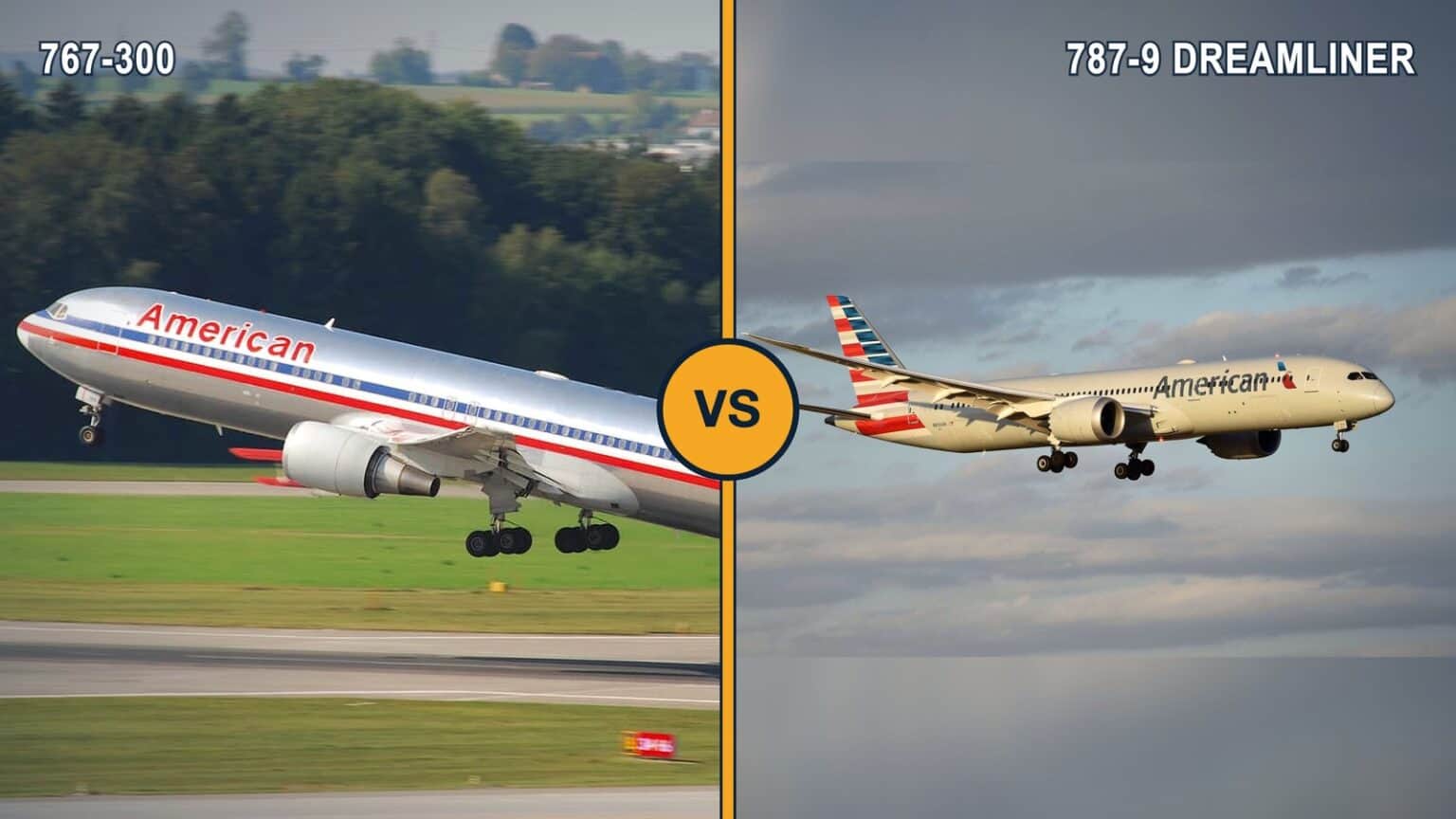
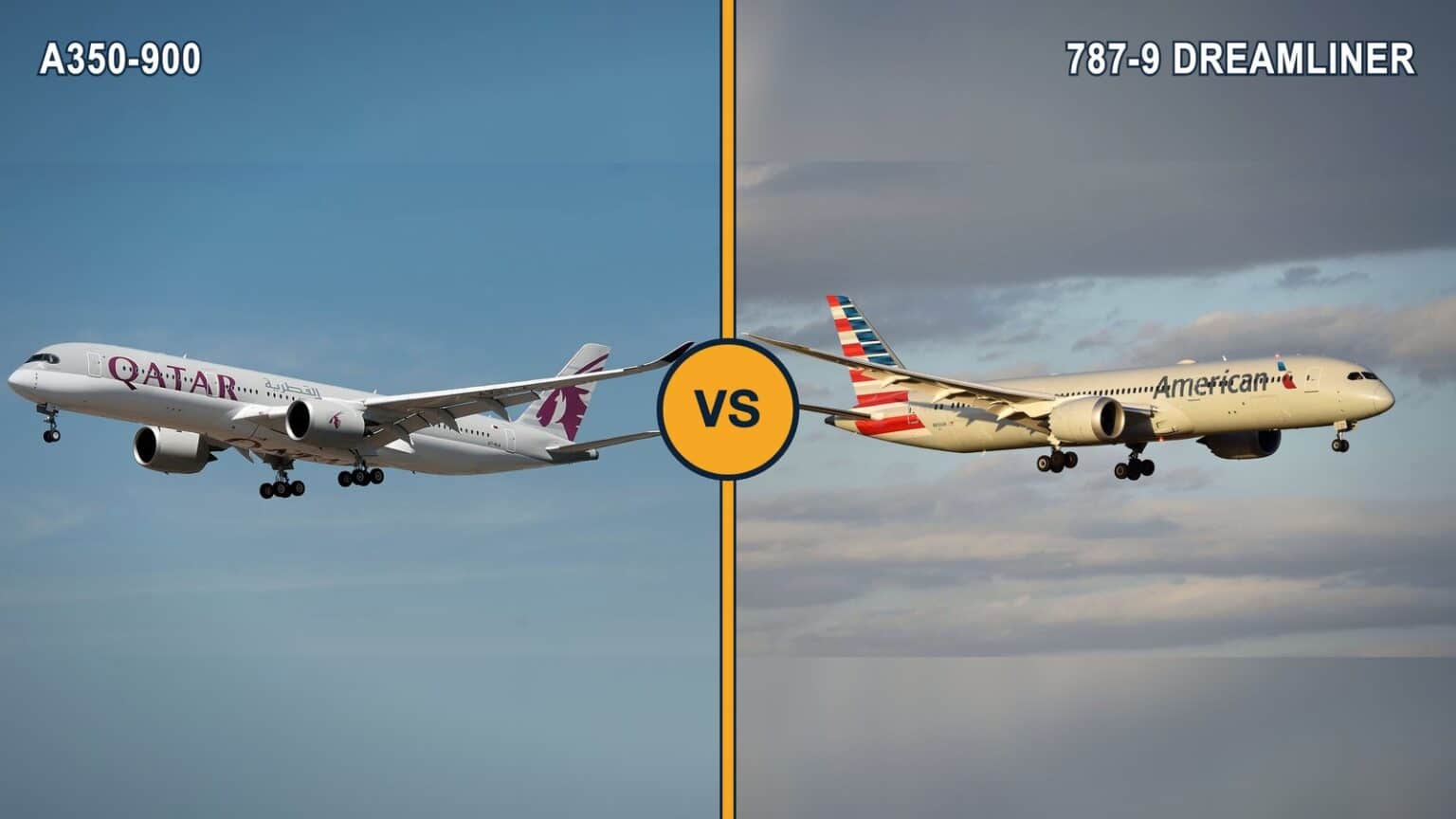
The panel above compares the Boeing 787-9 with the base Boeing 767-300. The 787-9 is the stretched Dreamliner and the most common long-haul version. The aircraft many travelers mean by “the 767” is often the 767-300ER, which flies farther than the base -300, so this page names which one it means wherever the difference matters.
Size: the 787-9 is longer, wider and far heavier
Both are twin-engine, twin-aisle jets, and the 787-9 is bigger in every direction. The 787-9 is 206 ft 1 in (62.81 m) long. The 767-300 is 180 ft 3 in (54.94 m).
The wing span is 197 ft 3 in (60.12 m) against 156 ft 1 in (47.57 m). The fuselage is wider too, at 18 ft 10 in (5.75 m) against 16 ft 6 in (5.03 m).
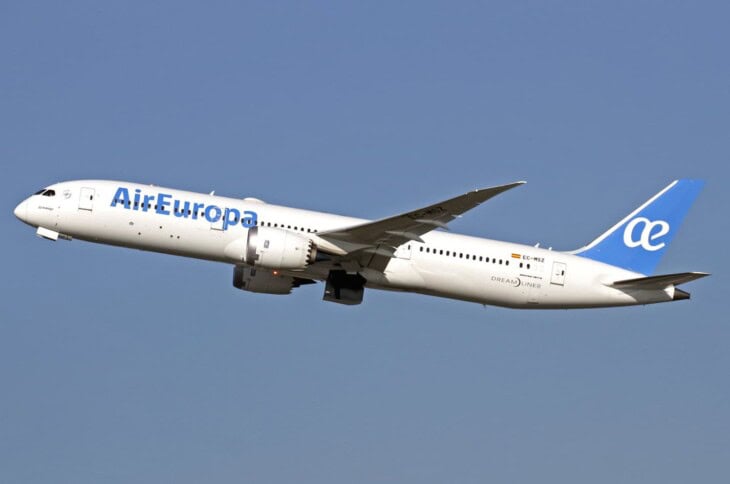
Weight shows the gap best. The 787-9 has a maximum takeoff weight of 571,000 lb (259,000 kg). The 767-300 is at 350,000 lb (159,000 kg).
Range: the 787 flies much farther
The 787-9 has a range of 8,300 nm (9,550 mi, 15,370 km). The base 767-300 manages 3,900 nm (4,490 mi, 7,220 km).
The 767-300ER narrows the gap at 5,980 nautical miles (6,880 miles, 11,070 km). It has more fuel and a higher takeoff weight, but the same fuselage and wing.
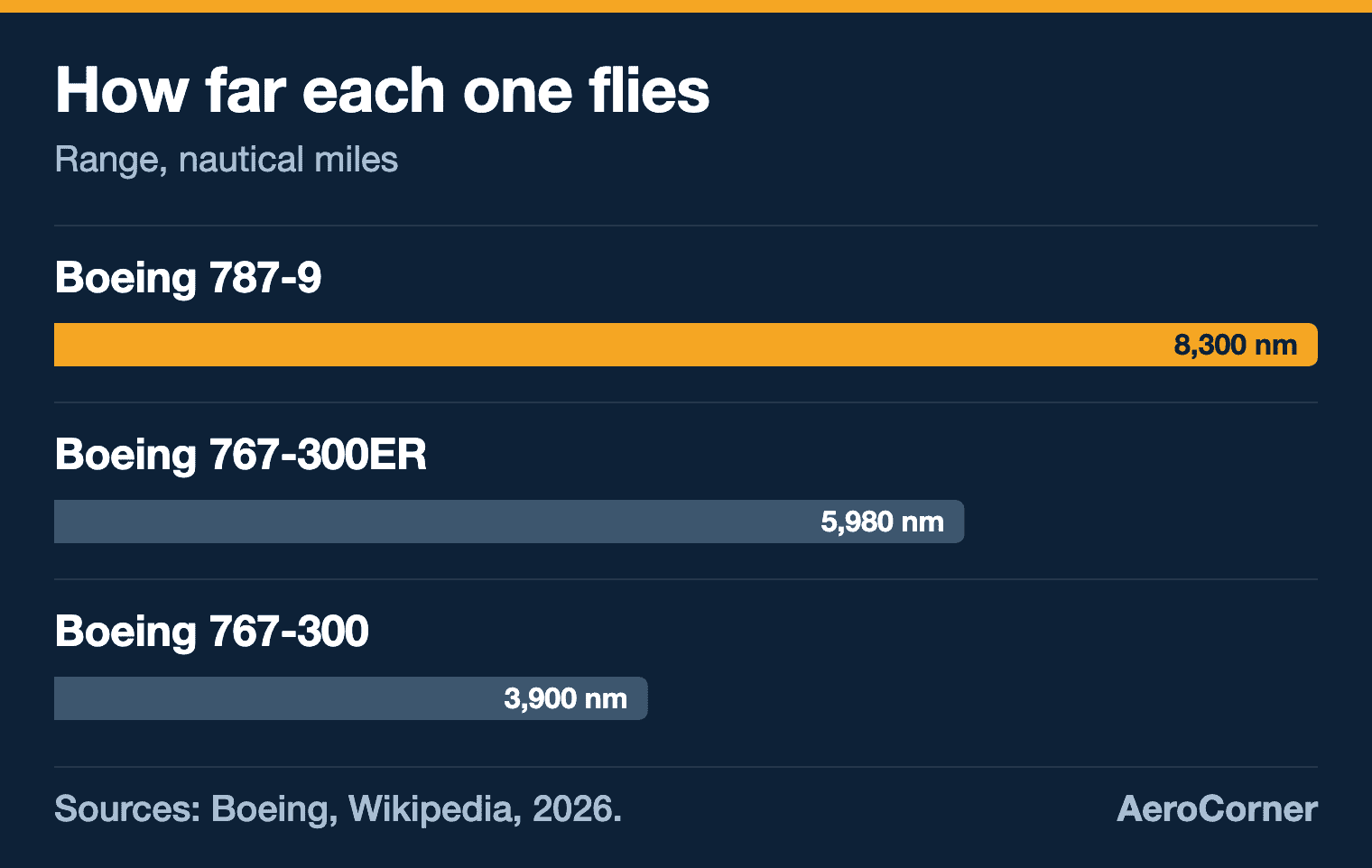
That range is why airlines use the 787 on routes a 767 cannot fly nonstop. For the very longest, see our ranking of the longest flights in the world.
Engines: more thrust, cleaner design
The 787-9 uses two General Electric GEnx-1B or Rolls-Royce Trent 1000 engines, rated at 71,000 lbf (316 kN) each. The 767-300 carries two Rolls Royce RB211-524H, General Electric CF6-80C2B or Pratt & Whitney PW4060 engines, at 60,600 lbf (270 kN) each.
The 787 pairs that thrust with a far larger fuel load. It holds 33,400 gal (126,400 L) against 16,700 gal (63,200 L) for the 767-300.
Materials: composite versus aluminum
The big technical change is the airframe. The 767 is mainly aluminum. Boeing built the 787 mostly from carbon-fiber composite, and that is a large part of its weight and fuel savings.

The 787 also has raked wingtips, while the 767-300 has no winglets in the panel. Some operators retrofitted blended winglets to 767s.
Cabin and comfort: wider, but airlines decide
The 787-9 cabin is 18 ft 0 in (5.49 m) wide. The 767-300 cabin is 15 ft 6 in (4.72 m).
Airlines fit about seven abreast in a 767 economy cabin and often nine in a 787. So the extra width is usually spent on seats, and the better ride depends on the carrier’s seat map.

Which is more comfortable, and which would you rather fly?
Many travelers prefer the 787 for its larger windows, higher cabin air pressure and lower noise. Those are Boeing’s design goals for it, and they are not guaranteed on every airline.
If you see a 767 on a route, a smaller, older cabin is the likely trade-off. For a sense of how it fits among the biggest passenger jets, see our ranking of the largest commercial airplanes.
Payload and cargo: the 787 carries far more
The 787-9 has 6,088 ft³ (172.4 m³) of baggage volume. The 767-300 has 4,029 ft³ (114.1 m³).
Maximum payload is 141,000 lb (64,000 kg) for the 787-9 against 88,000 lb (40,000 kg) for the 767-300. That extra belly space is a big reason airlines value the 787 on long routes that also carry freight.
Speed and runway needs
The 787-9 cruises at 488 kt (562 mph, 904 km/h). The 767-300 cruises at 459 kt (528 mph, 850 km/h), so the gap is modest.
Both list a takeoff distance of 9,200 ft (2,800 m). On landing, the 787-9 needs 5,000 ft (1,520 m) against 5,900 ft (1,800 m) for the 767-300.
Price: what each costs
The panel lists the 787-9 at $292.5 million (2020) and the 767-300 at $217.9 million (2019). These are catalog-style figures from different years, and airlines pay far less after discounts, so treat them as a rough guide only.
History: why the 787 followed the 767
The 767 first flew in 1981 and entered service with United on September 8, 1982. It was the first widebody twinjet to cross the Atlantic routinely once ETOPS rules loosened.
The 787 was designed decades later as a long-range, fuel-efficient replacement. It first flew in 2009, and the stretched 787-9 followed in 2013.

The 767 did not disappear. The 767-300F freighter is still built, and the type is the base of the KC-46 tanker.
How to tell a 767 from a 787
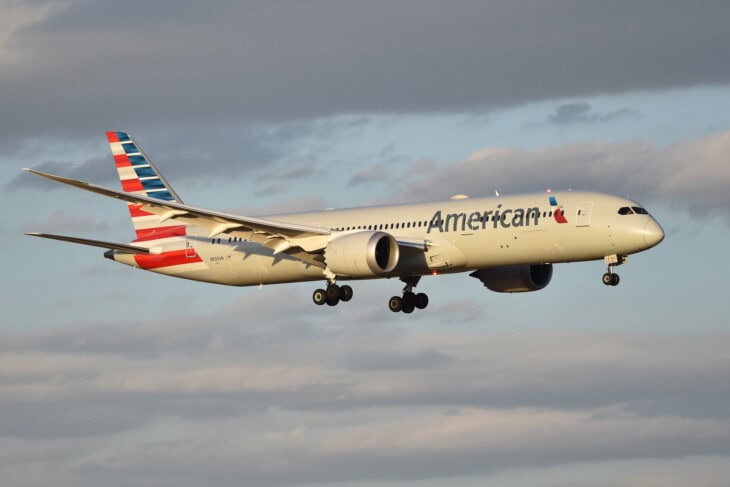
Look at the engine nacelles first. The 787’s have a scalloped, sawtooth edge at the back, and the 767’s are plain.
The 787 also has a long, flexing, raked wing and a sloping nose with large windows. The 767 has a shorter, straighter wing and a rounder nose.
Which one wins?
The 787-9 wins on size, range, payload, cabin width and cargo space. It is the better choice for any long route with a full load.
The 767-300 wins on one thing: it is smaller and cheaper to buy. That suits a route that needs a widebody but not 8,300 nm of range or the extra seats.
For most passengers the answer is simple. If you can pick, the 787-9 is usually the roomier and quieter flight, and the 767 is the aircraft you will meet on older, shorter widebody routes.
The myth this page used to repeat
“The 787 is just a new 767” is wrong. The 787 is a clean-sheet composite airliner with a much wider cabin, and the two share only a manufacturer and a twin-engine layout.
FAQ
Sources and references used for research and fact-checking.
About the Author

Tim is the owner and lead editor of AeroCorner since 2019, overseeing aviation content covering aircraft, airlines, airports, and the broader aviation industry. Through years of researching, writing, editing, and publishing aviation-focused content, he has developed extensive practical knowledge of commercial aviation and air travel. Based in Asia and a frequent traveler himself, Tim also brings firsthand passenger experience to AeroCorner’s coverage. Outside of publishing, he has also explored aviation firsthand through hands-on flight training in New Zealand.