

Table of Contents
Listen to a recorded airport weather broadcast in Florida and you will hear something like “Information Lima, time one seven five three Zulu.” Read a weather report on a pilot’s tablet in Denver and the timestamp ends in a Z.
It is not Florida time or Denver time. It is the same clock a pilot in Tokyo, Nairobi or London is reading at that exact moment.
That clock is Zulu time. Here is what it is, where the odd name comes from, why aviation refuses to run on anything else, and how to turn it into the time on your own wall.
What Is Zulu Time?
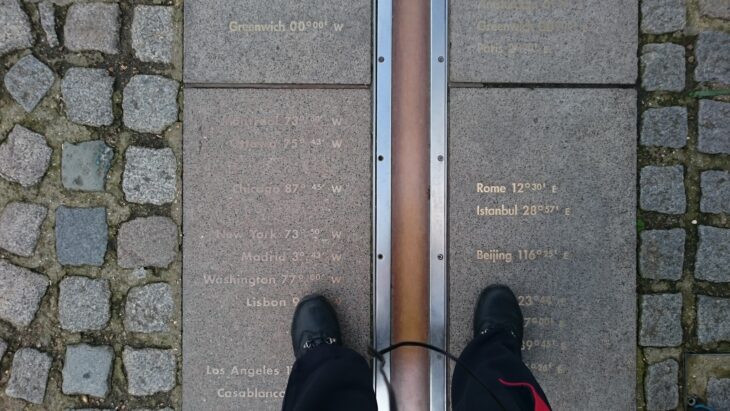
Zulu time is Coordinated Universal Time, or UTC: the time at the prime meridian, 0 degrees longitude, which runs through Greenwich in London. Pilots and controllers say “Zulu” because UTC’s time zone letter is Z, and Zulu is the NATO phonetic alphabet word for Z.
The FAA puts it plainly in its pilot manual: it “uses Coordinated Universal Time (UTC) for all operations,” and “the term ‘Zulu’ may be used to denote UTC.” Zulu never springs forward or falls back, and it is written as four digits on a 24-hour clock, so 1753Z is 5:53 p.m. UTC.
Zulu time at a glance
Zulu time = UTC = the time at 0 degrees longitude. Written with a Z (1753Z), spoken digit by digit (one seven five three Zulu). No daylight saving time, ever. In the US, add 4 hours to Eastern Daylight Time or 5 hours to Eastern Standard Time to get Zulu.
Why “Zulu”? The world is lettered A to Z
The name is older than jet travel. According to the National Institute of Standards and Technology (NIST), nautical time zones were being referred to by letters from the 1920s, and the zone at the “zero” meridian got the letter Z.
NATO first distributed the scheme in a 1950 note, and it survives today as the military time zones. Going east from Greenwich, the letters run A to M. Going west, they run N to Y.
The two halves meet at the International Date Line, where zone M and zone Y share the same clock time but sit a full calendar day apart.
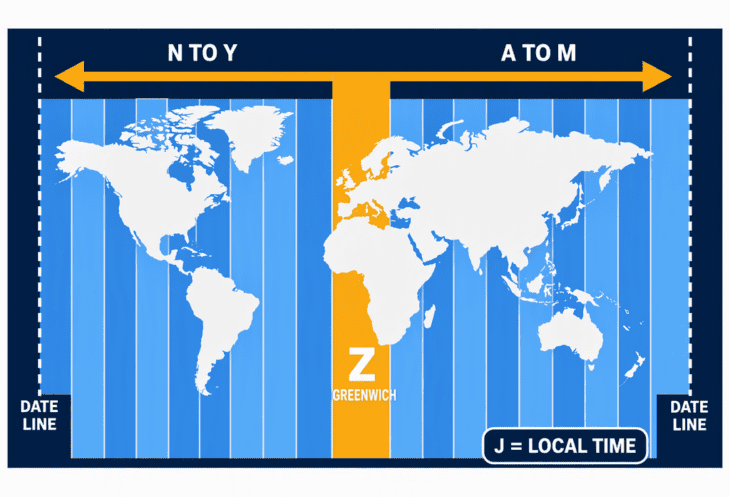
One letter is missing from the sequence. J, or Juliett, was originally left out, and it is now used to mean the observer’s own local time. The US Eastern time zone in winter is R, so 6 a.m. in New York in January is written 0600R, or “zero six hundred Romeo.”
The same Z now reaches far beyond aviation. The international date and time standard ISO 8601 marks a UTC timestamp with a trailing Z, as in 2026-09-28T17:53:00Z, and that suffix is sometimes called “Zulu time” too, because it is the same letter.
Why pilots can’t just use local time
An airliner can cross several time zones in a single flight. If every departure, arrival, weather report and clearance were stamped in the local time of wherever it was written, every one of them would need converting before anyone could compare them.
Take New York to London. AeroCorner’s JFK to Heathrow flight time estimate is 7 hours 30 minutes over 3,442 miles (5,540 km). Leave JFK at 6:30 p.m. on a summer evening and you land at 7:00 a.m. the next morning, London time.
On the two local clocks, 12 and a half hours have passed. In Zulu, the flight left at 2230Z and landed at 0600Z, and the arithmetic takes no thought at all. That is the whole point.
Daylight saving time makes local clocks even less reliable, because countries do not switch on the same day. The US moves its clocks on the second Sunday of March and the first Sunday of November. The UK moves on the last Sunday of March and the last Sunday of October.
In 2026, that meant New York sat four hours behind London instead of the usual five from March 8 to March 29, and will again from October 25 to November 1. Arizona and Hawaii skip daylight saving altogether. Zulu ignores all of it.
The Zulu day ends before dinner
Because the Zulu date rolls over at midnight UTC, it changes at 8 p.m. in New York during daylight saving time and at 5 p.m. in Los Angeles. A pilot flying an evening departure from the West Coast is often flying on tomorrow’s date before the wheels leave the ground.
That is why so much of aviation is stamped in Zulu. A METAR weather report opens with a group like 281153Z, meaning the 28th of the month at 11:53 UTC. The ATIS broadcast at a towered airport gives its observation time in Zulu, and the North Atlantic track system publishes its daily routes against the UTC clock.
Controllers read times as four separate digits. The FAA’s controller handbook gives 0715 UTC, which is 1:15 a.m. Central Standard Time, as “zero seven one five.” When a controller gives a time check, it is rounded to the nearest quarter minute.
How to convert Zulu time to US time
The FAA’s own table works from standard time: add 5 hours to Eastern Standard Time to get UTC, 6 to Central, 7 to Mountain, 8 to Pacific, 9 to Alaska and 10 to Hawaii. During daylight saving time, each gap shrinks by an hour, because Zulu does not move.
Going the other way, subtract. Here is what the clock says across the US when it is midnight Zulu, 0000Z.
| US time zone | Standard time | Daylight time | Local time at 0000Z |
|---|---|---|---|
| Eastern | UTC minus 5 | UTC minus 4 | 7 p.m. (8 p.m. in summer) |
| Central | UTC minus 6 | UTC minus 5 | 6 p.m. (7 p.m. in summer) |
| Mountain | UTC minus 7 | UTC minus 6 | 5 p.m. (6 p.m. in summer) |
| Pacific | UTC minus 8 | UTC minus 7 | 4 p.m. (5 p.m. in summer) |
| Alaska | UTC minus 9 | UTC minus 8 | 3 p.m. (4 p.m. in summer) |
| Hawaii | UTC minus 10 | No daylight time | 2 p.m. all year |
So the Florida broadcast from the opening, time 1753 Zulu, was 1:53 p.m. local time if it aired in summer, or 12:53 p.m. in winter. The Zulu figure itself never needs that footnote.
Zulu time vs. GMT: close, but not the same thing
Myth: Zulu time is just London time
For about seven months of every year, it isn’t. The UK moves to British Summer Time, one hour ahead, from the last Sunday in March to the last Sunday in October. A meeting set for 1500 Zulu in summer happens at 4 p.m. in London, not 3 p.m.
People often use Zulu, UTC and Greenwich Mean Time as synonyms. For a pilot’s purposes they are close enough, but they are not the same clock.
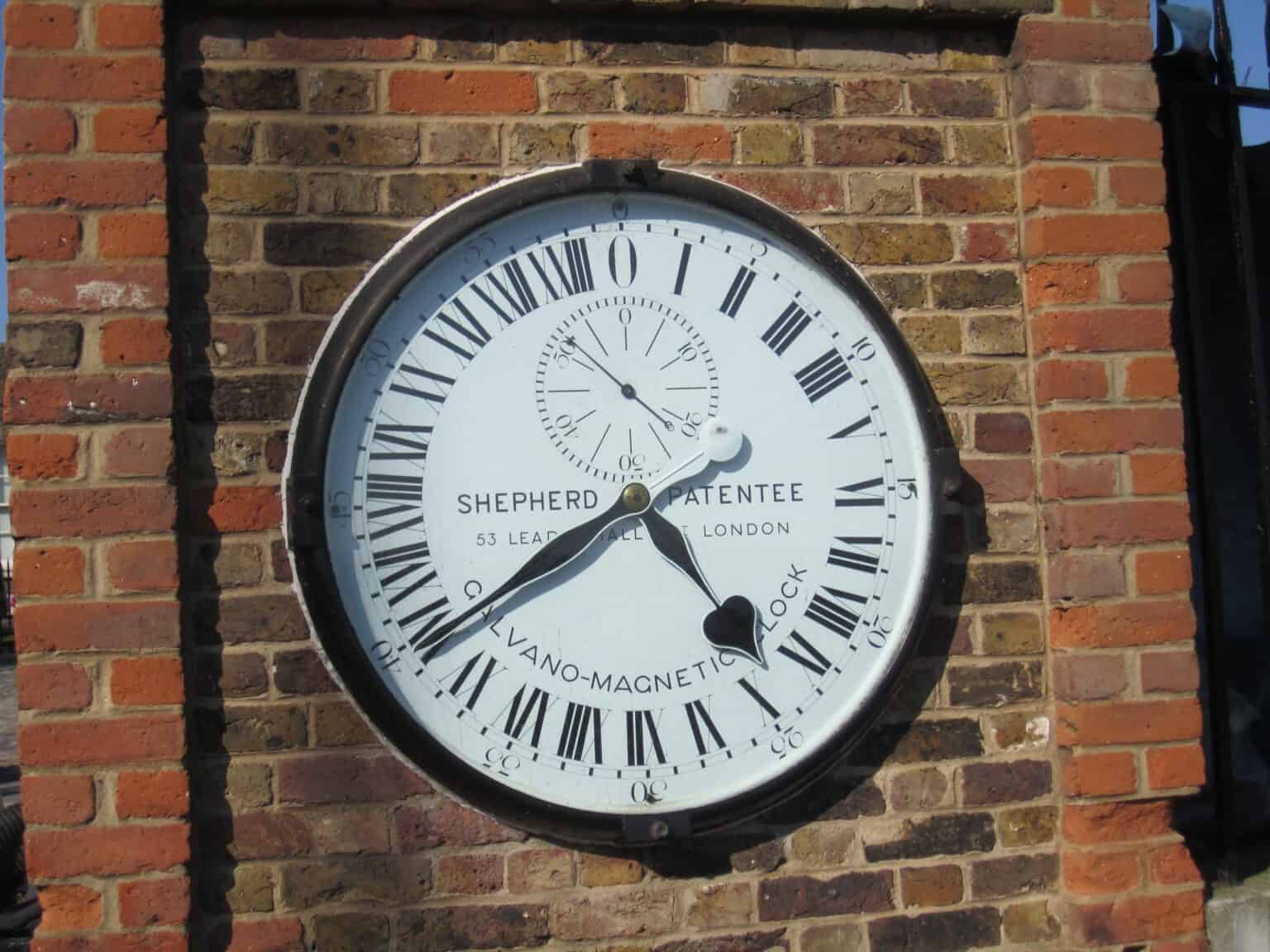
GMT began as the mean solar time measured at the Royal Observatory in Greenwich, and from 1884 until 1972 it was the world’s standard for civil time. It followed the Earth’s rotation, which is not perfectly steady. Today GMT is mostly the name of a time zone, the one Britain uses in winter.

UTC is kept by atomic clocks. NIST describes it as a “paper” time scale, calculated after the fact from the weighted average of more than 300 atomic clocks in more than 60 laboratories. National labs such as NIST and the US Naval Observatory run real-time versions that are often within a few billionths of a second of it.
Even the abbreviation is a diplomatic compromise. In English, Coordinated Universal Time would be CUT; in French, temps universel coordonné would be TUC. The International Telecommunication Union chose UTC so that neither language was favored.
The leap second, and why aviation won’t miss it
Because atomic time and the Earth’s rotation drift apart, UTC has been nudged back into line with leap seconds since 1972. There have been 27 of them, all extra seconds, with the most recent inserted on December 31, 2016.
Airlines have felt them. When a leap second was added at midnight UTC on June 30, 2012, it tripped a Linux bug that took the Amadeus Altéa reservation system offline for about an hour. Staff at Qantas and Virgin Australia had to check passengers in by hand, and flights were delayed.
The leap second may now be on its way out. The timeline below shows how the world’s clock got here.
1884
Greenwich becomes zero. The Greenwich meridian is recommended as the prime meridian of the world, and GMT becomes the international standard of civil time.
1920s
Time zones get letters. Nautical time zones start being referred to by alphabetic characters, with Z at the zero meridian.
1950
NATO standardizes the letters. A NATO note sets out the lettered zones for expressing date and time in military messages.
1972
Leap seconds begin. UTC replaces GMT as the world’s time standard and starts adding leap seconds to stay in step with the Earth.
2016
The last leap second. The 27th leap second is added on December 31. The Earth has since been spinning slightly faster.
2022
A deadline is set. The General Conference on Weights and Measures decides the allowed gap between UTC and the Earth’s rotation will be widened in or before 2035.
October 2026
A vote on ending it sooner. Timekeepers are due to vote on a proposal to replace the leap second with a far rarer leap hour as early as 2027.
The urgency comes from a problem nobody has faced before. With the Earth spinning faster, a negative leap second, one taken away rather than added, has become possible. Patrizia Tavella, who leads the time department at the International Bureau of Weights and Measures, told Scientific American that waiting until 2035 carried an estimated 30 percent risk of one.
For pilots, none of this changes the clock on the panel. Zulu is whatever UTC says, and letting UTC drift a little further from the sun makes no difference to a flight plan.
So the next time a weather broadcast says “one seven five three Zulu,” you know what is really going on. Somewhere on the far side of the world, another pilot is looking at a clock that reads exactly the same.
Sources and references used for research and fact-checking.
- Federal Aviation Administration, Aeronautical Information Manual, Chapter 4 Section 2: Radio Communications Phraseology and Techniques (4-2-12, Time)
- Federal Aviation Administration, Order JO 7110.65, Air Traffic Control, Chapter 2 Section 4: Radio and Interphone Communications
- National Institute of Standards and Technology, How is UTC(NIST) related to Coordinated Universal Time (UTC)?
- National Institute of Standards and Technology, Leap Seconds FAQs
- National Institute of Standards and Technology, Daylight Saving Time
- GOV.UK, When do the clocks change?
- Royal Museums Greenwich, Greenwich Mean Time (GMT)
- Wikipedia, Military time zone
- Wikipedia, ISO 8601
- Wikipedia, Coordinated Universal Time
- SKYbrary, Coordinated Universal Time (UTC)
- Flightradar24, Zulu and UTC: the story behind aviation's time zone
- International Bureau of Weights and Measures (BIPM), Resolution 4 of the 27th CGPM (2022): On the use and future development of UTC
- Scientific American, International timekeepers to vote on changing the leap second to a leap hour
- The Register, Leap second bug cripples Linux servers at airlines, Reddit, LinkedIn
- iTnews, Qantas outage pinpointed on leap second Linux bug
- Tech Times, Earth rotation records spur October vote to avert negative leap second
Get the Newsletter
The latest aviation news and stories sent to your inbox.
About the Author

Tim is the owner and lead editor of AeroCorner since 2019, overseeing aviation content covering aircraft, airlines, airports, and the broader aviation industry. Through years of researching, writing, editing, and publishing aviation-focused content, he has developed extensive practical knowledge of commercial aviation and air travel. Based in Asia and a frequent traveler himself, Tim also brings firsthand passenger experience to AeroCorner’s coverage. Outside of publishing, he has also explored aviation firsthand through hands-on flight training in New Zealand.