

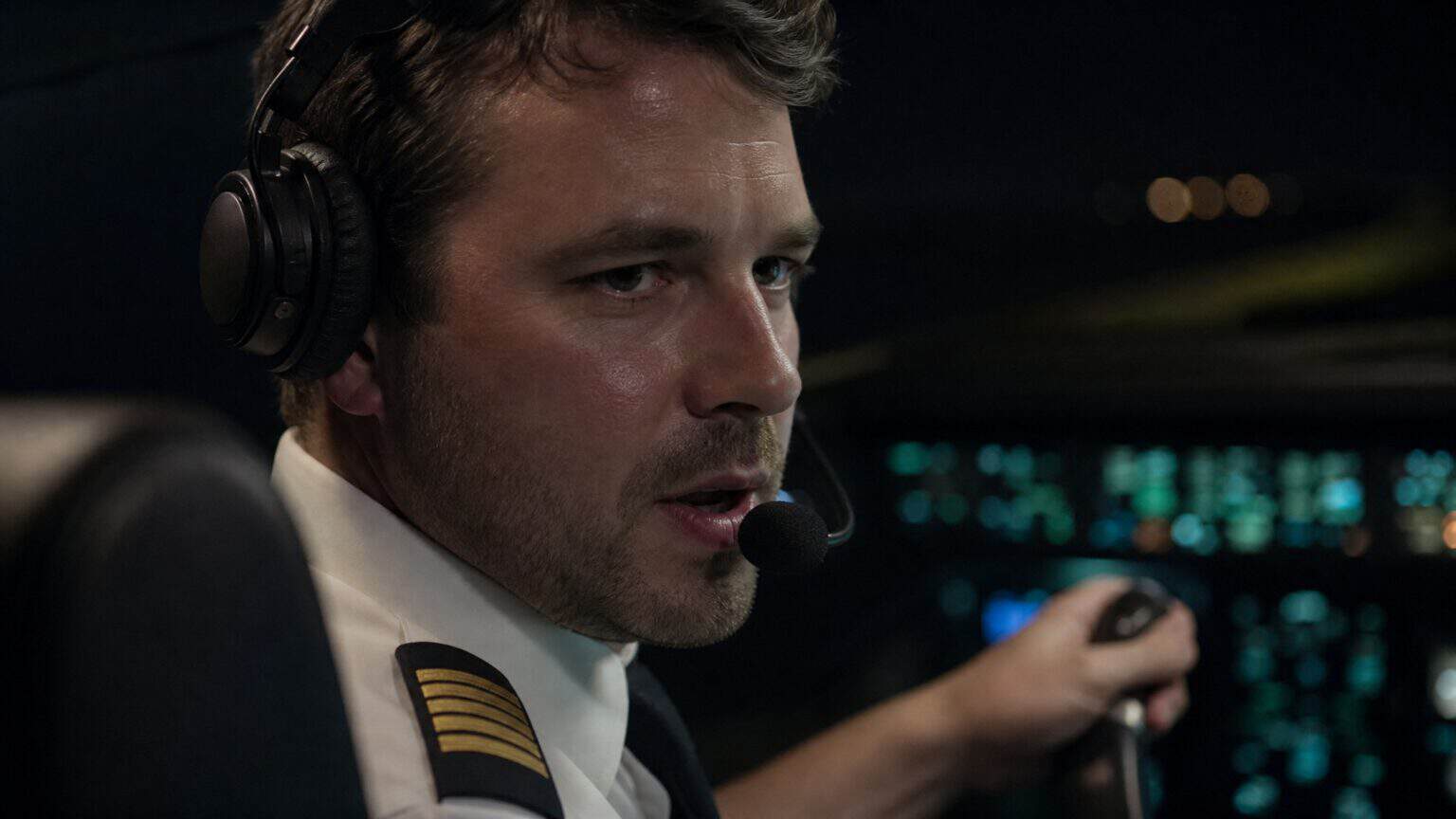
A pilot calls the tower and says “November Eight Two Four Charlie Papa.” Nobody on the frequency thinks that is a strange way to talk. It is the only way to say N824CP and be certain the controller writes down the same six characters you meant.
Most people know the words. Alfa, Bravo, Charlie, Delta. Far fewer know that the list is not a bit of military flavour, and that essentially none of it was chosen because it sounded good.
Every word survived years of laboratory testing across dozens of languages. Two of them are spelled wrong on purpose. Five more were thrown out after failing in the field. Here is the full chart, and the reason each word is the word.
NATO Phonetic Alphabet: Full Chart and Why It Exists
The alphabet exists because single letters are the least reliable sound in human speech, and a radio is the worst place to say one. Replacing each letter with a distinct multi-syllable word gives the listener several chances to get it right instead of one.
The version in use today was finalised by the International Civil Aviation Organization and took effect on 1 March 1956. It has not changed since.
The short version
The 26 code words are the ICAO International Radiotelephony Spelling Alphabet, finalised on 1 March 1956 and unchanged for 70 years. Each word had to be a real word in English, French and Spanish, start with the letter it stands for, survive a noisy radio, and carry no offensive meaning anywhere. Alfa and Juliett are deliberately misspelled so that non-English speakers pronounce them correctly.
| Letter | Code word | Said as |
|---|---|---|
| A | Alfa | AL-fah |
| B | Bravo | BRAH-voh |
| C | Charlie | CHAR-lee |
| D | Delta | DELL-tah |
| E | Echo | ECK-oh |
| F | Foxtrot | FOKS-trot |
| G | Golf | GOLF |
| H | Hotel | hoh-TELL |
| I | India | IN-dee-ah |
| J | Juliett | JEW-lee-ETT |
| K | Kilo | KEY-loh |
| L | Lima | LEE-mah |
| M | Mike | MIKE |
| N | November | no-VEM-ber |
| O | Oscar | OSS-cah |
| P | Papa | pah-PAH |
| Q | Quebec | keh-BECK |
| R | Romeo | ROW-me-oh |
| S | Sierra | see-AIR-rah |
| T | Tango | TANG-go |
| U | Uniform | YOU-nee-form |
| V | Victor | VIK-tah |
| W | Whiskey | WISS-key |
| X | X-ray | ECKS-ray |
| Y | Yankee | YANG-key |
| Z | Zulu | ZOO-loo |
Why B, D and E Sound Identical Over a Radio
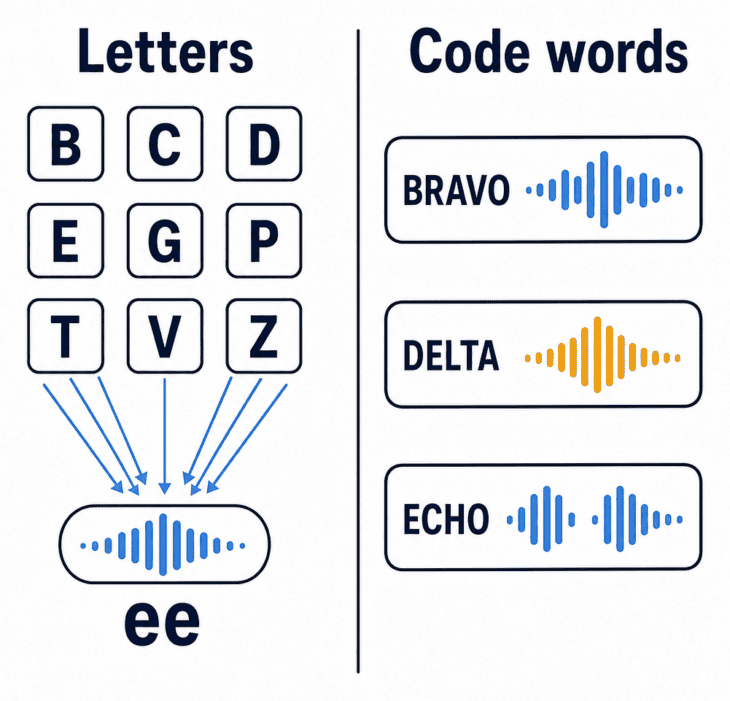
Say B, C, D, E, G, P, T, V and Z out loud. Every one of them is the same vowel, “ee”, with a very short consonant tacked on the front.
That consonant is where all the information lives, and it is the fragile part. It lasts a few hundredths of a second and sits in the higher frequencies, which are exactly what a compressed VHF radio channel, a headset, engine noise and static chew up first.
What survives is the long, loud vowel, which is the part that is identical across all nine letters. The listener hears “ee” and has to guess.
“Bravo” and “Delta” have no such problem. They differ in their consonants, their vowels, their number of syllables and their stress pattern, so damaging any one of those still leaves the other three intact.
That redundancy is the whole design. It is why controllers reach for the alphabet the moment a frequency gets busy or a signal gets weak, and why they use a separate scale to report how clearly they are hearing you, which is where the phrase five by five comes from.
The same logic drives the rest of radio phraseology. Short, fixed, unmistakable words beat natural speech every time, which is how you end up with a single word like wilco standing in for “I have received your message and I will comply with it.”
The Numbers Got Rewired Too
Digits do not get replacement words, because there is no shortage of confusion-free numbers. Instead, four of them get a deliberately mangled pronunciation.
| Number | Said as | Why |
|---|---|---|
| 3 | TREE | Stops it being heard as “sri” by speakers who struggle with the “th” sound |
| 4 | FOW-er | Adds a syllable so it cannot collapse into “for” |
| 5 | FIFE | The hard “f” ending keeps it clear of “fire” |
| 9 | NIN-er | Adds a syllable so it is never mistaken for the German “nein” |
“Niner” is the one everybody notices, and the reason is usually told as a joke. It is not. Postwar aviation put German, Dutch and English speakers on the same frequencies, and “nine” and “nein” are close enough to be dangerous when one of them means a heading and the other means no.
Alfa and Juliett Are Misspelled on Purpose
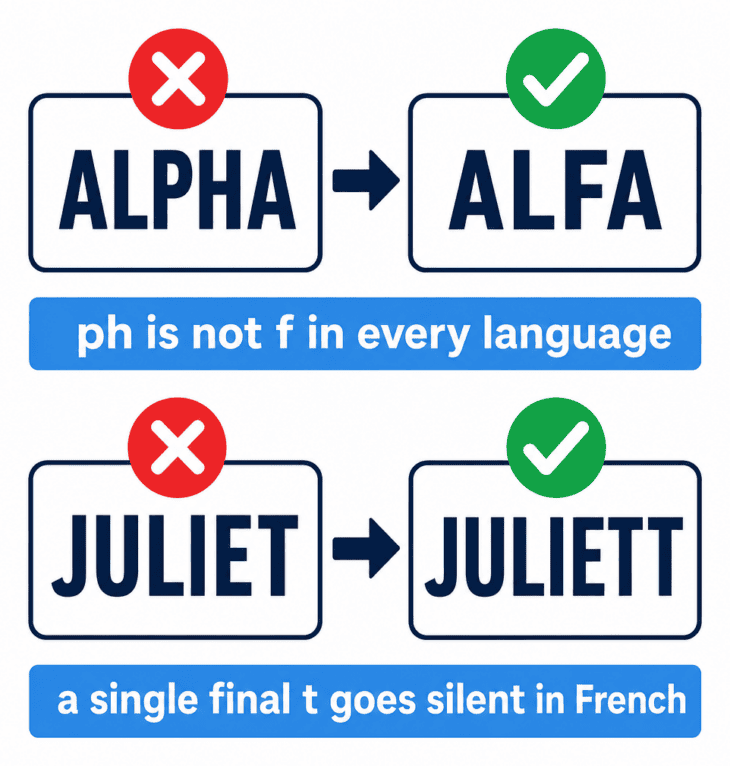
The official spellings are Alfa and Juliett. Not Alpha. Not Juliet. Both are corrections aimed at readers who do not speak English.
“Alpha” only reads as “AL-fah” if you already know the English convention that “ph” makes an “f” sound. A Spanish or Italian speaker reading it cold does something else with those two letters. Spelling it Alfa removes the ambiguity entirely.
“Juliett” is the same fix for French. French orthography treats a single final “t” as silent, so “Juliet” invites a French speaker to say “JEW-lee-ay”. Doubling the consonant is the standard French signal to voice it.
These are not typos that stuck. They are the visible edge of the design brief that Jean-Paul Vinay, a linguistics professor at the Université de Montréal, drew up with ICAO’s language section between 1948 and 1949.
Each word had to be a genuine, living word in English, French and Spanish, spelled similarly in all three, and beginning with the letter it represented.
It also had to be easy for any speaker to pronounce and recognise, it had to survive a radio, and it had to be free of any association with an objectionable meaning in any of those languages. That last criterion quietly rules out a lot of otherwise excellent words.
Almost everyone spells it wrong
Alfa and Juliett are the correct ICAO spellings, and they are misspelled constantly, including in military and government material. NATO and the FAA also depart from ICAO on X, printing it as one word, Xray, so that nobody reads the hyphen as a pause and says two separate things.
The Words That Did Not Survive Testing
The first ICAO version took effect on 1 November 1951, and most of it is the list we still use. But five words failed once real crews started saying them over real radios.
C was Coca. M was Metro. N was Nectar. U was Union. X was Extra. Nectar kept being confused with Victor, Extra with Delta, and several of the others simply fell apart under poor reception.
Between 1952 and 1955 ICAO ran a testing programme using speakers from 31 countries, paid for mainly by the governments of Canada, the United Kingdom and the United States.
One of its firmest conclusions is a lesson in system design. You cannot fix one confused pair in isolation, because swapping a single word forces you to re-check the whole alphabet in case the replacement introduces a new collision somewhere else.
Coca, Metro, Nectar, Union and Extra became Charlie, Mike, November, Uniform and X-ray. That was the last change anyone made.
1927
The first international attempt. The ITU adopts a spelling alphabet built from place names: Amsterdam, Baltimore, Casablanca. Long, awkward, and revised within five years.
1941
Able Baker. The US Joint Army/Navy alphabet is adopted across all American services, and by the RAF in 1943. Able, Baker, Charlie, Dog, Easy, Fox.
1947
Two alphabets is one too many. Able Baker is so English that Latin American routes need their own version, Ana Brazil. IATA proposes a single universal alphabet at its Nice conference.
1948 to 1949
The linguistics. Professor Jean-Paul Vinay of the Universite de Montreal works with ICAO’s language section, testing sounds, words and entire alphabets to formulate the selection principles.
1 November 1951
First ICAO version in service. Alfa and Juliett are already there. So are Coca, Metro, Nectar, Union and Extra.
1952 to 1955
Testing across 31 countries. Funded principally by Canada, the UK and the US. Five words are found wanting and the whole alphabet is re-checked around their replacements.
1 March 1956
The final version. Charlie, Mike, November, Uniform and X-ray go in. NATO adopts it the same day, the ITU follows in 1959 and the maritime world in 1965. Nothing has changed since.
There Is No Separate Military Phonetic Alphabet
People search for the “military phonetic alphabet” as though it were a different list. It is not. The US and allied militaries use the same 26 ICAO words a private pilot uses, which is exactly the point of having agreed on them.
What people are usually half-remembering is one of two genuinely different lists. The first is Able Baker, the wartime alphabet that ran from 1941 until 1956 and is what you hear in most films set in that era.
The second is the police one. American law enforcement mostly runs on the APCO alphabet drawn up in 1941: Adam, Boy, Charles, David, Edward, Frank. APCO formally adopted the ICAO words in 1974 and most departments simply carried on with Adam and Boy anyway.
So if a cop show and an aviation documentary seem to be using two different alphabets, they are. Only one of them is the international standard.
It Is Not Phonetic, and It Was Not NATO’s
The myth
That this is NATO’s alphabet, and that it is phonetic. Both halves of the popular name are wrong. It is the ICAO International Radiotelephony Spelling Alphabet, written by civil aviation, and it is a spelling alphabet rather than a phonetic one.
A phonetic alphabet is a system for writing down the sounds of speech, letter by letter. The International Phonetic Alphabet is one. This is not that.
What these 26 words do is the opposite job: they take a written letter and give it a spoken name that cannot be misheard. The technical term for that is a spelling alphabet, and ICAO’s formal name for this one is the International Radiotelephony Spelling Alphabet.
NATO’s claim is thinner still. NATO adopted the finished ICAO list on the day it came into force in 1956 and has used it ever since, which is how the name stuck in English, but the research, the funding and the decisions were civil aviation’s.
The one genuine soft spot is Delta. It is also Delta Air Lines’ radio callsign, and at the airline’s Atlanta hub that collision was serious enough that taxiway D was published as “Dixie” for decades. It reverted to plain D by NOTAM only in August 2020.
Callsign suffixes carry the same risk of blurring into the words around them, which is why a term like heavy sits in a fixed position in the callsign and is never improvised.
Beyond that, the 1956 list has held for 70 years across aviation, shipping, the military, emergency services and amateur radio, which is a remarkable run for 26 words picked by a committee.
Next time you hear a crew read back a clearance, listen to what they are actually doing. A general aviation tail number goes out one code word at a time, in an order and a stress pattern that a linguist specified in 1949 and 31 nationalities stress-tested through the mid-1950s.
The words sound arbitrary because that is the point. Nothing about Foxtrot, Quebec or Zulu resembles anything else on the list, which is exactly why a misheard one is almost impossible.
Sources and references used for research and fact-checking.
- International Civil Aviation Organization, Annex 10: Aeronautical Telecommunications, The Postal History of ICAO
- ICAO Uniting Aviation, You've heard alfa, bravo, charlie, but do you know where it came from?
- NATO, The NATO Phonetic Alphabet
- Wikipedia, NATO phonetic alphabet
- Federal Aviation Administration, Aeronautical Information Manual 4-2-7: Phonetic Alphabet
- Hartzell Propeller, Charlie Oscar Delta Echo: The History of the International Radiotelephone Spelling Alphabet
- Wikipedia, APCO radiotelephony spelling alphabet
- Airliners.net, Taxiway DIXIE at ATL has Reverted to D
Get the Newsletter
The latest aviation news and stories sent to your inbox.
About the Author
Tim is the owner and lead editor of AeroCorner since 2019, overseeing aviation content covering aircraft, airlines, airports, and the broader aviation industry. Through years of researching, writing, editing, and publishing aviation-focused content, he has developed extensive practical knowledge of commercial aviation and air travel. Based in Asia and a frequent traveler himself, Tim also brings firsthand passenger experience to AeroCorner’s coverage. Outside of publishing, he has also explored aviation firsthand through hands-on flight training in New Zealand.