


Table of Contents
As of October 2026, 13 colleges hold the FAA’s Enhanced Air Traffic Collegiate Training Initiative (Enhanced AT-CTI) designation. Their graduates can go straight to an FAA tower or center for on-the-job training, skipping the FAA Academy in Oklahoma City.
That designation is the measure this list uses, because it is the only school credential that changes what happens to you after graduation. The University of Oklahoma and Tulsa Community College got it first, on October 2, 2024, and Shenandoah University in Virginia became the 13th on September 17, 2026.
Below, every Enhanced school in the order the FAA approved it, with the credential it awards, the training track it covers, and the one fact that sets it apart. One thing first: you do not need any of them to become a controller.
| # | School | State | Enhanced since | Credential |
|---|---|---|---|---|
| 1 | University of Oklahoma | Oklahoma | Oct. 2024 | Bachelor’s |
| 2 | Tulsa Community College | Oklahoma | Oct. 2024 | Associate (A.A.S.) |
| 3 | Embry-Riddle, Daytona Beach | Florida | Nov. 2024 | Bachelor’s |
| 4 | University of North Dakota | North Dakota | Jan. 2025 | Bachelor’s |
| 5 | Vaughn College | New York | Apr. 2025 | Two-semester Enhanced program |
| 6 | SUNY Schenectady County Community College | New York | May 2025 | Associate (A.A.S.) |
| 7 | Middle Georgia State University | Georgia | July 2025 | Air traffic management program |
| 8 | Nashua Community College | New Hampshire | Aug. 2025 | Associate |
| 9 | Embry-Riddle, Prescott | Arizona | Sept. 2025 | Bachelor’s |
| 10 | Sacramento City College | California | Jan. 2026 | Associate (A.S.) |
| 11 | Aims Community College | Colorado | Mar. 2026 | Associate (A.A.S.) |
| 12 | Angelo State University | Texas | May 2026 | Bachelor’s |
| 13 | Shenandoah University | Virginia | Sept. 2026 | Undergraduate certificate |
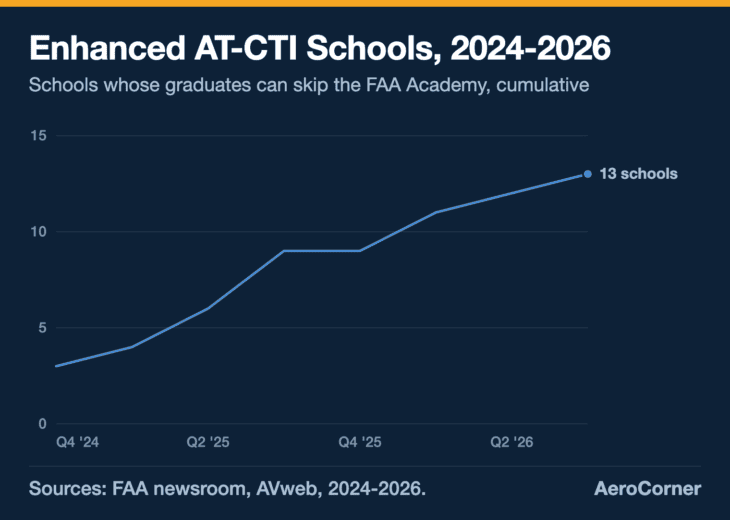
How this list works
Only schools the FAA has signed as Enhanced AT-CTI partners are listed, ordered by the date the FAA announced each one. The older Standard AT-CTI program is much larger (Tulsa Community College puts the number of U.S. air traffic control programs at under 40), and the FAA publishes its member list only as an interactive map. Standard schools save you the first five weeks of the Academy; Enhanced schools save you the whole trip. Tuition changes every year, so check each school’s current fees.
Standard vs. Enhanced: What an ATC School Actually Gets You
The FAA has run the Air Traffic Collegiate Training Initiative for decades as a non-funded partnership with colleges. Graduates of a Standard AT-CTI school still go to the FAA Academy, but they skip Air Traffic Basics, its first five weeks.
The Enhanced version, opened to applications on April 1, 2024, goes much further. An Enhanced school teaches the Academy’s own curriculum on simulators that meet Academy standards, and its graduates report straight to an FAA facility.
The FAA’s terms are strict. Instructors teaching the Academy’s tower or en route courses need at least three years as a fully credentialed controller, and simulations may not be run virtually. Graduates still have to pass the Air Traffic Skills Assessment (ATSA) and meet the FAA’s medical and security requirements.
The program is young but already producing hires. An FAA blog post updated in October 2026 counts 36 Enhanced graduates so far, a small number against the shortfall described in our look at the air traffic controller staffing crisis.
1. University of Oklahoma (Norman, Oklahoma)
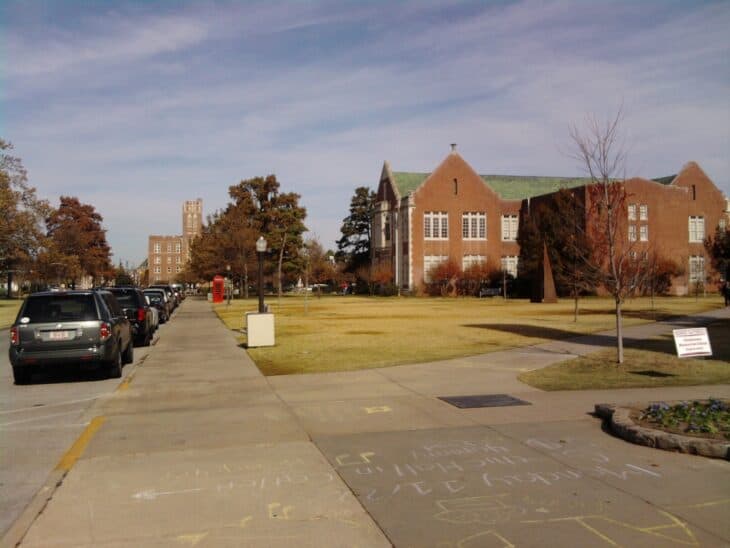

OU was one of the first two Enhanced schools, signed on October 2, 2024, and the first to build the program into a four-year degree. The curriculum sits inside its Bachelor of Science in air traffic management, and students in other aviation majors can reach it through a four-year air traffic control minor.
It also owns the program’s biggest milestone so far. In July 2026, OU said its Enhanced program had prepared the first graduate in the nation to reach Certified Professional Controller status under the FAA’s accelerated model.
The Academy is down the road
OU in Norman and Tulsa Community College both sit in Oklahoma, the home of the FAA Academy their graduates now skip. TCC says it is one of only two Enhanced programs in the state.
2. Tulsa Community College (Tulsa, Oklahoma)
TCC signed alongside OU on October 2, 2024, and offers a two-year credential: an Associate of Applied Science in Air Traffic Control, four semesters full-time. Training runs on high-fidelity tower and radar approach simulators at its Riverside campus, including a $1.4 million system the FAA inspected in September 2024.
It produced the first hire. TCC graduate Rebecca Nobles, 20, became the first Enhanced graduate in the country hired directly by the FAA, and went to a facility in Waco, Texas, without setting foot in the Academy.
Seats are the catch. TCC fills each cohort and keeps a waitlist, and students who miss out must reapply in the fall semester for the next year’s class.
3. Embry-Riddle Aeronautical University (Daytona Beach, Florida)
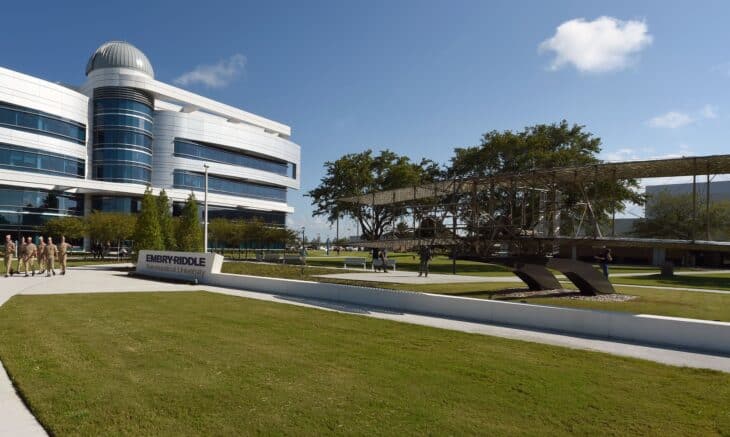

Embry-Riddle’s Daytona Beach campus became the third Enhanced school on November 20, 2024. On May 30, 2025, the FAA also approved its En Route program, making it the first school authorized for both tower and en route training.
That second track matters. En route controllers work the Air Route Traffic Control Centers that handle airliners at cruise altitude, a different job from the tower, which is explained in our guide to what air traffic controllers actually do. The credential is a Bachelor of Science in Air Traffic Management, accredited by the Aviation Accreditation Board International (AABI).
4. University of North Dakota (Grand Forks, North Dakota)


UND signed on January 20, 2025, and teaches the full FAA Academy tower curriculum on campus inside its AABI-accredited Bachelor of Science in Air Traffic Management. Its labs include a 360-degree control tower simulator and a 32-position radar lab.
Its first Enhanced graduate, Anthony Lake, finished in December 2025. The program’s own faculty call the track “not for every student,” built for people willing to put in significant extra lab time, which is the honest description of every school on this list.
UND is also one of the country’s big pilot schools, and it appears in our ranking of the best aviation colleges for future airline pilots.
5. Vaughn College (New York)
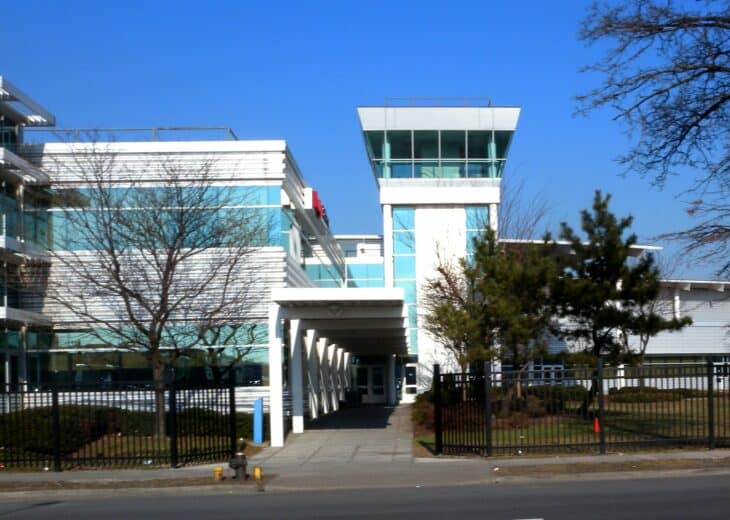

Vaughn became the fifth Enhanced school and the first in the Northeast on April 9, 2025. It has taught basic air traffic control since 1997, and its graduates work at LaGuardia, JFK and Westchester, among other facilities.
Its first Enhanced class has the best published result so far. Nine students started the two-semester program in fall 2025, and all nine passed, Vaughn reported in June 2026.
6. SUNY Schenectady County Community College (Schenectady, New York)
SUNY Schenectady signed on May 30, 2025, and awards an A.A.S. in Air Traffic Control, a degree it has offered since 2012. Its simulator, unveiled in January 2025, has three tower stations, four radar TRACON stations and seven remote pilot stations so trainees talk to real human voices.
The college calls it the largest air traffic control simulator at a community college east of the Mississippi River.
7. Middle Georgia State University (Eastman, Georgia)


Middle Georgia State became the first Enhanced school in Georgia on July 2, 2025. Its air traffic management program runs from the School of Aviation on the university’s Eastman campus.
It offers a second door as well. The school has a training partnership with Serco, a contractor that supports 28 control towers in seven states, so qualifying graduates may be able to go straight to work for Serco as well as aim at the FAA.
8. Nashua Community College (Nashua, New Hampshire)
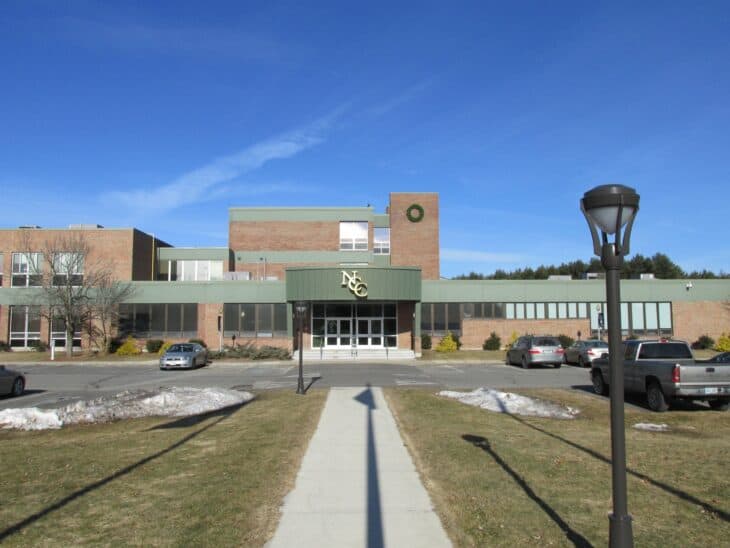

Nashua signed on August 11, 2025, the first Enhanced school in New Hampshire, weeks before its new two-year Air Traffic Control associate degree took its first students that fall. The college says students can now complete all of their training in the state.
Its department chair is unusually blunt about the FAA’s rules: you have to be younger than 31 by the end of the program, a U.S. citizen and fluent in English. Students take the ATSA early, because a low score means the FAA will not look at them.
9. Embry-Riddle Aeronautical University (Prescott, Arizona)


Embry-Riddle’s Prescott campus became the ninth Enhanced school, and the first in Arizona, on September 15, 2025. It offers the same Bachelor of Science in Air Traffic Management as Daytona Beach, built around computer-based simulation.
That makes Embry-Riddle the only university with two Enhanced campuses, one in the East and one in the West. For a student choosing between them, Daytona Beach is the one with the approved en route track.
10. Sacramento City College (Sacramento, California)
Sacramento City College became the first Enhanced school in California on January 22, 2026. The FAA’s agreement covers its En Route program, so graduates can be placed at an Air Route Traffic Control Center.
The A.S. in Enhanced Air Traffic Control runs as a tight cohort, 12 to 17 units a semester in classes of four to eight weeks, and courses cannot be taken out of order. Its catalog lists both terminal and en route course sequences, but the FAA’s announcement names en route only.
11. Aims Community College (Greeley, Colorado)
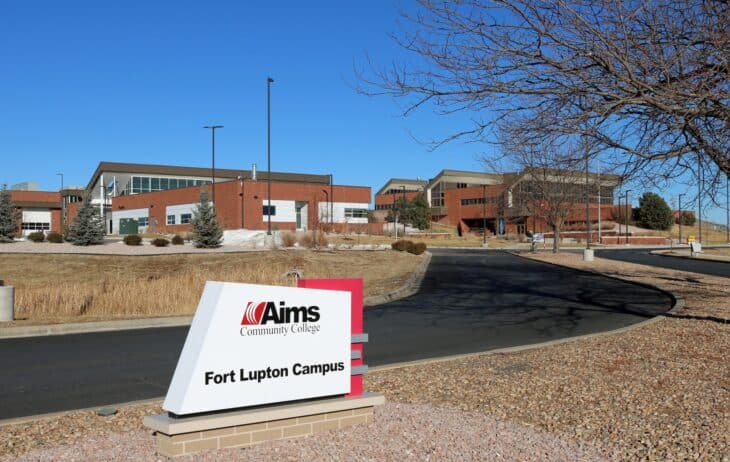

Aims was approved on March 2, 2026, after an FAA on-site evaluation that January, and is the first Enhanced school in Colorado. It awards a 65-credit Air Traffic Control associate degree.
Aims says it is the first community college in the nation authorized for both the terminal (tower) and en route pathways. That puts a two-year school level with Embry-Riddle Daytona Beach on breadth of training.
12. Angelo State University (San Angelo, Texas)
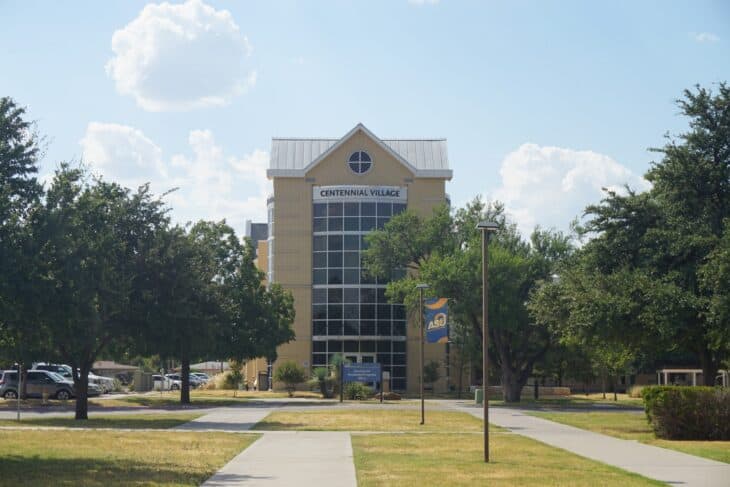

Angelo State became the 12th Enhanced school and the first in Texas when the FAA announced it on May 28, 2026. The approval covers the Air Traffic Operations track of its Bachelor of Commercial Aviation, a track less than a year old at the time.
Its lead instructor says it now has three streamlined entry routes. Besides Standard and Enhanced AT-CTI, Angelo State joined the FAA’s Control Tower Operator Partnership Program, which lets qualifying graduates start on-the-job training at a federal contract tower.
13. Shenandoah University (Virginia)


Shenandoah is the newest Enhanced school, announced on September 17, 2026, and the first in Virginia. The agreement covers its control tower program.
It is also the only one on this list built around a certificate rather than a degree: an undergraduate certificate of five courses over two years. The first class, ATC-101, started in fall 2026, with the full program due in spring 2027, so it has no graduates yet.
Do you need an air traffic control school at all?
No. The FAA’s own hiring checklist asks for U.S. citizenship, an age under 31, and one year of full-time work or college, and says no college degree is required. The standard route is to apply to the FAA, pass the ATSA and go to the Academy. A Standard school saves you five weeks of that; an Enhanced school saves you the whole Academy. The real deadline is your age, not your degree.
How to Choose Among Air Traffic Control Schools
Start with the age rule, because it decides the rest. The FAA’s fact sheet says you must start the Academy by your 31st birthday, so a four-year degree started at 25 leaves little room, and a two-year associate may be the safer bet.
Then pick the track. If you want an en route center rather than a tower, Embry-Riddle Daytona Beach, Aims and Sacramento City are the Enhanced schools with announced en route training.
Finally, weigh the money. The pay at the end is strong, as our breakdown of how much air traffic controllers make shows, but no school can promise you an FAA job, and the ATSA, medical and background checks still decide who gets hired.
FAQ
Sources and references used for research and fact-checking.
- FAA, Enhanced Air Traffic Collegiate Training Initiative
- FAA, Collegiate Training Initiative (CTI) Schools
- FAA, ATC Hiring Checklist
- FAA, Air Traffic Control Specialist fact sheet
- FAA, FAA Opens Application Process for Enhanced Air Traffic-Collegiate Training Initiative
- FAA, FAA Announces First Two Schools for Enhanced Air Traffic-Collegiate Training Initiative Program
- FAA, FAA Announces Next School for Enhanced Air Traffic-Collegiate Training Initiative Program
- FAA, FAA Announces University of North Dakota as Next Enhanced Air Traffic-Collegiate Training Initiative Program
- FAA, New York's Vaughn College Joins Enhanced Air Traffic Controller Training Program
- FAA, New York School Joins Enhanced Air Traffic Controller Training Program
- FAA, Transportation Secretary Sean P. Duffy Announces First Georgia School to Join Enhanced Air Traffic Controller Training Program
- FAA, U.S. Transportation Secretary Sean P. Duffy Announces First New Hampshire School to Join Air Traffic Controller Program
- FAA, FAA Announces First Arizona School to Join the Enhanced Air Traffic – Collegiate Training Initiative Program
- FAA, Trump's Transportation Secretary Sean P. Duffy Announces First California College to Join Air Traffic Controller Program
- FAA, Trump's Transportation Secretary Sean P. Duffy Announces First Colorado College to Join Air Traffic Controller Training Program
- FAA, Trump's Transportation Secretary Sean P. Duffy Announces First Virginia College to Join Air Traffic Controller Training Program
- FAA, From the Classroom to the Control Tower
- AVweb, Angelo State Gets FAA Air Traffic Training Designations
- University of Oklahoma, OU to Offer First Four-Year Degree Combined with Enhanced FAA Initiative
- University of Oklahoma, OU Program Supports FAA Workforce Expansion
- Tulsa Community College, TCC One of First in Nation to Join FAA's Enhanced Air Traffic Training Program
- Tulsa Community College, TCC Student Becomes First Enhanced Air Traffic Control Graduate Hired by FAA
- Tulsa Community College, Air Traffic Control program
- Embry-Riddle Aeronautical University, Bachelor of Science in Air Traffic Management
- University of North Dakota, Air Traffic Management, B.S.
- University of North Dakota, UND celebrates first graduate of Enhanced FAA Air Traffic Controller Program
- Vaughn College, First Class Completes Vaughn's New Enhanced Air Traffic Collegiate Training Initiative with 100% Pass Rate
- SUNY Schenectady County Community College, SUNY Schenectady and FAA Sign Agreement for Enhanced AT-CTI Program
- Middle Georgia State University, FAA Grants Enhanced CTI Status To MGA's Air Traffic Management Program
- Nashua Community College, NCC Offers First Enhanced Air Traffic Collegiate Training in New Hampshire
- Nashua Community College, Air Traffic Control to Launch at NCC Fall 2025
- Sacramento City College, Air Traffic Control, 2026-2027 Official Catalog
- Aims Community College, Aims Community College Earns FAA Enhanced AT-CTI Designation
- Aims Community College, Air Traffic Control associate degree
- Shenandoah University, Shenandoah University Launches Program to Meet Air Traffic Control Staffing Challenge
Get the Newsletter
The latest aviation news and stories sent to your inbox.
About the Author

Tim is the owner and lead editor of AeroCorner since 2019, overseeing aviation content covering aircraft, airlines, airports, and the broader aviation industry. Through years of researching, writing, editing, and publishing aviation-focused content, he has developed extensive practical knowledge of commercial aviation and air travel. Based in Asia and a frequent traveler himself, Tim also brings firsthand passenger experience to AeroCorner’s coverage. Outside of publishing, he has also explored aviation firsthand through hands-on flight training in New Zealand.