

Table of Contents
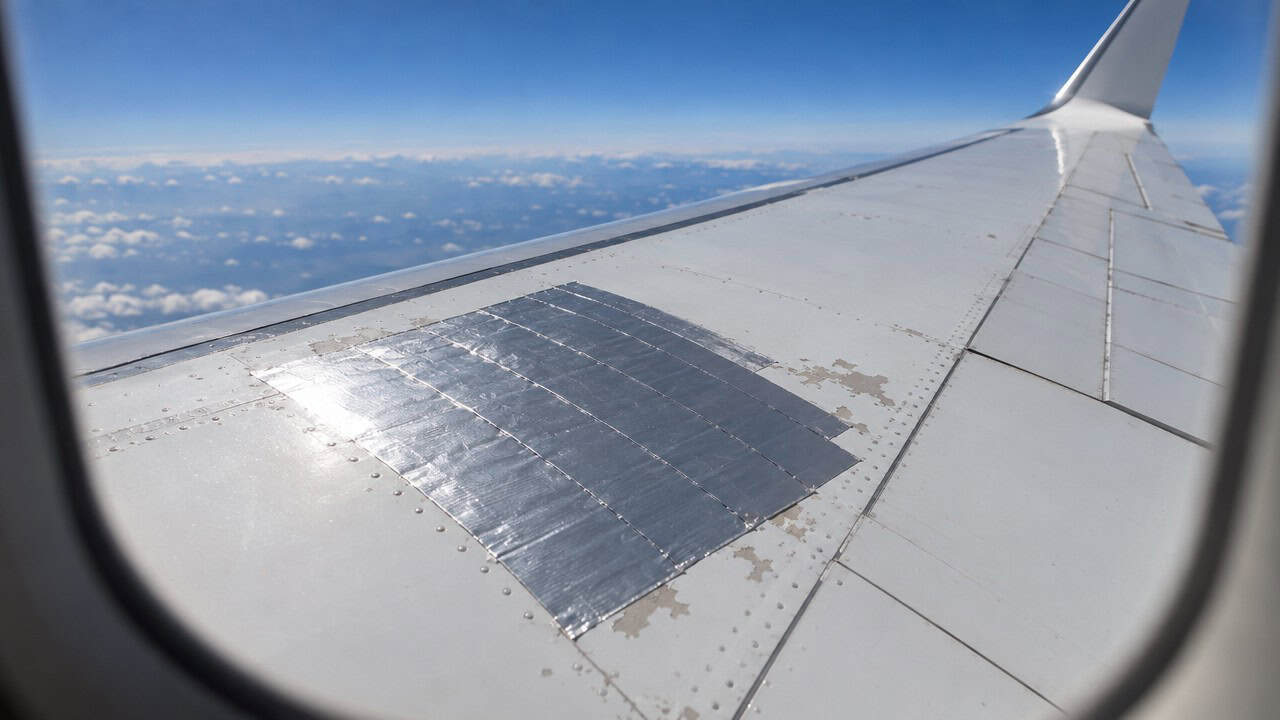
Passengers keep photographing it and asking their airline whether the jet is being held together with a hardware-store product. It is not, and the paperwork behind it is stricter than the photos suggest.
The silver strips you see on a wing or an engine nacelle are speed tape: pressure-sensitive tape with an aluminum foil backing, made for aircraft use. The FAA says it is used “for temporary, minor repairs to nonstructural aircraft components,” and only where the manufacturer’s manuals allow it.
On Oct. 19, 2026, View from the Wing rounded up the latest wave of “duct tape” posts, led by a passenger asking United what was “up with the duct tape on this 787.” The question is fair. The answer is that the tape is real aviation hardware, and Boeing itself has told the FAA it looks worse than it is.
Why Airlines Put Aluminum Tape on a Jet at All
Speed tape exists because small cosmetic and surface damage happens constantly, and grounding an airliner for every chipped edge or lifting patch of paint would be absurd. The tape seals and smooths the surface until a permanent fix can be scheduled.
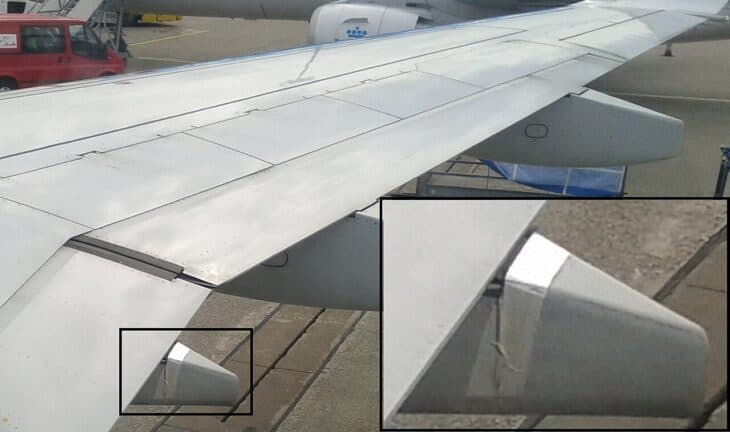
It is not a mechanic’s improvisation. In a 2023 statement to the Associated Press, the FAA said its “regulations require an operator to follow the aircraft manufacturer’s maintenance manuals, which may allow for the installation of speed tape for temporary use in certain situations.”
That sentence carries three limits. The manual has to allow it, the use has to be temporary, and the part has to be nonstructural. Tape does not hold a wing together, and it is never a substitute for a structural repair.
The most visible case is the Boeing 787 Dreamliner. Boeing told the FAA in an October 2022 petition that operators “have experienced paint peeling issues on the upper/lower surfaces of the wing and horizontal stabilizer due to exposure to ultraviolet (UV) radiation.” The short-term fix, Boeing wrote, “involves repeated use of speed tape over the affected areas.”
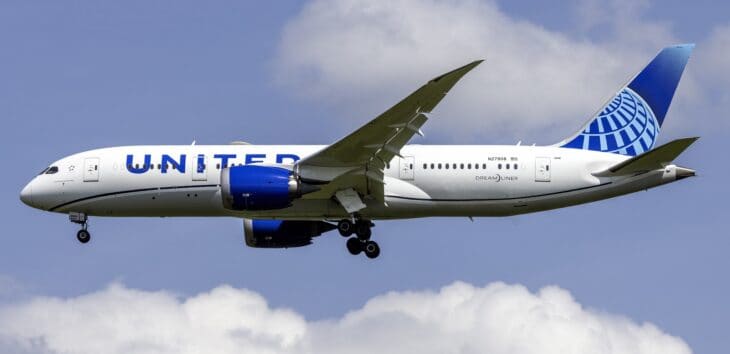

That is why the tape so often shows up on Dreamliner wings in passenger photos. When an Air New Zealand 787-9 went viral for its taped wings in 2022, Boeing said the peeling “does not affect the structural integrity of the wing, and does not affect the safety of flight.”
In Boeing's own words
“Even though the use of speed tape has no effect on the safety of the airplane, the public could perceive an unsafe condition when seeing tape on the wing surfaces.” Boeing petition to the FAA, October 2022.
What the Tape Is Actually Rated For
The product in those photos is not something from a kitchen drawer. Aviation foil tape is a thin sheet of soft aluminum with an engineered acrylic adhesive, sold against aerospace specifications.

One example is 3M’s Aluminum Foil Tape 425, which Boeing’s own parts store, Boeing Distribution, sells by the case. 3M lists aerospace among its industries and gives a total thickness of 4.6 mil (0.12 mm), of which 2.8 mil is the aluminum foil backing.
3M rates the tape for operating temperatures from -65°F to 300°F (-54°C to 149°C).
The same listing says the tape meets FAR 25.853, the FAA flammability standard for transport-category airplanes, and SAE AMS-T-23397, an aerospace material specification. It is built to be put on airplanes.
What 3M does not publish is an airspeed rating. Despite the name, the limit on speed tape is not a number printed on the roll. It is where the airplane’s manuals say it may go, how big an area it may cover, and how long it may stay before the permanent repair.
Those limits live in the manufacturer’s manuals for each aircraft type, so there is no single rule for every airliner. When Spirit Airlines faced its own viral “duct tape” video in 2023, it said the use was “authorized by the aircraft manufacturer and our Engineering team.”
The Time the FAA Said the Tape Went Too Far
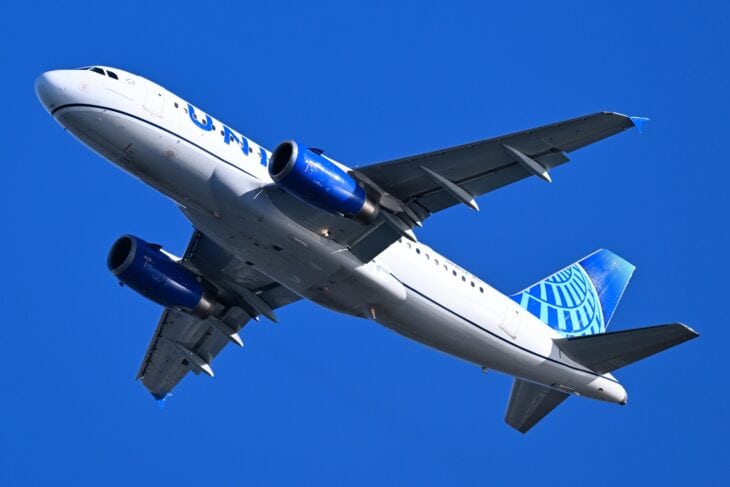
The limits are real, and the FAA has enforced them. In December 2002, the agency proposed an $805,000 civil penalty against United Airlines over three Boeing 757-200 jets.
According to the FAA, on or about March 2, 2002, United maintenance workers found small holes in the spoilers of the aircraft. They made a temporary repair of the spoiler skin that was “not within approved methods, techniques or practices” in the manufacturer’s repair manuals, and the jets flew 193 flights that way.
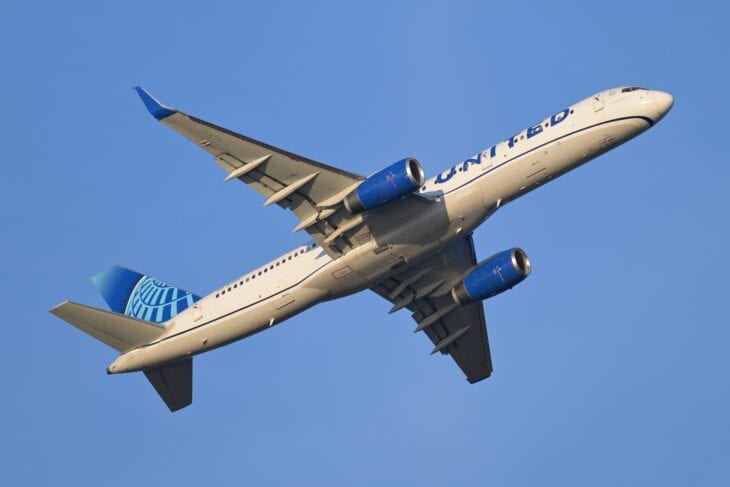

AVweb reported at the time that the patches were tape, and that the FAA believed the holes were “either too large or too close to critical areas on the spoiler.” United said it would fight the fine, and we could not find a public record of how the case ended.
That case is the useful half of the story. Tape applied inside the manual’s limits is a legal, routine repair. Tape applied outside them is a violation, and in the United case the FAA alleged the jets were flown when they were not airworthy.
For a passenger, the distinction is invisible from seat 23A. What you can know is that the system has a rule for it, and that the people who write the rules have shown they will enforce it. Our ranking of the safest airlines in the world is a better guide to an airline’s safety culture than a strip of foil on its wing.
Boeing’s Fix for the Taped 787 Wing
Boeing did not treat the 787 tape as a safety problem. It treated it as a maintenance and perception problem, and asked the FAA for a way to fix it faster.
The fix is a revised paint system that adds “a layer of ultraviolet blocking black topcoat in-between the primer and the white topcoat.” Because the thickness of the exterior finish can affect fuel tank lightning protection, the change needed regulatory relief before it could go on in-service jets.
The FAA granted it on June 1, 2023, as Exemption No. 20370, covering the 787-8, 787-9 and 787-10. The FAA wrote that the revised paint scheme “will also help to eliminate a misperception of an unsafe condition because of the very visible use of speed tape.”
An exemption is permission, not a repaint. In October 2026, more than three years later, passengers were still posting photos of taped jets, including that United 787.
So the regulator, the manufacturer and the airline all agree on what the silver strip is. The only party still unconvinced is the person in the window seat, and that is the one problem a roll of aluminum cannot fix.
Sources and references used for research and fact-checking.
- View from the Wing, "Duct Tape" On Planes Is Scaring Passengers: Airlines Are Making Safe Repairs Look Like Dangerous Shortcuts
- Associated Press, Video shows speed tape, not duct tape, on Spirit Airlines plane
- The Boeing Company via Regulations.gov, Petition for Exemption, Boeing Model 787 (Docket FAA-2022-1397)
- Federal Aviation Administration via Regulations.gov, Exemption No. 20370, Grant of Exemption to The Boeing Company
- 3M, 3M Aluminum Foil Tape 425
- Boeing Distribution, 3M Aluminum Foil Tape 425, Silver, 4 in x 60 yd
- Breaking Travel News (FAA release), FAA Proposes $805,000 Fine Against United
- AVweb, United Fights Maintenance Fine
- AVweb, Speed Tape Patches Prompt Viral Post
Get the Newsletter
The latest aviation news and stories sent to your inbox.
About the Author

Tim is the owner and lead editor of AeroCorner since 2019, overseeing aviation content covering aircraft, airlines, airports, and the broader aviation industry. Through years of researching, writing, editing, and publishing aviation-focused content, he has developed extensive practical knowledge of commercial aviation and air travel. Based in Asia and a frequent traveler himself, Tim also brings firsthand passenger experience to AeroCorner’s coverage. Outside of publishing, he has also explored aviation firsthand through hands-on flight training in New Zealand.