

Table of Contents
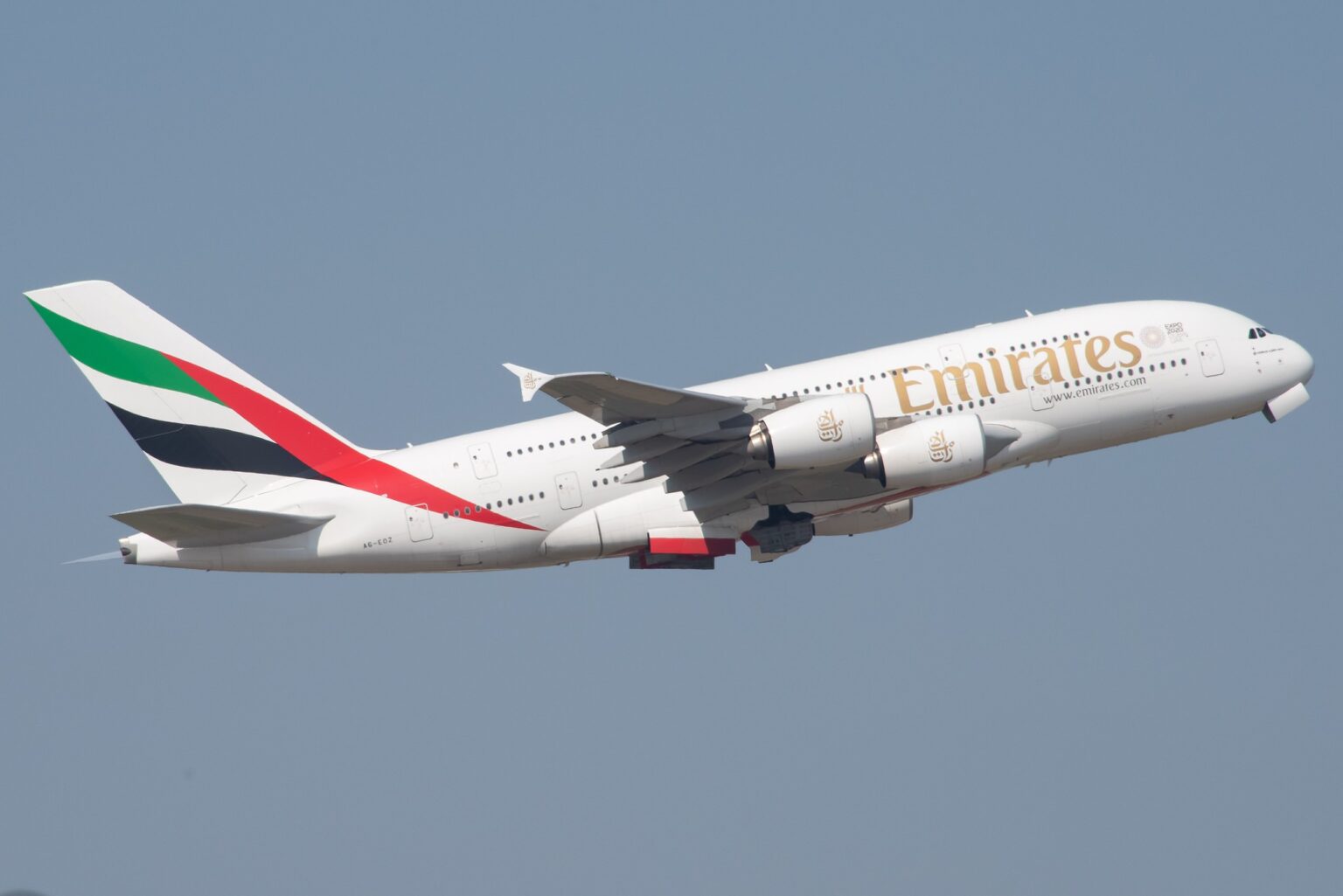
Emirates has 277 planes. That is the count in the Emirates Group annual report for March 31, 2026: 264 passenger jets and 13 Boeing 777 freighters.
Every one of them is a widebody. Emirates flies no narrowbody jets and no regional jets at all, so its whole fleet is built around two big long-haul types, the Airbus A380 and the Boeing 777.
How Many Planes Does Emirates Have?
277, as of March 31, 2026, the end of Emirates’ financial year. The count covers every aircraft the airline owns or leases: 190 owned and 87 leased.
It leaves out the 367 aircraft on firm order. A year earlier, on March 31, 2025, the same count was 260, so the fleet grew by 17 aircraft in twelve months.
It has grown again since. In its half-year results on November 5, 2026, Emirates said it took nine more A350s and five more 777 freighters between April and September. It did not publish a new total.
The count at a glance
277 aircraft on March 31, 2026: 116 Airbus A380s, 119 Boeing 777-300ERs, 10 Boeing 777-200LRs, 19 Airbus A350-900s and 13 Boeing 777 freighters. Average age 10.8 years. Not counted: 367 aircraft on firm order, 270 of them Boeing 777Xs. Since then: 9 more A350s and 5 more 777 freighters delivered by September 30. Source: Emirates Group Annual Report 2025-26 and half-year results 2026-27.
The Emirates fleet, type by type
Emirates publishes its full fleet in the fleet information table of its annual report. This is the table for March 31, 2026, with what it has on order.
| Aircraft | In fleet | Owned | Leased | On order |
|---|---|---|---|---|
| Airbus A380-800 | 116 | 78 | 38 | 0 |
| Boeing 777-300ER | 119 | 77 | 42 | 0 |
| Boeing 777-200LR | 10 | 7 | 3 | 0 |
| Airbus A350-900 | 19 | 19 | 0 | 54 |
| Passenger fleet | 264 | 181 | 83 | |
| Boeing 777 freighter | 13 | 9 | 4 | 8 |
| Boeing 777X | 0 | 270 | ||
| Boeing 787 | 0 | 35 | ||
| Whole fleet | 277 | 190 | 87 | 367 |
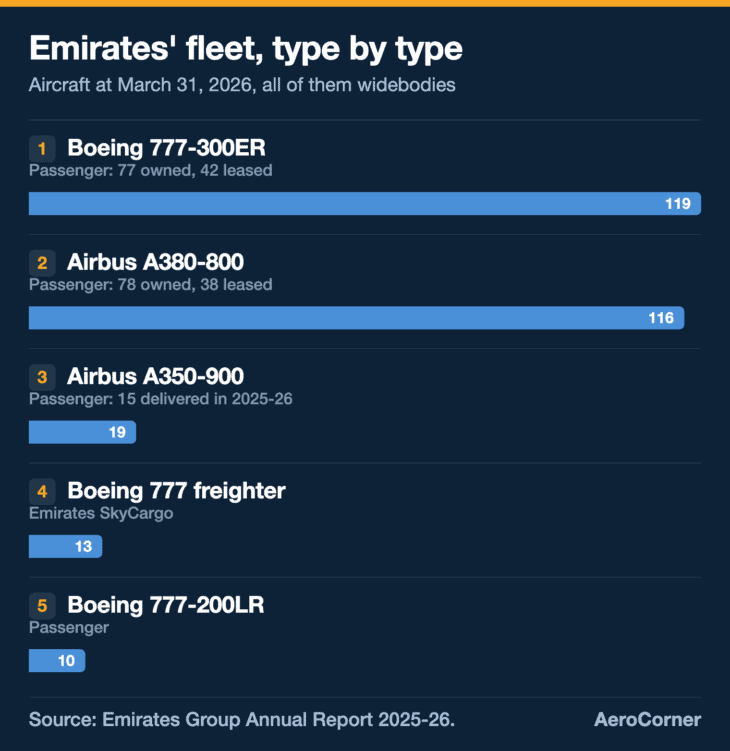
The Boeing 777-300ER and the Airbus A380 are the airline. Together they make up 235 of the 277 aircraft, almost 85% of the fleet.
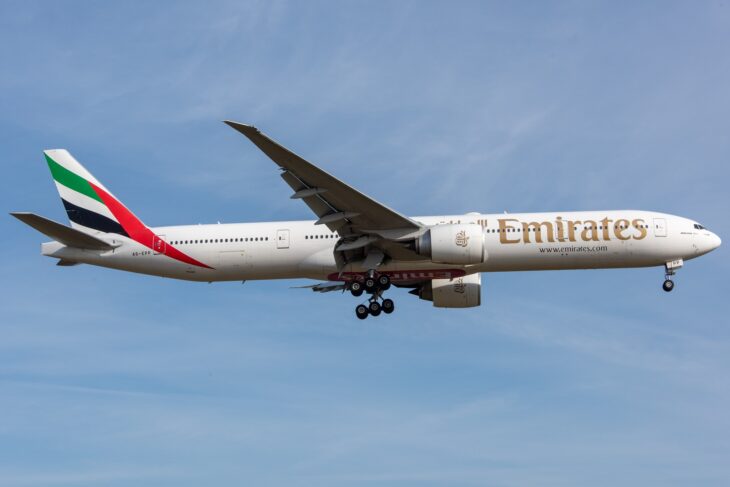
Count the 777 family as one and it is the biggest: 142 aircraft, made up of 119 777-300ERs, 10 777-200LRs and 13 freighters. The annual report says Emirates is the world’s largest 777 operator, and that the 777 flew 47% of its seat capacity and carried more than half of its passengers in 2025-26.
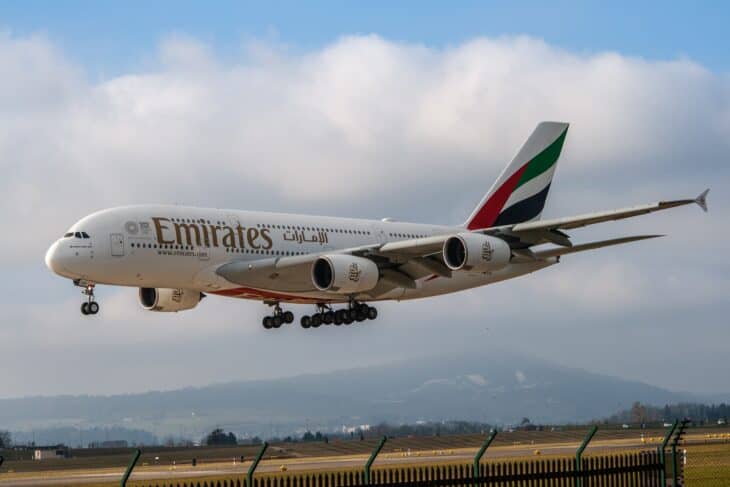
The A380 carried 43% of Emirates’ passengers across 53 destinations. Emirates holds 116 of the 251 A380s ever delivered, which is why it is the airline most people picture when they think of the airlines still flying the A380.

The newcomer is the Airbus A350-900. Emirates took 15 of them in 2025-26, taking the type from 4 to 19, and they carried 2.1 million passengers, about 4% of the total.
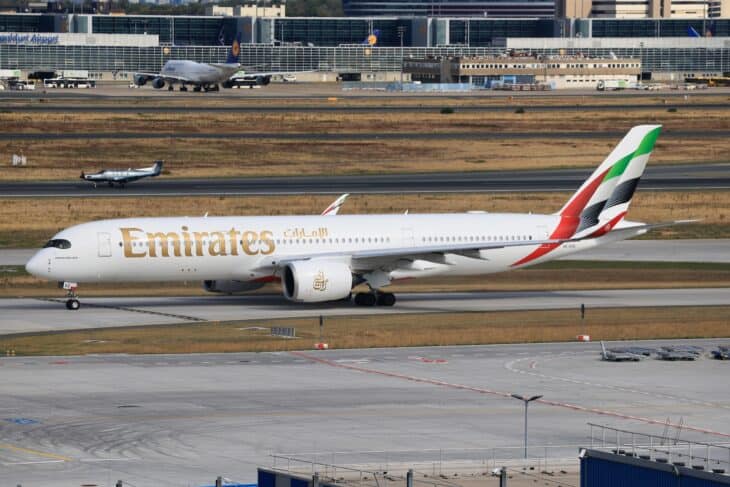
The fleet is young for its size. Its average age was 10.8 years on March 31, 2026, against an industry average of 15.1 years at the end of 2025, according to the annual report.
Why the numbers differ
Search this question and you will see 260, “over 250”, 273 and 277. Most of them were right on some date. They are counting different things, or counting at a different time.
An old date
260 is Emirates’ own count for March 31, 2025. Since then it has taken 15 A350s and 5 freighters in 2025-26, then 9 more A350s and 5 more freighters by September 30, 2026.
Some aircraft also left. The annual report says two older freighters were retired in 2025-26, and the 777-300ER count fell by one in the year Emirates began converting its first 777-300ER into a freighter.
Passenger jets or the whole fleet
Wikipedia’s Emirates fleet table gives 273 passenger aircraft as of October 2026: 30 A350s, 116 A380s, 10 777-200LRs and 117 777-300ERs. It lists the freighters separately, under Emirates SkyCargo.
That SkyCargo table shows 19 777 freighters, two 777-300ERs converted or being converted to freighters, and six wet-leased 747 freighters. The 747s are flown for Emirates by other operators, so they never appear in Emirates’ own count.
In the fleet is not the same as flying
Emirates has 116 A380s, but not 116 in the air. In November 2025, it said it was flying 95 to 96 of them, with more coming back from long-term storage after maintenance and cabin upgrades.
Retrofits take jets out of service too. Each A380 refit takes 22 days and each 777 takes 18, and Emirates refurbished 42 aircraft in 2025-26 and 12 more between April and September 2026.
The most repeated mistake: Emirates flies 116 A380s
116 is how many A380s Emirates has, not how many it flies. In November 2025 Emirates said 95 to 96 were active, and it planned to bring the active fleet to 110 by the end of 2026 by reactivating stored airframes. It plans to keep flying the type until 2041.
The order book, and where the fleet is going
Emirates has more aircraft on order than it flies. On March 31, 2026, the order book stood at 367: 270 Boeing 777Xs, 54 A350-900s, 35 Boeing 787s and 8 777 freighters, with deliveries scheduled through 2038.
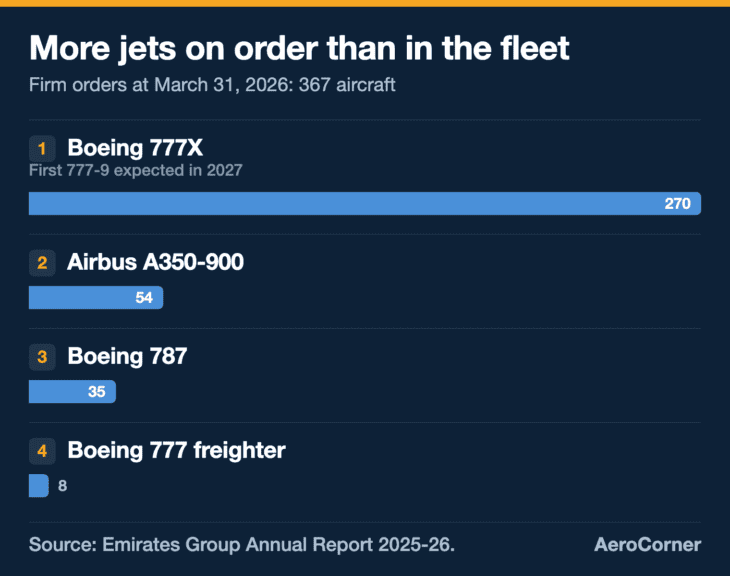
The 777X order grew at the Dubai Airshow in November 2025, when Emirates ordered 65 more 777-9s along with 8 more A350-900s. None has been delivered yet.
In July 2026, Emirates said it expected its first 777-9 in the second quarter of 2027, and that it would not accept the first ten 777-9s built for it because of the rework they would need. The full story is in our piece on the Boeing 777X delay.
The A350 is filling the gap. The nine delivered between April and September took the type to 28, against 54 on order in March, so 45 of that order were still to come at the end of September.
The freighter fleet is changing shape as well. Emirates SkyCargo put its first passenger-to-freighter conversion into service in the half year, alongside the five new 777 freighters.
How Emirates compares with other big airlines
By aircraft count, Emirates is not close to the biggest. American Airlines had 1,609 aircraft on June 30, 2026, and United had 1,143 mainline jets on September 30, as our count of how many planes United has breaks down.
Count widebodies only and the order flips. United flew 244 widebodies on September 30, 2026, against Emirates’ 277 six months earlier.
That is why fleet size alone is a poor ranking. In our list of the largest airlines in the world by fleet, JetBlue’s 279 aircraft take 12th place, and Emirates’ 277 would sit just behind it.
Closer to home, Emirates is about twice the size of Abu Dhabi’s Etihad, which had an operating fleet of 127 aircraft at the start of 2026. How the two feel from the cabin is a different question, covered in Emirates vs Qatar vs Etihad.
FAQ
Sources and references used for research and fact-checking.
- The Emirates Group, The Emirates Group Annual Report 2025-26
- Dubai Media Office, Emirates Group achieves record profit in 2025-26
- Dubai Media Office, Emirates Group announces half-year profit for 2026-27
- Wikipedia, Emirates fleet
- Wikipedia, Emirates SkyCargo
- AFM, Emirates to Grow Active A380 Fleet to 110 in 2026
- Finviz, Emirates targets second-quarter 2027 delivery for Boeing 777-9 as certification nears
- Aviation Week, Emirates Rejects Early-Build Boeing 777Xs
- American Airlines Group, via SEC EDGAR, American Airlines Group second-quarter 2026 earnings release (Form 8-K exhibit 99.1)
- United Airlines Holdings, via SEC EDGAR, United Airlines investor update, third quarter 2026 (Form 8-K exhibit 99.2)
- Airways Magazine, Etihad January traffic: 2.2m passengers, 89.9% load factor
Get the Newsletter
The latest aviation news and stories sent to your inbox.
About the Author

Tim is the owner and lead editor of AeroCorner since 2019, overseeing aviation content covering aircraft, airlines, airports, and the broader aviation industry. Through years of researching, writing, editing, and publishing aviation-focused content, he has developed extensive practical knowledge of commercial aviation and air travel. Based in Asia and a frequent traveler himself, Tim also brings firsthand passenger experience to AeroCorner’s coverage. Outside of publishing, he has also explored aviation firsthand through hands-on flight training in New Zealand.