

Table of Contents
California has 864 open airports and landing facilities, according to the FAA’s airport master records effective October 29, 2026. That is the third-highest count of any state, behind Texas (1,861) and Florida (928).
Most of them are closed to you. 621 are private-use, 243 are open to the public, and just 24 boarded more than 10,000 airline passengers in 2025. Those 24 still carried more passengers than the airports of any other state.
How Many Airports Are in California?
The FAA answer is 864 for 2026. In the FAA’s records, “airport” means any registered landing facility: runway airports, heliports, seaplane bases, gliderports and ultralight fields.
The file holds 873 California records in all, but 9 are marked closed indefinitely. Eight are private, among them ranch strips and the old heliport on Alcatraz Island. The one public field on the closed list is William Robert Johnston Municipal at Mendota, in the Central Valley.
Count runway airports only and the number is 467. Count only the airports with real airline traffic and it drops to 24.
California airports at a glance
864 open landing facilities in FAA data effective October 29, 2026. 467 runway airports. 243 open to the public. 30 certified by the FAA for airline service. 24 primary airports with 10,000 or more boardings in 2025. 3 large hubs that carried about two-thirds of those passengers.
What the 864 Actually Are
Split the total by type and by who may use it, and the picture changes. Barely half are runway airports, and seven in ten are private.
| Facility type | Public use | Private use | Total |
|---|---|---|---|
| Airports (runways) | 242 | 225 | 467 |
| Heliports | 0 | 389 | 389 |
| Gliderports | 0 | 4 | 4 |
| Seaplane bases | 1 | 2 | 3 |
| Ultralight fields | 0 | 1 | 1 |
| Total | 243 | 621 | 864 |
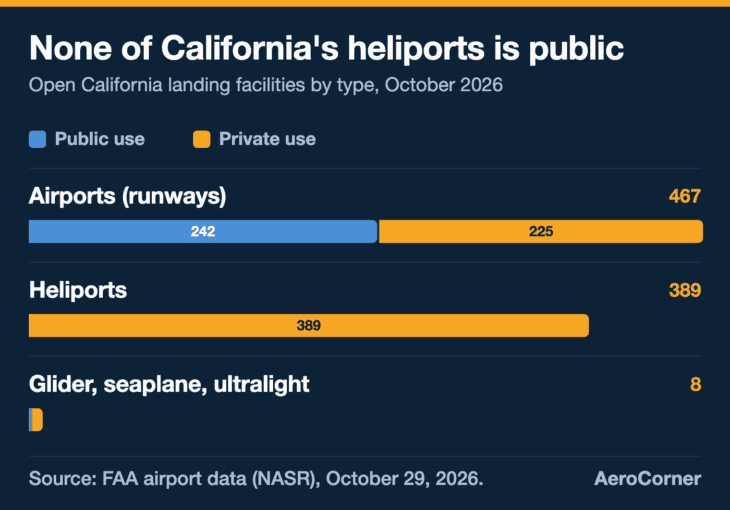
The heliports are the California signature. There are 389 of them, the second most of any state, and the FAA lists every one as private-use. A pilot needs the owner’s permission to land at any of them.
At least 147 carry the name of a hospital, medical center or health system. The rest sit on sheriff’s stations, power substations, dams, refineries, hotels, office towers and TV stations, and one sits on the Queen Mary in Long Beach.
Los Angeles County alone has 149 landing facilities, 128 of them heliports. That is more than seven whole states, including Connecticut (97), Vermont (85), Hawaii (39) and Delaware (38).
The runway airports lean public, unlike Texas or Florida. 242 of 467 are open to any pilot. Of the 243 public-use facilities, 213 are owned by a city, county or airport authority, 28 are privately owned but open to all, and two belong to the Air Force.
California also holds both ends of the elevation scale. Furnace Creek in Death Valley sits 210 feet (64 m) below sea level, the lowest public-use airport in the FAA file, and a private strip at the Salton Sea sits lower still at 223 feet (68 m) below. Monache Meadows in the Sierra Nevada is the state’s highest public-use field at 7,874 feet (2,400 m).
Very few fields need a control tower. The FAA file lists one at 73 of the 864. Everywhere else, pilots coordinate with each other over a shared radio frequency. Our guide to the different types of airports explains how each class works.
How Many California Airports Have Airline Flights?
30 California airports hold an FAA operating certificate under 14 CFR Part 139 in the October 2026 file. An airport needs one to serve scheduled passenger flights on aircraft with more than 9 seats, or unscheduled flights from 31 seats up.
The FAA counts 24 California airports as primary, meaning they boarded at least 10,000 passengers in 2025. Five more boarded between 2,500 and 10,000, which makes 29 commercial service airports in all.
| Airport | FAA hub size | 2025 boardings |
|---|---|---|
| Los Angeles (LAX) | Large | 36.5 million |
| San Francisco (SFO) | Large | 26.3 million |
| San Diego (SAN) | Large | 12.7 million |
| Sacramento (SMF) | Medium | 6.8 million |
| Santa Ana, John Wayne (SNA) | Medium | 5.5 million |
| San Jose (SJC) | Medium | 5.3 million |
| Oakland (OAK) | Medium | 4.5 million |
| Ontario (ONT) | Medium | 3.5 million |
| Hollywood Burbank (BUR) | Medium | 3.2 million |
| Long Beach (LGB) | Small | 1.9 million |
| Palm Springs (PSP) | Small | 1.7 million |
| Fresno (FAT) | Small | 1.4 million |
| Santa Barbara (SBA) | Small | 740,028 |
| San Luis Obispo (SBP) | Nonhub | 399,302 |
| Santa Rosa (STS) | Nonhub | 386,629 |
| Monterey (MRY) | Nonhub | 326,154 |
| Bakersfield (BFL) | Nonhub | 218,742 |
| Arcata-Eureka (ACV) | Nonhub | 135,016 |
| Redding (RDD) | Nonhub | 86,888 |
| Carlsbad, McClellan-Palomar (CRQ) | Nonhub | 67,693 |
| Stockton (SCK) | Nonhub | 66,395 |
| San Bernardino (SBD) | Nonhub | 25,957 |
| Santa Maria (SMX) | Nonhub | 17,081 |
| Bishop (BIH) | Nonhub | 13,219 |
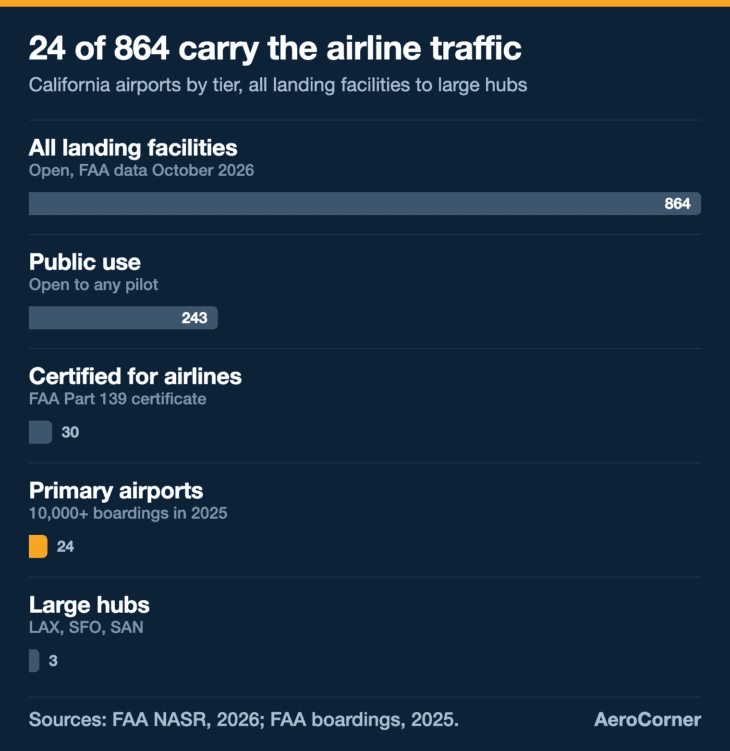
Those 24 airports boarded 111.6 million passengers in 2025, the most of any state. The three large hubs carried 68 percent of them, and LAX and SFO alone carried 56 percent. Our ranking of the busiest airports in the US shows where they sit nationally.
LAX is the busiest by a wide margin, with 36.5 million boardings, fifth in the country. In AeroCorner analysis of airline schedule data, one sample week a month from June to November 2026, it averaged about 865 departures a day on passenger-airline routes, to 171 destinations. Its busiest route was the short hop to San Francisco, at about 44 departures a day.
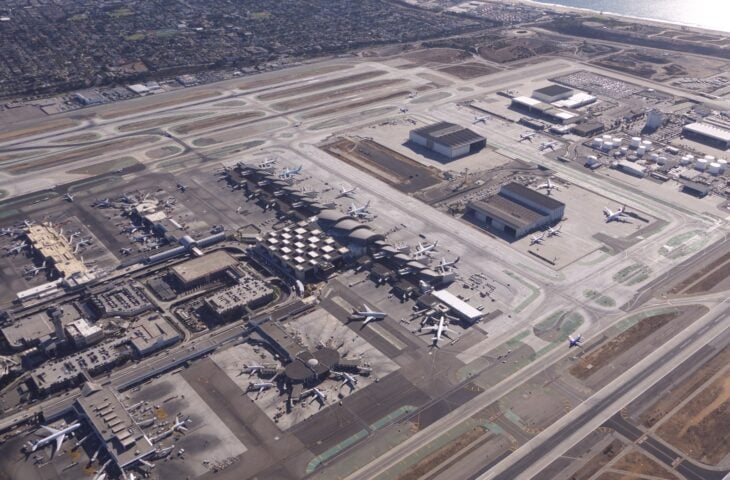

The Los Angeles area spreads its traffic across five airline airports: LAX, Burbank, Long Beach, Ontario and John Wayne in Orange County. Burbank, the smallest of the medium hubs, opened a new terminal in October 2026; our story on the Burbank replacement terminal explains why the old one had to go.
Mammoth: an airline airport at 7,135 feet
Mammoth Yosemite, in the Eastern Sierra, sits 7,135 feet (2,175 m) above sea level, the highest of California’s 30 airline-certified airports. It boarded 3,260 passengers in 2025, down from 3,632 in 2024, which put it just inside the FAA’s commercial service band and well short of primary status.
Why Other Sites Give a Different Number
Search the question and you will see 864, 243, 239, 30, 29 and 24. All of them are real counts. They just count different things.
The state's 239 is a different list
Caltrans, California’s transportation department, publishes a public-use airport list with 239 airports. The FAA counts 243. The FAA includes Palmdale’s Air Force Plant 42 and March Air Reserve Base, both open to civil users, plus the Lake Oroville seaplane landing area and two remote fields, Happy Camp and Monache Meadows. Caltrans still lists Mendota, which the FAA has marked closed.
The airline counts split three ways too. 30 airports hold a Part 139 certificate, 29 are commercial service airports and 24 are primary. The groups overlap but do not match.
Six airports hold a certificate without primary status: Crescent City, Mammoth Yosemite, Concord’s Buchanan Field, Chico, Oxnard and Southern California Logistics at Victorville. Chico logged one airline boarding in 2025 and Oxnard 51, yet both keep their certificates.
Three commercial service airports have no certificate at all: Hawthorne, Merced and Imperial County. Their scheduled flights use aircraft small enough not to need one.
Boardings do not follow the labels either. Commercial service status needs scheduled passenger flights, and the FAA classes March Air Reserve Base as general aviation even though it logged 26,355 boardings in 2025. That is more than three of the state’s primary airports. Concord logged 12,820, also as general aviation.
Military fields add another layer. The FAA lists 31 military-owned sites in California: 14 Navy and Marine Corps, 9 Army, 7 Air Force and Space Force, and a Coast Guard heliport in San Diego. Among them are Edwards, Miramar, Travis and the island fields of San Clemente and San Nicolas.
And the count is about to shrink. Under a 2017 consent decree with the FAA, the City of Santa Monica may close Santa Monica Airport at the end of 2028, and the city has said it will.
How California Compares With Other States
California ranks third for total landing facilities with 864, behind Texas with 1,861 and Florida with 928. Nationally, the FAA counts 19,445; our breakdown of how many airports are in the US explains where they all are.
It is third for public-use facilities too, with 243 against Alaska’s 392 and Texas’s 389. On heliports it is second, with 389 to Texas’s 465.
On airlines, California leads. It ties Texas for the most airline-certified airports, with 30 each, and its 111.6 million boardings in 2025 beat Florida’s 108.1 million and Texas’s 101.4 million. Our count of how many airports are in Texas shows how the state with more than twice as many airports ends up third for passengers.
FAQ
Sources and references used for research and fact-checking.
- Federal Aviation Administration, NASR 28-day subscription: airport data (APT CSV), effective October 29, 2026
- Federal Aviation Administration, CY 2025 Commercial Service Airports: passenger boardings, rank order and percent change from 2024
- Federal Aviation Administration, CY 2025 Enplanements at All Airports
- Federal Aviation Administration, Airport Categories
- Federal Aviation Administration, Part 139 Airport Certification
- California Department of Transportation, Division of Aeronautics, California Public Use Airports list
- Bureau of Transportation Statistics, National Transportation Statistics, Table 1-3: Number of U.S. Airports
- City of Santa Monica, Santa Monica Airport will close forever on December 31, 2028
- City of Santa Monica, City Reaffirms Santa Monica Airport Closure at End of 2028 as JSX Lease Considered
Get the Newsletter
The latest aviation news and stories sent to your inbox.
About the Author

Tim is the owner and lead editor of AeroCorner since 2019, overseeing aviation content covering aircraft, airlines, airports, and the broader aviation industry. Through years of researching, writing, editing, and publishing aviation-focused content, he has developed extensive practical knowledge of commercial aviation and air travel. Based in Asia and a frequent traveler himself, Tim also brings firsthand passenger experience to AeroCorner’s coverage. Outside of publishing, he has also explored aviation firsthand through hands-on flight training in New Zealand.