


Table of Contents
In the United States, a helicopter can legally land almost anywhere the pilot has permission and room to do it safely. No federal rule says a private helicopter must land at an airport or a heliport.
What stops a helicopter is rarely the FAA. It is the landowner, the town’s zoning code, a handful of federal lands such as national parks and wilderness areas, the control tower at a busy airport, and the FAA’s catch-all ban on careless or reckless flying.
That is why a 69-year-old pilot could fly to a Cabela’s store in Richfield, Wisconsin, on Aug. 1, 2026, set down in the parking lot and go shopping. A sheriff’s deputy came out, found he was licensed and had followed FAA rules, and issued no citation.
| Where | Can a helicopter land there? | Who decides |
|---|---|---|
| Your own land | Usually, if local zoning allows it | City or county zoning, some states |
| Someone else’s land | Yes, with the owner’s permission | The owner, then zoning |
| A store parking lot | Yes, with permission and room to do it safely | The owner, local ordinances, 14 CFR 91.13 |
| A permanent helipad you build | Yes, after the paperwork | FAA notice (Part 157), state permit, zoning |
| An airport with a control tower | Yes, with an ATC clearance | Air traffic control (14 CFR 91.129) |
| A national park | Only at designated sites or with a permit | National Park Service (36 CFR 2.17) |
| A federal wilderness area | No, except for administration and emergencies | Wilderness Act |
| Water | Only if the helicopter is built or equipped to float | The aircraft itself |
| Anywhere, in an emergency | Yes | The pilot in command (14 CFR 91.3) |
What Federal Law Actually Says
The key rule is 14 CFR 91.119, the FAA’s minimum safe altitudes. Airplanes must stay at least 1,000 feet above the highest obstacle over a congested area, and 500 feet above the surface elsewhere, “except when necessary for takeoff or landing.”
Helicopters get their own paragraph. Under 91.119(d), they may fly below those minimums as long as the flight is conducted without hazard to people or property on the surface, and they follow any routes or altitudes the FAA has set for helicopters.
Nothing in that rule, or anywhere else in Part 91, tells a private pilot where a landing has to happen. The limit that does apply everywhere is 14 CFR 91.13: no one may fly “in a careless or reckless manner so as to endanger the life or property of another.”
The short version
Federal rules decide how a helicopter is flown, not where it may land. Where it may land is a property question: the owner’s permission, then the local zoning code, then any special federal land such as a park or wilderness area.
Can You Land a Helicopter on Private Property?
Yes, with the owner’s permission. Landing on someone else’s land without it is a property and trespass problem before it is an aviation one.
Landing on your own land is where zoning comes in. A town’s code may say nothing about helicopters, may require a special permit, or may be used to stop a homeowner flying from his own land.
The best-known case is Rockport, Massachusetts. Ron Roma had registered his oceanfront property with the FAA as a private-use heliport in 2013, but the town’s zoning had no provision for private helipads, and in January 2018 the Massachusetts Appeals Court sided with the town.
The court’s reasoning was blunt: “Towns have the right to determine how land within their borders is used.” Aviation law covers flying, it found, not where a heliport may sit.
Some states push the other way. Virginia’s Code 15.2-2293.2 bars any local zoning ordinance from imposing a total ban on personal, noncommercial helicopter takeoffs and landings, though a county may still require a special use permit for repeated landings on the same parcel.
If you are pricing a first machine, our list of the cheapest helicopters you can buy is a good start. Check the zoning code for your address before you check the classifieds.
Can I Build a Helipad on My Property?
Usually, but a permanent landing site brings paperwork that an occasional landing does not. Federally, anyone who plans to build or activate an airport must file FAA Form 7480-1 under 14 CFR Part 157, and the rule’s definition of an airport includes heliports and helistops.
The notice is due at least 90 days before work begins. The FAA then studies the site’s effect on the airspace and nearby airports, but its determination is “only advisory” and does not consider land use, so it never overrides local zoning.

Part 157 has two exceptions that cover most casual flying. A site used under visual flight rules for less than 30 consecutive days, with no more than 10 operations a day, needs no notice.
Neither does the intermittent use of a spot that is not an established airport, for less than a year and only under visual flight rules. “Intermittent” means no more than 3 days in any week and no more than 10 operations on any day.
States can add their own layer. California makes it unlawful, as a general rule, to operate a heliport without a State Heliport Permit, but it exempts personal-use heliports in unincorporated areas that meet its regulations, along with temporary sites used for less than a year that are not within 1,000 feet of a school.
Caltrans adds that none of its exemptions “supersede or negate” federal or local requirements. A state permit or exemption does not get you past the county zoning board.
Is It Legal to Land a Helicopter in a Parking Lot?
It can be. The Richfield Cabela’s landing is the proof: the Washington County Sheriff’s Office said the pilot landed safely and complied with all applicable FAA regulations, and deputies found no violations.
The office even joked that it was a “unique way to make a shopping trip to avoid all the roundabouts in front of Cabela’s.” The pilot told the deputy the drive was simply too long.
Three things can still turn a parking lot landing into trouble. The property owner can object, a city ordinance can ban it, and a landing among cars and people can be judged careless or reckless under 91.13 if it endangers anyone’s life or property.
Can Helicopters Land Anywhere in an Emergency?
Yes. Under 14 CFR 91.3, a pilot facing an in-flight emergency that requires immediate action may deviate from any rule in Part 91 to the extent the emergency requires, and must send the FAA a written report only if asked.
The land rules make room for this too. The National Park Service rule on aircraft does not apply to landings “due to circumstances beyond the control of the operator,” and the Wilderness Act allows landings in emergencies involving people’s health and safety.

Air ambulances get their own carve-outs as well. California, for example, exempts emergency medical landing sites from its heliport permit, as long as a site averages no more than 6 landings a month and is used only for emergency medical purposes.
Can Helicopters Land at Airports?
Yes. At an airport with an operating control tower, every aircraft, helicopters included, needs a clearance from air traffic control before it uses a runway or taxiway, takes off or lands, under 14 CFR 91.129.
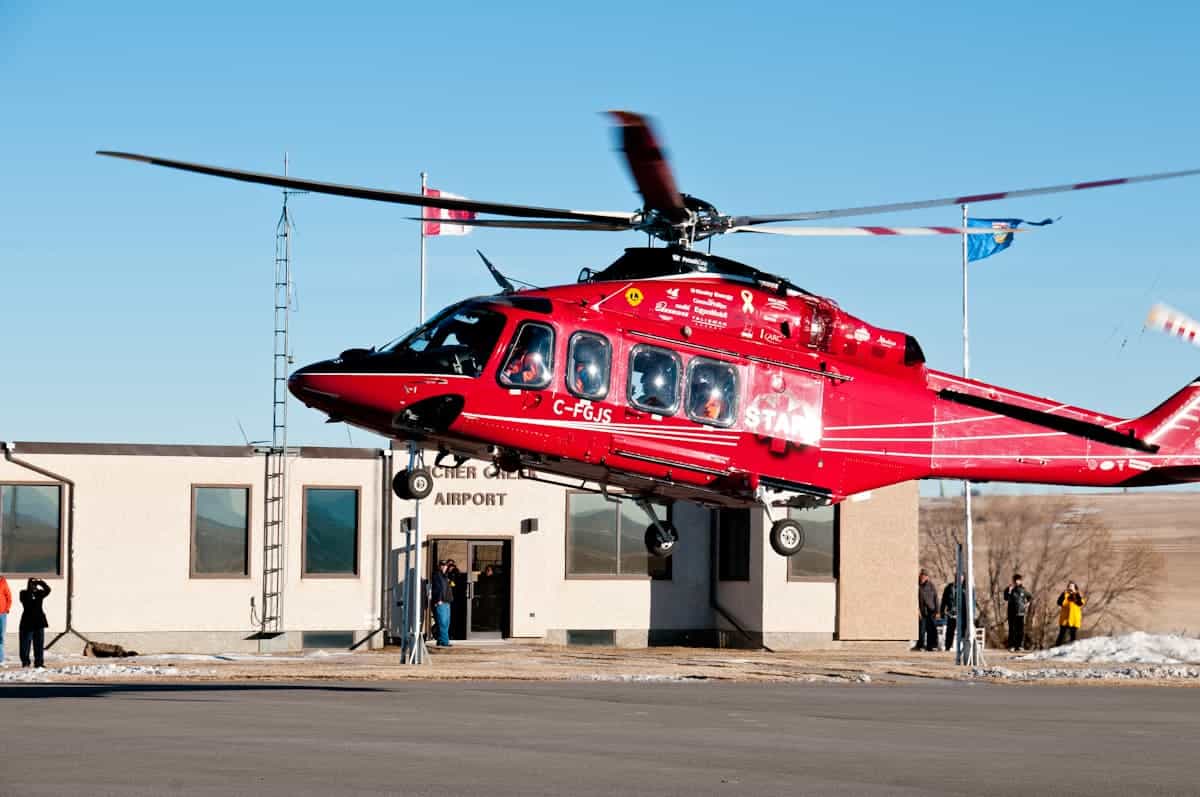
Where on the field a helicopter touches down is part of that clearance. Big cities can add their own airspace restrictions, as our guide to flying a helicopter over Manhattan explains.
Where Helicopters Cannot Land: National Parks and Wilderness
National parks are the clearest no. 36 CFR 2.17 prohibits “operating or using aircraft on lands or waters other than at locations designated pursuant to special regulations.”
The same rule bans delivering or picking up a person or object by helicopter in a park, except in emergencies involving public safety or serious property loss, or under a permit. Official federal business and rescues directed by the superintendent are exempt.
Flying over a park is a separate question with its own rules, covered in our guide to helicopter tours and flights over national parks.
Federal wilderness areas go further. The Wilderness Act of 1964 says there shall be “no landing of aircraft” in a designated wilderness, except as needed to administer the area and in emergencies involving people’s health and safety.
There is one grandfather clause. Where aircraft use was already established before an area was designated, the law allows it to continue, subject to restrictions.
Can Helicopters Land on Water?
Only the ones built or equipped for it. For anything else, putting down on water is a ditching, not a landing.
The US Coast Guard’s HH-3F Pelican was the classic exception. The Coast Guard bought its first one in November 1967, and the type was amphibious, with a rear ramp that could be opened in flight, on the ground or on the water.

Today’s Coast Guard fleet is in our roundup of every Coast Guard aircraft and helicopter flying now.
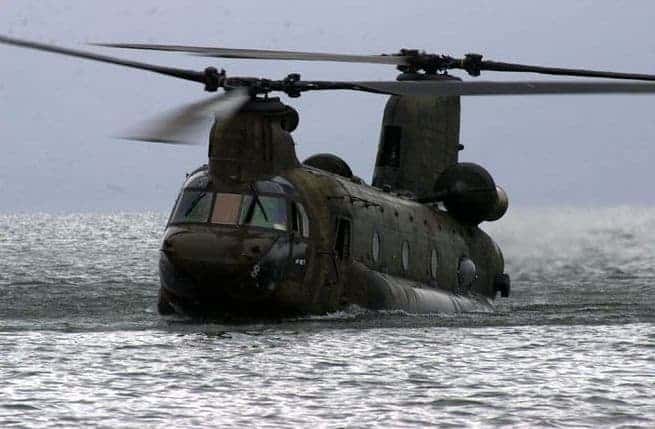
The Army’s CH-47 Chinook can land on water too. Boeing and the Army proved it in 1965 with an early CH-47A whose fuselage had been sealed, but water landings are rare and have to be deliberate.
Before you land anywhere new
Get the owner’s permission. Check the city or county zoning code, not just the FAA rules. Make sure the spot is not in a national park or wilderness area. Then ask whether the landing can be made without endangering anyone on the ground, because careless or reckless flying is the one federal rule every landing has to clear.
FAQ
Sources and references used for research and fact-checking.
- Cornell Law School LII, 14 CFR 91.119, Minimum safe altitudes: General
- Cornell Law School LII, 14 CFR 91.13, Careless or reckless operation
- Cornell Law School LII, 14 CFR 91.3, Responsibility and authority of the pilot in command
- Cornell Law School LII, 14 CFR 91.129, Operations in Class D airspace
- Cornell Law School LII, 14 CFR 157.1, Notice of construction of airports: Applicability
- Cornell Law School LII, 14 CFR 157.2, Definition of terms
- Cornell Law School LII, 14 CFR 157.7, FAA determinations
- Cornell Law School LII, 14 CFR 157.5, Notice of intent and time of notice
- Cornell Law School LII, 36 CFR 2.17, Aircraft and air delivery (National Park Service)
- Cornell Law School LII, 16 U.S. Code 1133, Wilderness Act: Use of wilderness areas
- Caltrans Division of Aeronautics, Heliport Permits
- FindLaw, Virginia Code 15.2-2293.2, Regulation of helicopter use
- Patch, North Shore Man's Chopper Must Stay On His Own Property
- FOX6 Milwaukee, Pilot flies helicopter to Richfield Cabela's, lands in parking lot
- Coast Guard Aviation Association, Sikorsky HH-3F Pelican
- SlashGear, Can The Chinook Helicopter Land On Water?
Get the Newsletter
The latest aviation news and stories sent to your inbox.
About the Author

Tim is the owner and lead editor of AeroCorner since 2019, overseeing aviation content covering aircraft, airlines, airports, and the broader aviation industry. Through years of researching, writing, editing, and publishing aviation-focused content, he has developed extensive practical knowledge of commercial aviation and air travel. Based in Asia and a frequent traveler himself, Tim also brings firsthand passenger experience to AeroCorner’s coverage. Outside of publishing, he has also explored aviation firsthand through hands-on flight training in New Zealand.