

Table of Contents
Florida has 928 open airports and landing facilities, according to the FAA’s airport master records effective October 29, 2026. Only Texas has more.
Most of them are closed to you. 800 are private-use, 128 are open to the public, and just 21 boarded more than 10,000 airline passengers in 2025.
How Many Airports Are in Florida?
The FAA answer is 928 for 2026. In the FAA’s records, “airport” means any registered landing facility: runway airports, heliports, seaplane bases, gliderports and ultralight fields. The file holds 937 Florida records in all, but nine of them are marked closed, mostly private ranch strips plus a tour heliport in Orlando.
Count runway airports only and the number drops to 476. Count only the airports with scheduled airline flights and it drops to the low twenties, depending on where you draw the line.
Florida's airports at a glance
928 open landing facilities in FAA data effective October 29, 2026. 476 runway airports. 128 open to the public. 27 certified by the FAA for airline service. 21 primary airports with 10,000 or more boardings in 2025. 4 large hubs that carried 76 percent of those passengers.
What the 928 Actually Are
Split the total by type and by who may use it, and the picture changes. Barely half are runway airports, and six in seven are private.
| Facility type | Public use | Private use | Total |
|---|---|---|---|
| Airports (runways) | 122 | 354 | 476 |
| Heliports | 1 | 384 | 385 |
| Seaplane bases | 5 | 58 | 63 |
| Gliderports | 0 | 2 | 2 |
| Ultralight fields | 0 | 2 | 2 |
| Total | 128 | 800 | 928 |
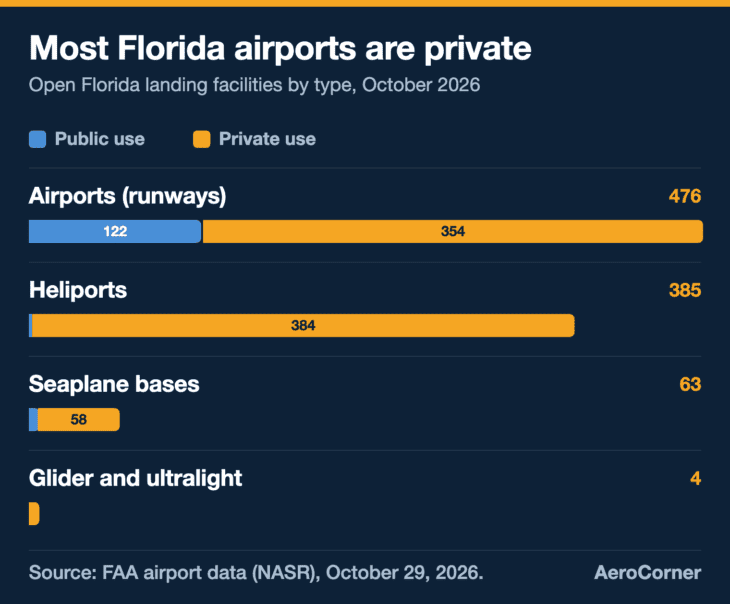
Heliports are the surprise. Florida has 385 of them, and 384 are private. At least 199 carry the name of a hospital, medical center or health system, which tells you who flies into them.
Even among runway airports, three in four are private: ranch strips, fly-in communities and company fields, usable only with the owner’s permission. Our guide to the different types of airports explains how each class works.
The airports cluster where the people are. Miami-Dade County has the most landing facilities of any Florida county with 46, just ahead of Orange County (45) and Polk County (44).
Public use does not always mean public ownership. Of the 128 open to everyone, 106 are owned by a city, county or airport authority, 21 are privately owned but open to any pilot, and one belongs to the Air Force.
Very few are busy enough to need a control tower. The FAA file lists a tower at 64 of the 928 facilities. At every other Florida field, pilots coordinate with each other over a shared radio frequency.
How Many Florida Airports Have Airline Flights?
27 Florida airports hold an FAA operating certificate under 14 CFR Part 139. An airport needs one to serve scheduled passenger flights on aircraft with more than 9 seats, or unscheduled flights from 31 seats up.
Not every certificate gets used. The FAA counts 21 Florida airports as primary, meaning they boarded at least 10,000 passengers in 2025. Two more, Fort Lauderdale Executive and Witham Field in Stuart, boarded between 2,500 and 10,000, which makes 23 commercial service airports in all.
| Airport | FAA hub size | 2025 boardings |
|---|---|---|
| Orlando (MCO) | Large | 28.0 million |
| Miami (MIA) | Large | 26.5 million |
| Fort Lauderdale (FLL) | Large | 15.6 million |
| Tampa (TPA) | Large | 12.1 million |
| Fort Myers (RSW) | Medium | 5.5 million |
| West Palm Beach (DJT) | Medium | 4.3 million |
| Jacksonville (JAX) | Medium | 3.7 million |
| Sarasota/Bradenton (SRQ) | Small | 2.2 million |
| Orlando Sanford (SFB) | Small | 1.6 million |
| Pensacola (PNS) | Small | 1.5 million |
| St. Pete-Clearwater (PIE) | Small | 1.4 million |
| Destin-Fort Walton Beach (VPS) | Small | 1.2 million |
| Punta Gorda (PGD) | Small | 1.1 million |
| Panama City (ECP) | Small | 947,007 |
| Key West (EYW) | Small | 760,753 |
| Tallahassee (TLH) | Nonhub | 442,104 |
| Daytona Beach (DAB) | Nonhub | 375,353 |
| Melbourne (MLB) | Nonhub | 313,198 |
| Gainesville (GNV) | Nonhub | 288,515 |
| Vero Beach (VRB) | Nonhub | 128,961 |
| Lakeland (LAL) | Nonhub | 91,018 |
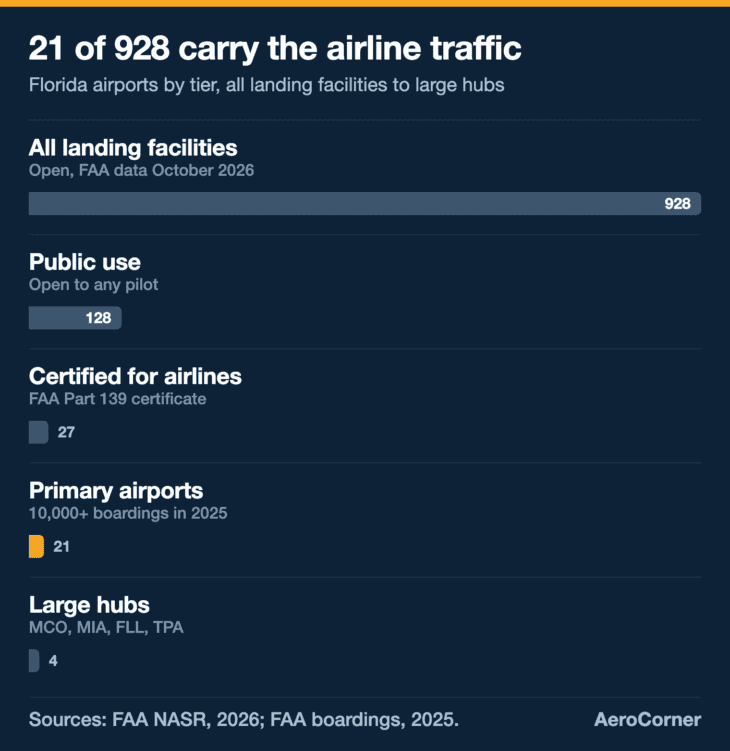
Those 21 airports boarded 108.1 million passengers in 2025, second only to California among the states. Four large hubs carried 76 percent of them.
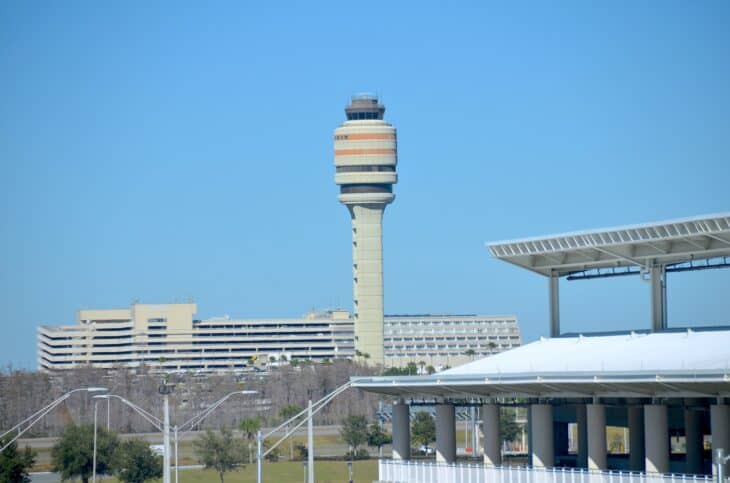
Orlando International is the busiest, with 28.0 million boardings, seventh in the country. In AeroCorner’s flight data, updated November 13, 2026, it averages 606 flights a day to 198 destinations.

An airline airport on an Air Force base
Destin-Fort Walton Beach Airport (VPS) sits on Eglin Air Force Base, and the FAA lists it as Air Force owned. It still boarded 1.2 million airline passengers in 2025, more than Key West or Panama City.
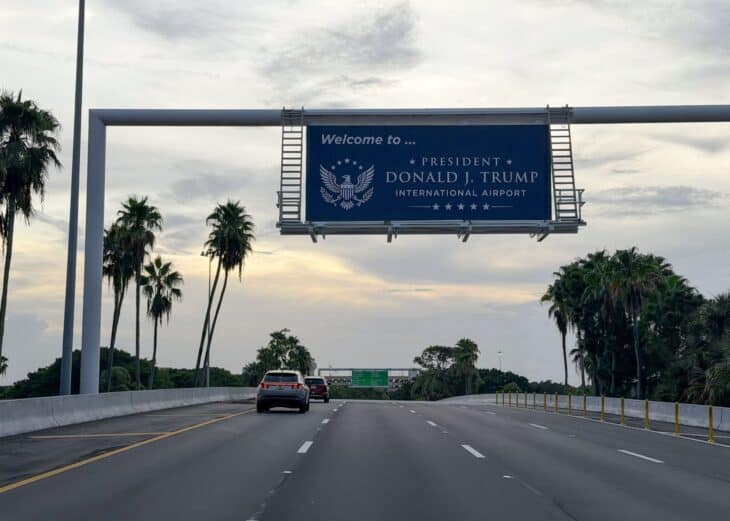
One code on the list is new. Palm Beach International became President Donald J. Trump International Airport in July 2026, and the FAA now lists it as DJT.

Why Other Sites Give a Different Number
Search the question and you will see “over 130”, “19 major airports”, 21, 128 and “more than 575 private airports”. Most of them are real counts. They just count different things.
The state's count leaves out most facilities
The Florida Department of Transportation counts 128 public-use airports and more than 575 private-use airports. The 128 matches the FAA exactly. But the FAA lists 800 private-use facilities, because its count includes 384 private heliports and 58 private seaplane bases.
FDOT’s 21 commercial service airports matches the FAA’s 21 primary airports for 2025. Its own airports page, though, lists 19 airline airports, which is where the “19 major airports” line comes from.
The certificate count is higher again. Six Florida airports hold a Part 139 certificate without primary status: Naples, Ocala, St. Augustine, Fort Pierce, Marathon and Titusville. Naples boarded 3,740 passengers in 2025, yet the FAA classes it as a general aviation airport.
Military fields split the same way. FDOT counts 11 military aviation facilities, while the FAA lists 24 military-owned sites: 13 Navy, 10 Air Force and one Army. The Air Force column includes Patrick Space Force Base and the Cape Canaveral Space Force Station skid strip. The FAA total lists each Navy outlying landing field separately, most of them around Pensacola and Milton, where student pilots practice landings.
How Florida Compares With Other States
Florida ranks second for total landing facilities, behind Texas with 1,861 and ahead of California with 864. Nationally, the FAA counts 19,445; our breakdown of how many airports are in the US explains where they all are.
On runway airports alone, Florida drops to third, with 476 against 1,381 in Texas and 585 in Alaska. It is also third for airline-certified airports, behind California and Texas with 30 each.
Florida punches above its count on passengers. Its 108.1 million boardings in 2025 beat Texas, which has twice as many landing facilities, by almost 7 million.
FAQ
Sources and references used for research and fact-checking.
- Federal Aviation Administration, NASR 28-day subscription: airport data (APT CSV), effective October 29, 2026
- Federal Aviation Administration, CY 2025 Commercial Service Airports: passenger boardings, rank order and percent change from 2024
- Federal Aviation Administration, CY 2025 Enplanements at All Airports
- Federal Aviation Administration, Passenger Boarding (Enplanement) and All-Cargo Data for U.S. Airports
- Bureau of Transportation Statistics, National Transportation Statistics, Table 1-3: Number of U.S. Airports
- Federal Aviation Administration, Part 139 Airport Certification
- Florida Department of Transportation, Aviation and Spaceports Office, Florida Aviation Fast Facts
- Florida Department of Transportation, Aviation and Spaceports Office, Florida Airports
- AirlineGeeks, Palm Beach Airport Officially Renamed for Trump
Get the Newsletter
The latest aviation news and stories sent to your inbox.
About the Author

Tim is the owner and lead editor of AeroCorner since 2019, overseeing aviation content covering aircraft, airlines, airports, and the broader aviation industry. Through years of researching, writing, editing, and publishing aviation-focused content, he has developed extensive practical knowledge of commercial aviation and air travel. Based in Asia and a frequent traveler himself, Tim also brings firsthand passenger experience to AeroCorner’s coverage. Outside of publishing, he has also explored aviation firsthand through hands-on flight training in New Zealand.