

Table of Contents
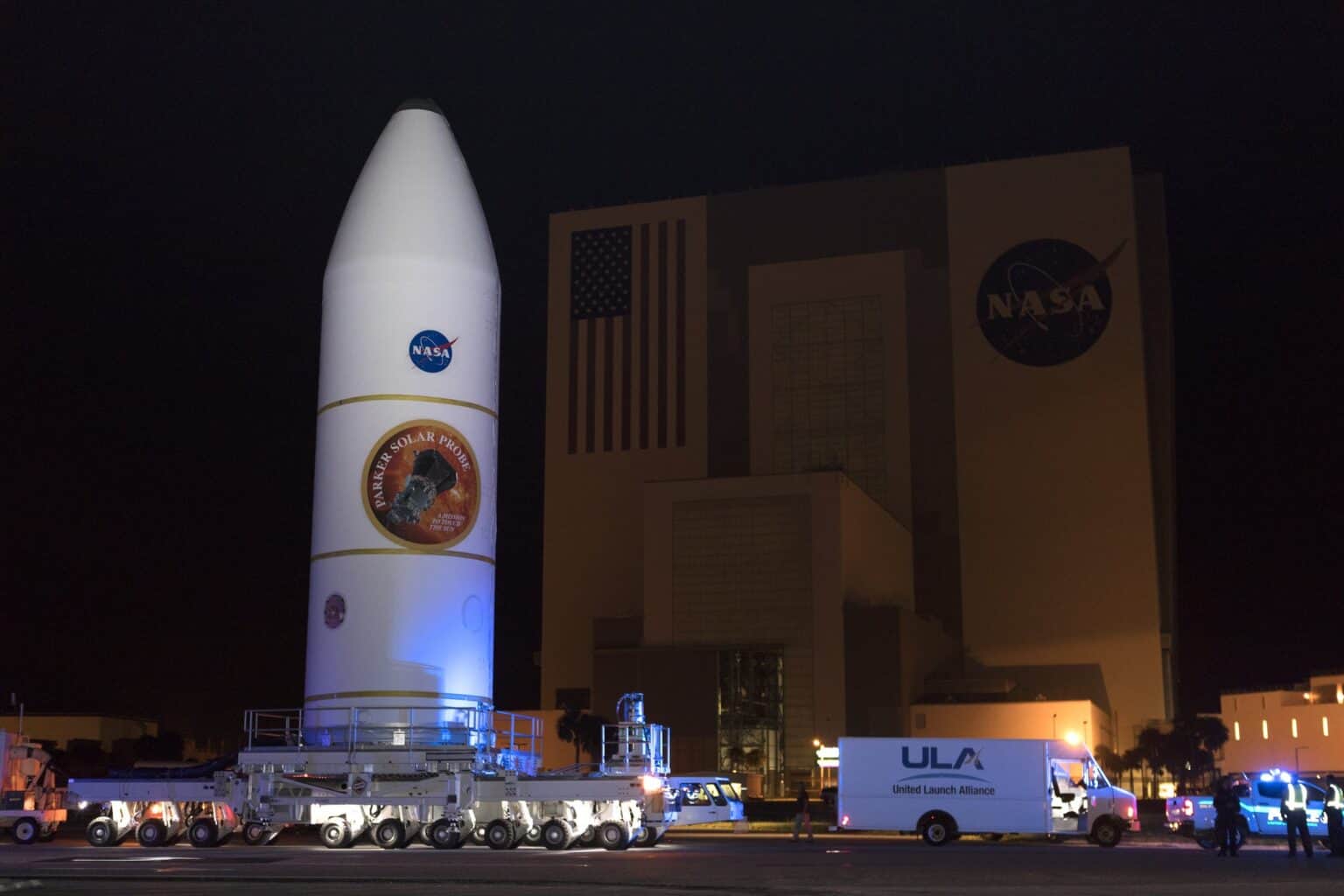
The fastest spacecraft ever launched is NASA’s Parker Solar Probe. On Dec. 24, 2024, it swung 3.8 million miles (6.1 million km) above the Sun’s surface at 430,000 mph (692,000 km/h), the fastest any human-made object has ever moved.
That is about 2.8 times the old record, set by the German-American Helios 2 probe in 1976, and more than 17 times faster than the fastest humans ever traveled. Parker has matched the figure on seven later passes, most recently on Sept. 4, 2026.
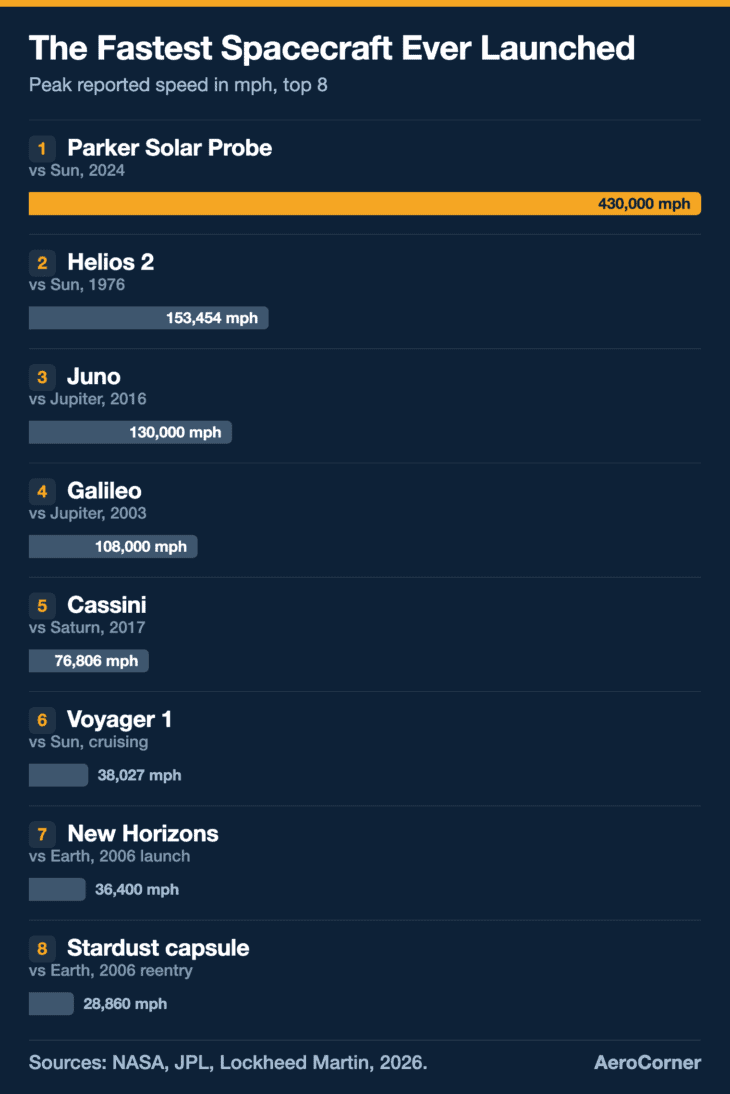
This list ranks nine spacecraft by their peak reported speed, as of November 2026. Every speed in space is measured against something, so each entry names what it was measured against, and the table shows it.
| Rank | Spacecraft | Peak speed | Relative to | When |
|---|---|---|---|---|
| 1 | Parker Solar Probe | 430,000 mph (692,000 km/h) | Sun | Dec. 24, 2024 |
| 2 | Helios 2 | 153,454 mph (247,000 km/h) | Sun | April 1976 |
| 3 | Juno | 130,000 mph (209,000 km/h) | Jupiter | July 4, 2016 |
| 4 | Galileo | 108,000 mph (174,000 km/h) | Jupiter | Sept. 21, 2003 |
| 5 | Cassini | 76,806 mph (123,608 km/h) | Saturn | 2017 |
| 6 | Voyager 1 | 38,027 mph (61,200 km/h) | Sun | Still cruising |
| 7 | New Horizons | 36,400 mph (58,536 km/h) | Earth | Jan. 19, 2006 |
| 8 | Stardust return capsule | 28,860 mph (46,440 km/h) | Earth | Jan. 15, 2006 |
| 9 | Apollo 10 (crewed) | 24,791 mph (39,897 km/h) | Earth | May 26, 1969 |
How this ranking works
Each spacecraft is ranked by its highest reported speed, measured against the body whose gravity was in charge at that moment: the Sun for solar probes, the planet for an orbiter, Earth for a launch or a reentry. That is the convention mission teams use. It is also why a probe can look faster or slower depending on who is quoting it, so where a second figure circulates, the entry gives both. Rockets on the way up, missiles and the planes of the X-15 era are left out: none of them comes close.
1. Parker Solar Probe: 430,000 mph
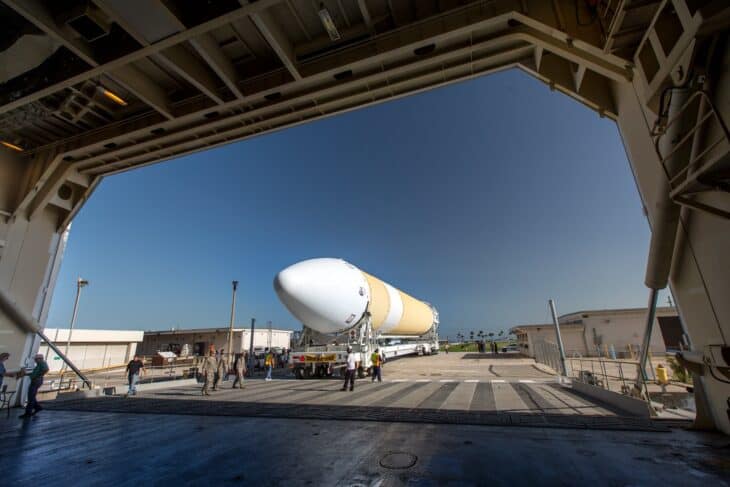
Parker Solar Probe launched on Aug. 12, 2018, on a Delta IV Heavy, with one job: fly through the Sun’s outer atmosphere, the corona. Its speed is a side effect of that job.
A spacecraft falling toward the Sun speeds up the way a ball speeds up rolling downhill, and Parker falls closer than anything ever built. After a Venus gravity assist tightened its orbit, it reached 430,000 mph (692,000 km/h) at its 22nd close approach on Dec. 24, 2024, about 3.8 million miles (6.1 million km) from the surface.
It has repeated that pass again and again: NASA counts seven flybys since then that matched both the speed and the distance, through the 29th close approach on Sept. 4, 2026. The mission has been extended into 2029 in the same orbit, so the number will keep being matched rather than beaten.
Earth to the Moon in about half an hour
At 430,000 mph, Parker would cover the average Earth-Moon distance of about 239,000 miles in roughly 33 minutes.
Parker first took the record in October 2018, only weeks after launch. On Oct. 29, 2018, NASA’s mission team calculated that it had passed 153,454 mph, Helios 2’s 42-year-old mark.
2. Helios 2: 153,454 mph
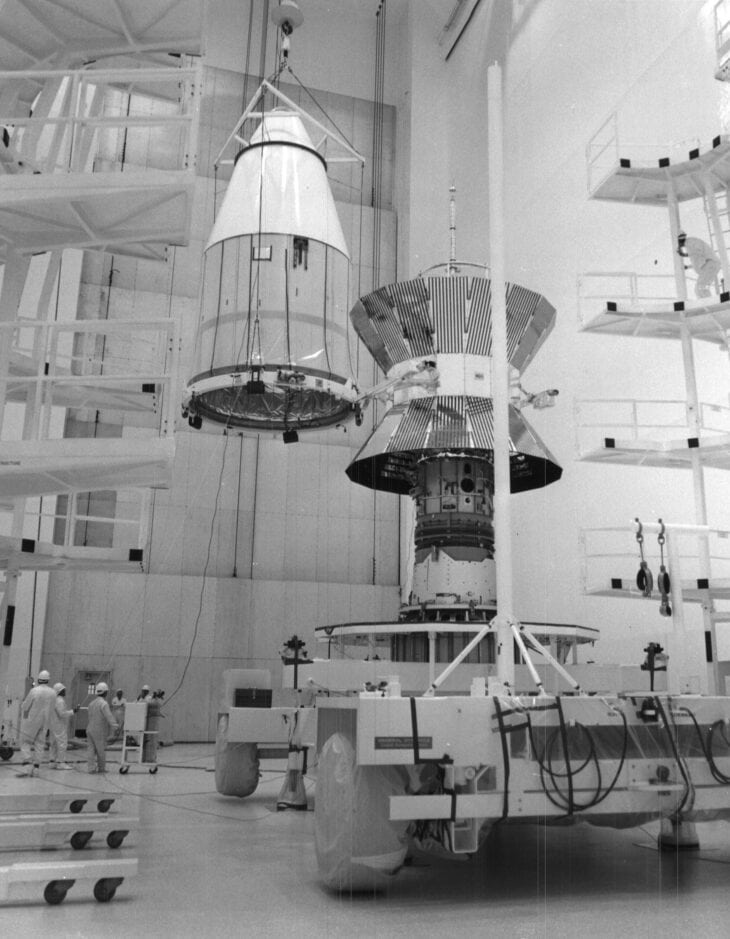

Helios 2 held the title of fastest human-made object for 42 years. It was a joint mission of West Germany’s space agency, which paid about 70 percent, and NASA, and it was built by Messerschmitt-Bölkow-Blohm.
Launched in January 1976, it reached its closest point to the Sun on April 17, 1976, about 27 million miles (43.4 million km) out, inside the orbit of Mercury. NASA puts its record at 153,454 mph (247,000 km/h); some references quote up to 157,078 mph, so treat the last few thousand as uncertain.
Its twin, Helios 1, launched on Dec. 10, 1974. Both probes worked the same trick Parker uses: fall close to the Sun and let its gravity do the accelerating.
3. Juno: 130,000 mph
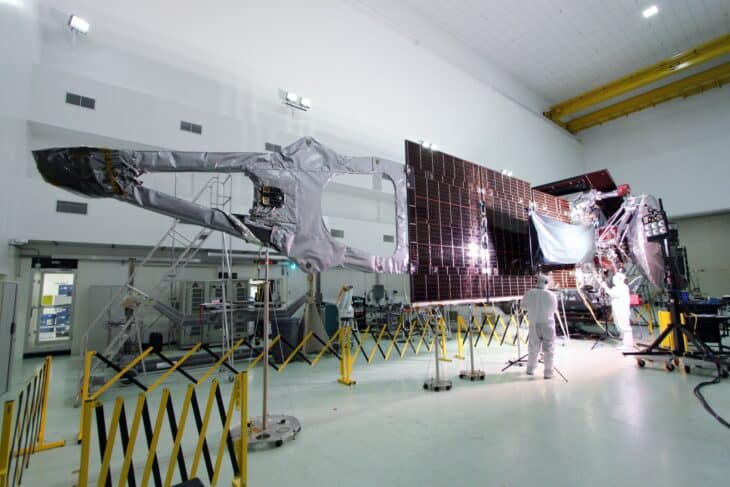

NASA’s Juno arrived at Jupiter on July 4, 2016, and Jupiter’s gravity had pulled it up to about 130,000 mph (209,000 km/h) relative to the planet before the engine burn that put it into orbit.
Measured against Earth, the same moment reads about 165,000 mph (266,000 km/h), which is why some 2016 headlines called Juno the fastest spacecraft ever. That figure is real, but it is a different yardstick from the one used for Parker and Helios 2.
4. Galileo: about 108,000 mph
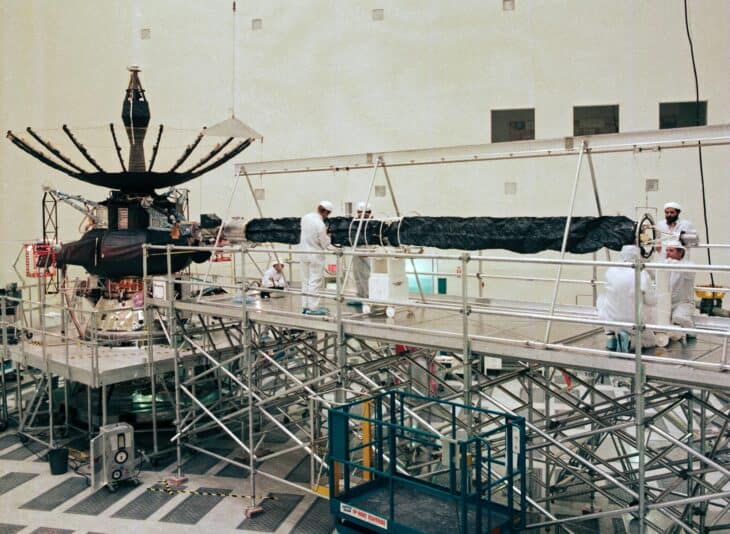

Galileo spent years orbiting Jupiter before NASA ended the mission on purpose. Low on propellant, it was steered into the planet on Sept. 21, 2003, so it could never crash into the moon Europa.
It hit Jupiter’s atmosphere at nearly 108,000 mph (48.2 km per second, about 174,000 km/h). That figure was published before impact, since nothing survived to measure it.
5. Cassini: 76,806 mph
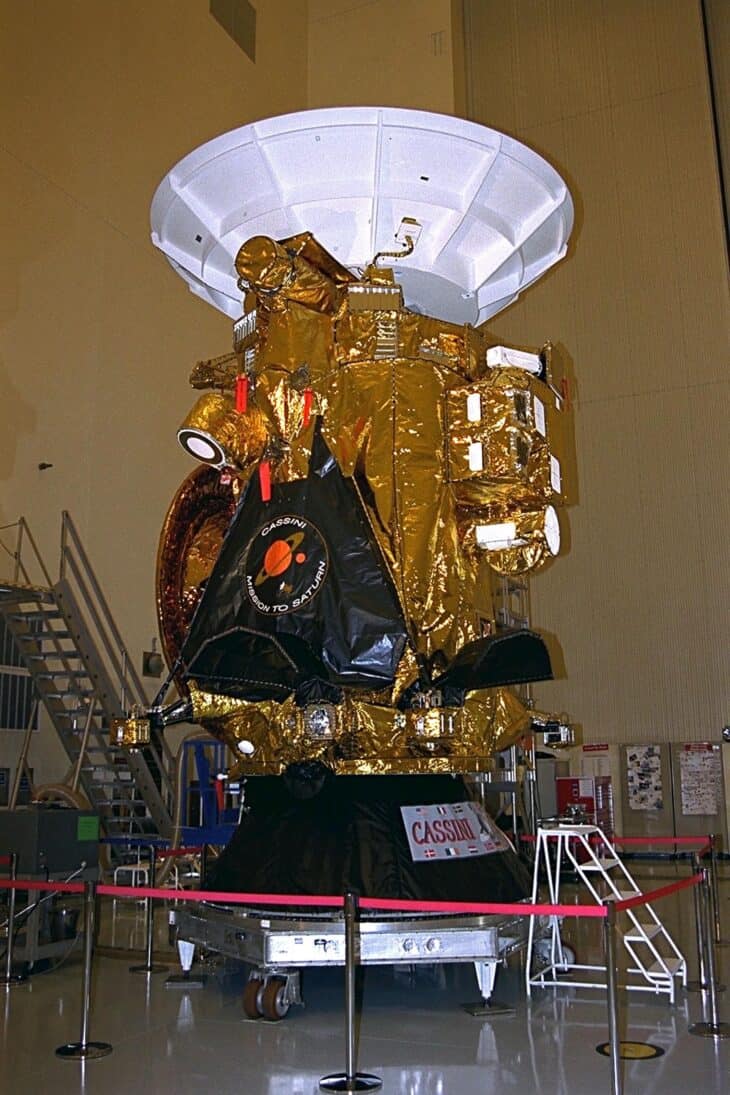

Cassini ended its 13-year Saturn mission with the Grand Finale of 2017, a series of dives through the gap between the planet and its rings. NASA gives its top speed relative to Saturn as 76,806 mph (123,608 km/h).
Like Galileo, it was nearly out of propellant and was sent into the planet on purpose, on Sept. 15, 2017, to keep the ocean moon Enceladus and the moon Titan uncontaminated.
6. Voyager 1: 38,027 mph, and still going
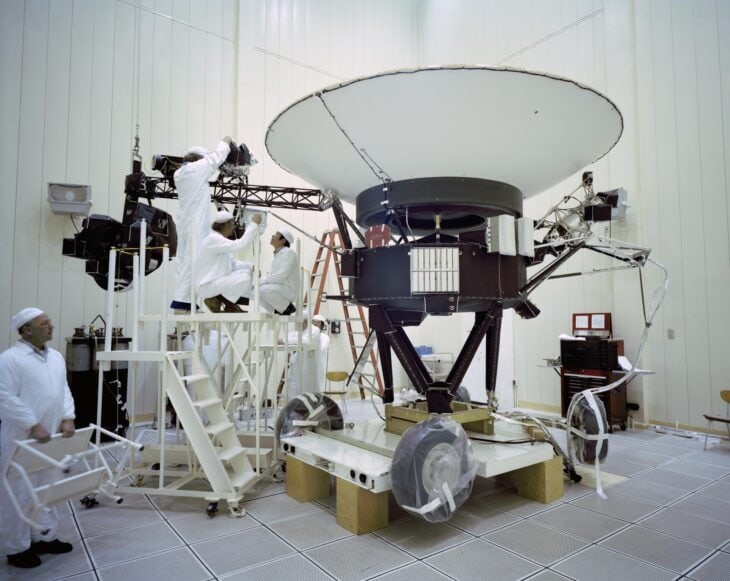

Voyager 1 is not the fastest spacecraft, but it is the fastest one this far from the Sun. As of Aug. 21, 2024, NASA had it 164.7 astronomical units from Earth, the most distant human-made object, moving at 38,027 mph (17.0 km per second) relative to the Sun.
It launched on Sept. 5, 1977, and much of its speed came from flybys of Jupiter and Saturn rather than from its rocket. It holds the record for the highest speed this far from the Sun.
7. New Horizons: 36,400 mph off the pad
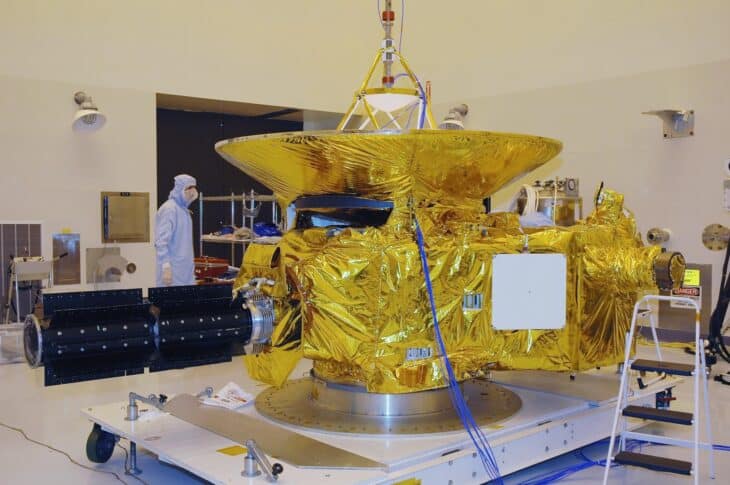

New Horizons holds a different record: the fastest launch. When it left Earth on Jan. 19, 2006, on its way to Pluto, it was moving about 36,400 mph (58,536 km/h), which NASA calls the highest launch speed relative to Earth of any human-made object.
It still took nine and a half years to reach Pluto, flying past on July 14, 2015. The fastest launch is not the fastest flight: the Sun’s gravity slows every probe heading outward.
8. Stardust capsule: 28,860 mph into Earth’s atmosphere
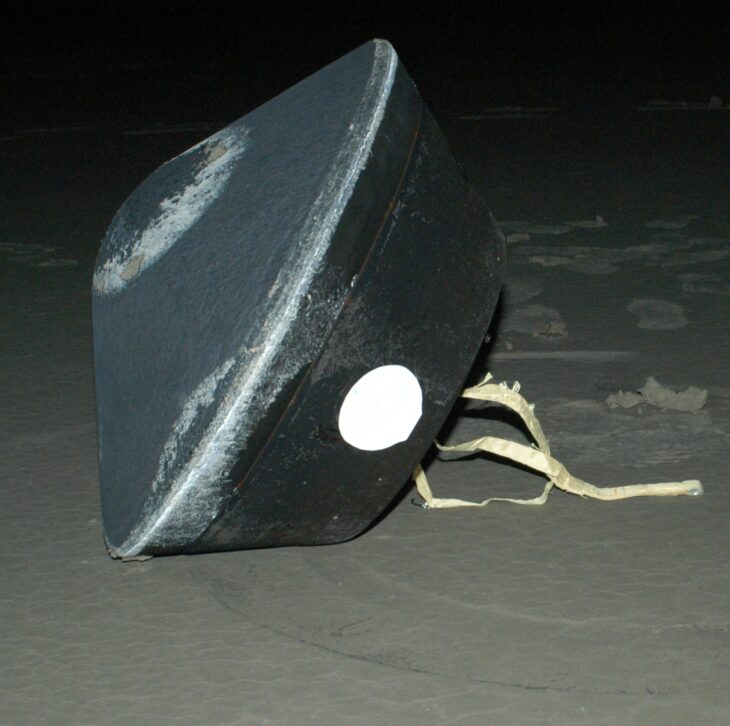

Stardust collected dust from comet Wild 2 and brought it home. Its sample capsule hit Earth’s atmosphere at 28,860 mph (46,440 km/h) on Jan. 15, 2006, which NASA’s Jet Propulsion Laboratory called the fastest reentry of any human-made object on record.
It came down by parachute on the U.S. Air Force Utah Test and Training Range, southwest of Salt Lake City, and it beat a record that had stood since Apollo 10.
9. Apollo 10: 24,791 mph, the fastest humans
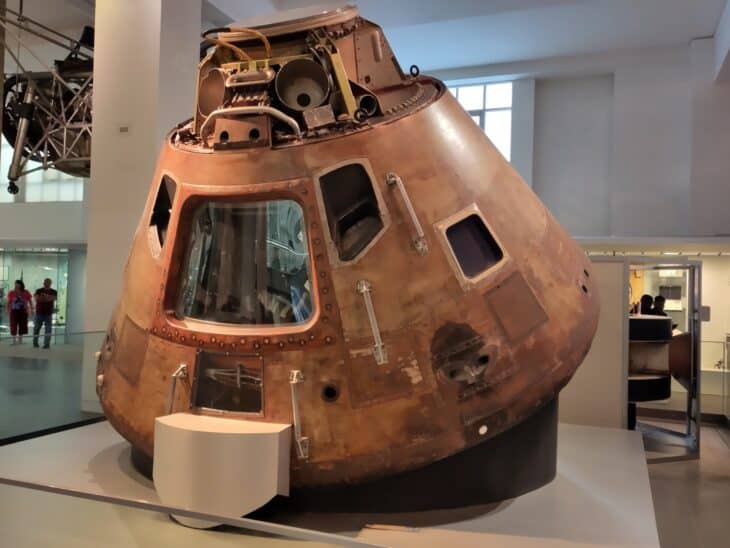

The fastest any person has traveled is still 24,791 mph (39,897 km/h). Thomas Stafford, Eugene Cernan and John Young hit it in the Apollo 10 command module on May 26, 1969, as they reentered Earth’s atmosphere on the way home from the Moon.
NASA calls it the fastest reentry of any crewed mission, and the three men still hold the record as the fastest humans. Guinness World Records now lists a slightly higher 24,816 mph for the same flight; older editions used the NASA figure.
For scale, the fastest anyone has flown in an airplane is 4,520 mph (7,270 km/h), set by Pete Knight in the North American X-15 on Oct. 3, 1967. Our ranking of the fastest aircraft in the world covers everything that flies with wings.
Why “fastest” depends on what you measure against
There is no fixed speedometer in space. A spacecraft’s speed relative to the Sun, to Earth and to Jupiter are three different numbers at the same instant, and each can be correct.
Mission teams normally quote the frame of whatever body dominates the spacecraft’s motion. That is why this list puts Parker and Helios 2 against the Sun, Juno and Galileo against Jupiter, and the reentries against Earth, and why lists that mix frames freely disagree about the order.
It is also why the fastest spacecraft are the ones that dive toward something massive. Speed in space mostly comes from falling, not from engines, which is the same reason hypersonic aircraft top out in the thousands of mph while probes reach the hundreds of thousands.
What about the manhole cover?
A popular story says a steel cap blown off a borehole in the 1957 Pascal-B nuclear test is the fastest human-made object. Physicist Robert Brownlee did estimate its speed at about six times Earth’s escape velocity, roughly 150,000 mph. But the cap was never found, the speed was never measured, and scientists think it most likely vaporized in the atmosphere. Even taken at face value, the estimate is about a third of Parker Solar Probe’s 430,000 mph.
FAQ
Sources and references used for research and fact-checking.
- NASA, Parker Solar Probe mission page
- NASA, After Latest Swing Past Sun, NASA's Parker Solar Probe Checks In
- NASA, NASA's Parker Solar Probe Makes 27th Swing Around the Sun
- NASA, Parker Solar Probe Becomes Fastest-Ever Spacecraft
- Guinness World Records, Fastest spacecraft speed
- Wikipedia, Helios (spacecraft)
- Lockheed Martin, July 4: Juno Dances with the Largest Planet in our Solar System
- Astronomy, Galileo's death plunge
- NASA, Galileo End of Mission Press Kit
- NASA, Cassini by the Numbers: The Grand Finale
- NASA, Cassini mission page
- Wikipedia, North American X-15
- NASA, Voyager 1
- Scientific American, The Fastest Spacecraft Ever?
- NASA, New Horizons mission page
- NASA Jet Propulsion Laboratory, NASA Prepares for Return of Interstellar Cargo
- NASA, 50 Years Ago: Apollo 10 Clears the Way for the First Moon Landing
- Guinness World Records, Fastest speed achieved by humans
- Wikipedia, List of vehicle speed records
- Wikipedia, Operation Plumbbob
Get the Newsletter
The latest aviation news and stories sent to your inbox.
About the Author

Tim is the owner and lead editor of AeroCorner since 2019, overseeing aviation content covering aircraft, airlines, airports, and the broader aviation industry. Through years of researching, writing, editing, and publishing aviation-focused content, he has developed extensive practical knowledge of commercial aviation and air travel. Based in Asia and a frequent traveler himself, Tim also brings firsthand passenger experience to AeroCorner’s coverage. Outside of publishing, he has also explored aviation firsthand through hands-on flight training in New Zealand.