

Table of Contents
On Jan. 1, 2020, about 2,300 working satellites circled the Earth. Less than seven years later, that number has grown more than sevenfold.
There are 17,099 active satellites in orbit, according to astrophysicist Jonathan McDowell’s satellite catalog, with data as of Oct. 26, 2026. Of those, 11,148 are SpaceX Starlinks.
How Many Satellites Are in Space?
The working count is 17,099, but that is not everything up there. McDowell’s catalog also lists 3,098 dead satellites still in orbit, which brings the total number of satellites in orbit, working or not, to 20,196.
Add spent rocket stages, detached parts and tracked debris, and the catalog holds 34,946 objects in Earth orbit. Satellites are a little over half of everything we track, and working ones are under half.
The count at a glance (Oct. 26, 2026)
Working satellites: 17,099. Of those, SpaceX Starlinks: 11,148. Dead satellites still in orbit: 3,098. All cataloged objects in orbit, including rocket stages and debris: 34,946. Source: Jonathan McDowell, planet4589.org.
What the 17,099 Working Satellites Are
McDowell splits the active fleet three ways: Starlinks, every other satellite that can steer itself, and satellites that cannot steer at all. The third group has no way to change its orbit once it is up.
| Group | Active satellites | Share |
|---|---|---|
| SpaceX Starlink | 11,148 | 65% |
| Other satellites that can maneuver | 3,669 | 21% |
| Satellites that cannot maneuver | 2,281 | 13% |
| Total active | 17,098 | 100% |
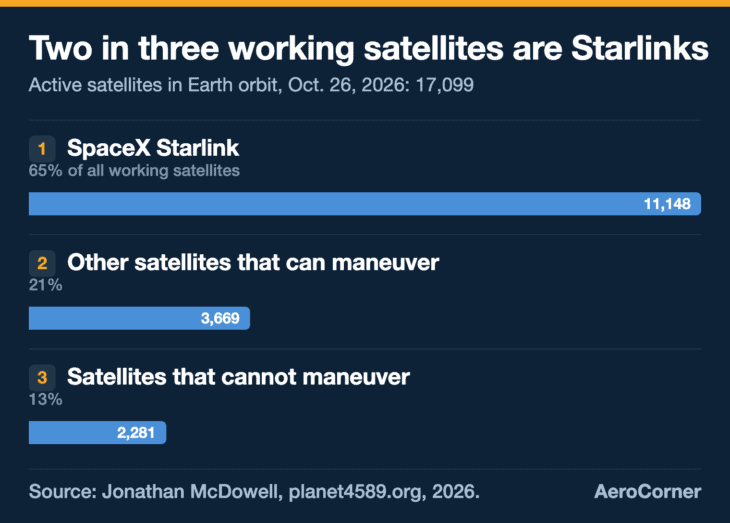
The surprise is the size of one company’s share. Starlink’s 11,148 satellites are about 65% of all working satellites, so every other operator on Earth, including NASA, the U.S. military, China and the GPS network, shares the remaining third.
That is also why the count moves so quickly. McDowell’s separate Starlink tally shows 13,096 Starlinks launched by Nov. 9, 2026, of which 11,190 were working; most of the rest have already reentered the atmosphere.
By orbit and by country
Almost all of them sit in low Earth orbit. McDowell’s orbit files put about 16,100 active satellites there, about 280 in medium orbit, where navigation networks like GPS fly, and about 580 in the synchronous belt roughly 22,200 miles (35,800 km) up.
| Owner | Active satellites (approx.) |
|---|---|
| United States | 13,020 |
| China | 1,470 |
| Europe | 1,340 |
| Russia | 370 |
| All other countries | 760 |
The United States owns roughly three in four working satellites, almost entirely because Starlink is an American company. Take Starlink out, and the U.S. count drops to about 1,900, not far ahead of China’s 1,470.
Why Other Sites Give Different Numbers
Search this question and you will see answers from about 3,000 to more than 19,000. Most of the spread comes from three things: the date of the count, whether dead satellites are included, and who decided which satellites still work.
The date. The count gained about 3,050 working satellites between Jan. 1 and Oct. 26, 2026 alone, so any figure more than a year old is badly out of date. McDowell’s own data put the count at about 9,800 in mid-July 2024, so a figure from that summer is now about 7,300 short.
The number that will not go away: 7,560
The Union of Concerned Scientists satellite database is still one of the most quoted sources, but its data runs only through May 1, 2023, and UCS has paused updates. Its 7,560 operational satellites is less than half of today’s count.
Working or not. The European Space Agency’s figures, updated Nov. 2, 2026, put about 19,610 satellites still in space. That is close to McDowell’s 20,196 working and dead satellites, and it is a different question from how many still work.
Who judges “working”. ESA counts about 15,800 of those satellites as still functioning, roughly 1,300 fewer than McDowell. The two catalogs use their own methods to decide when a satellite has stopped working, and they draw that line differently.
Total object counts differ the same way. ESA counts about 47,390 objects regularly tracked and kept in space surveillance catalogs, against the 34,946 in McDowell’s catalog, and its statistical model estimates about 68,450 objects larger than 4 inches (10 cm) in orbit.
What the rest of the catalog is
Of the 34,946 objects in McDowell’s catalog, 2,067 are spent rocket stages and 1,543 are parts that came off satellites during their missions. Another 11,140 are pieces of debris big enough to track.
About 2,652 of those debris pieces come from anti-satellite weapon tests, and 762 from collisions between objects in orbit. Deliberate weapon tests have left more than three times as much trackable debris as accidental collisions.
Most debris is too small to track at all. ESA’s models estimate about 1.5 million objects between 0.4 and 4 inches (1 to 10 cm) across, and about 230 million smaller than that, down to a few hundredths of an inch (1 mm).

How Fast the Number Is Growing
For most of the space age the working count grew slowly. McDowell’s data shows about 1,400 active satellites at the start of 2016 and about 2,300 at the start of 2020.
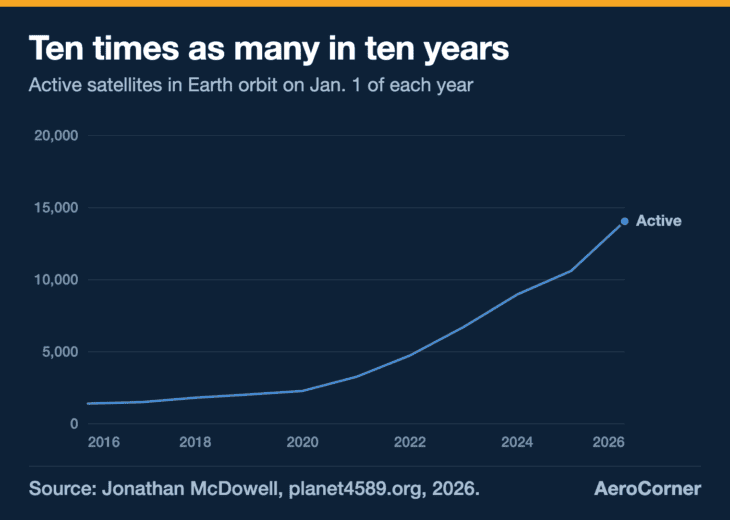
Then the megaconstellations arrived. The count passed 4,700 at the start of 2022, 8,900 at the start of 2024 and 14,000 at the start of 2026, before reaching 17,099 in late October.
Satellites also leave. Low-orbit satellites like Starlinks are built to fall back and burn up at the end of their lives, so the count is launches minus reentries, and it is updated by the day. Anyone who owns a satellite of their own adds to the same tally.
Since 1957
ESA counts about 7,400 successful rocket launches since the start of the space age, which have put about 28,570 satellites into Earth orbit. About 19,610 of them are still up there.
What 17,099 Means for Aviation
Some of these satellites touch every flight. GPS signals feed the WAAS system that guides precision approaches, and satellite broadband now carries in-flight Wi-Fi, the reason airlines like Delta faced a choice over whether to sign up for Starlink.
FAQ
Sources and references used for research and fact-checking.
- Jonathan McDowell, Jonathan's Space Report, Satellite statistics: Satellite and Debris Population
- Jonathan McDowell, Jonathan's Space Report, Sat and Debris Population vs time (data file)
- Jonathan McDowell, Jonathan's Space Report, Owner Country of Active Sats versus Orbit Type
- Jonathan McDowell, Jonathan's Space Report, Starlink Launch Statistics
- European Space Agency, Space Debris Office, Space debris by the numbers
- Union of Concerned Scientists, UCS Satellite Database
Get the Newsletter
The latest aviation news and stories sent to your inbox.
About the Author

Tim is the owner and lead editor of AeroCorner since 2019, overseeing aviation content covering aircraft, airlines, airports, and the broader aviation industry. Through years of researching, writing, editing, and publishing aviation-focused content, he has developed extensive practical knowledge of commercial aviation and air travel. Based in Asia and a frequent traveler himself, Tim also brings firsthand passenger experience to AeroCorner’s coverage. Outside of publishing, he has also explored aviation firsthand through hands-on flight training in New Zealand.