

Table of Contents
On Nov. 13, 2026, the FAA stopped every departure in the country after its air traffic network failed. Officials were quick to say it was a telecom outage, not an attack.
That distinction matters more than it sounds. A nationwide ground stop is a civilian traffic tool, run by the FAA. Behind it sits a second plan, owned by the military, that hands the sky to NORAD and decides which aircraft may fly at all.
For most of the Cold War that plan was called SCATANA. Here is what it was designed to do, what actually happened when it was used for the only time, and the quieter plan that replaced it.
What Is SCATANA?
SCATANA stands for Security Control of Air Traffic and Air Navigation Aids. It was a US emergency plan under which the Department of Defense, the FAA and the Federal Communications Commission would jointly take control of civil air traffic and the radio beacons pilots navigate by.
In plain terms, it let the military order every unauthorized aircraft out of the sky and, if needed, switch the navigation system off. It was invoked for real once, on Sept. 11, 2001, and only in a modified form. In 2006 the Pentagon replaced it with a plan called ESCAT.
SCATANA at a glance
Full name: Security Control of Air Traffic and Air Navigation Aids. Who ran it: the Defense Department, the FAA and the FCC. What it did: cleared unauthorized aircraft from US airspace and could shut down navigation aids so enemy bombers could not use them. Real-world use: once, on 9/11, in modified form. Status: replaced by the Plan for the Emergency Security Control of Air Traffic (ESCAT), effective Jan. 18, 2007.
A Plan Written for Soviet Bombers
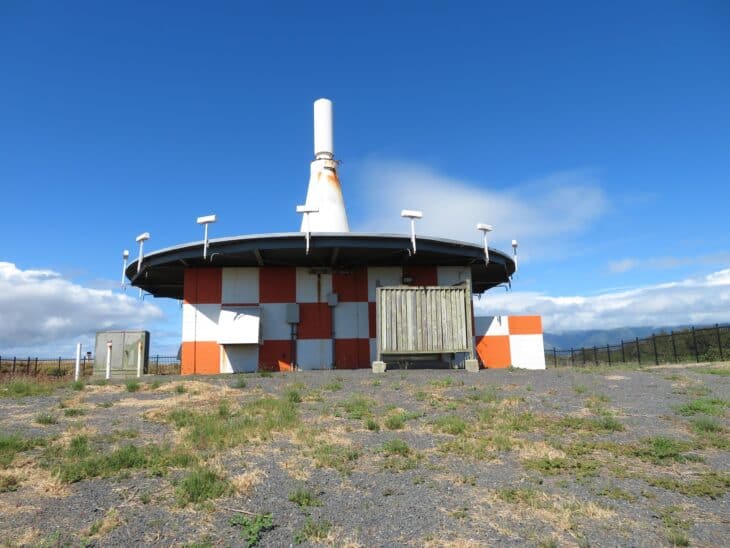
SCATANA’s second half, the navigation aids, explains what it was for. In the 1950s and 1960s the threat was a fleet of long-range Soviet bombers crossing the Arctic, and a bomber crew could steer toward an American city using the same radio beacons an airliner used.
So the plan worked in two moves: clear the sky of friendly traffic, then take away the signals. The FCC was a partner because it licenses the stations involved, from VOR beacons to instrument landing systems.

NORAD’s commander on 9/11, Gen. Ralph Eberhart, described the logic to the 9/11 Commission in 2004. “We see a bomber coming from a long range, we tell everybody to get the aircraft down, safely, then nothing flies and we control the airspace.”
Versions of the plan are known from 1971 and 1975, drawing on the Federal Aviation Act of 1958, the Communications Act of 1934 and a 1969 executive order on emergency preparedness. Its radio half sat alongside CONELRAD, the 1950s scheme that kept broadcast stations from becoming homing beacons for the same bombers.
The groundings were rehearsed in the 1960s
Emptying the sky was not a theory. Between 1960 and 1962, NORAD ran three air defense exercises called Sky Shield, and each one grounded civil flying across the United States and Canada while military jets played attacker and defender.
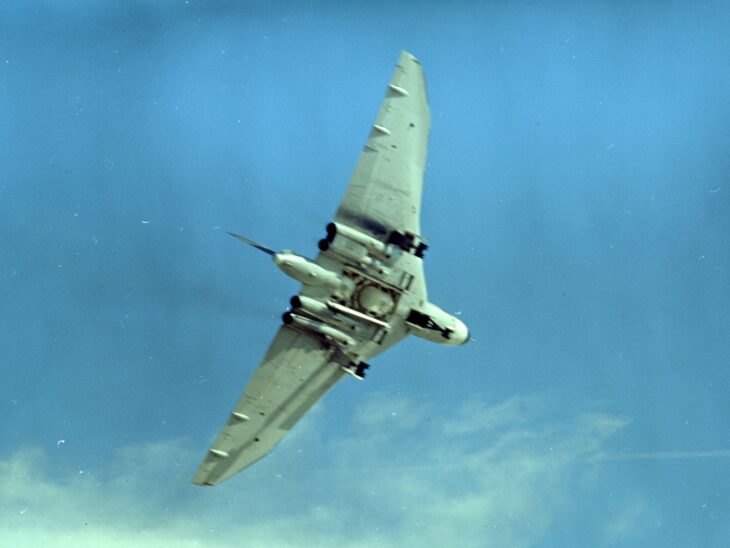
The biggest, Sky Shield II on Oct. 14, 1961, kept civil aircraft on the ground for about 12 hours. Roughly 2,900 US and Canadian airline flights were canceled, and RAF Vulcan bombers flew in from Scotland and Bermuda to play the Soviet attackers.

Eight weeks of notice, then none
Airlines got about eight weeks of warning before Sky Shield I in 1960. On Sept. 11, 2001, the FAA had no warning at all, and FAA Deputy Administrator Monte Belger told the 9/11 Commission the airspace was emptied of all but military and emergency flights for the first time in the agency’s history.
What Happened on 9/11
SCATANA is often credited with grounding America’s airliners on 9/11. The record says the FAA had already done most of that work before the military plan was invoked.
9:25 a.m.
The FAA Command Center orders a nationwide ground stop. No new departures anywhere in the country, according to the 9/11 Commission Report.
9:42 a.m.
Every aircraft is told to land. After news reports of the Pentagon strike, national operations manager Ben Sliney orders all FAA facilities to land all aircraft at the nearest airport.
About 11 a.m.
NORAD executes a modified SCATANA. Commissioner Jamie Gorelick put the military takeover at around this time, more than an hour after Sliney’s order.
12:16 p.m.
The sky is empty. FAA Deputy Administrator Monte Belger testified that US airspace held only military and essential emergency flights, after more than 4,500 aircraft had landed.
The 9:42 order, the subject of our story on Ben Sliney’s first day in the job, was an FAA decision. The 9/11 Commission called it unprecedented and credited the air traffic system with landing about 4,500 aircraft without incident.
Eberhart explained the delay himself. With “four to five thousand airplanes airborne,” NORAD’s radars could not separate traffic the way the FAA could, so declaring control early “would have had worse problems than we had that morning.”
The written plan also carried a step nobody wanted. “We’re supposed to turn off all the navigational aids,” Eberhart told the Commission, and that morning it was “the last thing we wanted to do.”
So NORAD rewrote it on the spot. The version it executed left the navigation aids on, left the FAA controlling the traffic still flying, let law enforcement and medical flights keep operating, and added a way to apply for waivers.
SCATANA Is Gone: Meet ESCAT
The lesson of 9/11 was that the threat could start inside the system, aboard an airliner already cleared by ATC. In October 2006 the Defense Department published a rewrite of the plan in the Federal Register as 32 CFR Part 245, the Plan for the Emergency Security Control of Air Traffic, or ESCAT. A correction set its effective date as Jan. 18, 2007.
The cast changed. ESCAT is a joint plan of the Defense Department, the FAA and the Department of Homeland Security through the TSA, neither of which existed on 9/11. The FCC is no longer a named party.
So did the navigation aids. Switching them off is no longer spelled out in the plan: any “mitigation of hostile use of NAVAID signals” now needs a separate agreement between Defense and the other departments. The rule also tells commanders that interference with normal air traffic “should be minimized.”
Who can declare it, and when
The commander of NORAD declares ESCAT for the lower 48 states, Alaska, Canada, Puerto Rico and the US Virgin Islands. The commander of US Pacific Command covers Hawaii, Guam and the Pacific oceanic airspace the FAA controls.
It can be declared in an air defense emergency, when an attack is probable, imminent or under way. It can also be used when a neighboring command is under attack, or when national security is threatened short of a declared emergency. That third case is the one that fits a 9/11-style attack.
Before declaring it, the commander is to consult the FAA and TSA administrators and, time permitting, get the Secretary of Defense’s approval. It can be phased in rather than imposed all at once, and once it is declared, the military commander has the final say.
Who gets to fly
The heart of ESCAT is an eight-level priority list. Airspace is opened from the top down, and anything not on the list falls to the bottom.
| Priority | Who it covers (summary) |
|---|---|
| 1 | The President, the Prime Minister of Canada and essential staff; interceptors, tankers, AWACS and other active air defense aircraft; strategic retaliatory forces and airborne command posts |
| 2 | Forces deploying for military operations, including activated Civil Reserve Air Fleet airliners; special operations; federal homeland security and law enforcement flights |
| 3 | Forces in pre-deployment, base defense aircraft, other search and rescue, emergency flight inspection, damage assessment |
| 4 | Dispersal of tactical military aircraft and CRAF airliners, flight inspection, test flights |
| 5 | Military commanders and key officials, dispersal of non-tactical military aircraft, federal contract aircraft |
| 6 | State and local police, approved emergency plans, air ambulance (LIFEGUARD and MEDEVAC) flights, national security production flights |
| 7 | Other military flights |
| 8 | Everything else, including ordinary airline and private flights |
Priority 1 and 2 aircraft cannot be delayed or diverted by military commanders. Everything from 3 down can be held, diverted or rerouted to protect the air defense picture.
A Priority 8 flight takes off only with a Security Control Authorization, requested through the TSA and approved by the military, case by case. Every flight that does move must file a flight plan, squawk a discrete transponder code and stay in radio contact with ATC.
ESCAT vs. an FAA Ground Stop
The two get confused because both can leave every airliner parked. They come from different owners and solve different problems.
| FAA ground stop | ESCAT | |
|---|---|---|
| Who orders it | The FAA, usually its Command Center | NORAD, or Pacific Command in the Pacific |
| Why | Capacity, weather or equipment failure | An air defense or national security emergency |
| Aircraft already flying | Usually continue to their destinations | Can be diverted, rerouted or landed |
| Who may fly | Everyone, once the stop lifts | Set by an eight-level priority list |
| Who has the final say | The FAA | The military commander |
A ground stop is the FAA’s everyday brake, and it is usually aimed at one airport. Our explainer on how ground stops and flow control work covers the routine version.
The Nov. 13 order was the nationwide version, and it still left the decisions with the FAA. Flights already in the air continued to their destinations, and departures resumed as the radar centers recovered. ESCAT was never part of it.
Smaller security measures sit in between. A temporary flight restriction closes a defined block of airspace, around a presidential visit or a stadium, without touching the rest of the country. ESCAT’s own test message names TFRs among the air control measures a commander can order.
The Myths About SCATANA
Myth: SCATANA grounded every plane on 9/11
The FAA did. The nationwide ground stop came at 9:25 a.m. and the order to land everything at 9:42 a.m., both civilian decisions. NORAD’s modified SCATANA followed at around 11 a.m., and it left the FAA in charge of the traffic still airborne.
The second myth is that the plan is secret. Its successor, ESCAT, is printed in full in the Code of Federal Regulations, priority list included, where anyone can read it.
What is not public is the classified detail around it. The rule mentions “anchor annex flights,” defined only as a classified Defense mission, and leaves the procedure for switching off navigation aids to a separate agreement.
The third myth is that ESCAT gets tested by grounding traffic. The rule requires a test at least once a year, and it bars exactly that. During a test, aircraft are not grounded or diverted, nothing is broadcast to pilots, radio contact is not interrupted and navigation aids are not touched.
A test runs as a message chain instead. NORAD sends an “Exercise, Exercise, Exercise” message to the FAA Command Center, which passes it to the centers and approach controls and reports back how long the notification took.
So the next time every departure board in the country turns red, look at who gave the order. If it came from the FAA, it is a traffic problem with a fix. If it came from NORAD, the priority list is in force, and an airline seat is Priority 8.
Sources and references used for research and fact-checking.
- Department of Defense, Federal Register, Plan for the Emergency Security Control of Air Traffic (ESCAT), final rule, 71 FR 61889
- Department of Defense, Federal Register, Plan for the Emergency Security Control of Air Traffic (ESCAT), final rule; correction, 71 FR 66110
- Cornell Law School Legal Information Institute, 32 CFR Part 245, Plan for the Emergency Security Control of Air Traffic (ESCAT)
- National Commission on Terrorist Attacks Upon the United States, Twelfth Public Hearing, June 17, 2004: Transcript
- National Commission on Terrorist Attacks Upon the United States, The 9/11 Commission Report, Chapter 1: We Have Some Planes
- Wikipedia, Security Control of Air Traffic and Air Navigation Aids
- Hackaday, Radio Apocalypse: Clearing The Air With SCATANA
- Wikipedia, Operation Sky Shield
- Aviation International News, Operation Skyshield Remembered 50 Years Later
- AVweb, Rare Silent Skies Before 9/11
Get the Newsletter
The latest aviation news and stories sent to your inbox.
About the Author

Tim is the owner and lead editor of AeroCorner since 2019, overseeing aviation content covering aircraft, airlines, airports, and the broader aviation industry. Through years of researching, writing, editing, and publishing aviation-focused content, he has developed extensive practical knowledge of commercial aviation and air travel. Based in Asia and a frequent traveler himself, Tim also brings firsthand passenger experience to AeroCorner’s coverage. Outside of publishing, he has also explored aviation firsthand through hands-on flight training in New Zealand.