

Table of Contents
A change to how US airlines report delays rewrites the deal behind every meal voucher and hotel room they promise, and the government’s own analysis says passengers will get fewer of both.
On October 19, 2026, a Department of Transportation rule takes ten causes of delay and cancellation out of the “Air Carrier” code, the category reserved for problems within an airline’s control.
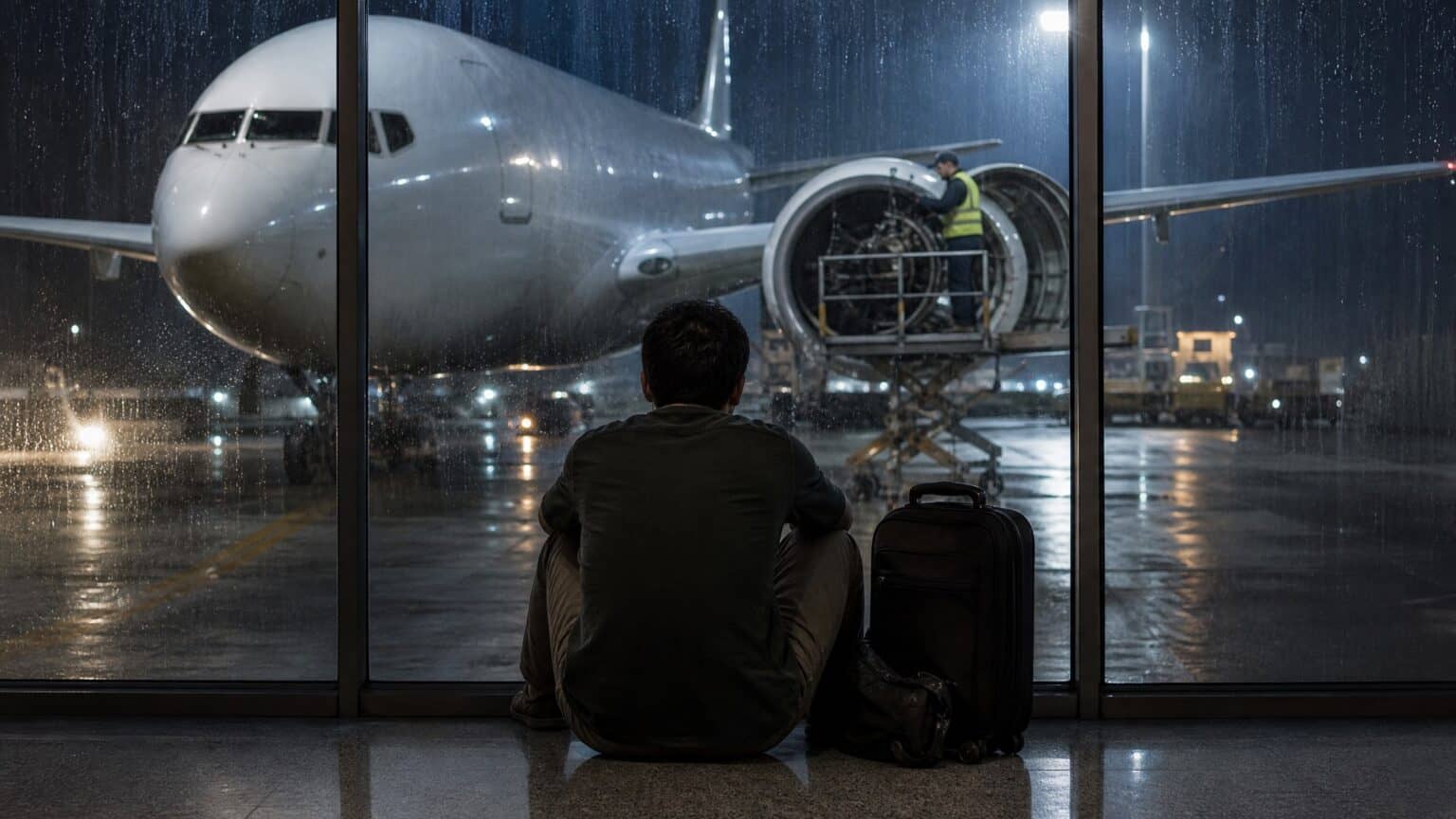
One of the ten is unscheduled maintenance that cannot be deferred or must be fixed before the aircraft flies, which can include a hydraulic leak or a warning light found at the gate.
That matters because airline promises of a meal after a three-hour wait and a hotel after an overnight stranding apply only to controllable disruptions. The DOT, which published the final rule on September 3, says the number of delays that earn those amenities “is expected to be reduced.”
Congress Wrote the List in 2024, and the DOT Skipped Public Comment
The list comes from Section 511(b) of the FAA Reauthorization Act of 2024, signed on May 16, 2024. It says ten events “shall not be included within the Air Carrier code,” and the rule copies that text word for word into a new reporting category called “Section 511(b).”
Airlines for America, the industry’s main trade group, filed a petition on October 22, 2024, asking the DOT to speed the change along. Because the statute left no room for interpretation, the DOT decided public comment was “unnecessary” and went straight to a final rule, signed by Transportation Secretary Sean Duffy.
Unscheduled maintenance is the exemption closest to an everyday delay. The other nine are:
- Aircraft damage from extreme weather, foreign object debris, or sabotage
- Overheated brakes after a safety incident that required emergency procedures
- A cyberattack, if the airline complied with cybersecurity rules
- An unexpected failure of a government system needed to fly safely
- A bag system outage the airline and its contractors do not control
- Removing an unruly passenger
- A medical emergency that was not the airline’s fault
- Cleaning required by the death of a passenger
- An airport closure caused by volcanic ash, wind, or wind shear
Plenty stays on the airline’s side of the ledger: crew shortages, fueling, catering, baggage loading, cabin cleaning, and maintenance that runs late inside a scheduled program. A fault the airline can legally defer under its minimum equipment list also stays in the Air Carrier column, because the exemption only covers work that cannot wait.
8.2% of July’s Flights Ran Late for the Airline’s Own Reasons
The DOT’s September 2026 Air Travel Consumer Report covers July 2026. Of 697,754 flights marketed by the reporting airlines, the Air Carrier code accounted for the equivalent of 57,341 delayed flights, or 8.2%.
That compares with 6.9% for the National Aviation System, meaning traffic, air traffic control and ordinary weather, and 1.1% for extreme weather. The largest share, 10.9%, went to late-arriving aircraft, the knock-on code for a plane that showed up late from its previous flight. All of that is part of why one delay creates more.
How much of that 8.2% is unscheduled maintenance? Nobody can say. The rule states the DOT “does not have visibility into the frequency” of the ten events, because carriers report only five broad cause categories.
The cost figures are precise. The DOT estimates each of the 13 reporting carriers will spend $8,659 reprogramming its systems, $112,567 in total, plus $48,000 at the Bureau of Transportation Statistics and $16,000 at the FAA.
It then scores the rule’s total cost as “less than zero.” The reason given is that airlines will suffer less “negative reputational” harm once fewer delays are blamed on them in public data. The meals and hotels passengers stop receiving are booked as “a transfer of value from consumers back to air carriers,” not as a cost.
The Label on a Delay Decides Who Pays for the Night
The rule changes a reporting code, not any airline’s contract. It does not order a carrier to rewrite its customer service plan, but those plans promise amenities only for disruptions within the airline’s control, and that is the definition the DOT just narrowed.
On the DOT’s own dashboard, every listed airline commits to a meal or meal voucher when a controllable delay or cancellation means a wait of three hours or more. Every one except Frontier also commits to a free hotel and ground transport after an overnight controllable disruption.
Consider January 2024. After the door plug blew out on Alaska Airlines Flight 1282, the FAA issued an emergency airworthiness directive grounding every Boeing 737 MAX 9 with a mid-cabin door plug until it was inspected, and Alaska cancelled 110 to 150 flights a day.
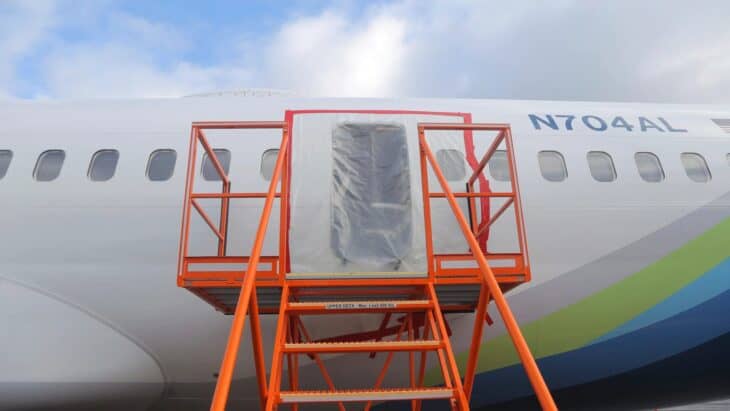

The new category covers unscheduled maintenance “including in response to an airworthiness directive” that “must be addressed before flight.” That describes those cancellations closely, so under the new rule they would no longer have been reported as the airline’s fault.
Europe went the other way. In Wallentin-Hermann v Alitalia in 2008, the EU Court of Justice ruled that a technical problem with an aircraft is generally not an “extraordinary circumstance,” so the airline still owes compensation.
In McDonagh v Ryanair in 2013, the same court held that even the Eyjafjallajökull ash cloud did not release Ryanair from its duty to provide care. Under the US rule, an airport closed by volcanic ash is now one of the ten exemptions.
Your refund is not part of this
The rule touches amenities, not refunds. Under the DOT’s separate 2024 refund rule, a cancelled or significantly changed flight you choose not to take still entitles you to a prompt refund, whatever caused it. The only enforcement pause covers flights that were merely renumbered, and it runs to July 7, 2027.
There is a quieter incentive too. Our look at why airlines would rather delay you than cancel you shows how much the label on a disruption already shapes an airline’s decisions, and this rule gives one of the most common labels a cheaper version.
The Airlines Have Not Shown Their Hand Yet
As of October 11, 2026, we found no major US airline that has announced a change to its customer service plan, and the DOT does not require one. Nothing stops a carrier from keeping its current generosity, and the DOT says those with no formal commitment may still provide amenities at their discretion.
The DOT dashboard, checked the same day, still gives “maintenance or crew problems” as its first example of a controllable delay. That page cannot stay as it is for long, because the 2024 Act requires it to explain controllability “consistent with” the very reporting rule that changes on October 19.
More changes are coming. Section 511(a) of the same law orders a rulemaking on a separate code for delays caused by FAA air traffic control instructions, and the airline petition asks for revisions beyond the ten exemptions. Both need public comment, so the DOT has put them in a later rulemaking.
Until airlines show their hand, the practical move at a broken gate is simple: ask the agent whether the delay is coded as controllable, and get the answer in the app or in writing.
Airlines can move without a rule forcing them: American told its gate agents to stop involuntary bumping in an internal memo this fall. From October 19, the word “maintenance” alone no longer settles who pays for the hotel.
Sources and references used for research and fact-checking.
- Federal Register, US Department of Transportation, Cause of Airline Delay and Cancellation Categories Under Section 511(b) of the FAA Reauthorization Act of 2024 (Final Rule, Doc. 2026-18040)
- US Department of Transportation, Airline Cancellation and Delay Dashboard
- US Department of Transportation, Air Travel Consumer Report, September 2026 (July 2026 data)
- Federal Register, US Department of Transportation, Airline Refunds and Other Consumer Protections (enforcement discretion extension, Doc. 2026-13675)
- Court of Justice of the European Union (EUR-Lex), Friederike Wallentin-Hermann v Alitalia, Case C-549/07
- Court of Justice of the European Union (EUR-Lex), Denise McDonagh v Ryanair Ltd, Case C-12/11
- Wikipedia, Alaska Airlines Flight 1282
- View from the Wing, Your Plane Breaks, But The Airline May No Longer Owe You A Hotel
- Elliott Report, A maintenance delay was the airline's problem. Not anymore.
Get the Newsletter
The latest aviation news and stories sent to your inbox.
About the Author

Tim is the owner and lead editor of AeroCorner since 2019, overseeing aviation content covering aircraft, airlines, airports, and the broader aviation industry. Through years of researching, writing, editing, and publishing aviation-focused content, he has developed extensive practical knowledge of commercial aviation and air travel. Based in Asia and a frequent traveler himself, Tim also brings firsthand passenger experience to AeroCorner’s coverage. Outside of publishing, he has also explored aviation firsthand through hands-on flight training in New Zealand.