

Table of Contents
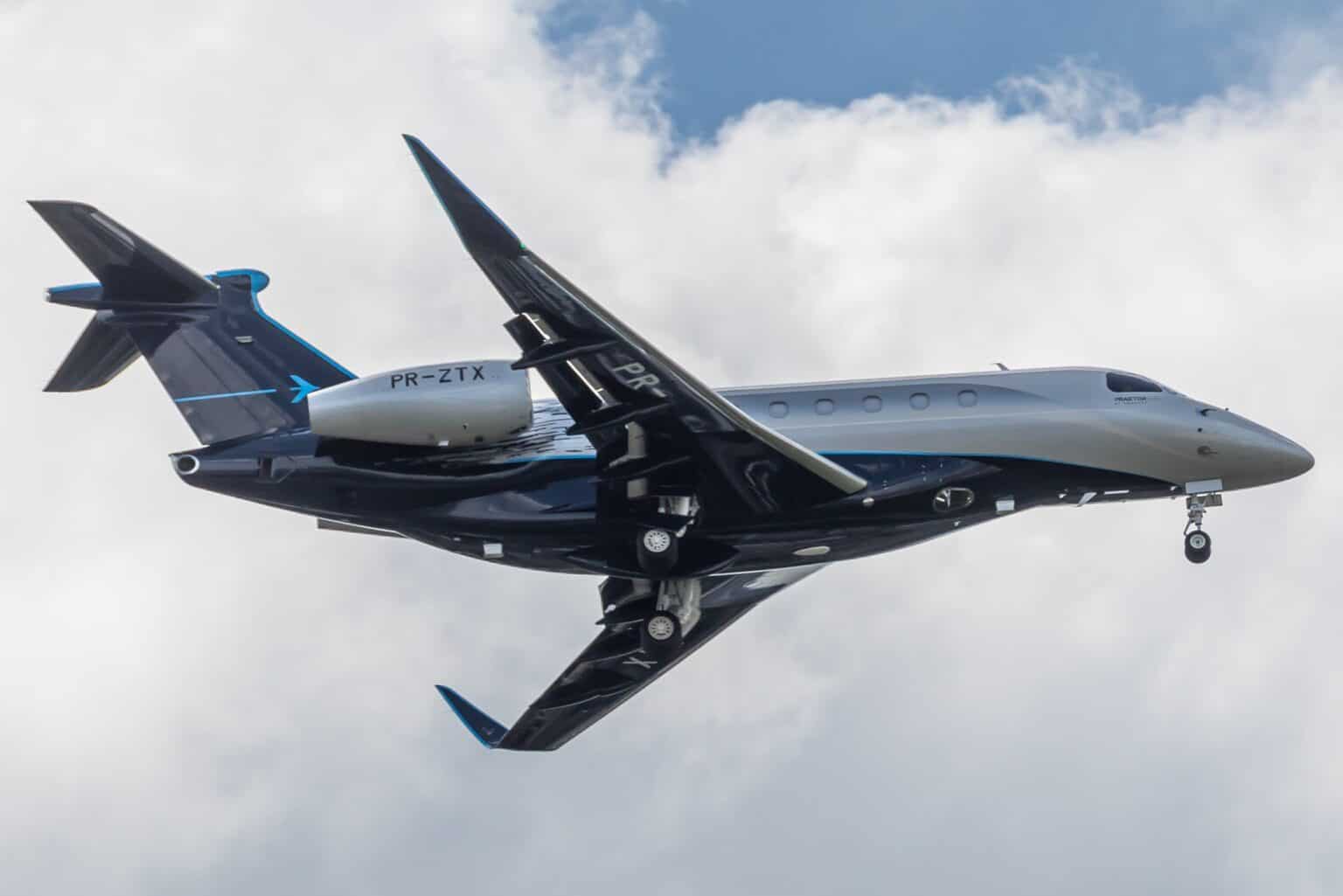
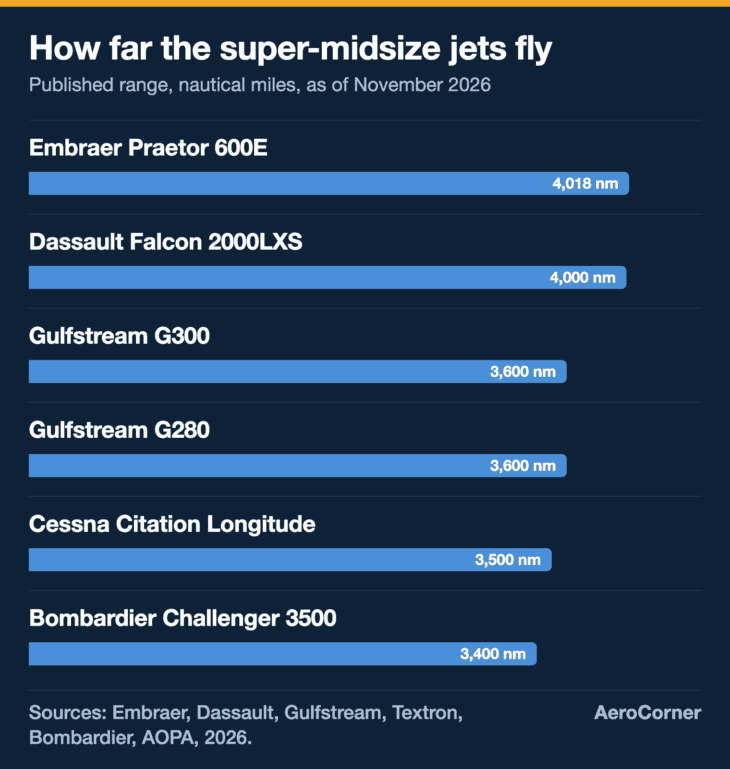
The best super-midsize business jet you can buy new in 2026 is the Embraer Praetor 600E. It flies the farthest in its class, 4,018 nautical miles with four passengers, and AOPA’s aircraft guide lists the Praetor 600 at about $21 million new, less than its main rivals.
The Bombardier Challenger 3500 is a close second and the one most buyers actually choose: Bombardier delivered its 200th in July 2026. This ranking weighs range, cabin size, speed, price and how each jet is selling, using manufacturer specifications and GAMA delivery data as of November 2026.
| Rank | Jet | Range | Cabin width | Status (Nov. 2026) |
|---|---|---|---|---|
| 1 | Embraer Praetor 600E | 4,018 nm | 6 ft 10 in (2.08 m) | In production |
| 2 | Bombardier Challenger 3500 | 3,400 nm | 7 ft 2 in (2.18 m) | In production |
| 3 | Cessna Citation Longitude | 3,500 nm | 6 ft 5 in (1.96 m) | In production |
| 4 | Gulfstream G280 | 3,600 nm | 6 ft 11 in (2.11 m) | Final deliveries due around mid-2027 |
| 5 | Gulfstream G300 | 3,600 nm | 6 ft 11 in (2.11 m) | In flight test, certification targeted late 2027 |
| 6 | Dassault Falcon 2000LXS | 4,000 nm | 7 ft 8 in (2.34 m) | In production |
How this ranking works
There is no official definition of super-midsize. We use AOPA’s working one: about 3,000 nm of range with four passengers, a maximum cruise speed of Mach 0.80 or better, eight or nine seats with a galley and lavatory, and a maximum takeoff weight of 30,000 to 40,000 pounds. Only jets in production or in flight test are ranked, scored on range, cabin size, speed, list price and 2025 to 2026 deliveries. Range figures are the makers’ own and are not measured the same way: Bombardier quotes Mach 0.77, Gulfstream Mach 0.80, Embraer long-range cruise, and Dassault eight passengers instead of four.
Super-midsize is the step below the large-cabin jets covered in our ranking of the best private jets in the world. You give up a bedroom and an ocean of range, and in exchange you get a stand-up, flat-floor cabin at a far lower price.
1. Embraer Praetor 600E
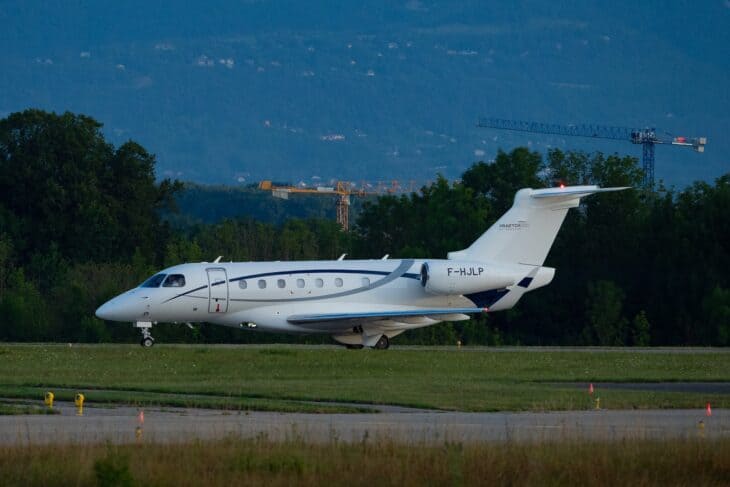
The Embraer Praetor 600 wins on the number that defines the class: range. Embraer quotes 4,018 nm with four passengers and NBAA IFR reserves at long-range cruise, and calls it the farthest-flying super-midsize jet.
At its 2019 certification Embraer also gave 3,719 nm at the faster Mach 0.80, still more than any other super-midsize jet’s headline figure. The maximum operating altitude is 45,000 feet, and the cabin is six feet tall with a flat floor.
The 600E is the updated version, unveiled in February 2026 with a redesigned cabin and an optional 42-inch OLED “Smart Window.” It won Brazilian, FAA and EASA certification on April 30, 2026, and the first one went to Flexjet in September.
It keeps full fly-by-wire flight controls with active turbulence reduction, and Embraer says it is the only manufacturer delivering that combination. Its 155 cubic feet of baggage space, per AOPA, is the largest of the six jets here.
One customer has 182 Embraer jets on order
Flexjet, which took the first Praetor 600E in September 2026, holds a firm order for 182 aircraft, according to Runway Girl Network. For scale, Embraer delivered 30 Praetor 600s in all of 2025, per GAMA.
Why it beats the Challenger 3500: about 600 nm more range on paper, and a lower price. AOPA’s aircraft guide lists the Praetor 600 at $20,995,000 new, against $26.7 million for the Challenger 3500 when it entered service in 2022. The Challenger’s wider cabin is the one place it clearly loses.
2. Bombardier Challenger 3500
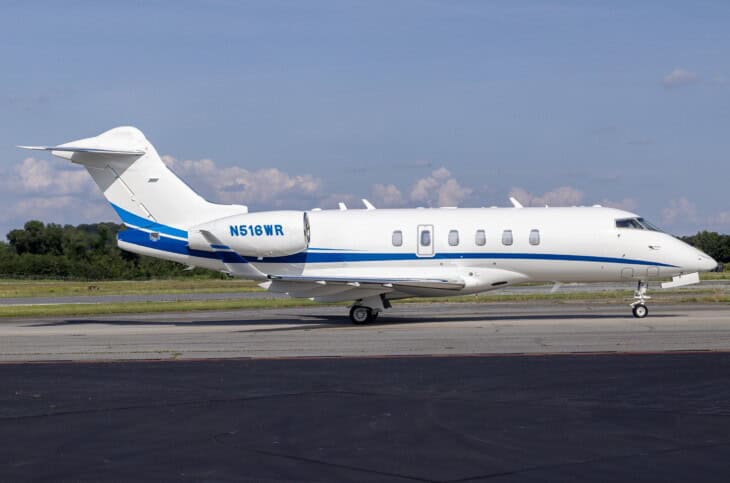
If the Praetor is the best on paper, the Challenger 3500 is the market’s choice. Bombardier delivered the 200th on July 27, 2026, and says it has outdelivered every medium and heavy business jet since 2023.
It is the evolution of the Challenger 350, launched in September 2021 and in service from September 2022. Its cabin is 7 feet 2 inches (2.18 m) wide, the widest of the core super-mids, with a 6-foot (1.83 m) ceiling and 25 feet 2 inches (7.67 m) of length, not counting the baggage compartment.
Bombardier quotes a top speed of Mach 0.83, room for up to 10 passengers and a 45,000-foot ceiling. Two Honeywell HTF7350 engines make 7,323 pounds of thrust each, and the 106-cubic-foot baggage hold can be reached in flight.
Its weakness is range. Bombardier’s 3,400 nm is the shortest published figure here, though it is quoted at a slow Mach 0.77 on a warm ISA+15°C day, a tougher test than some rivals use. It also has the longest published takeoff distance of the six, 4,835 feet at maximum takeoff weight.
3. Cessna Citation Longitude

The Cessna Citation Longitude has a maximum cruise of 483 knots true airspeed, per Textron, and its range of 3,500 nm sits between the Challenger and the Praetor.
Textron lists a 6-foot (1.83 m) tall, 6-foot 5-inch (1.96 m) wide cabin, 25 feet 2 inches (7.67 m) long, and up to 12 occupants. AOPA describes typical layouts of eight to ten passengers. The 112-cubic-foot baggage hold is accessible at any time in flight.
It won FAA certification in September 2019 and EASA approval in July 2021. Two Honeywell HTF7700L engines produce 7,665 pounds of thrust each, and the takeoff distance is 4,810 feet.
It ranks third because it has the narrowest cabin of the group, and AOPA lists it at $28,345,000, well above the Praetor. Sales are climbing, though: GAMA counted 25 deliveries in 2025 and 14 more in the first half of 2026.
4. Gulfstream G280

The Gulfstream G280 is still a strong jet, but it is on its way out. Gulfstream’s own G280 web page now redirects to its replacement, the G300, and final G280 deliveries are expected around mid-2027.
In its 2013 flight report, AOPA Pilot gave the G280 a range of 3,600 nm at Mach 0.80 with four passengers, a cabin 6 feet 3 inches (1.91 m) tall and 25 feet 10 inches (7.87 m) long, and a maximum takeoff weight of 39,600 pounds. AOPA’s guide adds 120 cubic feet of baggage space and a Mach 0.84 cruise.
It entered service in November 2012, and GAMA counted 22 deliveries in 2025. Buy one new now and you are buying the end of a production run, which is why it sits behind three jets with a longer future.
5. Gulfstream G300
The G300 is the newest super-midsize jet, unveiled in Savannah on September 30, 2025, as the G280’s replacement. It first flew on December 5, 2025, and Gulfstream is targeting certification in late 2027.
Gulfstream’s preliminary figures give 3,600 nm at Mach 0.80, or 3,000 nm at Mach 0.84, with a maximum operating speed of Mach 0.85. The cabin is 6 feet 1 inch (1.85 m) tall and 27 feet 7 inches (8.41 m) long excluding baggage, which Gulfstream calls the longest cabin in its class.
It also promises a 4,800-foot cabin altitude at 41,000 feet, seats for up to 10 and a 4,780-foot takeoff distance. AOPA projects a price of $28.7 million. Until it is certified and delivered, every one of those numbers is a promise, so it ranks fifth.
6. Dassault Falcon 2000LXS
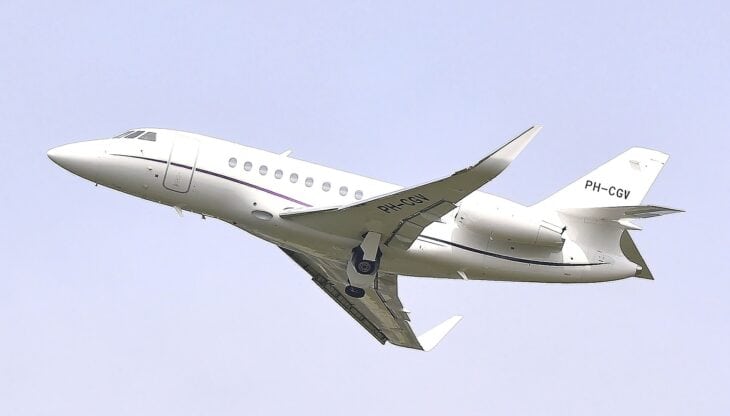
The Falcon 2000LXS is the jet buyers cross-shop when a super-mid feels small. Dassault calls it a large-body cabin, and at 7 feet 8 inches (2.34 m) wide and 6 feet 2 inches (1.88 m) tall, it is roomier than anything above it.
It also flies far: 4,000 nm with eight passengers and NBAA IFR reserves, with a maximum operating speed of Mach 0.86 and a 47,000-foot ceiling. Its 4,675-foot takeoff distance is the shortest published figure of the six.
It ranks last only because it is not really a super-midsize jet. It is still in production, and in October 2026 Dassault announced that new 2000LXS aircraft will get the EASy IV avionics upgrade.
What about the Citation Latitude and Praetor 500?
Both are often listed as super-midsize jets, and both are midsize by their makers’ own description. Textron calls the Citation Latitude its best-selling midsize business jet, with 2,700 nm of range and up to nine passengers. Embraer calls the Praetor 500 midsize, with 3,340 nm of range. Each has a six-foot, flat-floor cabin, so if you never fly more than about 2,700 nm they are worth a look, and they cost less.
The best used super-midsize jets
Several classics are out of production but still flying on the used market. They are not ranked above because you can no longer buy them new.
- Bombardier Challenger 300 and 350. The 350 is the direct predecessor of the Challenger 3500, which Bombardier describes as its evolution.
- Cessna Citation X. Production ended in 2018, per AOPA. It was built for speed, with a maximum of Mach 0.935 and 3,450 nm of range.
- Hawker 4000. Only 69 were built, from 2008 to 2012, with a composite fuselage, about 6 feet of headroom and 3,100 nm of range, per AOPA.
- Original Praetor 600 and G280. Both are likely to reach the used market in larger numbers as the 600E and G300 take over.
If range is what matters most, compare these with our list of the longest-range private jets, where the large-cabin jets take over.
FAQ
Sources and references used for research and fact-checking.
- Bombardier, Challenger 3500 specifications
- Bombardier via BNN Bloomberg, Bombardier celebrates 200th delivery of its Challenger 3500 jet
- Bombardier, Bombardier Challenger 3500 enters service
- Bombardier, Challenger 3500 launch
- Flying, Bombardier Challenger 3500 enters service
- Embraer, Praetor 600E
- Embraer via Defense Daily, Embraer Praetor 600 receives Brazilian certification
- AVweb, Embraer unveils updated Praetor 600E and 500E
- AVweb, Praetor 600E receives triple certification
- Runway Girl Network, Inaugural Praetor 600E delivered to Flexjet
- AOPA, Embraer Praetor 600 aircraft guide
- Textron Aviation, Citation Longitude
- Textron Aviation, Cessna Citation Longitude enters service
- Textron Aviation, Cessna Citation Longitude achieves EASA certification
- AOPA, Cessna Citation Longitude aircraft guide
- Textron Aviation, Citation Latitude
- AOPA, Gulfstream G280 aircraft guide
- AOPA Pilot, Gulfstream's latest super-mid
- Gulfstream, Gulfstream G300
- AOPA, Gulfstream debuts super-midsize G300
- AVweb, Gulfstream G300 completes first flight
- AVweb, Gulfstream targets 200 annual deliveries by 2030
- Gulfstream via AviationPros, Gulfstream debuts brand-new aircraft, the Gulfstream G300
- Dassault Aviation, Falcon 2000LXS
- Airframer, Dassault announces EASy IV upgrade for Falcon 2000 series
- Embraer via Defense Daily, Embraer Praetor 500 receives EASA and FAA approval
- AOPA, Production ceases for Cessna's speed demon
- AOPA Pilot, Turbine quick look: Hawker 4000
- GAMA, 2025 Aircraft Shipment Report
- GAMA, 2026 Q2 Aircraft Shipment Report
Get the Newsletter
The latest aviation news and stories sent to your inbox.
About the Author

Tim is the owner and lead editor of AeroCorner since 2019, overseeing aviation content covering aircraft, airlines, airports, and the broader aviation industry. Through years of researching, writing, editing, and publishing aviation-focused content, he has developed extensive practical knowledge of commercial aviation and air travel. Based in Asia and a frequent traveler himself, Tim also brings firsthand passenger experience to AeroCorner’s coverage. Outside of publishing, he has also explored aviation firsthand through hands-on flight training in New Zealand.