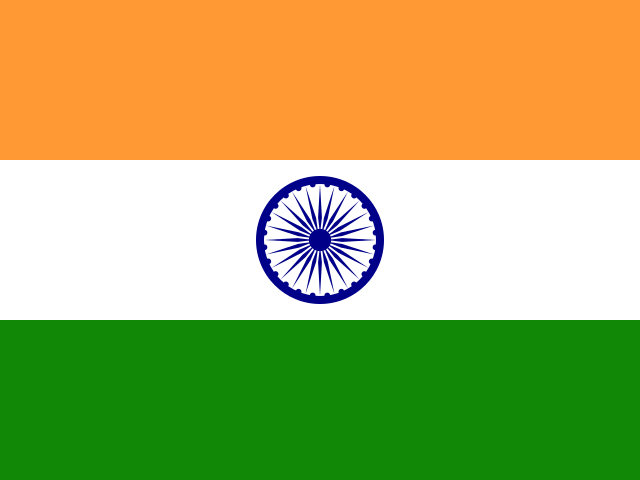



































New Delhi Indira Gandhi (IATA: DEL) operates around 668 flights per day to 165 nonstop destinations. Its network includes 65 domestic and 66 international routes, with IndiGo as the leading carrier and Mumbai currently the busiest connection. From DEL, passengers can reach 51 countries across 5 continents, and the longest runway measures 4,378 m (14,364 ft).
Table of Contents
Airlines and Destinations Overview
Indira Gandhi International Airport serves as the primary aviation hub for Delhi and one of the busiest airports in India. Its network combines extensive domestic connectivity with a growing number of international routes linking India to Europe, the Middle East, North America, and Asia-Pacific. This mix allows the airport to function both as a national gateway and as a key transit point within South Asia.
The airline mix is led by major Indian carriers such as Air India and IndiGo, supported by a wide range of international airlines. This structure enables strong point-to-point demand within India as well as increasing transfer traffic, particularly on long-haul routes connecting India with global destinations.
Terminal Buildings and Facilities
Indira Gandhi International Airport operates three main passenger terminals: Terminal 1, Terminal 2, and Terminal 3. Terminal 3 serves as the primary international terminal and also handles a significant share of domestic traffic, while Terminals 1 and 2 are mainly used for domestic operations. The layout is designed to manage high passenger volumes while maintaining relatively efficient flows between check-in, security, and boarding areas.
Key characteristics of the terminal system include:
- Three active passenger terminals
- Terminal 3 as the main international hub
- Separation of domestic and international operations
- High-capacity infrastructure for large passenger volumes
Passenger facilities are distributed across the terminals, with Terminal 3 offering the most extensive range of services. The airport provides WiFi, charging areas, retail outlets, and dining options, along with premium services for business and long-haul travelers.
Passenger facilities available across the airport include:
- WiFi and charging stations
- Retail and duty-free shopping areas
- Dining outlets across terminals
- Premium and fast-track services
Airport Lounges
Delhi Airport offers a range of lounge facilities across its terminals, including both airline-operated lounges and independent lounges accessible through membership programs or paid entry. These lounges are primarily located in Terminal 3, serving both domestic and international passengers.
Notable lounges include:
- Air India Maharaja Lounge
- Plaza Premium Lounge
- Encalm Lounge
- American Express Lounge
Dining and Food Options
Dining options at Delhi Airport include a mix of international chains and Indian brands, with food outlets available throughout all terminals. The airport provides both quick-service counters and sit-down restaurants, catering to a wide range of passenger preferences.
Common dining options include:
- Starbucks
- KFC
- Subway
- Haldiram’s
- Costa Coffee
Public Transport and Parking
Delhi Airport is well connected to the city through a combination of rail, road, and bus networks. The airport is linked to central Delhi via the Delhi Airport Metro Express, which provides a fast and direct connection to the city center. Additional transport options include taxis, ride-hailing services, and airport buses.
Passengers can reach the airport using:
- Delhi Airport Metro Express
- Local bus services
- Taxis and ride-hailing services
- Private car access via major roads
Road access is supported by major highways connecting the airport to central Delhi and surrounding regions. Parking facilities are available near all terminals, offering options for both short-term and long-term stays. More details are available on the official Delhi Airport parking pages.
Parking options include:
- Short-term parking near terminals
- Long-term parking areas
- Premium parking services
- Multi-level parking facilities
Runways and Operations
Indira Gandhi International Airport operates three runways configured to handle high traffic volumes and a wide range of aircraft types. The runway system supports both domestic and international operations, including long-haul flights using widebody aircraft.
The runway system includes:
- Three runways with parallel and intersecting configurations
- Infrastructure supporting simultaneous operations
- Long runways suitable for widebody aircraft
- High-capacity taxiway network
The airport’s operational setup is designed to manage one of the highest traffic volumes in the region, with a focus on maintaining efficient aircraft movement and minimizing delays.
Passenger Traffic and Airport Role
Delhi Airport plays a central role in India’s aviation network and serves as one of the country’s primary international gateways. It handles a large volume of domestic traffic while also supporting a growing number of long-haul international routes.
The airport’s role includes:
- A major hub for domestic travel in India
- A key international gateway
- A regional transit hub in South Asia
- A central node for business and tourism travel
Passenger demand is driven by a mix of business, leisure, and connecting traffic, with strong growth in both domestic and international segments.
Location and Catchment Area
Indira Gandhi International Airport is located approximately 16 kilometers (10 miles) southwest of central New Delhi. Its position provides access to one of the largest metropolitan areas in the world, as well as strong connections to surrounding regions.
The airport serves:
- New Delhi metropolitan area
- National Capital Region (NCR)
- Northern India
- International transfer passengers
Its location and connectivity make it a critical hub for both domestic and international travel.
Hotels Near the Airport
Delhi Airport is surrounded by a range of hotels catering to transit passengers, business travelers, and longer stays. Several properties are located within or close to the airport complex, offering convenient access to terminals.
Notable nearby hotels include:
- Holiday Inn Express New Delhi Airport T3
- JW Marriott Hotel New Delhi Aerocity
- Andaz Delhi by Hyatt
- Pullman New Delhi Aerocity
- ibis New Delhi Aerocity
Airport History
Indira Gandhi International Airport traces its origins to Safdarjung Airport, which served as Delhi’s primary airport before the development of a larger facility became necessary. As air traffic increased in the mid-20th century, a new airport site was established at Palam, which eventually evolved into the modern airport.
The airport was officially renamed Indira Gandhi International Airport in 1986 and gradually expanded to accommodate growing passenger demand. Over time, new terminals and runway infrastructure were developed, allowing the airport to handle increasing domestic and international traffic.
A major milestone in the airport’s development was the opening of Terminal 3 in 2010, built ahead of the Commonwealth Games. This terminal significantly increased capacity and introduced modern passenger facilities, helping transform the airport into a global-standard hub.
In recent years, continued expansion and modernization projects have further improved infrastructure and operational efficiency. Today, Delhi Airport stands as one of the leading aviation hubs in Asia, balancing high passenger volumes with ongoing development to support future growth.