Military Trainers
Alenia Aermacchi M-346
ICAO: M346
The British trainer the US Navy rebuilt to land on carriers.
Updated: by Tim de Vries
The latest aviation news and stories sent to your inbox.
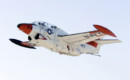
The T-45 Goshawk is the US Navy’s carrier-capable jet trainer, a heavily rebuilt version of the British BAE Systems Hawk. Stronger landing gear, a catapult tow bar and an arresting hook let it do what no other trainer could, which is put a student on a carrier deck before they earn their wings. Boeing and BAE Systems built 221 between 1988 and 2009, and the contract to replace them is not due to be awarded until 2027.
Live Fleet Activity (HAWK)
Fetching live data…


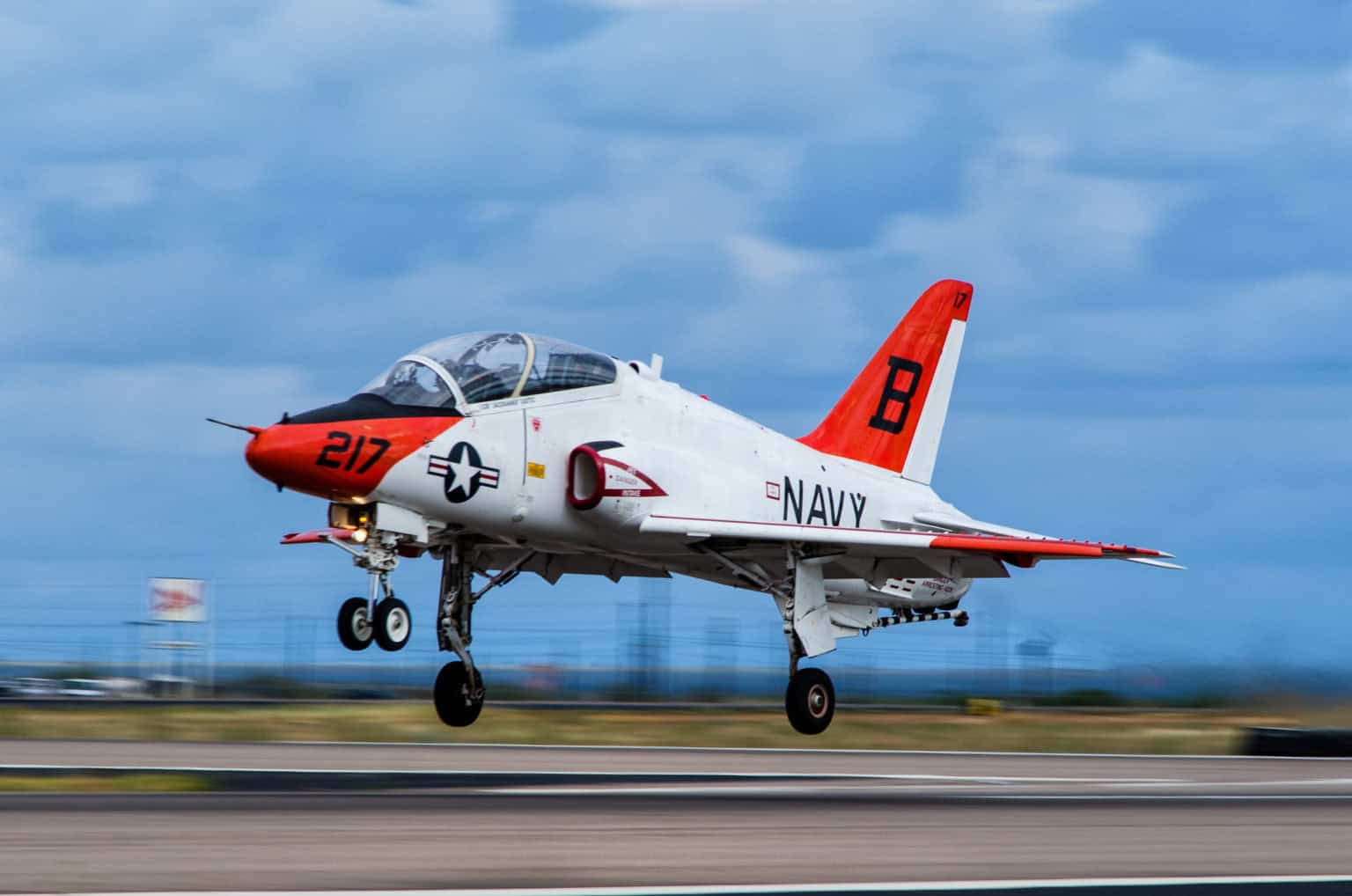


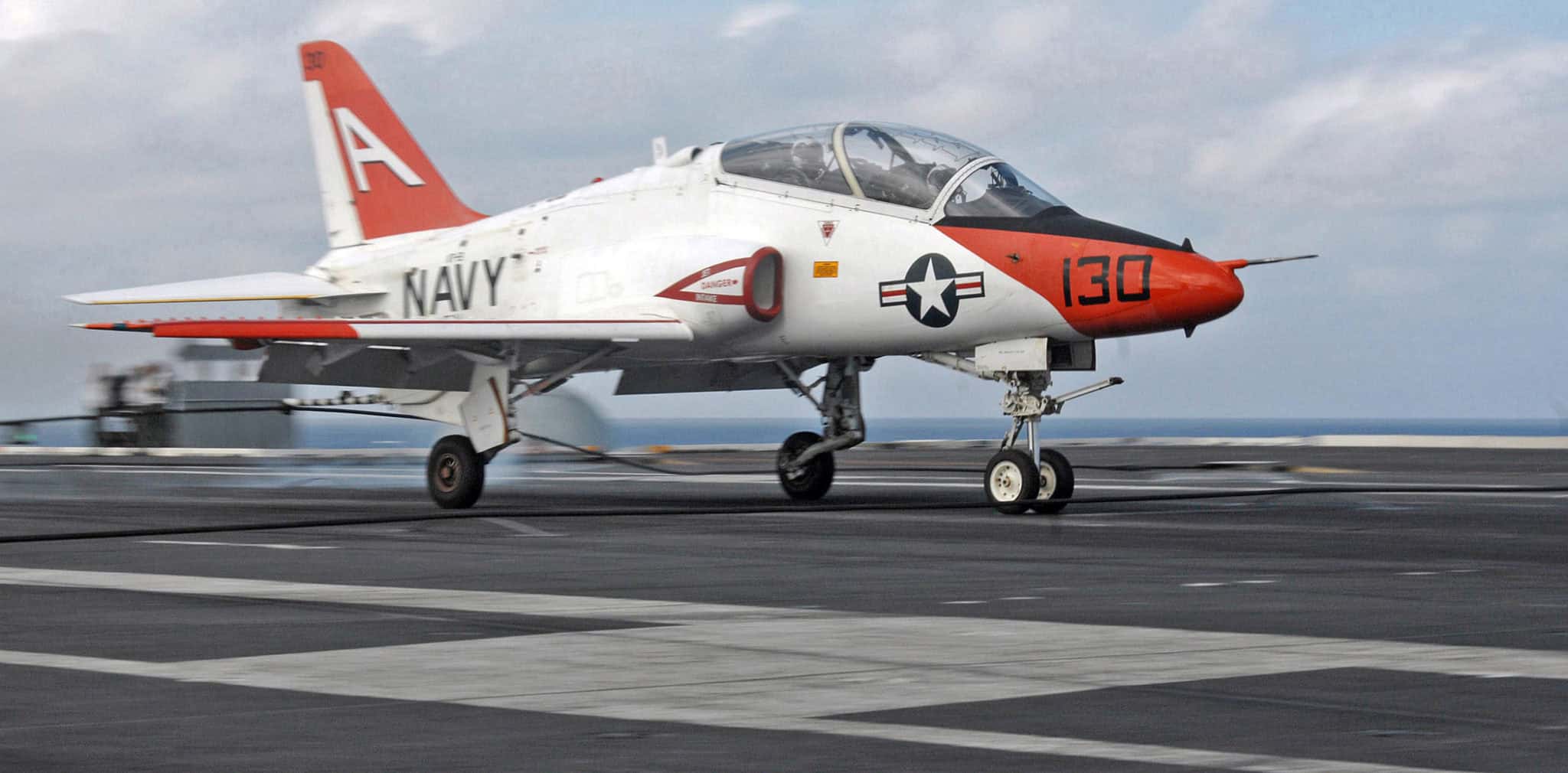


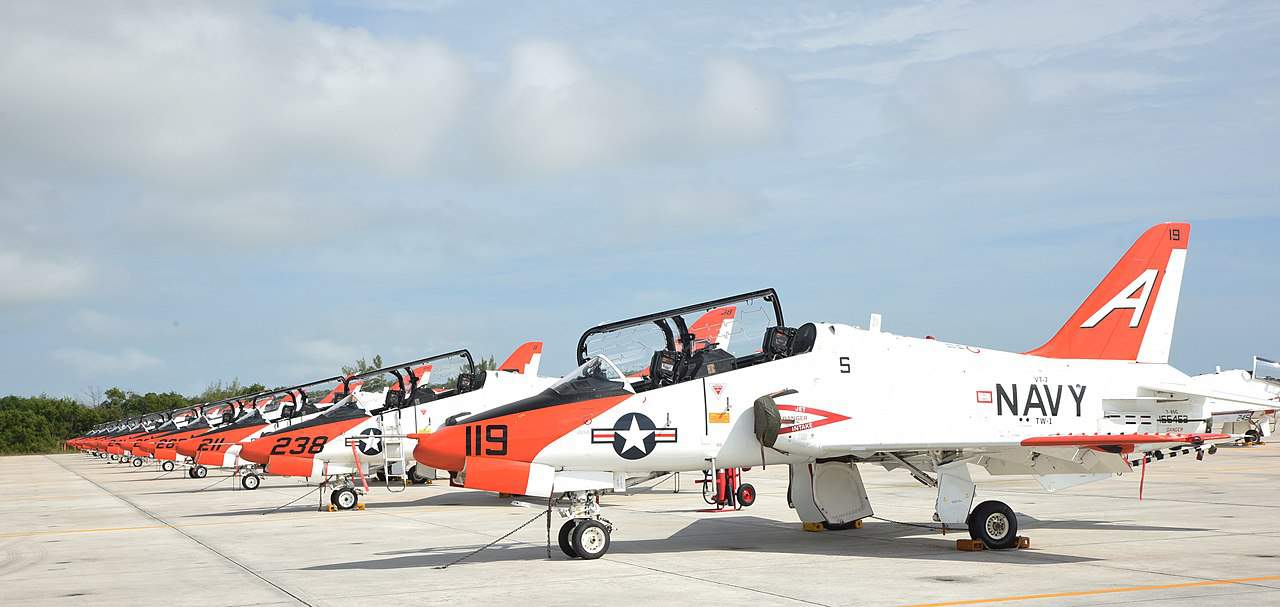
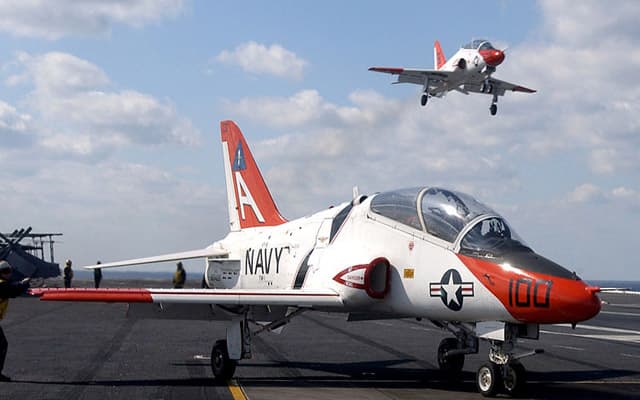
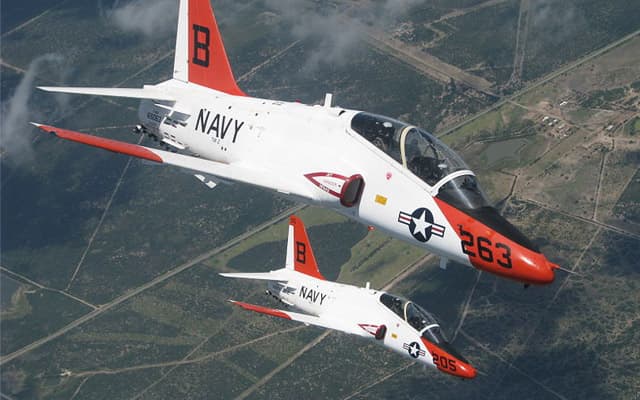
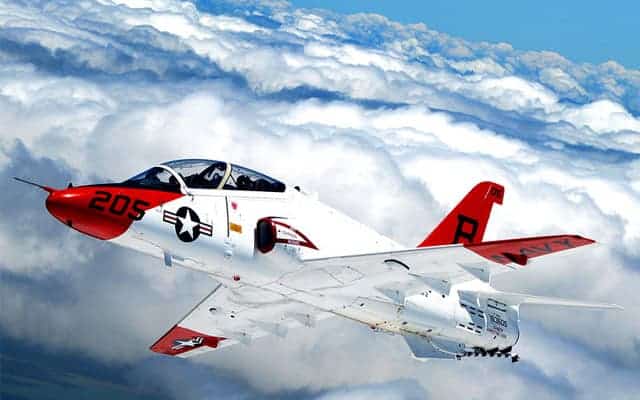
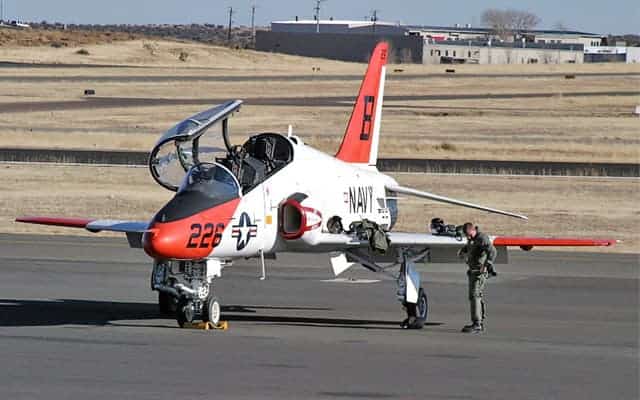
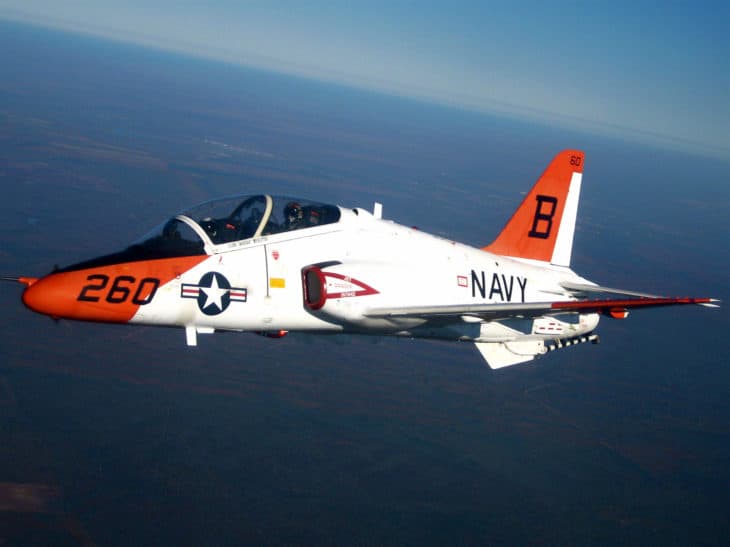
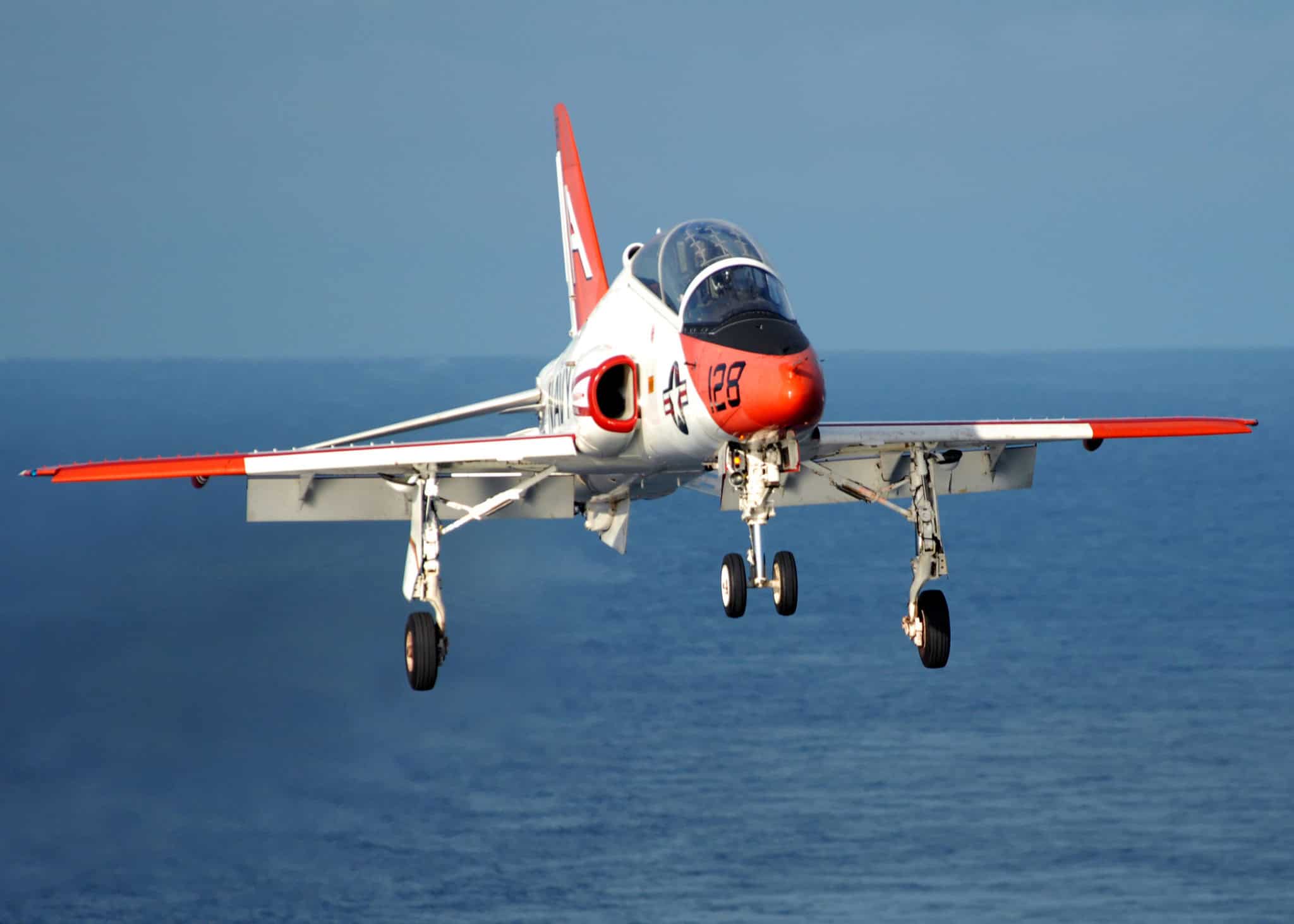
The T-45 Goshawk is the jet the US Navy uses to turn student pilots into carrier aviators. It is a heavily rebuilt version of the British BAE Systems Hawk, redesigned to survive catapult launches and arrested landings that the original was never built to take.
That British ancestry is obvious from the outside. Underneath, almost every load-bearing part is different.
The Navy describes it as a tandem-seat, carrier-capable jet trainer for Navy and Marine Corps pilots. It replaced two aircraft at once: the T-2C Buckeye in the intermediate phase and the TA-4J Skyhawk in the advanced phase.
The full specification table for the aircraft is on this page. The sections below explain where those numbers came from and what they cost the design.
The Navy started looking for a single Buckeye and Skyhawk replacement in the mid-1970s. It formally launched the VTXTS advanced trainer program in 1978.
British Aerospace and McDonnell Douglas offered a navalized Hawk. They beat a Dassault and Dornier team offering the Alpha Jet, along with a Lockheed bid.
The competition was never just about the airplane. It covered five things at once: the aircraft, the flight simulators, the academic courseware, the logistics support, and the program management. That bundle is why the Navy still describes the Goshawk as an integrated training system rather than a jet.
The Navy picked the Hawk in November 1981 and awarded the full-scale engineering development contract in September 1982. Roughly 60 percent of the work was done in Britain.
The first T-45A flew on 16 April 1988, more than six years after selection. It entered service in 1991.
A land-based trainer touches down gently on a long runway. A carrier trainer is flown into the deck at a sink rate that would fold an ordinary airframe.
The Goshawk had to absorb 14 feet per second (4.3 m/s) of descent at touchdown. That single requirement drove stronger landing gear and a reinforced airframe throughout.
The nose gear was replaced with a twin-wheel unit carrying a catapult tow bar on its oleo strut. An arresting hook went on the tail, the tailplane span was increased, and the airbrakes were moved to the sides of the fuselage.

Small vanes called SMURFS, for Side Mounted Upper Rear Fuselage Strakes, were added to keep airflow attached to the stabilator when the speed brakes are out.
Navy test pilots then found more problems. Fixing them added a ventral fin ahead of the arresting hook, a 6-inch (0.15 m) extension to the tail fin, squared-off wing tips, and leading-edge slats.
One vanished ship explains much of the design. When the Goshawk was selected, the Navy’s training carrier was the World War II-era USS Lexington, whose 910-foot (277 m) angled deck had short-stroke catapults and short, undamped arresting gear. The Goshawk was shaped around that unforgiving deck, and the low-speed handling work that resulted is the reason it approaches as slowly as it does.
The T-45A is the original, with an analog cockpit. It became operational in 1991.
The T-45B was proposed and then killed. It would have been a land-based Hawk with a Navy cockpit and no carrier gear, giving students an earlier jet, but the Navy dropped it in 1984 and spent the money updating the TA-4J and T-2C instead.
The T-45C, first delivered in December 1997, is the one that matters today. It brought a glass cockpit and a head-up display.

From 2003, every surviving T-45A was converted to T-45C standard under the Required Avionics Modernization Program. That brought the whole fleet to a common Cockpit 21 configuration, deliberately closer to the frontline fighters students would fly next.
A T-45D was sketched out in 2008 as a further upgrade with helmet-mounted displays and manufacturing improvements. It went no further than a tentative designation.
Production ran from 1988 to 2009. The 200th aircraft was delivered in March 2007, and the 221st and last in November 2009.
The T-45C’s avionics were chosen to look like a fleet fighter rather than a trainer. The suite includes a BAE and Marconi AN/ASN-180 navigation guidance system, a Rockwell Collins AN/ARN-144 VOR and ILS receiver, and a Honeywell AN/APN-194 radar altimeter.
Navigation runs on a Northrop Grumman AN/ASN-166 inertial guidance set built around an LN-100G ring laser gyro, a Rockwell Collins GPS, and a Kalman filter blending the two.
In early 2008 the Navy announced a synthetic radar capability for the type. An initial batch of 19 T-45Cs received the virtual mission training system, which simulates the Super Hornet’s APG-73 radar, including ground mapping, air-to-air and air-to-ground targeting, and electronic warfare training.
Those jets went to Pensacola to train Naval Flight Officers, the back-seat weapons and sensor operators who go on to the F/A-18 Super Hornet and the EA-18G Growler. It is a rare case of a trainer simulating a radar it does not carry.
Strike pilot training happens at two bases. Training Air Wing One is at NAS Meridian, Mississippi, and Training Air Wing Two is at NAS Kingsville, Texas.
Training Air Wing Six at NAS Pensacola, Florida, runs the Naval Flight Officer track that picked up the T-45C in 2008. A small number of aircraft also fly with Naval Air Systems Command at NAS Patuxent River, Maryland.

Reported fleet size has drifted down as airframes are lost and retired. Coverage of the March 2025 grounding put it at roughly 190 aircraft, and reporting four months later put it at about 180 across the Navy and Marine Corps.
The paint is changing too. In October 2024 the Navy began applying a glossy gray scheme with training air wing tail flashes in place of the traditional orange and white, a change the training command attributed to instructor and student feedback and to making the trainers look more like fleet jets.
In April 2017 more than 100 T-45 instructor pilots refused to fly. The Navy grounded the fleet for what it called a three-day safety pause.
The pilots blamed the onboard oxygen generation system, a Cobham GGU-7, for a rising count of physiological episodes. Senior naval aviators testified that month that oxygen-related episodes had nearly quadrupled over the previous five years.
The grounding was first extended, then partly lifted so flights could continue below 10,000 feet where the oxygen system is not needed. All restrictions came off in August 2017.
The fix was incremental rather than dramatic. The fleet got new oxygen monitoring sensors and a water separation system, and was later refitted with Cobham’s revised GGU-25 generators.
It worked. By the first quarter of 2018 physiological episodes had fallen back to normal rates after peaking across 2016 and 2017.
The Goshawk’s recent history is a series of engine-driven pauses. On 14 October 2022 the fleet was grounded after a low-pressure compressor blade fault was found during a pre-flight check, and flying resumed two weeks later.
On 11 March 2025 a T-45C at NAS Kingsville suffered an engine malfunction before takeoff. The crew was unhurt, but the Navy paused every T-45C in the fleet while NAVAIR ran an engineering investigation. Flying later resumed.
On 26 May 2026 a T-45C from Training Air Wing One crashed on farmland in Noxubee County, Mississippi, around 12:30 p.m. local time. Both crew ejected safely and the cause is still under investigation.
Over the type’s life, roughly 34 Goshawks have been destroyed in accidents as of May 2026. That is about 15 percent of the inventory, at a rate of roughly one airframe per year across more than three decades of intensive student flying.
For three decades the T-45 existed to do one thing that no other trainer could: put a student on a carrier deck before they earned their wings. In 2025 the Navy stopped requiring it.
The last strike-pipeline carrier qualification took place in March 2025. Students heading for the F/A-18, F-35 and EA-18G are no longer required to land aboard a ship before they are winged.

Field carrier landing practice ashore is still mandatory. The first real trap now happens at the Fleet Replacement Squadron, in the fleet aircraft itself.
The Navy cited increased technological capability in the fleet and the need to cut time out of the training pipeline. Frontline aircraft now carry recovery aids that do much of the work the T-45 makes a student do by hand.
The requirement did not disappear entirely. E-2 Hawkeye pilots and international students still carrier-qualify in the Goshawk.
The replacement program is called the Undergraduate Jet Training System, and it is one of the larger training buys in recent Navy history. The service released its final request for proposals in March 2026.
The Navy wants 216 aircraft. Four development jets come first, then seven low-rate production aircraft in 2032, rising to 25 a year from 2035.
Bids are capped hard. Any engineering and manufacturing development offer above roughly $1.8 billion is rejected outright.
The requirement itself was rewritten in a way that follows directly from the 2025 carrier decision. The new trainer only has to fly field carrier landing practice to a wave-off, not to a touchdown, so it does not need the Goshawk’s structural strength.
The schedule has already slipped. On 2 September 2026 the Navy pushed the proposal deadline back to 30 October 2026 and moved the contract award from March 2027 to 30 June 2027.
Breaking Defense has reported bidders including Boeing, Lockheed Martin, Textron Aviation Defense with Leonardo offering the M-346N, and Sierra Nevada Corporation with Northrop Grumman and General Atomics offering the Freedom trainer.
Meanwhile the Goshawk is being kept alive. In July 2025 the Navy inducted the first two aircraft into a service life extension effort at Fleet Readiness Center Southeast in Jacksonville, Florida, one for a wing swap and one for a full overhaul, with work planned to run through 2036.
No single retirement date has been published. The Navy’s own program schedule, with low-rate replacement deliveries starting in 2032 and life extension funded through 2036, implies the Goshawk flies well into the 2030s, which lines up with the commonly cited estimate of 2035 or later.
A few figures in the specification panel are quoted against each other online, so they are worth separating.
The engine is rated at 5,527 pounds of thrust, which is what NAVAIR publishes and what the panel shows. The same Rolls-Royce Turbomeca Adour F405-RR-401 has a nominal rating of 5,845 pounds, and it is de-rated in the Goshawk. Both numbers are real, and the lower one is the one the airplane actually flies on.
Top speed is 543 knots, measured at 8,000 feet. Higher figures circulate because two other limits exist: Mach 0.84 at 30,000 feet, and a never-exceed speed of 575 knots (662 mph). Google’s knowledge panel shows 645 mph, which matches neither the published maximum of 625 mph nor the never-exceed limit.
Range is 700 nautical miles, and unusually, the ferry range is the same 700 nautical miles. The Goshawk carries 430 gal internally with provision for two 156-gallon drop tanks, but as a trainer it flies short sorties from a home field, so nobody publishes a stretched ferry profile.
The takeoff and landing distances in the panel are measured over an obstacle, not as ground roll. The takeoff distance is 3,600 ft (1,100 m) to clear 50 feet. The landing distance is 3,300 ft (1,010 m) from 50 feet.
The $17.2 million unit cost comes from NAVAIR’s fact sheet, which does not state a base year. Treat it as an order-of-magnitude figure for an airplane whose production ended in 2009, not as a current price.
Yes. As of September 2026 the T-45C is the US Navy’s intermediate and advanced jet trainer, flying at NAS Meridian, NAS Kingsville and NAS Pensacola.
Its replacement has not been chosen. The Navy moved the Undergraduate Jet Training System contract award to 30 June 2027, with the new jet’s first low-rate deliveries not expected until 2032, and it is running a service life extension program on the existing fleet through 2036.
No. The Goshawk has served only in the training role, teaching US Navy and Marine Corps students, and no export customer was ever won despite marketing to Australia, Greece, India and Israel.
It is not equipped for combat either. The two underwing hardpoints carry practice bomb racks, rocket pods or fuel tanks, and a centerline station is used for a crew baggage pod.
About 34 airframes have been destroyed in accidents as of May 2026, roughly 15 percent of the inventory, at a rate of about one per year. That is a long record for a jet flown daily by students learning to fly it.
The type’s most serious systemic problem was not structural. A wave of hypoxia-like physiological episodes traced to the onboard oxygen system led more than 100 instructors to refuse to fly in April 2017, and the fleet was grounded until fixes were fitted.
Engine problems have also stopped the fleet twice, in October 2022 and again after a March 2025 engine malfunction at NAS Kingsville. A T-45C crashed in Mississippi in May 2026, with both crew ejecting safely.
Not operational ones. Each wing has a single hardpoint that can take a practice bomb rack carrying up to 12 Mk-76 practice bombs, a rocket pod, or a drop tank.
No gun or missile armament is listed for the type. The aircraft exists to teach weapons delivery patterns, not to deliver weapons.
Its published maximum is 543 knots (625 mph, 1,006 km/h) at 8,000 feet, or Mach 0.84 at 30,000 feet. The never-exceed speed is 575 knots.
The numbers that matter more in training are at the slow end: a carrier launch speed of 121 knots and an approach speed of 125 kt.
The Goshawk is a carrier-capable rebuild of the Hawk, not a repainted one. It adds an arresting hook, a twin-wheel nose gear with a catapult tow bar, strengthened gear and structure, a larger-span tailplane, side-mounted airbrakes, leading-edge slats, squared wing tips, a ventral fin and a taller tail fin.
The two are close enough that ICAO assigns them the same type designator, HAWK. They are far enough apart that the Goshawk needed its own flight test program to fix the handling problems the changes introduced.
221, all for the US Navy. Production ran from 1988 to 2009, with the 200th delivered in March 2007 and the last in November 2009.
Airframes were split between two countries. BAE Systems built the rear fuselage, air intakes and vertical stabilizer at Samlesbury and the wings at Brough in England, and Boeing assembled the aircraft in St. Louis.
The Navy began replacing the orange-and-white training scheme with glossy gray in October 2024. The training command said the change came from instructor and student feedback and makes the trainers resemble fleet aircraft.
The repaint is gradual. Aircraft get the new scheme as their existing paint reaches the end of its life, so both schemes are flying side by side.
Sources and references used for research and fact-checking.