Military Propellor Planes
Curtiss SBC Helldiver
ICAO: SBC
The Hawk that fought at Pearl Harbor, over France and for Finland, and became the P-40.
Updated: by Tim de Vries
The latest aviation news and stories sent to your inbox.
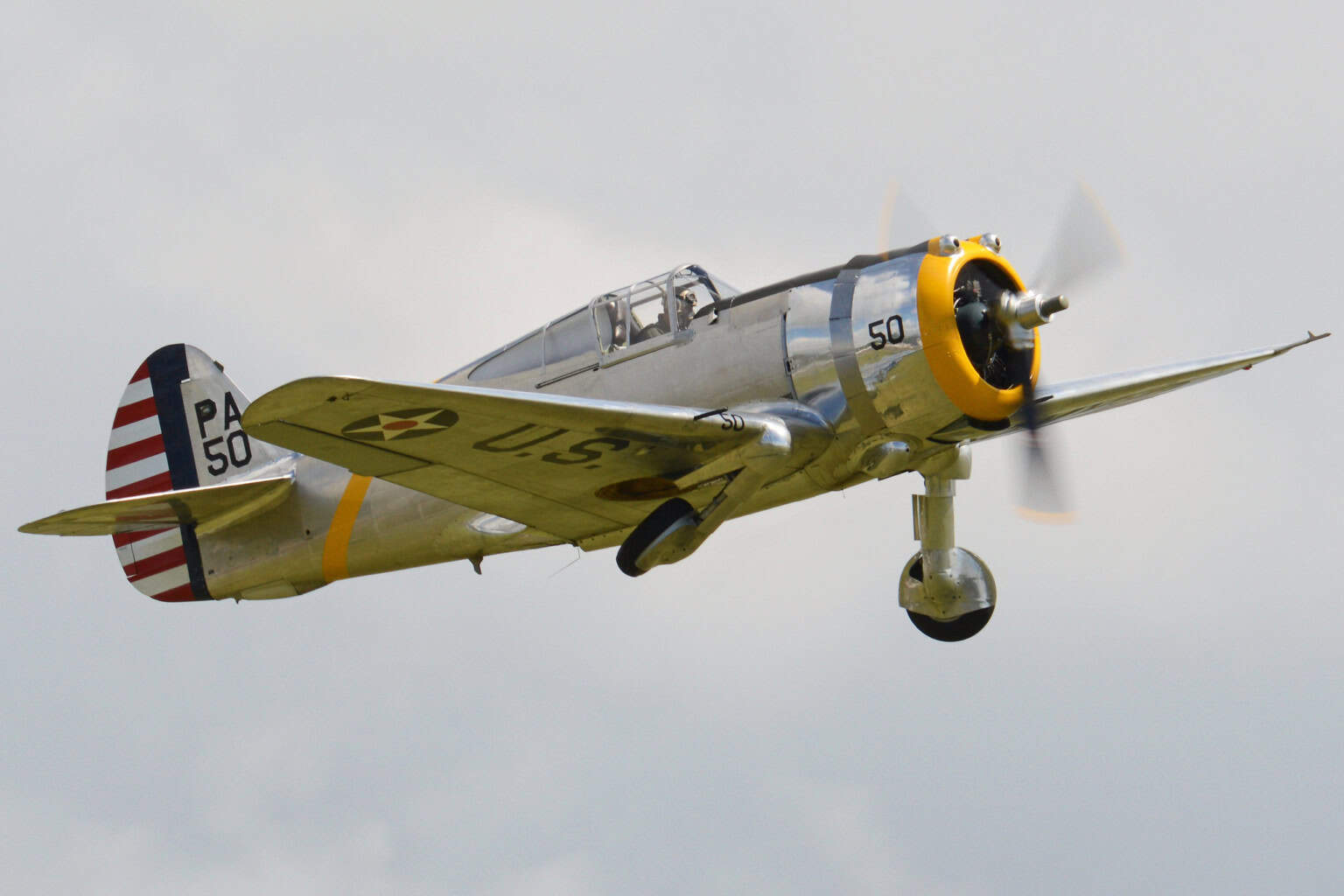
Curtiss P-36 Hawk, the all-metal fighter that flew first on May 6, 1935 and became the US Army Air Corps’ front-line pursuit aircraft in 1938. Known as the Curtiss Hawk 75 on the export market and the Mohawk in British service, it fought over France in 1939 and 1940, for Finland against the Soviet Union, and at Pearl Harbor. It was also the airframe that became the P-40 Warhawk.


The Curtiss P-36 Hawk was an all-metal, single-engine fighter that first flew on May 6, 1935 and entered US Army Air Corps service in 1938. Curtiss sold the same airframe abroad as the Hawk 75, and the British flew the ones diverted from French orders as the Mohawk.
Curtiss built about 1,000 of them, and the type served with more than a dozen air forces. The Air Corps took 243 P-36s, a total that includes 30 export-order aircraft the US government seized in 1942.
Its war record is wider than most people expect. French pilots claimed 230 victories in 1939 and 1940, Finnish crews flew captured Hawks against the Soviet Air Force, and a handful of US Army P-36As got airborne at Pearl Harbor.
It is also the direct ancestor of the Curtiss P-40 Warhawk, which began as a P-36 fitted with a liquid-cooled engine.
Curtiss designed the Model 75 as a private venture. The designer was Don R. Berlin, a former Northrop engineer, and the first prototype used all-metal construction with fabric-covered control surfaces.
That prototype first flew on May 6, 1935 with a 900 hp Wright radial engine. In early tests it reached 281 mph (452 km/h) at 10,000 ft.
Curtiss flew it to Wright Field on May 27, 1935 for the Army fighter fly-off, but the contest slipped because the Seversky entry crashed on its way there. Curtiss used the delay to fit a 950 hp Wright Cyclone and rework the fuselage, adding distinctive scalloped rear windows to improve visibility.
The fly-off finally ran in April 1936, and the new engine failed to deliver its rated power. The aircraft managed only 285 mph (459 km/h), and the Seversky P-35 was declared the winner with an order for 77 aircraft.
The Army wanted a backup anyway. Worried about political turmoil in Europe and about Seversky’s ability to deliver, it ordered three Curtiss prototypes, designated Y1P-36, on June 16, 1936.
With a 900 hp Pratt & Whitney Twin Wasp, the Y1P-36 performed so well that it won the 1937 Army competition. The reward was an order for 210 P-36A fighters.

The first production P-36As reached the 20th Pursuit Group at Barksdale Field, Louisiana, in April 1938. Teething problems with engine exhaust, skin buckling over the landing gear and weak points in the airframe restricted what pilots could do with them.
By the time those problems were fixed, the P-36 was already considered obsolete. It ended up in training units and overseas detachments in the Panama Canal Zone, Alaska and Hawaii.
The full specification table for the aircraft is on this page. These notes cover the figures that need context.
The P-36A’s top speed is 313 mph (504 km/h), and its cruise speed is 270 mph (435 km/h). Aviation-History.com puts that top speed at 10,000 ft.
The engine’s single-speed supercharger was a serious handicap at high altitude. The type was also underpowered, which hurt acceleration and top speed, even though its service ceiling is listed at 32,700 ft (10,000 m).
The wing loading was only 23.9 pounds per square foot (117 kg/m²), which gave the Hawk outstanding turning performance. The power-to-weight ratio of 0.186 hp per pound gave it superb climbing performance for the time, and the climb rate is listed at 3,400 ft/min.
The Royal Air Force tested a borrowed French Hawk 75A-2 against a Spitfire Mk I. The Hawk had lighter controls at speeds above 300 mph, was easier to maneuver in a dogfight, had better all-round visibility and was easier to take off and land.
The Spitfire still came out ahead, because its acceleration and top speed let it engage and leave combat at will.
The range of 860 mi (1,390 km) is the figure Wikipedia’s spec block gives at a slow 200 mph cruise. At the 270 mph cruise the same block gives only 625 miles.
The Air Force museum’s fact sheet quotes 830 miles. All three numbers describe the same aircraft flown at different speeds, so compare them only when the cruise speed matches.
The standard P-36A carried one .30-caliber and one .50-caliber Browning machine gun firing through the propeller arc. The Air Force museum describes two .30s or two .50s, which reflects how the fit changed across the production run.
The prototype had no cockpit armor and no self-sealing fuel tanks. Some later aircraft carried a hardpoint under each wing for a bomb of up to 100 pounds (45 kg).
The P-36A was the main production model. A single P-36B received a 1,100 hp Twin Wasp and reached 313 mph (504 km/h), then went back to P-36A configuration.
The last 30 or so production aircraft were completed as P-36Cs, with an extra .30-caliber gun in each wing. Sources count between 30 and 33 of them.

Curtiss tried several experiments on production airframes. The XP-36F carried two 23 mm Madsen cannon under the wings and lost so much speed, down to 265 mph (426 km/h), that it was reverted to a standard P-36A.
A company-owned Model 75R with a turbo-supercharger reached 330 mph (531 km/h), but it proved complex and unreliable.
France was the first big customer and took the Hawk 75A-1 through A-4. The orders were 100, 100, 135 (133 delivered) and 285 aircraft, although only 81 of the last batch reached France.
French H75s had a 900 hp Twin Wasp, instruments calibrated in metric units and four or six 7.5 mm FN-Browning machine guns. Their throttle also worked in reverse of American and British practice, with full power at the rear of the quadrant.
Norway ordered 24 Twin Wasp Hawk 75A-6s and 19 were delivered, but none was combat-ready when Germany invaded. The Netherlands ordered 24 Hawk 75A-7s for the Dutch East Indies in October 1939, and Iran’s 10 Hawk 75A-9s were still in crates when Commonwealth forces seized them during the August 1941 invasion of Iran.
Simplified fixed-gear versions went to China (Hawk 75M), Siam (Hawk 75N) and Argentina (Hawk 75O). Argentina bought 30 from Curtiss and built 20 more locally, out of a planned 200.
France opened talks for 300 aircraft before the P-36A even entered production. The Curtiss fighter cost double the Morane-Saulnier M.S.406 and Bloch MB.150, and the Army Air Corps opposed the export sale.
It took direct intervention from President Franklin Roosevelt to let the French test pilot Michel Detroyat fly the Y1P-36. His enthusiasm, problems with the MB.150 and German rearmament finally pushed France to buy.

On September 20, 1939, Sergeant André-Armand Legrand of Groupe de Chasse II/5 La Fayette was credited with the first Allied air victory on the Western Front. He shot down a Messerschmitt Bf 109E of 3/JG 53 over Überherrn.
Over 1939 and 1940, French H75 pilots claimed 230 air-to-air kills and 81 probables against 29 aircraft lost in aerial combat. The H75 made up only 12.6 percent of the French single-seat fighter force but accounted for almost a third of the air-to-air kills in the Battle of France.
Seven of the 11 French aces of the early war flew H75s. The leading one, Lieutenant Edmond Marin la Meslée, scored 15 confirmed and five probable victories in the type.
After the armistice, H75 squadrons evacuated to French North Africa. Under the Vichy government they clashed with British aircraft at Mers El-Kebir and Dakar, and with US Navy Wildcats during Operation Torch.
Britain ended up with 229 Hawks, from shipments diverted from occupied France and aircraft flown over by escaping French pilots. They became the Mohawk I to IV and received .303-caliber machine guns and conventional throttles.
The RAF considered the Mohawk obsolete but still used it with the Royal Indian Air Force in India and Burma. The South African Air Force received 72, which supported the East African Campaign and the Battle of Gondar.
Hawks captured by German forces in Norway and France were sold on to Finland. Finnish pilots liked them and called them “Sussu,” which means “Sweetheart.”
From 1942 the State Aircraft Factory replaced the fuselage guns with heavier .50-caliber weapons, because Soviet aircraft had grown faster and tougher. The last operational Finnish Hawks went into storage on August 30, 1948, and the stored aircraft were scrapped in 1953.
The Hawk 75A-7s ordered by the Netherlands were shipped in 1940 and ended up fighting the Japanese over Malacca, Sumatra and Java. By then the aircraft had flown so many hours that their engines were badly worn.
Thailand’s Hawk 75Ns fought in the French-Thai War and at the Battle of Prachuab Khirikhan. On January 28, 1941, three Thai Hawk 75s escorted nine Ki-30 bombers on a raid into French Indochina.
The Luftwaffe also used a few. Between August and October 1940, the 7th Staffel of JG 77 reportedly flew a total of 12 captured H75s in Brittany as a stopgap during a Bf 109 shortage.
The last Argentine Hawks stayed in service until November 1954, and Wikipedia lists that as the type’s retirement date.
During 1941 the Air Corps sent 39 of its P-36s to Hawaii and 20 to Alaska. The only combat by US-operated P-36s took place during the Japanese attack on Pearl Harbor on December 7, 1941.
Accounts differ on how many got airborne. Wikipedia says five of the 39 took off and were credited with two Mitsubishi A6M2 Zeros for the loss of one P-36, while the Air Force museum names four pilots who took off from Wheeler Field and fought over Kaneohe Bay.
The best-known of them was 2nd Lt. Philip M. Rasmussen of the 46th Pursuit Squadron, who was still in his pajamas when the attack began. At the flight line, every aircraft was destroyed or burning except a few P-36s.
Rasmussen shot down one Japanese aircraft, then two Zeros hit him. Gunfire and 20 mm cannon shells shattered his canopy, destroyed the radio and severed the hydraulic lines and rudder cable.
He escaped into cloud and landed at Wheeler Field without brakes, rudder or tailwheel, with more than 500 bullet holes in the aircraft. He received the Silver Star, and the Air Force museum’s P-36A is painted to represent his aircraft.

Curtiss had an obvious route to a faster fighter. Production P-36A serial 38-010 was fitted with a liquid-cooled Allison V-1710 engine and became the prototype for the P-40 Warhawk.
Curtiss also built 13 service-test YP-37s with the Allison engine, plus the XP-42, a P-36 test bed for streamlined engine cowlings. The P-37 and XP-42 were unsuccessful, but the P-40 became one of the main American fighters of the war.
After World War II began, the outmoded P-36 was relegated to training and courier duties within the country. Many of the best fighters of the era are covered in our guide to American fighter planes of World War II.
Searching for “Curtiss Hawk” turns up a whole family of aircraft. Curtiss used the Hawk name on many fighters, most of them before the Model 75.
Wikipedia’s list runs from the P-1 Hawk (Model 34A) and the carrier-based F6C Hawk through the P-6 Hawk, the Hawk II and the Hawk III export fighters. The early Hawks such as the P-1 and P-6 were biplane fighters, quite different from the all-metal monoplane P-36.
The Model 75 is the one most people mean when they say “Curtiss Hawk 75,” and it is the one this page covers.
The best place to see a P-36 in the United States is the National Museum of the US Air Force in Dayton, Ohio. Its P-36A, serial 38-001, was donated by Edward S. Perkins of Anniston, Alabama, in April 1959.
The Fighter Collection at Duxford, England, flies a Hawk 75A-1 (registration G-CCVH) in the French three-tone scheme. The Flying Legends airshow site describes it as the only airworthy example of the P-36 lineage left anywhere in the world.
The collection’s P-36C, serial 38-210, the last one built, was restored at Chino, California and shipped to England in 2015. Vintage Aviation News reported in September 2025 that it had been sold to the collector Walter Bowe and was being disassembled at Duxford for shipment to California.
Airworthy status changes, so check with the operator before planning a trip around a flying display.
It was a good design for 1937 that aged quickly. Pilots praised its handling, with lighter controls than a Spitfire Mk I above 300 mph, and French pilots claimed 230 victories against 29 losses in aerial combat.
But it was underpowered, its single-speed supercharger hurt it at altitude and its armament was light. By 1941 it was considered obsolete for the Army Air Corps.
Yes. It fought with France in 1939 and 1940, Britain and the Commonwealth in East Africa, India and Burma, Finland against the Soviet Union, the Dutch East Indies and Thailand.
The only combat by US-operated P-36s took place at Pearl Harbor on December 7, 1941.
The Curtiss P-36 was replaced in Air Corps service by the P-40 Warhawk, which grew out of the P-36 airframe.
If you mean the BAE Systems Hawk jet trainer, that is a different aircraft with no connection to the Curtiss Hawk.
Curtiss-Wright was formed on July 5, 1929 from the Curtiss Aeroplane and Motor Company, Wright Aeronautical and other companies. After the XF-87 Blackhawk was cancelled in October 1948, it shut down its Airplane Division and sold the assets to North American Aviation.
The company still exists as a maker of components for aircraft and other equipment, headquartered in Davidson, North Carolina.
They are the same basic airframe under different names. P-36 is the US Army designation, Hawk 75 is the Curtiss company name used on export aircraft, and Mohawk is what the British and Commonwealth air forces called the Hawk 75s they inherited from French orders.
Wikipedia lists about 1,000 built by Curtiss, made up of 215 P-36s and roughly 900 export Hawk 75s. The Air Force museum counts 243 P-36s for the Air Corps, including 30 export-order aircraft seized in 1942, so published totals differ by source.
The Fighter Collection at Duxford operates a French-marked Hawk 75A-1, and the airworthy P-36C that used to fly there was sold to a California collector in September 2025. Static P-36As are on display, including the one at the National Museum of the US Air Force.
Sources and references used for research and fact-checking.