Mitsubishi T-2
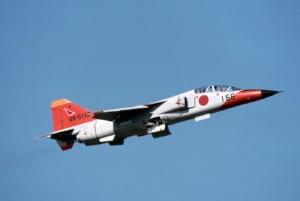
In March 1969, the T-2 design was completed with the first prototype designation XT-2. On April 28, 1972, the prototype was rolled out, and almost three months later, on July 20, it took to the air for the first time. In 1975, the aircraft entered into service and was used by Japan Air Self Defense […]
Curtiss-Wright AT-9
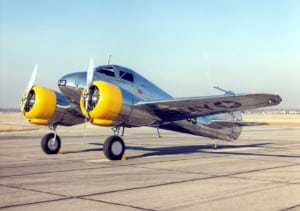
The American manufacturing company Curtiss-Wright developed the CW-25 prototype with fuselage and tail surfaces covered in fabric upon anticipating the need for a high-performing aircraft powered by twin engines. The prototype was built with the characteristics of a light bomber in taking off and landing. In 1941, it took to the air for the first […]
Lockheed T-33 Shooting Star
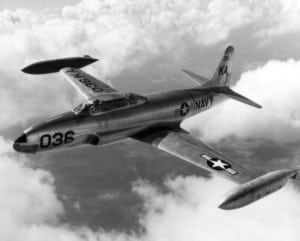
On March 22, 1948, the Lockheed T-33 with the initial designation TF-80C took to the air for the first time. It was operated by the American test pilot Tony LeVier. The aircraft was produced from 1948 until 1959 with a total number of 6,557 T-33s built. It was operated by several air forces such as […]
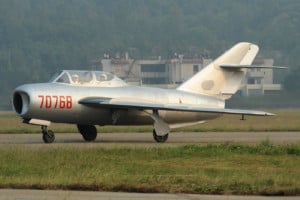
Chengdu JJ-5
During the late 1960s, the Chengdu Aircraft Industry Corporation developed a two-seat trainer variant based on the MiG-17. The aircraft was designated as Chengdu JJ-5 and incorporated the two-seat cockpit of the MiG-15UTI dual-control jet trainer, as well as the J-5’s engine, and the J-5A’s fuselage. The internal armament was removed and replaced by a […]
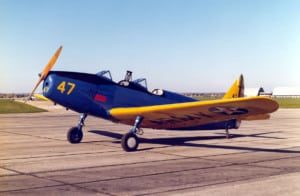
Fairchild PT-19
Development and Design Fairchild PT-19 series was initiated from the Fairchild Mp-62 during the USAAC ordered the aircraft in 1940 as an extension for their expansion program. Its cantilever low-wing plane that has a tailwheel design and fixed landing gear was originally based on the two-place, open cockpit, and tandem seating arrangement. Its simple and […]
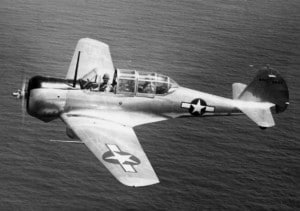
Curtiss-Wright CW-22
The CW-22 was developed by the American Curtiss-Wright Corporation in their St. Louis factory during the 1940s. It was a development of the CW-19 civil utility aircraft through the CW-21 fighter-interceptor. In 1940, the aircraft prototype designated as CW-A22 took to the air for the first time. It was a less-powered, all-metal low-wing monoplane fitted […]
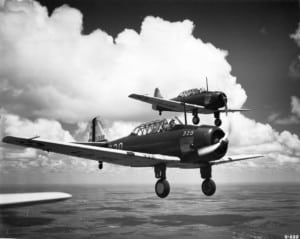
North American BT-14
The North American BT-14 is a two-seat primary training monoplane with a lengthened fuselage of welded chrome-molybdenum steel-tube framework. The fuselage is fabric-covered and has an external length of 8.7 meters, an external height of 2.7 meters, and a fuselage diameter of 1.1 meters. The cantilever tail and fin were made of metal and covered […]
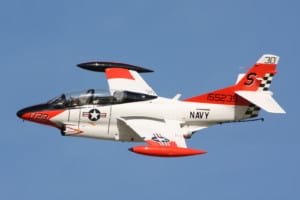
North American T-2 Buckeye
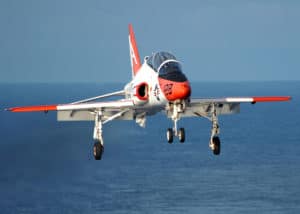
On January 31, 1958, the first T2J-1 took to the air for the first time. After a year, in 1959, the T2J-1 entered into service and was later redesignated in 1962 as the T-2A. The aircraft was eventually modified and the single-engine was replaced with twin engines. The T-2B was an enhanced variant with two […]
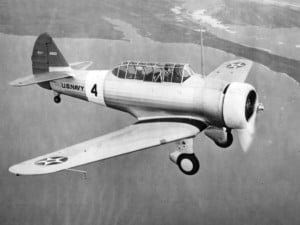
North American NA-16
On December 10, 1934, the NA-16 specification was designed by James Howard Dutch Kindelberger, John L. Lee Atwood, and H.R. Raynor of the North American Aviation. A primary feature was an enclosed canopy. On April 1, 1935, the NA-16 operated by Eddie Allen took to the air for the first time. On May 27, 1935, […]