

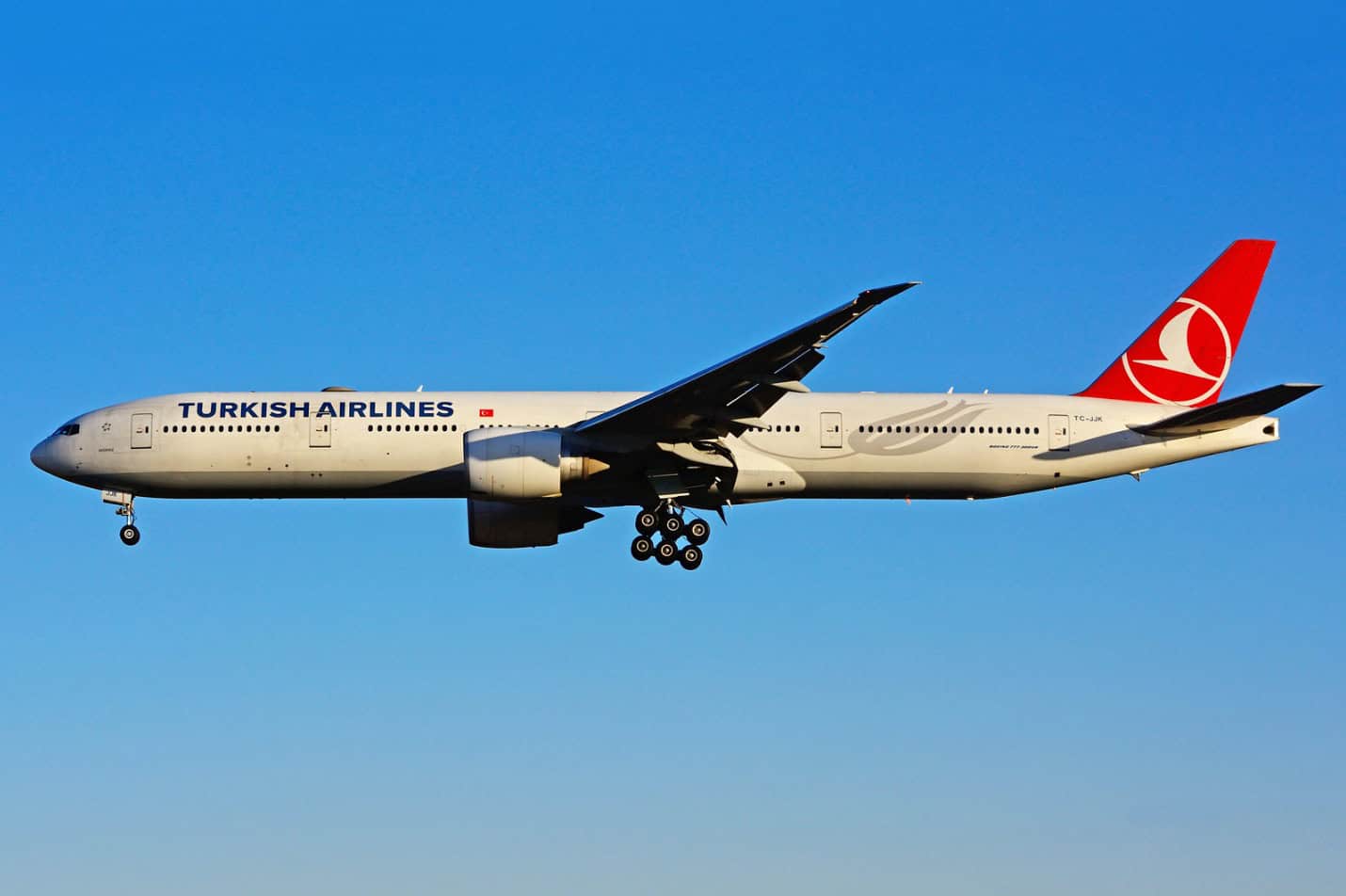
On July 28, 2026, a Turkish Airlines Boeing 777-300ER bound for Toronto turned back over the North Sea and diverted to Manchester after the crew reported a technical fault. Flight TK17, registered TC-JJR, had left Istanbul earlier that afternoon and was roughly four hours into its transatlantic run when the problem appeared.
The crew broke off the crossing before committing to the open Atlantic. According to flight-tracking data reported by aviation trackers, the aircraft was cruising at 32,000 feet when it descended into a holding pattern at 26,000 feet, then routed to Manchester and landed on Runway 23L at about 7:30 p.m. local time.
How the diversion unfolded
TK17 is a scheduled long-haul service between Istanbul and Toronto, a run of roughly ten to eleven hours in the 777-300ER. It had departed on time at 16:40 local and climbed to its cruising altitude before the fault interrupted the crossing about four hours later, out over the North Sea.
Rather than continue toward the Atlantic, the crew worked the problem with air traffic control and held to set up an approach. Firefighters were scrambled to meet the jet, which touched down on Manchester’s Runway 23L without further incident. It taxied in normally, and there were no reports of injuries.
Turkish Airlines and the airport described the problem only as a technical issue that was subsequently addressed. Neither released the nature of the fault or the number of passengers on board, and no official report has been published.
The stop added several hours to the journey. After engineers inspected TC-JJR and the aircraft was refueled, the flight pushed back roughly three hours after landing and flew the final leg of about seven hours across the Atlantic to Toronto Pearson, reaching Canada late that night. Because the same airframe continued the route, passengers arrived on their original jet, simply well behind schedule.
Why a crew turns back instead of pressing on
A diversion like this looks dramatic on a flight map, but it reflects routine airmanship. Once a long-haul flight leaves Europe, the next several hours are spent over open ocean with few places to land. A crew that notices an abnormality beforehand has every reason to deal with it while good options are still within reach.
Manchester Airport is one of those options. It is a major long-haul hub with runways long enough for a fully loaded 777, full emergency cover, and heavy engineering support. For a Turkish flight over the North Sea, it sits almost directly on the path and offers everything a crew would want for a precautionary landing.
Why Manchester
Manchester was the last major widebody-capable airport on the flight’s path before the North Atlantic crossing. Landing there kept long runways, full emergency cover, and engineering support within easy reach, rather than committing to hours over open ocean.
The holding pattern before landing matters too. A 777 that has only just started a transatlantic flight is heavy with fuel, often above its maximum safe landing weight. Circling to burn fuel down, or in some cases jettisoning it, lets the jet touch down at a weight the airframe and brakes are designed for.
The event is a good example of what actually happens when a flight diverts: a manageable problem, an early decision, and a landing at a well-equipped airport well short of any emergency. It follows a string of transatlantic turnbacks this summer, including an American Airlines 777 that diverted to New York after its landing gear jammed in the down position.
Still unconfirmed
Turkish Airlines has not said what the technical fault was, and no official report has been published. Until the airline or investigators confirm details, the cause remains unknown.
Get the Newsletter
The latest aviation news and stories sent to your inbox.
About the Author
Tim is the owner and lead editor of AeroCorner since 2019, overseeing aviation content covering aircraft, airlines, airports, and the broader aviation industry. Through years of researching, writing, editing, and publishing aviation-focused content, he has developed extensive practical knowledge of commercial aviation and air travel. Based in Asia and a frequent traveler himself, Tim also brings firsthand passenger experience to AeroCorner’s coverage. Outside of publishing, he has also explored aviation firsthand through hands-on flight training in New Zealand.