

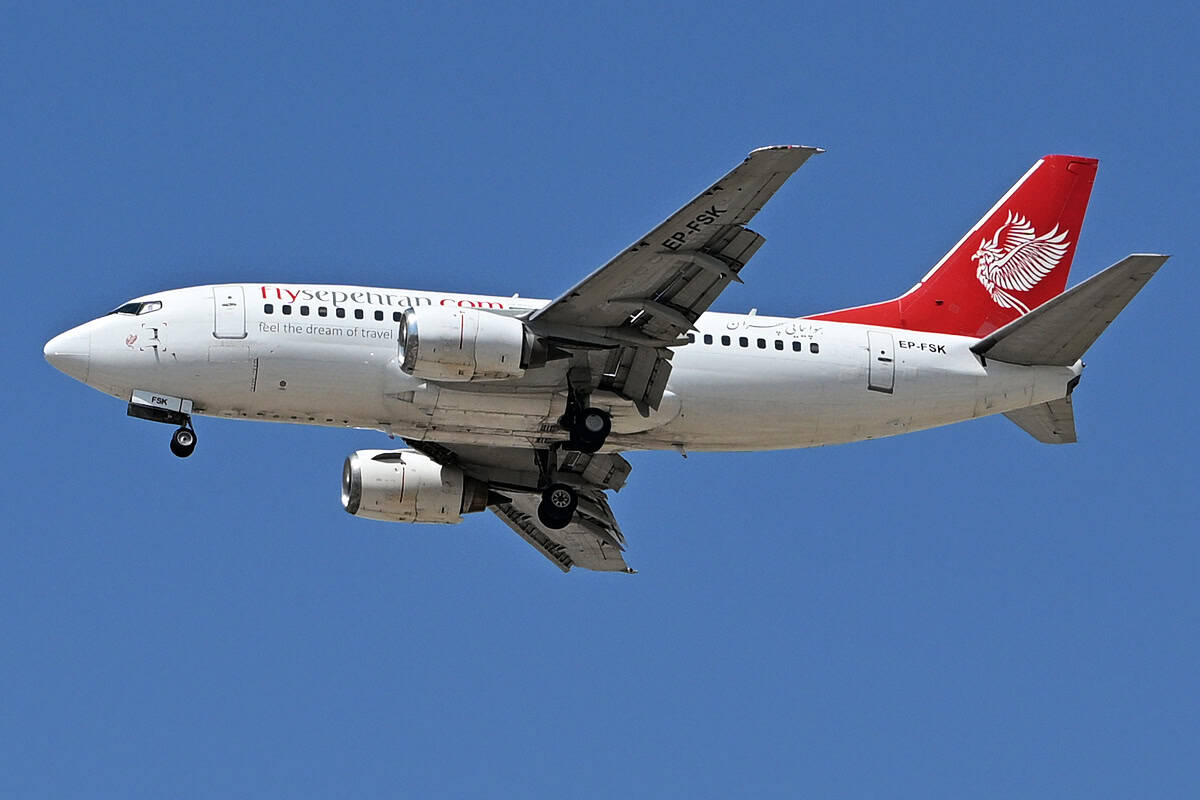
Sepehran Airlines flight IS4360 returned to Mashhad International Airport on September 15, 2026, minutes after taking off for Kermanshah, when the outer rubber of a landing gear tire separated during the takeoff roll. The Boeing 737 landed safely and nobody on board was hurt.
What happened aboard IS4360
The aircraft left Shahid Hasheminejad International Airport at about 17:30 local time. The crew declared an emergency roughly nine minutes later, after reporting a problem with an engine.
As the jet flew its return circuit, vibration running through the airframe worked sections of the cabin ceiling lining and the overhead bins loose. Passengers filmed panels hanging down and dropping into the cabin.
Footage carried by Iranian outlets showed passengers praying and calling out as the interior came apart around them. The aircraft landed back at Mashhad without further incident.
Hassan Jafari, public relations director of the Razavi Khorasan provincial airports authority, said the tire’s outer surface separated as the aircraft left the runway, and that the tire itself had not burst. He said the passengers were flown on to Kermanshah on a replacement aircraft.
That account sits awkwardly against earlier reporting. Simple Flying described a burst tire on departure while noting the cause had not been confirmed, and said an airline spokesperson could not immediately be reached.
Reality check: the accounts do not yet agree
The first reports blamed turbulence for the falling panels. Later accounts, including the provincial airports authority, point instead to a tire failure on takeoff. Whether that tire burst or shed its tread is still contested, and the aircraft’s exact 737 variant has not been confirmed. The Civil Aviation Organization of Iran is investigating, and no finding has been published.
Why losing a tread shakes a whole aircraft
A main gear tire on a Boeing narrowbody carries tens of thousands of pounds and is spinning at well over 100 mph (160 km/h) by the time the aircraft lifts off. Losing the tread leaves that wheel badly out of balance.
An unbalanced wheel sends vibration up the landing gear leg and into the wing and fuselage structure. That energy does not stay politely in the gear bay.
Cabin ceiling panels and overhead bins hang from clips and brackets sized for normal flight loads, not for sustained shaking at an unusual frequency. Fasteners can work loose, which is what the passengers on IS4360 filmed.
Crews treat a suspected tire failure as a reason to come back rather than press on. Shed rubber can damage flaps, hydraulic lines or an engine, and a damaged wheel raises a separate question about how the landing itself will go.
Retracting a shredded wheel into the bay carries its own risk, since debris can foul the gear or the doors. A short circuit back to the departure airport is the standard answer.
The second Sepehran incident at Mashhad in three weeks
It was the second Sepehran 737 event at the same airport in under a month. On August 25, 2026, flight IS4310 from Tehran Mehrabad veered off runway 13L after landing and stopped on the parallel runway with its nose gear collapsed.
That aircraft, a Boeing 737-500 registered EP-FSF, was carrying 127 people. Nobody was injured, and the Civil Aviation Organization of Iran opened an investigation into that event as well.
Iranian carriers operate some of the oldest Western-built fleets still flying scheduled service. Sanctions have blocked access to new Boeing and Airbus aircraft, and to much of the spare parts market, for decades.
That is the backdrop to Iran’s effort to certify its own Simorgh turboprop, and it is why 737 Classics built in the 1980s and 1990s still fly domestic routes there.
Tires and brakes are consumable items with tightly controlled retirement lives. A fleet operating under sourcing constraints has a harder time keeping every consumable on schedule, though no investigator has linked the September 15 failure to parts supply.
Get the Newsletter
The latest aviation news and stories sent to your inbox.
About the Author

Tim is the owner and lead editor of AeroCorner since 2019, overseeing aviation content covering aircraft, airlines, airports, and the broader aviation industry. Through years of researching, writing, editing, and publishing aviation-focused content, he has developed extensive practical knowledge of commercial aviation and air travel. Based in Asia and a frequent traveler himself, Tim also brings firsthand passenger experience to AeroCorner’s coverage. Outside of publishing, he has also explored aviation firsthand through hands-on flight training in New Zealand.