

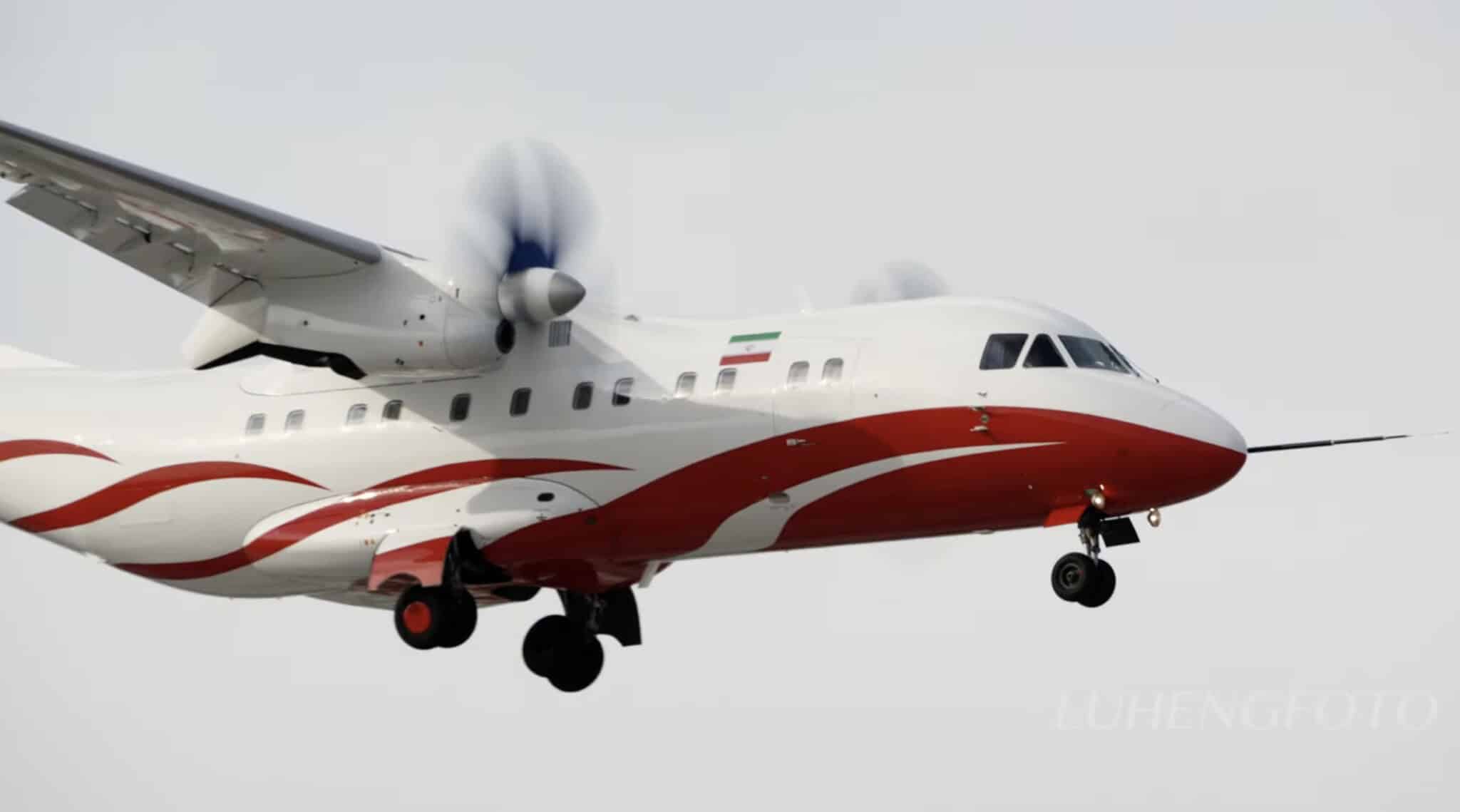
Iran announced on July 28, 2026, that its domestically built Simorgh transport aircraft has entered the certification phase, the last regulatory step before the type can carry commercial payloads. Officials say service entry is targeted for the Iranian year 1406, which runs from March 2027 to March 2028.
The statement came from Hossein Shokri, secretary of the aerospace, transportation and urban development headquarters under Iran’s Vice Presidency for Science, Technology and Knowledge-Based Economy, in remarks carried by Press TV and other Iranian state outlets.
“The Simorgh aircraft project has now entered the process of obtaining standards, permits and certification, a decisive stage,” Shokri said. He added that the 1406 target could slip: “Our estimates are still focused on 1406, although a short delay is possible.”
Iran’s Civil Aviation Organization holds the certification decision, working with the Iran Aircraft Manufacturing Industrial Company, known as HESA, which builds the aircraft at Shahin Shahr near Isfahan.
Treat the timeline as provisional
Every detail here comes from Iranian government statements relayed by state media. No type certificate has been published, no independent regulator has validated the programme, and Iranian aerospace schedules have slipped repeatedly before. This is an announced milestone, not a verified one.
A new name on an old airframe
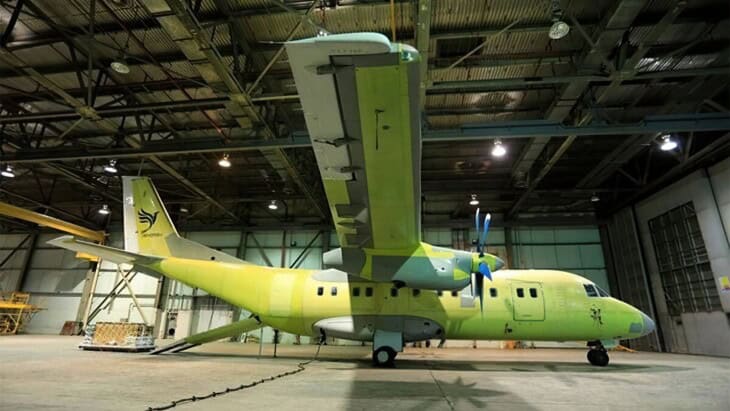
The Simorgh is not a clean-sheet design. It is a reworked version of the IrAn-140, itself a licence-built copy of the Ukrainian Antonov An-140 that HESA assembled from knock-down kits supplied by Antonov starting in 2000.


Iran unveiled the Simorgh in May 2022 with a reinforced fuselage, a longer wing, a rear cargo ramp and updated avionics. It flew for the first time in May 2023 and began certification flight testing at Shahin Shahr in late 2025.
2000
Licence assembly begins. HESA starts building the Antonov An-140 in Iran as the IrAn-140, from knock-down kits shipped by Antonov.
February 2011
First six enter service. Iranian operators put the type into commercial passenger use after a decade of slow assembly.
August 10, 2014
Sepahan Airlines Flight 5915. An IrAn-140 loses control after an engine failure on takeoff from Tehran Mehrabad and crashes, killing 40 of the 48 people on board. The fleet is grounded.
Late August 2014
Grounding lifted. Iranian defense officials declare the type airworthy again within about two weeks of the crash.
May 2022
Simorgh unveiled. Iran presents a modified IrAn-140 with a reinforced fuselage, longer wing and rear cargo ramp.
May 2023
First flight. The prototype flies a short maiden sortie.
July 28, 2026
Certification phase announced. Officials say the programme has entered the standards and permits stage, with service targeted for the year beginning March 2027.
Why the lineage is the story
The IrAn-140 has one of the worst safety records of any modern airliner relative to how few were built. Roughly a dozen airframes were completed, and one of them was destroyed in the accident that ended the type’s passenger career.
On August 10, 2014, Sepahan Airlines Flight 5915 lost its number two engine as it lifted off from Tehran Mehrabad, rolled toward the dead engine, stalled at barely 130 feet (40 m) and crashed into a residential area. Forty of the 48 people on board were killed.
Investigators pointed to an electronic engine control failure, an aircraft flight manual that led the crew to overestimate the permitted takeoff weight, and a rotation speed below the correct figure. The fleet was grounded, then declared airworthy again within about two weeks by Iranian defense officials rather than by an independent regulator.
That is the credibility problem the Simorgh inherits. A domestic certification granted by a domestic regulator carries no weight with the FAA, EASA or any leasing company, so the aircraft will not be flying outside Iran whatever Tehran certifies.
Cargo aircraft or military transport?
Iranian state coverage frames the Simorgh as a civil freighter aimed at domestic air cargo and logistics. Defense trade reporting describes a different aircraft.
Defence Security Asia reported the type as a tactical transport intended for the Iranian air force and possibly the IRGC Aerospace Force, sized to carry 60 troops or 24 stretchers and to operate from unprepared strips as short as 3,900 feet (1,200 m). Both descriptions can be true of the same airframe, and neither has been independently verified.
| Simorgh, as reported | Figure |
|---|---|
| Length | 75 feet (23 m) |
| Wingspan | 82 feet (25 m) |
| Max takeoff weight | 46,000 pounds (21 tonnes) |
| Payload | 13,000 pounds (6 tonnes) |
| Cruise speed | 286 mph (460 km/h) |
| Range | 2,400 miles (3,900 km) |
| Engines | Two turboprops, roughly 2,500 hp each, described as domestic versions of the Ukrainian TV3-117 |
The strategic logic is straightforward either way. Sanctions have kept Iran out of the new-aircraft market for most of two decades, and a fleet of light freighters it can build and support itself is worth more to Tehran than one it cannot buy parts for.
The category itself is sound. Rugged twin turboprops remain the right tool for short, thin, unpaved-runway work, which is a large part of why turboprops are still used long after jets took over everything else. Whether Iran can build a safe one is the question the certification phase is supposed to answer.
Sources and references used for research and fact-checking.
- Press TV, Iran's Simorgh aircraft enters certification phase, eyes commercial service in 2027
- Mehr News Agency, Iranian Simorgh airplane nears operational certification
- SKYbrary (EUROCONTROL), A140, vicinity Tehran Mehrabad Iran, 2014
- Aviation Safety Network, Loss of control Accident HESA IrAn-140-100 EP-GPA, Sunday 10 August 2014
Get the Newsletter
The latest aviation news and stories sent to your inbox.
About the Author

Tim is the owner and lead editor of AeroCorner since 2019, overseeing aviation content covering aircraft, airlines, airports, and the broader aviation industry. Through years of researching, writing, editing, and publishing aviation-focused content, he has developed extensive practical knowledge of commercial aviation and air travel. Based in Asia and a frequent traveler himself, Tim also brings firsthand passenger experience to AeroCorner’s coverage. Outside of publishing, he has also explored aviation firsthand through hands-on flight training in New Zealand.