

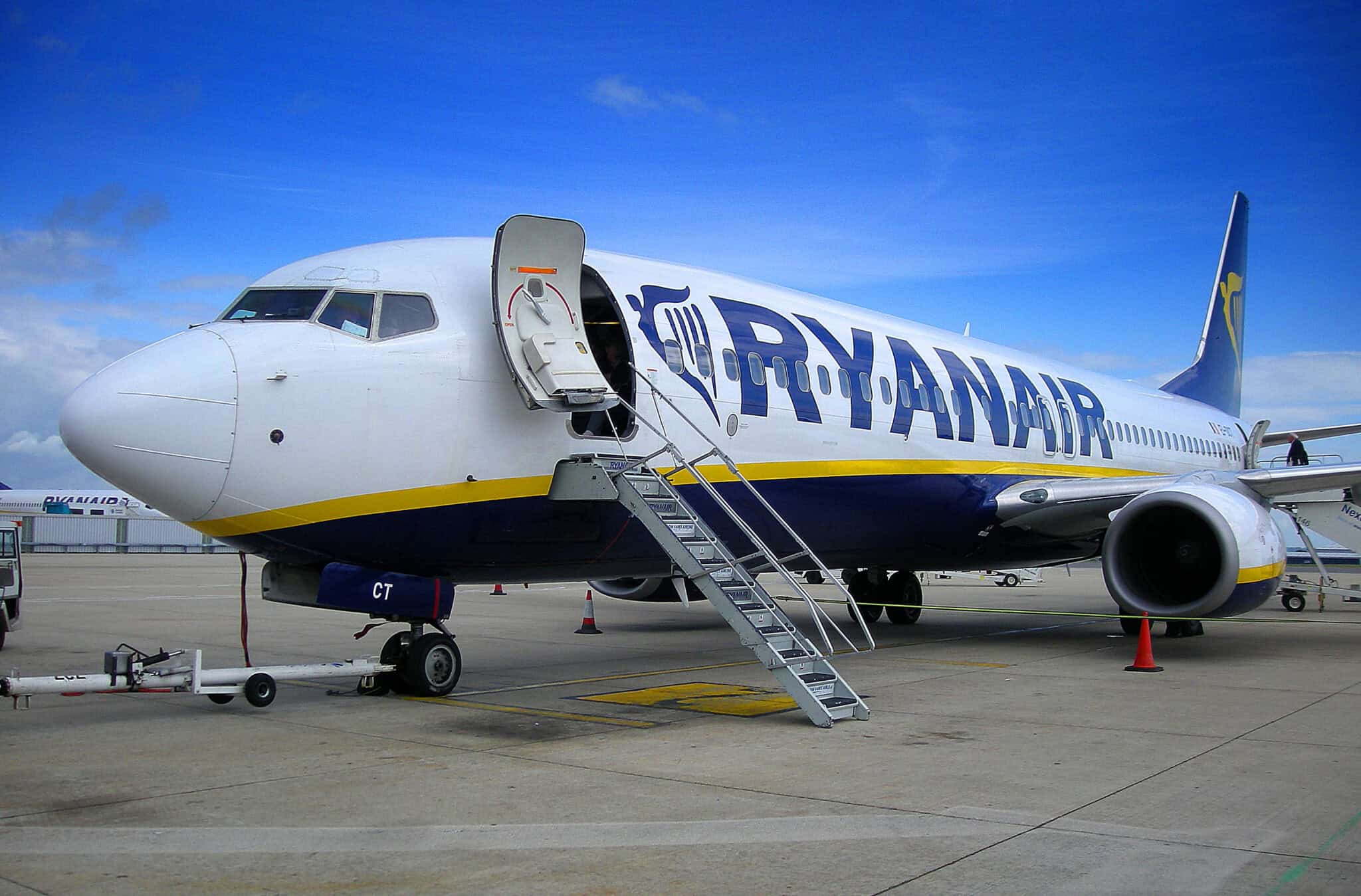
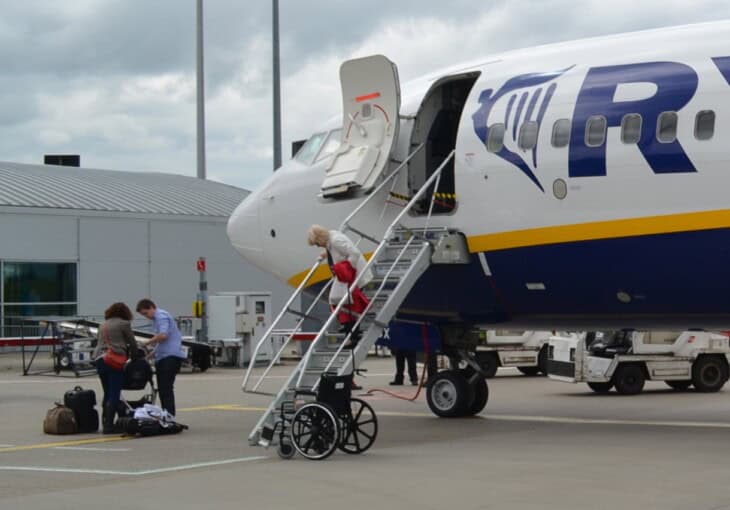
Italy’s flight safety agency, the ANSV, published a study on August 31, 2026, that tied most passenger falls during boarding and deplaning to one piece of equipment: the fold-out airstair built into the nose of the Boeing 737. Of 104 falls recorded in Italy from 2023 through 2025, 85 happened on that forward stair, which in Italy is used almost only by Ryanair.
What the ANSV Counted
The agency opened the study after a run of fall reports in 2025, three of which it escalated to formal safety investigations. Drawing on the European Union’s ECCAIRS occurrence database, it found that 85 of the 104 boarding and deplaning falls in Italy over the three years, about 82 percent, involved the 737’s integral forward stair.
Ryanair carried roughly 26 to 27 percent of all air passengers in Italy in those years. The airlines carrying the other 73 percent, using stairs supplied by airports, logged 19 falls between them. A separate Ryanair-wide dataset from Ireland’s accident investigation unit showed 489 airstair falls since 2021, 360 of them from the forward built-in stair.
ANSV also checked the database against numbers reported directly by Italian airport operators. The two sets did not match exactly, but both showed the fall rate on the 737’s built-in stair running at least twice, and on average well above, the rate on airport stairs.
Why the Built-In Stair Is Different
Boeing sells the folding airstair as an option on the 737. It stows in a bay below the forward door and extends on electric power, letting a crew unload passengers without a ground vehicle or a jet bridge.
The stair has 12 steps about 24 inches (61 cm) wide, roughly 8 inches (20 cm) high, with a 10-inch (25 cm) tread, set at about 35 degrees. The first step is shallower, near 7.5 inches (19 cm), and trapezoidal because it follows the curve of the fuselage.
Airport passenger stairs built to the EN 12312-1 standard must have uniform steps and a platform at least 39 inches (100 cm) wide. European rules set no size requirements for an aircraft’s own airstair, which is not classed as critical to flight. ANSV said the 737 stair sits at the limits for step height and steepness next to airport equipment.
The agency still put the falls down mainly to human factors. Passengers carry bags in both hands, skip the handrail, or step off without full attention, and millions descend these stairs each year while only a few dozen fall.
What Ryanair Changed
Spain’s investigation agency, the CIAIAC, went further after an October 2024 accident on a Ryanair 737-8200. It recommended that Boeing redesign the stair to cut its slope and step height, that EASA review whether built-in airstairs should be used for passengers at all, and that Ryanair move to certified airport stairs.
Ryanair, whose 737 fleet has drawn safety scrutiny before, revised its deplaning procedure on July 23, 2026. Cabin crew must now repeat the safety announcement in the languages of both the departure and arrival country rather than English alone, repeat it throughout deplaning, and remind passengers without a free hand to hold the handrail. A dedicated crew training module was added to recurrent training from August 21, 2026.
The change drew wider attention when FlightGlobal reported it in early September. Because Ryanair acted while the study was still open, ANSV said it agreed with the earlier recommendations but would issue none of its own.
Whether it works is not yet clear
An earlier announcement change in August 2025 did not move the numbers. ANSV counted 18 forward-stair falls in the four months after it, in line with the rate before. Whether the July 2026 revision does better will not be visible for months.
Sources and references used for research and fact-checking.
Get the Newsletter
The latest aviation news and stories sent to your inbox.
About the Author

Tim is the owner and lead editor of AeroCorner since 2019, overseeing aviation content covering aircraft, airlines, airports, and the broader aviation industry. Through years of researching, writing, editing, and publishing aviation-focused content, he has developed extensive practical knowledge of commercial aviation and air travel. Based in Asia and a frequent traveler himself, Tim also brings firsthand passenger experience to AeroCorner’s coverage. Outside of publishing, he has also explored aviation firsthand through hands-on flight training in New Zealand.