

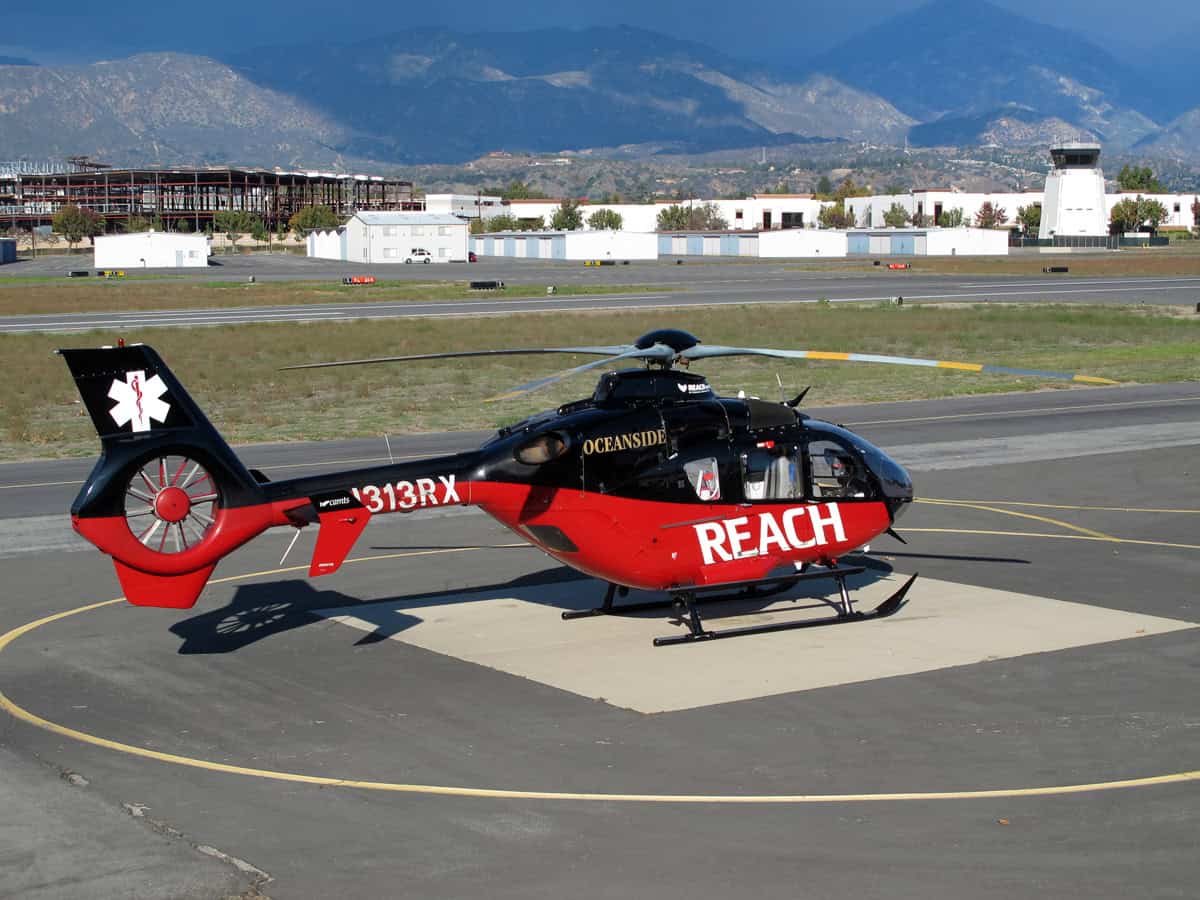
A REACH Air Medical Services helicopter that flight-tracking data identifies as Eurocopter EC135 N313RX went down in the Pacific off Pebbly Beach on Catalina Island at about 7:50 p.m. on Wednesday, September 30, 2026, shortly after takeoff. Two of the five people aboard died and two were taken to mainland hospitals.
The fifth person, the patient the crew was flying to the mainland, was still missing on Thursday morning, according to the Los Angeles County Fire Department and the U.S. Coast Guard.
What Officials Have Confirmed
L.A. County Fire said it sent helicopters and divers at around 7:50 p.m., soon after the first reports, and that five people were on board. Lifeguards, sheriff’s deputies, Avalon Fire and the Coast Guard joined the response near Pebbly Beach, about a mile from Avalon.


Fire Engineer Jonathan Torres told KTLA that the helicopter was leaving Catalina Island for the mainland. Rescuers found four of the five occupants: two were dead at the scene and two were taken to hospitals in stable condition.
KTLA also reported that the wreck lies in about 240 feet (73 m) of water. Catalina sits roughly 22 miles (35 km) off the Los Angeles County coast, and both survivors were taken to hospitals on the mainland.
On Wednesday night, Coast Guard Cmdr. Mark Leahey called the calm sea “ideal search conditions” in remarks reported by NBC San Diego, but said there was a lot of debris and some fuel in the water.
By Thursday morning, Capt. Stacey Crecy said crews had searched through the night in favorable weather and would keep going through the day, CBS Los Angeles reported. She said the helicopter was believed to be carrying someone off the island for further medical treatment.
Officials had not released the names of the people on board, or the roles of the two who died, at the time of writing. KESQ, citing KABC, reported that the two people killed were the pilot and a flight nurse, which no agency has confirmed.
The Helicopter and Its Last Flight
The FAA identified the aircraft as a Eurocopter EC135, and the NTSB described it as an EC 135 P2. The type is the twin-engine light helicopter that Airbus Helicopters now sells as the H135, which is why some reports call it an Airbus.
None of the agency statements reported by Thursday morning included a registration. FlightAware data shows REACH’s EC135 P2+ N313RX leaving the Oceanside Fire Department heliport at 6:40 p.m. PDT and last seen near Avalon at 7:04 p.m., the same times CBS Los Angeles reported from flight tracking.
The FAA registry lists N313RX as an EC 135 P2+, serial number 1097, built by Eurocopter Deutschland and registered to REACH Air Medical Services LLC of Santa Rosa, California. The same helicopter’s history shows an Oceanside-to-Avalon flight three days earlier, on September 27, followed by a leg to Zamperini Field in Torrance.
A Global Medical Response spokesperson said in a statement to KTLA that the company was gathering information and working with responders, and that “our immediate concern is for the well-being of those involved.”
What is still unconfirmed
Officials have not named the people on board or confirmed their roles, and the registration N313RX comes from flight-tracking data, not from an NTSB or FAA statement. The cause is unknown, and the patient was still missing when this was written on Thursday morning, October 1.
How the NTSB Investigation Will Work
The NTSB told KTLA it is “very early in the investigation.” Its investigators were due on scene Thursday to document the site and examine the helicopter once others handling the recovery finish, after which the wreck will go to a secure facility.
The agency says it generally tries to finish an investigation, with a probable cause, within 12 to 24 months. The Catalina case opens about two weeks after the N358TV news helicopter crash in Chatsworth on September 15, which the NTSB is also investigating.
The Rules Air Ambulances Fly Under
Helicopter air ambulances in the US have flown under a tighter set of FAA rules since April 22, 2014. The FAA wrote that rule to address an increase in fatal helicopter air ambulance accidents, and many of its parts answered NTSB recommendations.
It requires terrain awareness and warning systems, a documented preflight risk analysis and an operations control center for operators with 10 or more air ambulance helicopters. It also requires a flight data monitoring system, which the FAA said can give investigators critical information after an accident.
Overwater flying has its own rule. Beyond autorotational distance from the shore, every occupant must wear a life preserver with a locator light, and the helicopter must carry a 406 MHz emergency locator transmitter.
The rule exempts flying needed only for takeoff or landing, or allowed by the operator’s FAA operations specifications, and it excuses an air ambulance patient from wearing a life preserver when that would be medically inadvisable. Where the helicopter was relative to that line, and what equipment the occupants had, has not been reported.
Sources and references used for research and fact-checking.
Get the Newsletter
The latest aviation news and stories sent to your inbox.
About the Author

Tim is the owner and lead editor of AeroCorner since 2019, overseeing aviation content covering aircraft, airlines, airports, and the broader aviation industry. Through years of researching, writing, editing, and publishing aviation-focused content, he has developed extensive practical knowledge of commercial aviation and air travel. Based in Asia and a frequent traveler himself, Tim also brings firsthand passenger experience to AeroCorner’s coverage. Outside of publishing, he has also explored aviation firsthand through hands-on flight training in New Zealand.