

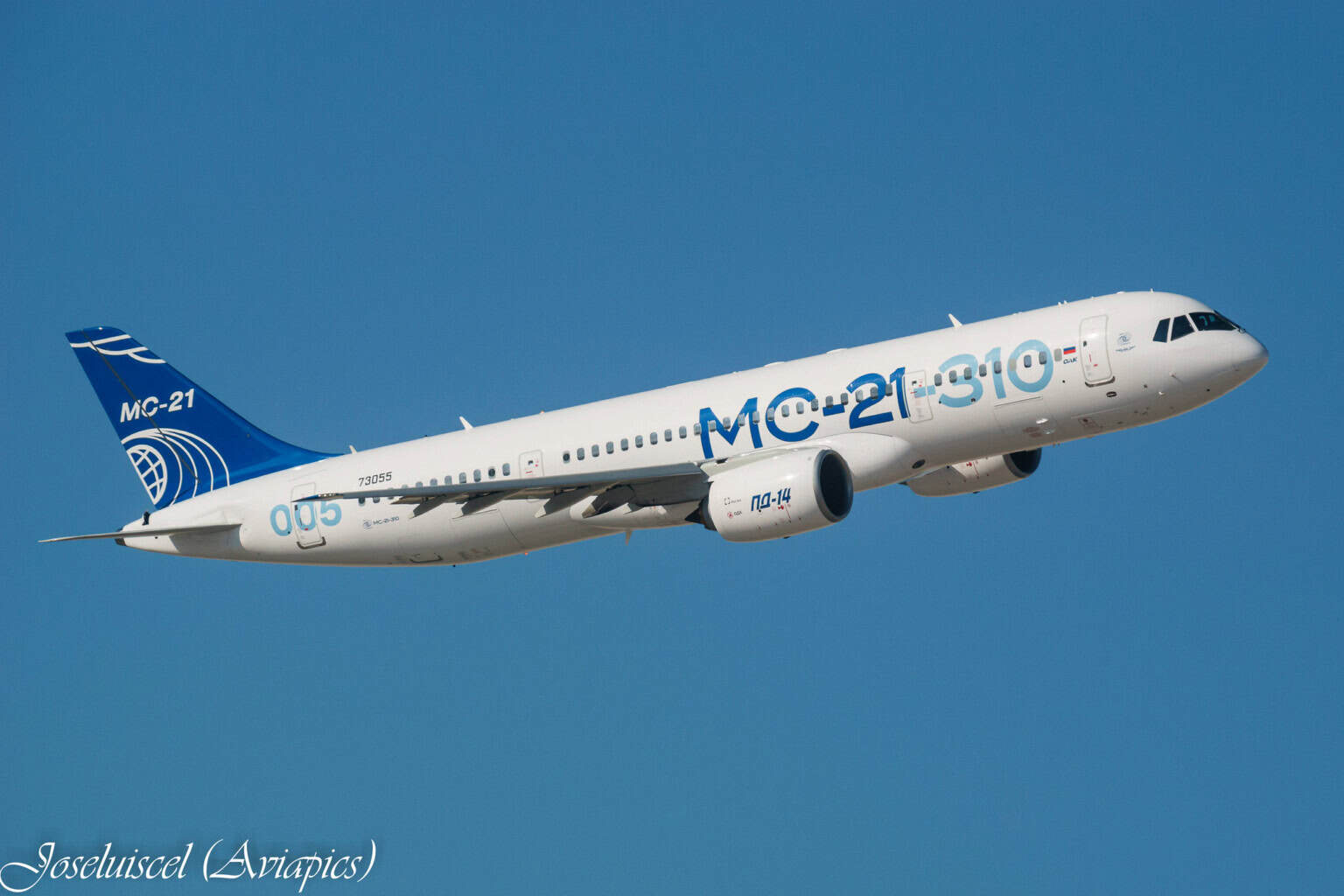
On August 3, 2026, the first production-standard MC-21-310 narrowbody flew for the first time from the airfield of the Irkutsk Aviation Plant in Siberia. State conglomerate Rostec said the aircraft spent 1 hour 23 minutes airborne, reaching 372 mph (600 km/h) and 19,700 feet (6,000 m).
According to Rostec, the crew checked stability and handling in several configurations and verified the operation of the domestically developed onboard systems. The flight plan was completed in full.
Test pilot Roman Taskayev said the assembly-line aircraft performed well, in comments carried by The Moscow Times. United Aircraft Corporation chief executive Vadim Badekha said the Irkutsk line is preparing an initial batch of 18 aircraft.
Why a “production-standard” first flight is its own milestone
The Yakovlev MC-21 has been flying since 2017, so this was not the type’s first flight. It was the first flight of an airframe built on the serial production line rather than by a development shop.
That distinction matters more than it sounds. Prototypes are assembled slowly, by hand, by engineers who can work around a part that does not fit. A production aircraft has to come together on tooling, to a takt time, using the supply chain that will feed every later delivery.
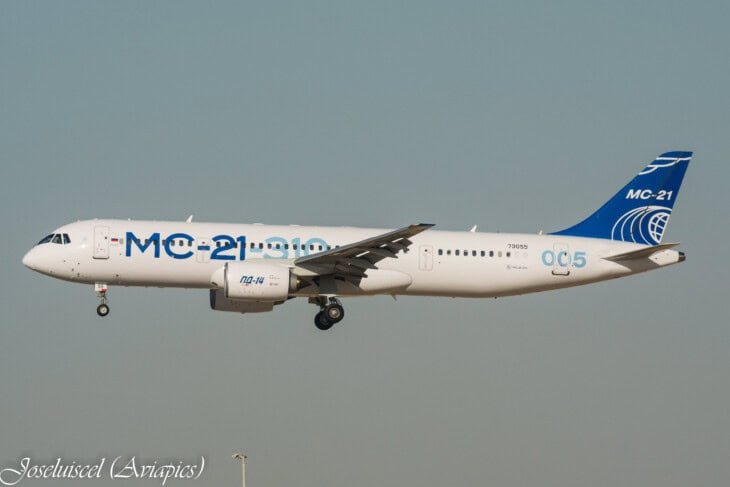
Rostec framed the flight in exactly those terms, saying it confirms that the production chains are ready for serial manufacturing of the type. Manufacturers everywhere run this step to expose the gap between a hand-built demonstrator and a factory product before customers start taking jets.
What was actually new
The MC-21 first flew in May 2017. What flew on August 3 was the first aircraft off the serial assembly line, built to validate final assembly, production flight testing and acceptance procedures ahead of type approval.
The bill for building it entirely at home
The MC-21 was designed as a Western-equipped aircraft, with Pratt & Whitney PW1400G engines, imported avionics and a composite wing that relied on US and Japanese materials. US sanctions cut off the composite supply in 2018, and the broader sanctions that followed the 2022 invasion of Ukraine removed the rest.
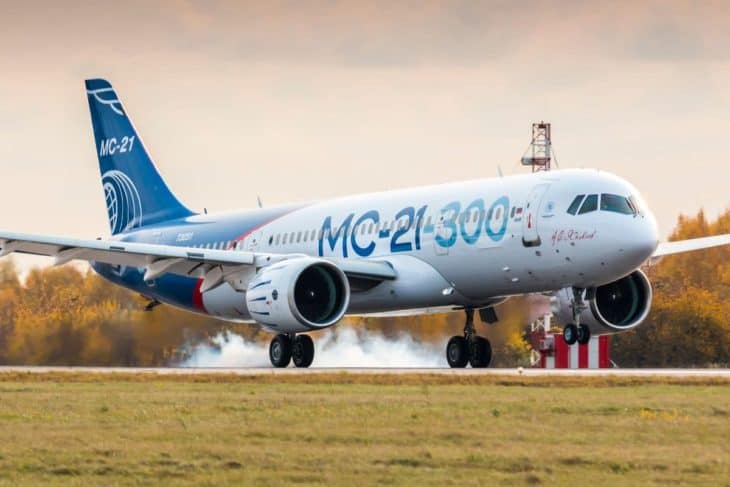
The MC-21-310 is the answer: Aviadvigatel PD-14 engines and Russian systems throughout. Russia has been here before with the Sukhoi Superjet 100, which had to be re-engineered around domestic parts after its foreign suppliers withdrew, and Iran is running a similar playbook with its Simorgh turboprop.
Substitution is rarely weight-neutral. Russian reporting has put the import-substituted airframe at roughly 5.75 tonnes (about 12,700 lb) heavier than the Western-equipped MC-21-300, which pushed range down from the original target.
Reality check on the numbers
Published range figures for the MC-21-310 disagree. Some Russian accounts put it near 3,170 miles (5,100 km), down from about 3,980 miles (6,400 km) for the Western-equipped version, while others report a steeper fall to roughly 2,380 miles (3,830 km). No certified figure exists yet, so treat all of them as provisional.
Certification is still the long pole
Four development aircraft have been carrying the certification campaign. Specialist outlet RuAviation reported they flew 136 sorties totalling just under 510 hours between January and July 2026, putting the program at roughly the halfway mark.
The target date is not settled. Rostec has pointed to completing certification by late 2026 with commercial service months later, while Rostec head Sergei Chemezov has previously put the end of certification flying and the start of serial production in 2027.
Building the first 18 aircraft in parallel with testing is a deliberate hedge, meant to shrink the gap between approval and delivery. It is also a bet that nothing found in the remaining half of the flight-test program forces a change to jets already on the line.
Provisional
The MC-21-310 is not yet certified and none have been delivered. Performance figures, certification dates and production rates all come from the manufacturer and Russian state media, and none have been verified by an independent regulator.
How the program got here
Late 2000s
Program launch. Irkut, later renamed Yakovlev, starts a Western-equipped narrowbody aimed at the A320 and 737 class.
May 2017
First flight. The prototype flies from Irkutsk on Pratt & Whitney PW1400G engines.
December 2021
Russian type certificate. The PW-powered MC-21-300 is certified domestically, but never enters commercial service.
2022
Sanctions and the pivot. Western suppliers withdraw and the program switches to the PD-14 engine and all-Russian systems.
August 3, 2026
First production aircraft flies. The first serial MC-21-310 completes an 83-minute flight at Irkutsk.
Even a fully certified MC-21 faces the problem every challenger runs into, which is that Airbus and Boeing dominate this segment on scale, support networks and residual values rather than on the aircraft alone. Sanctions have handed Yakovlev a captive home market, and for now that is the market the aircraft is built for.
Sources and references used for research and fact-checking.
Get the Newsletter
The latest aviation news and stories sent to your inbox.
About the Author

Tim is the owner and lead editor of AeroCorner since 2019, overseeing aviation content covering aircraft, airlines, airports, and the broader aviation industry. Through years of researching, writing, editing, and publishing aviation-focused content, he has developed extensive practical knowledge of commercial aviation and air travel. Based in Asia and a frequent traveler himself, Tim also brings firsthand passenger experience to AeroCorner’s coverage. Outside of publishing, he has also explored aviation firsthand through hands-on flight training in New Zealand.