

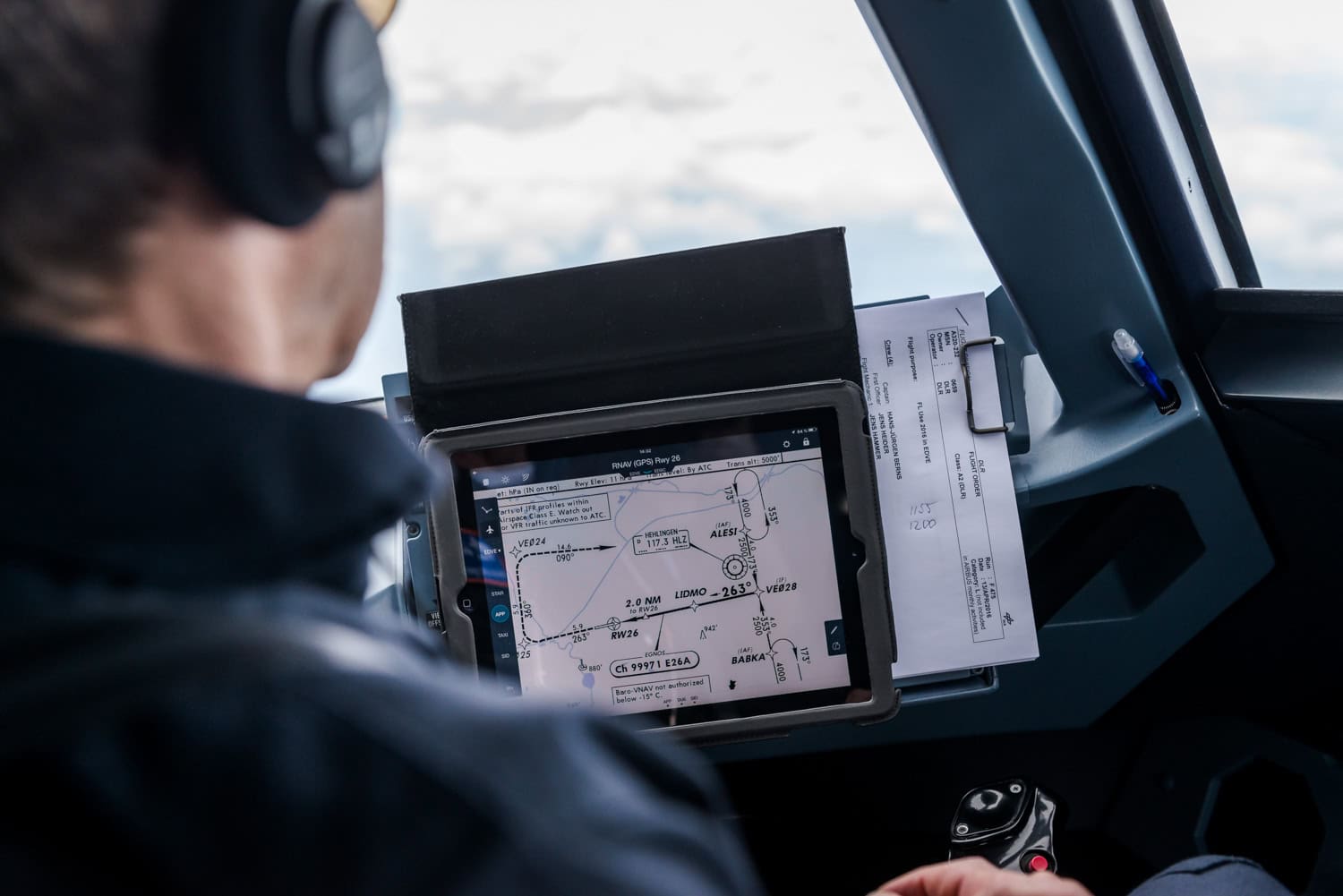
Two commercial flights reported losing satellite navigation while crossing Swedish airspace on September 17 and 18, 2026. Neither aircraft was in danger, both continued to their destinations, and the crews fell back on the navigation systems that airliners carried long before GPS existed.
What makes the pair worth reporting is what the Swedish Transport Agency has been saying about the airspace they were crossing.
What the two crews reported
According to reporting by AIRLIVE, a KLM flight from Amsterdam to Helsinki ran into navigation errors over southern Sweden on September 17. The crew contacted the airline’s maintenance control in flight and asked for help with a full system reset after persistent loss of the satellite signal threw avionics errors.
The following morning an Air Canada flight from Delhi to Toronto reported the same thing while transiting Swedish airspace. Both aircraft continued normally.
No Swedish or airline statement has been issued on either flight, so the detail rests on that reporting rather than on an official account.
The report count fell this year. The regulator says do not read that as good news
The Swedish Transport Agency had logged 142 reports of satellite navigation interference by May 28, 2026, against roughly 336 across 2025. The agency has warned against treating that as an improvement, because the 2026 figures are preliminary and the European reporting criteria changed in between.
Its own assessment, given to NordiskPost by Jorgen Andersson, who heads airspace and airports at the agency, is that interference has stayed at a high level with no clear decline since late winter. The clearest change in 2026, he said, is that spoofing has become more systematic and more widely spread geographically, particularly since the end of May.
Sweden is worst affected in the southeast, around Gotland and Oland and along the traffic flows toward Finland, Poland and the Baltic states. That is the corridor both of this week’s flights were in.
Jamming and spoofing are not the same problem
Jamming drowns the satellite signal in noise, so the receiver knows it has lost its fix and says so. Spoofing feeds the receiver a counterfeit signal, so the aircraft believes a position that is wrong. EASA rates spoofing the higher safety risk precisely because nothing on the flight deck flags it as a failure.
Why this does not put an airliner in the sea
An airliner does not navigate on GPS alone. It blends several position sources at once, which is why losing the satellite layer is an annoyance at cruise rather than an emergency, as our explainer on the four layers of airline navigation sets out.
The inertial reference system keeps computing position from motion with no outside signal at all, and ground beacons remain available across Europe. In its current Safety Information Bulletin, reissued on July 3, 2026, EASA tells crews to verify position by non-satellite means, monitor ground navigation aids, and stay closely on the ATC frequency.
The real cost shows up lower down. Satellite-based area navigation procedures are what let an aircraft fly a precise approach into an airport with no ground equipment on that runway, and those are the procedures that become unavailable when the signal is unusable. An instrument landing system is unaffected, but not every runway has one.
EASA has also documented the failure mode that actually worries regulators: crews reacting to false terrain warnings triggered by a corrupted position, and climbing hard on an alert that was never real.
The same interference is far more dangerous in smaller aircraft with a single navigation source and no inertial system, which is where American investigators have already been looking after a medevac crash tied to GPS interference.
Six states have taken it to ICAO
Sweden, Finland, Estonia, Latvia, Lithuania and Poland have jointly put the problem to the International Civil Aviation Organization, arguing that the interference originates from Russian territory and is a civil aviation safety matter rather than a regional nuisance.
The figures in that filing, first reported by Swedish public broadcaster SVT, covered January to April 2025: about 123,000 flights affected across 365 airlines, and 27.4 percent of all flights in the region disrupted in April alone. The transmitters were placed at Kaliningrad, St Petersburg, Smolensk and Rostov.
Those numbers are now more than a year old, and no comparable regional total has been published since. What the Swedish agency is describing this year is not a bigger count but a harder problem: interference that no longer announces itself.
Sources and references used for research and fact-checking.
Get the Newsletter
The latest aviation news and stories sent to your inbox.
About the Author

Tim is the owner and lead editor of AeroCorner since 2019, overseeing aviation content covering aircraft, airlines, airports, and the broader aviation industry. Through years of researching, writing, editing, and publishing aviation-focused content, he has developed extensive practical knowledge of commercial aviation and air travel. Based in Asia and a frequent traveler himself, Tim also brings firsthand passenger experience to AeroCorner’s coverage. Outside of publishing, he has also explored aviation firsthand through hands-on flight training in New Zealand.