

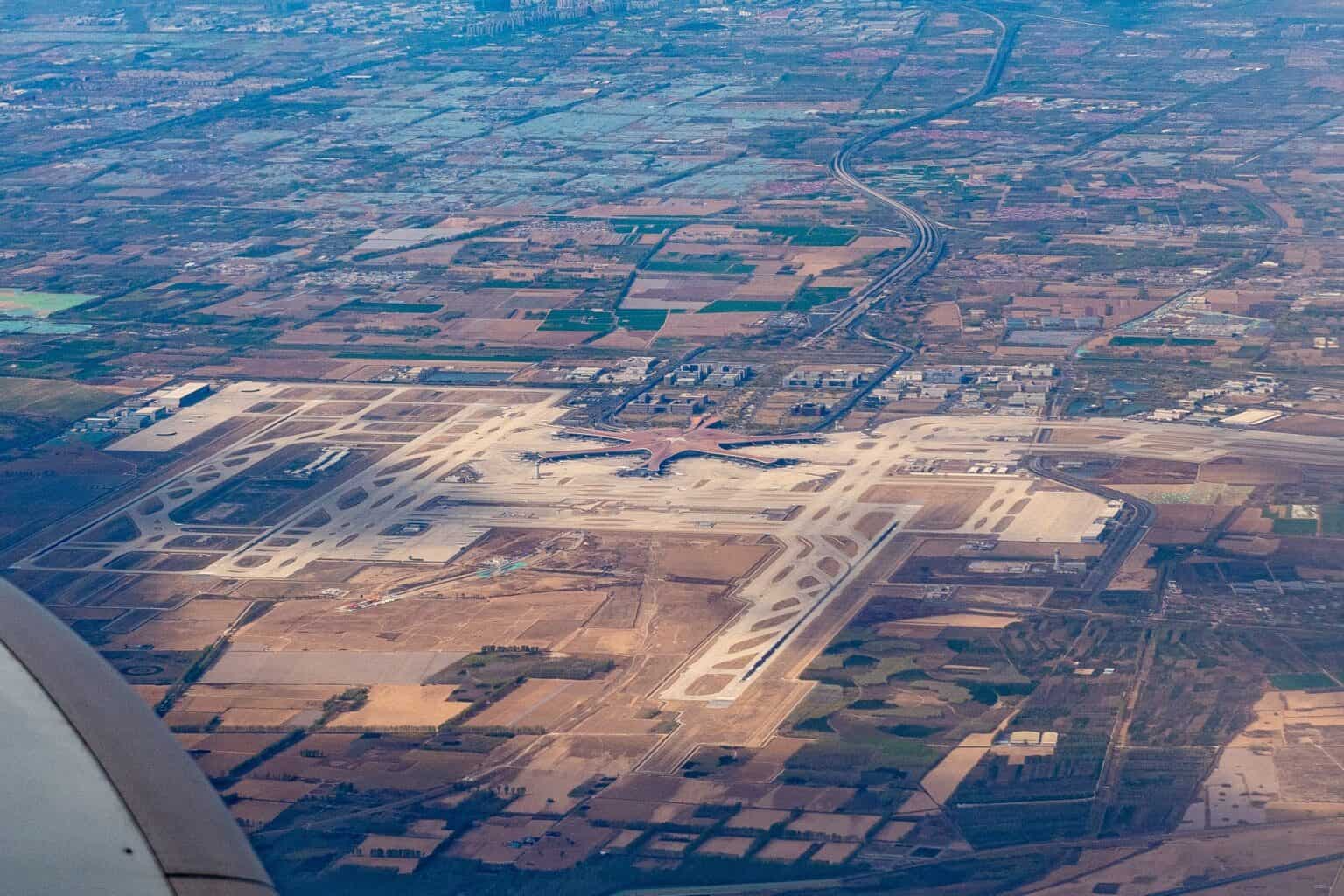
From September 20, 2026, the airspace above and around the Chinese capital becomes a permanent Special Restricted Area that reaches 186 miles (300 km) outward in every direction. The circle covers more than 108,000 square miles (280,000 sq km), an area roughly the size of Italy, and it runs from the surface to unlimited altitude.
The restriction surfaced as an aviation notice attributed to Beijing airspace control authorities and published through the US Federal Aviation Administration’s public NOTAM search system. It was first reported by Reuters on September 17.
What the Zone Actually Bars
Inside the circle, only four categories of flight remain permitted: commercial airline services, approved business flights, and military, customs, police and fire-rescue operations. Everything else needs case-by-case approval.
That “everything else” is the whole of general aviation: flight training, sightseeing and charter work, aerial photography and survey flying, agricultural operations, and private recreational flights.
Flights that do qualify carry conditions attached. Crews must file and follow a pre-approved flight plan, obtain clearance before deviating from it, hold continuous two-way radio contact with air traffic control, carry working identification and tracking equipment, and report their security status before entering the zone.
Geographically the ring takes in Beijing and Tianjin, most of Hebei province, and parts of Inner Mongolia, Shanxi, Shandong and Liaoning, plus a stretch of the Bohai Sea. Roughly 100 million people live inside it.
Scheduled traffic through Beijing Capital International Airport and Beijing Daxing is unaffected, which matters for a market where the country’s three largest carriers posted a combined $1.2 billion loss in the first half of 2026.
Reality check for passengers
Scheduled airline flights are exempt, so travelers routing through Beijing Capital or Beijing Daxing should see no change to their bookings. The weight of this restriction falls on the small end of Chinese aviation: flight schools, charter and survey operators, and private owners.
The Crash That Triggered It
On June 26, 2026, a single-engine Sunward SA 60L Aurora registered B-12PP struck the CITIC Tower, Beijing’s tallest building, in the city’s central business district. The 66-year-old pilot was killed and 13 people on the ground were injured.
The light-sport aircraft belonged to a local general aviation company running training, recreational and aerial photography flights, and had departed an airfield roughly 30 miles (50 km) east of the city. Chinese authorities said the pilot left his approved flying area and lost contact with that airfield before the impact.
June 26, 2026
Light aircraft hits the CITIC Tower. A Sunward SA 60L Aurora strikes Beijing’s tallest building. The pilot is killed and 13 people on the ground are injured.
September 20, 2026
The Special Restricted Area opens. A permanent 186-mile (300 km) radius zone closes the region to all but airline, approved business and emergency flights.
November 15, 2026
Citywide drone measures take effect. Beijing separately bars the possession, storage, transport and sale of civilian drones across the city, with fines reaching 10,000 yuan (about $1,500).
Why One Light Aircraft Can Close a Region This Size
Chinese general aviation was already among the most tightly managed in the world. Most of the country’s airspace sits under military control, and a private flight typically needs its route and time block cleared in advance rather than simply filing and departing.
That is close to the opposite of the American arrangement, where a pilot can leave an uncontrolled field and fly for hours without talking to anyone. When the baseline is already permission-based, extending it across a whole region is an administrative step rather than a structural change.
What stands out is the scale. The closest American equivalent is the Washington DC Special Flight Rules Area, which under 14 CFR Part 93 rings the capital out to 30 nautical miles from the surface to, but not including, flight level 180, with a tighter inner zone around Reagan National.
Beijing’s ring reaches more than five times further out and has no ceiling at all. A comparable US zone drawn around Washington would swallow Philadelphia, Richmond and most of the mid-Atlantic seaboard.
Neither the airspace notice nor the drone measures set an end date, and no Chinese authority has published a review point. Whether the zone eases once the CITIC Tower investigation closes is not known.
Sources and references used for research and fact-checking.
Get the Newsletter
The latest aviation news and stories sent to your inbox.
About the Author

Tim is the owner and lead editor of AeroCorner since 2019, overseeing aviation content covering aircraft, airlines, airports, and the broader aviation industry. Through years of researching, writing, editing, and publishing aviation-focused content, he has developed extensive practical knowledge of commercial aviation and air travel. Based in Asia and a frequent traveler himself, Tim also brings firsthand passenger experience to AeroCorner’s coverage. Outside of publishing, he has also explored aviation firsthand through hands-on flight training in New Zealand.