

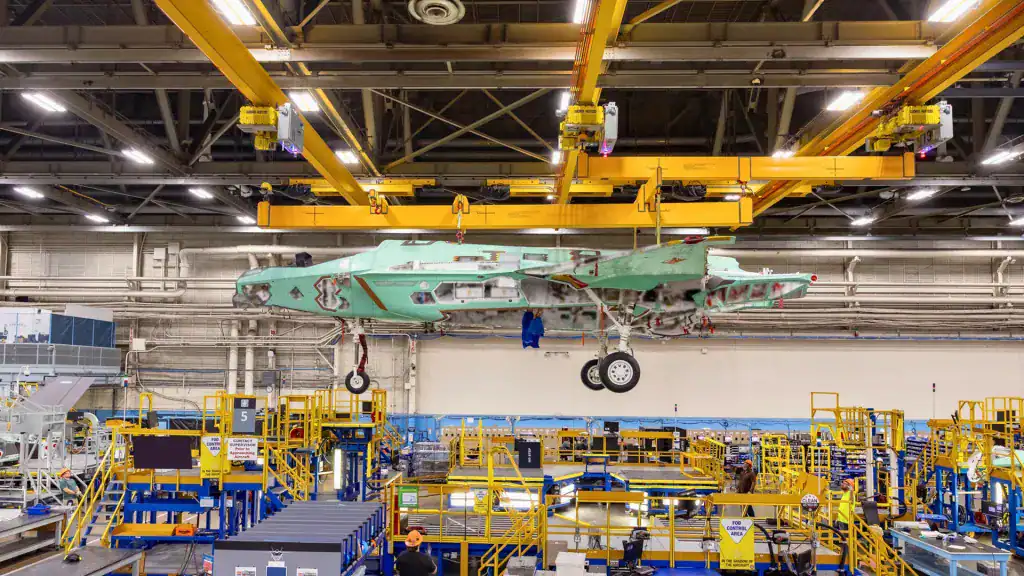
On August 18, 2026, Lockheed Martin confirmed that Germany’s first F-35A Lightning II, airframe MG-01, has completed final assembly at the company’s Fort Worth, Texas plant. The jet has moved into Aircraft Final Finishes, the stage where it receives its paint and low-observable coating, ahead of a planned rollout ceremony and first flight later this year.
MG-01 is the first of 35 F-35As Germany ordered to replace its aging Panavia Tornado fleet. Lockheed Martin Europe called the milestone another step toward “supporting the Luftwaffe.”
From Fort Worth to Büchel
Germany selected the F-35A in March 2022 and signed the procurement agreement in July 2023. Major structural assembly on MG-01 began in December 2024, and its Pratt & Whitney F135 engine was installed by June 2026, a step Lockheed Martin described as “the power behind Germany’s first F-35.”
A rollout ceremony is planned for September 18, 2026. From there, MG-01 heads to Ebbing Air National Guard Base in Fort Smith, Arkansas, joining seven more early German jets where Luftwaffe and US Air National Guard personnel will train together. The aircraft is expected to reach its permanent home at Büchel Air Base in 2027, with the full 35-jet order delivered by 2029.
Why the F-35A, Specifically
Büchel is the only German base certified to store US nuclear weapons under NATO’s nuclear-sharing arrangement, a Cold War-era policy under which a handful of European allies host American B61 gravity bombs and keep aircraft certified to carry them. That role currently belongs to the Panavia Tornado, in Luftwaffe service since the 1980s and due to retire by 2030.
The F-35A is the only Western fighter currently certified to carry the modernized B61-12 bomb, which is why it was Germany’s pick over other fifth-generation options. Without a replacement in place before the Tornado retires, Germany would have no aircraft able to fulfill its end of the nuclear-sharing commitment.
What nuclear sharing means
Under NATO’s nuclear-sharing policy, the US stores B61 gravity bombs at bases in several European countries, including Germany’s Buchel Air Base. Host-nation aircraft, not US ones, are certified to deliver those weapons if NATO ever authorized their use.
March 2022
Germany selects the F-35A. The type is chosen to replace the Tornado’s nuclear-sharing role.
July 2023
Procurement agreement signed. The order is set at 35 aircraft.
December 2024
Major assembly begins on MG-01, Germany’s first airframe.
June 2026
Engine installed. MG-01 receives its Pratt & Whitney F135 powerplant.
August 18, 2026
Final assembly complete. The jet enters paint and low-observable coating.
September 2026
Rollout and first flight planned, followed by delivery to Ebbing Air National Guard Base for training.
2027
Expected arrival at Buchel Air Base, Germany’s only site certified to store US nuclear weapons.
A Bigger Order Could Follow
Germany is also weighing a follow-on purchase of up to 15 more F-35As, which would push its total order to 50. Luftwaffe chief Lt. Gen. Holger Neumann said “there are ideas within the Luftwaffe to procure more F-35s,” though he noted “the decision lies with the Defence Ministry.”
The push for a larger order gained momentum after the France-led FCAS sixth-generation fighter program hit repeated delays, leaving Germany with fewer near-term alternatives to a fighter Lockheed Martin says it can keep building at scale.
Sources and references used for research and fact-checking.
Get the Newsletter
The latest aviation news and stories sent to your inbox.
About the Author
Tim is the owner and lead editor of AeroCorner since 2019, overseeing aviation content covering aircraft, airlines, airports, and the broader aviation industry. Through years of researching, writing, editing, and publishing aviation-focused content, he has developed extensive practical knowledge of commercial aviation and air travel. Based in Asia and a frequent traveler himself, Tim also brings firsthand passenger experience to AeroCorner’s coverage. Outside of publishing, he has also explored aviation firsthand through hands-on flight training in New Zealand.