

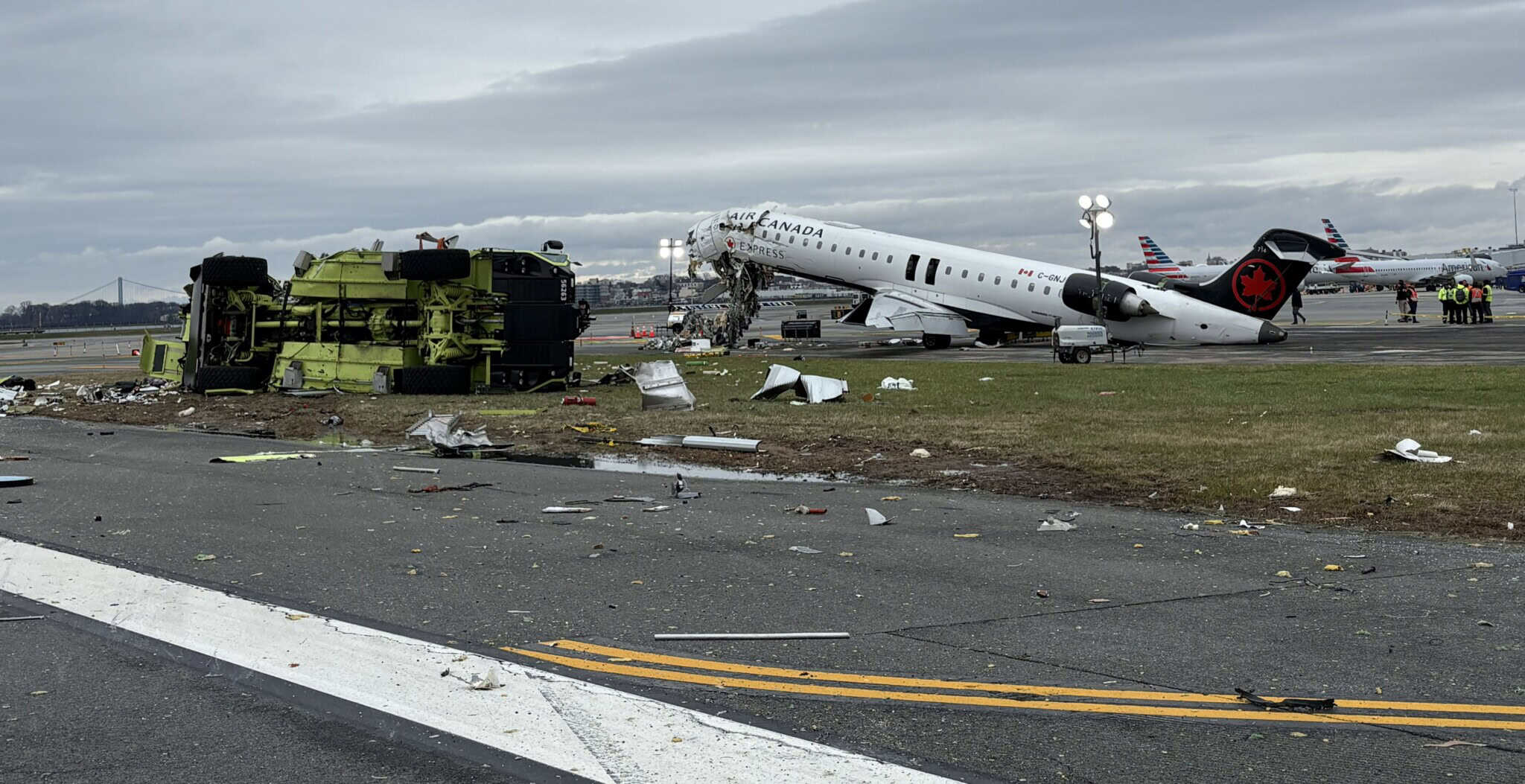
On August 27, 2026, several news organizations reported that the Federal Aviation Administration is moving to fire two air traffic controllers at New York’s LaGuardia Airport who left their shifts about an hour early on the night of March 22. That was the night an Air Canada Express regional jet collided with an airport fire truck while landing and both pilots were killed. The agency is treating the early departures as timecard fraud, according to reporting from CNN and Reuters.
What investigators say happened that night
The flight was Jazz Aviation operating as Air Canada Express 8646, a Bombardier CRJ900 arriving from Montreal. It struck an Oshkosh aircraft rescue and firefighting vehicle on Runway 4 at 11:37 p.m. Eastern, according to the NTSB. Captain Antoine Forest, 30, and First Officer Mackenzie Gunther, 24, died in what was the first fatal crash at LaGuardia in 34 years.
Of the 76 people on the jet and in the two ground vehicles, 39 were taken to hospitals and six were seriously hurt, the NTSB said. Its preliminary report found the controller cleared the fire truck to cross the runway about 12 seconds before the jet touched down, then began calling for the truck to stop roughly eight seconds after that. The runway status lights meant to warn ground vehicles of an arriving aircraft were working.
Two controllers were on position when the collision happened, one working local control and one on ground control as controller in charge. That is the airport’s normal overnight staffing. The two controllers now facing termination had already gone home, leaving those colleagues to handle traffic that weather and delays had pushed well above the scheduled volume.
The “early shove” and why the FAA is cracking down
Leaving a shift early once the assigned work is done has an informal name in control towers: the “early shove.” Reuters reported that the practice has been quietly tolerated at many facilities for years, with some managers treating it as a small reward after a hard push of traffic.
The FAA said it “is committed to holding employees accountable” and “will not compromise the safety or efficiency of the National Airspace System.” Transportation Secretary Sean Duffy said that when “a small percentage of individuals take advantage of the American taxpayer,” the agency has “no choice but to act.” The National Air Traffic Controllers Association said it is discussing the allegations with FAA leadership and declined further comment.
Why the staffing question matters
The disciplinary case is separate from the safety investigation. The NTSB does not assign blame or fault, and its final report on the collision, with a probable cause, is still months away. The FAA’s personnel action turns on attendance records, not on whether the two absent controllers would have changed the outcome.
The staffing angle matters because the margin is already thin. AeroCorner has covered the national controller shortage that forced flow restrictions across the Northeast this year. When a tower runs its overnight shift with only two qualified controllers, anyone leaving early removes a real layer of redundancy on exactly the kind of busy, weather-disrupted night the system is least able to absorb it.
Two parallel tracks
The FAA is pursuing a timecard-fraud case against two controllers who left early. The NTSB is separately investigating why a fire truck was on an active runway as a jet landed. Neither process has assigned fault for the collision itself.
Developing story
The FAA has not published a statement naming the controllers or a final disciplinary outcome. The accounts of the terminations come from unnamed sources cited by CNN, Reuters and other outlets, and the controllers retain appeal rights.
Sources and references used for research and fact-checking.
Get the Newsletter
The latest aviation news and stories sent to your inbox.
About the Author

Tim is the owner and lead editor of AeroCorner since 2019, overseeing aviation content covering aircraft, airlines, airports, and the broader aviation industry. Through years of researching, writing, editing, and publishing aviation-focused content, he has developed extensive practical knowledge of commercial aviation and air travel. Based in Asia and a frequent traveler himself, Tim also brings firsthand passenger experience to AeroCorner’s coverage. Outside of publishing, he has also explored aviation firsthand through hands-on flight training in New Zealand.