

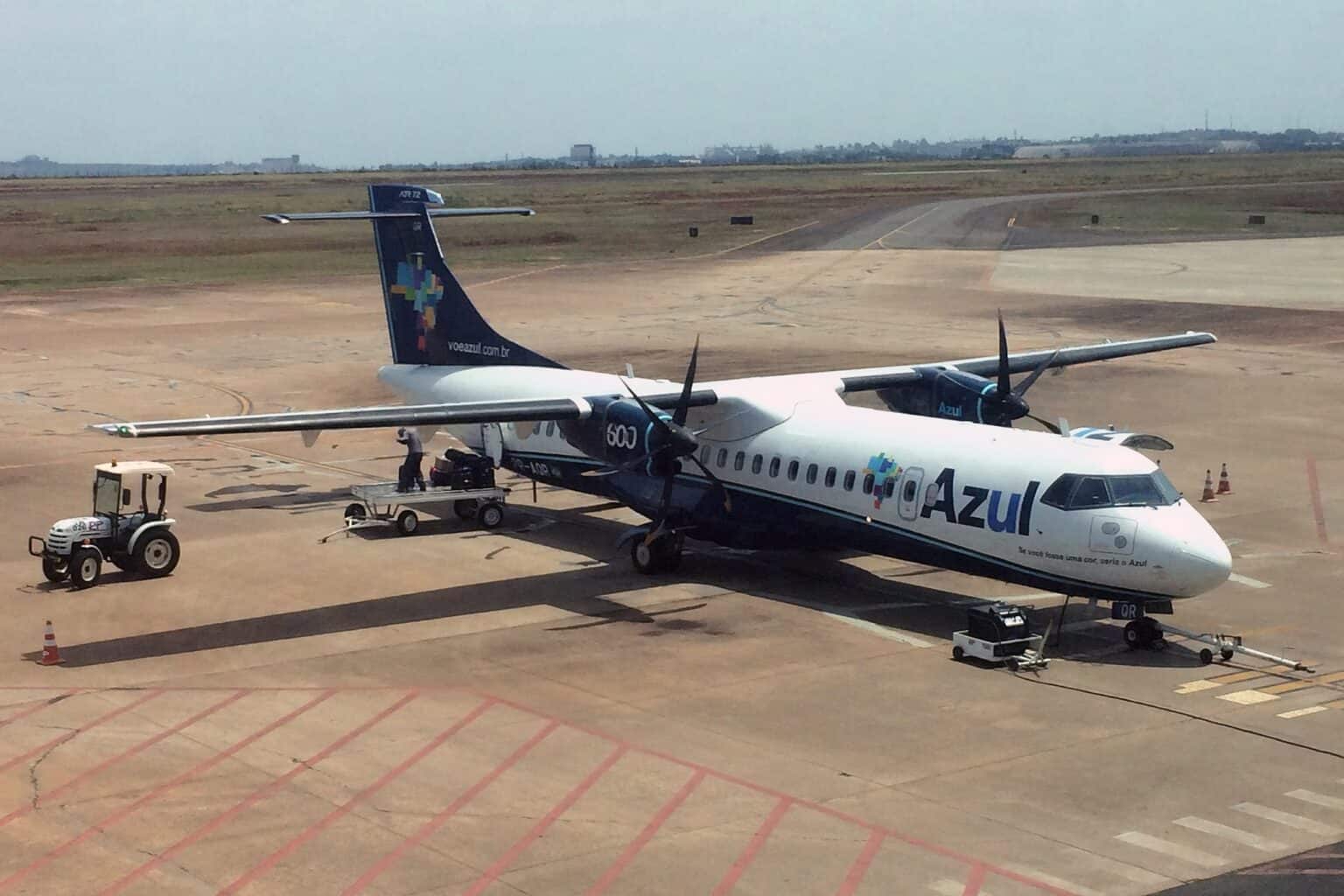
Azul flight AD2958, an ATR 72-600 bound for Curitiba, declared an emergency and returned to Pato Branco in southern Brazil on November 20, 2026, after the captain smelled smoke. Firefighters traced it to a lithium-battery wheelchair in the hold.
The battery heated up and produced smoke but did not catch fire, firefighters said in a report carried by FolhaMax. None of the 60 passengers needed medical care, according to Diário do Sudoeste.
Back on the Ground 15 Minutes After Takeoff
The airport radio room logged takeoff at 3:34 p.m. local time, the emergency at 3:42 p.m. and the landing at 3:49 p.m., FolhaMax reported. That is eight minutes to the emergency call and seven more to touchdown.
An early report by Rádio Plug put the emergency at seven minutes. Folha de Curitiba cited FlightAware for an 18-minute flight, but at the time of writing FlightAware shows the same 15 minutes as the airport log.
FlightStats tracking data lists the aircraft as PR-YXE. Azul’s reported statement does not give a registration.
The wheelchair was in the forward hold, said Elenice Catafesta, director of the city’s air transport department. She described it as a robotic wheelchair belonging to a passenger and said the airline had authorized it to travel.
On a standard ATR 72, the front cargo compartment sits between the flight deck and the passenger cabin, according to Airport Technology.
Airport staff called the fire department under an agreement between the city and the brigade. Catafesta told Diário do Sudoeste that the airport has no firefighting unit of its own in operation, and that one is not required for an airport of its class.
Passengers got off while the plane was inspected, then boarded again, and the wheelchair was left behind. FlightAware shows the flight taking off again at 4:38 p.m. and landing in Curitiba at 5:46 p.m.
What Azul Has Said About the Return
In a Saturday statement reported by OBemdito, Azul said the flight returned for technical reasons and that the captain declared an emergency as a precaution. The airline said the landing was normal and apologized for the inconvenience.
As reported, the statement mentions neither smoke nor a wheelchair. That account comes from firefighters and the city’s air transport director, as carried by local media.
Those two accounts also describe the battery a little differently. Catafesta said it was connected, while Diário do Sudoeste reported firefighters as saying it was switched on during the flight.
What is not yet known
Firefighters said there was no fire, and the statements reported so far do not describe thermal runaway. Why it heated up, its watt-hour rating and how it was prepared for loading have not been reported.
The Rules for Flying With a Powered Wheelchair
The difference between connected and switched on matters. A lithium battery can stay installed in a wheelchair, but the chair must not be able to power up by accident.
IATA’s 2026 guidance allows an installed battery, with airline approval, if it is securely attached, protected from damage and has its circuits isolated. Accidental activation, it warns, can create friction or electrical load that could lead to a fire.
Before accepting a chair, airline staff are meant to put it in drive mode and check whether it powers up and moves with the joystick. A device that has not been made safe must not be loaded, and the captain must be told where any chair with installed batteries is stowed.
If installed batteries total more than 300 watt-hours, the airline must consider extra precautions, such as a fire-resistant cover or container or a charge of 25% or less. Batteries that are removed go in the cabin, up to 300 watt-hours in total.
In Brazil, civil aviation regulator ANAC’s Resolution 280 requires wheelchairs classed as dangerous items to be carried under its hazardous-goods regulation, RBAC 175. It also requires passengers who need help with a mobility aid to tell the airline at least 48 hours before departure, though missing that deadline does not bar them if they accept the assistance available.
The same resolution says mobility aids carried in the hold travel on the owner’s aircraft. The reports do not say how or when the chair removed at Pato Branco was to reach its owner.
The power bank fire on SWISS flight LX52 started in the cabin, while powered wheelchairs travel in the hold. IATA cites the limited in-flight monitoring there as a reason airlines need assurance that the batteries passed United Nations transport tests.
Sources and references used for research and fact-checking.
Get the Newsletter
The latest aviation news and stories sent to your inbox.
About the Author

AeroCorner News is the aviation news desk of AeroCorner.com. It covers accidents and incidents, safety rulings, airline and airport disruption, and new aircraft. It works from primary sources such as the NTSB, FAA, EASA and the manufacturers' own announcements.