

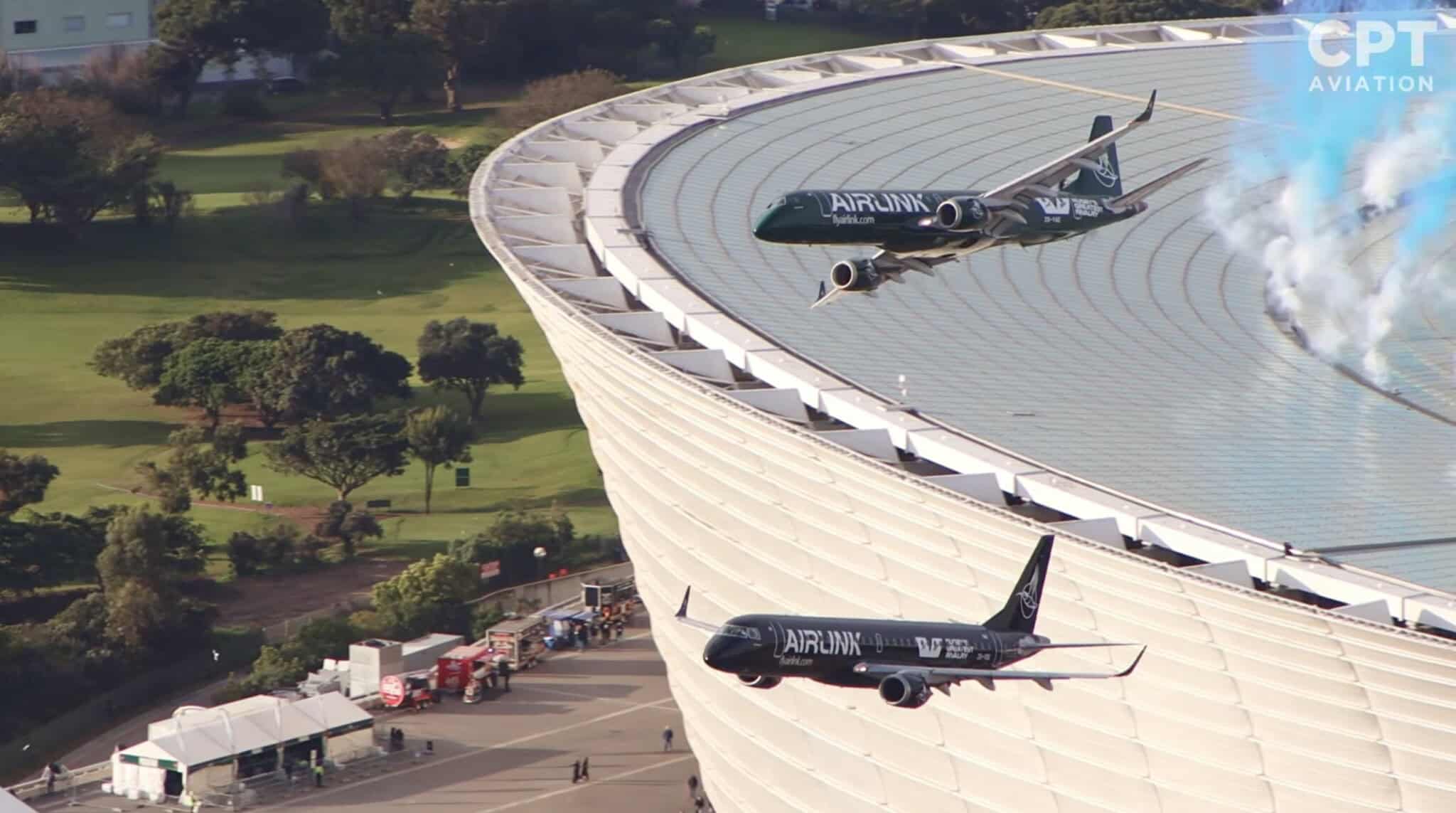
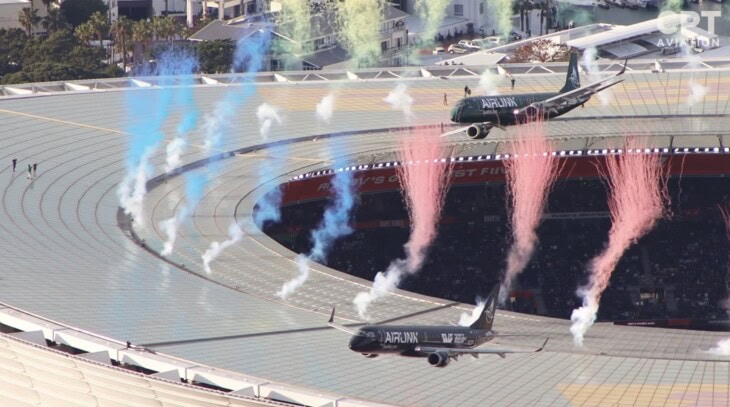
On August 29, 2026, two Airlink regional jets flew a low formation pass over Cape Town Stadium in the minutes before the Springboks beat the All Blacks 33 to 26 in the second Test of the Rugby’s Greatest Rivalry series. Flight tracking data suggesting the lead aircraft cleared the stadium roof by only tens of feet spread quickly online.
Airlink defended the flypast as a planned, rehearsed operation approved by South African regulators.
What the tracking data showed
The flypast used a two-ship formation of Embraer E-Jets: an Embraer E195 registered ZS-YDE and an Embraer E190 registered ZS-YAE, one of them in a special all-green livery for the tour. Airlink, a regional carrier that has long fed traffic to South African Airways, is the official domestic airline partner of the 2026 series.
The jets left Cape Town International Airport at about 2:10 p.m. local time and made two passes over the stadium at roughly 150 knots. Flightradar24 reported that the lead jet passed less than 50 feet above the roof.
A closer reading of the same data by Simple Flying corrected the recorded altitude to roughly 205 to 210 feet above sea level. With the stadium roof standing about 164 feet tall, that leaves a clearance of around 41 to 46 feet (13 to 14 m).
Video from inside the ground appeared to show one jet passing through colored smoke fired from pyrotechnics on the roof. Other observers argued that camera angles and higher GPS altitude readings pointed to more clearance than the footage implied.
Airlink’s response
In a statement on August 30, Airlink said the South African Civil Aviation Authority and Air Traffic Navigation Services provided “valuable guidance, approval and support” for the flyby, and that the maneuver required careful planning and rehearsal.
Each aircraft was flown by three senior captains, acting as commander, co-pilot and a dedicated safety and technical officer, the airline said. It added that flight data recorded by both jets confirms the passes stayed within the SACAA’s approved and rehearsed altitude and speed limits.
The SACAA had not commented publicly on the flypast as of August 31. It has not released the approved altitude floor or said whether the roughly 40-foot clearance fell inside the authorized profile.
How a stadium flypast is authorized
South African rules, like those in most countries, normally bar civil aircraft from flying below 500 feet or close to a gathering of people in the open air. A stadium flypast is a specific exemption the regulator grants case by case.
That approval comes with a defined profile: a minimum altitude, a target speed, set entry and exit tracks, and points at which the crew must break off if anything is wrong. The operator rehearses the pass and coordinates it with air traffic control.
The country has a long history of these displays. A South African Airways Boeing 747 flew over Ellis Park before the 1995 Rugby World Cup final, and airliner passes have marked major matches since.
The main risk in a pass like this is not the aircraft striking the structure. It is that an airliner flown at 150 knots and 40 to 50 feet has almost no height to trade for time if an engine surges or a bird strike occurs, which is why the approved profile and abort criteria exist.
For the airline, the payoff is visibility. A formation pass over a televised Test in front of a full stadium puts its aircraft before millions of viewers at a fraction of the cost of conventional advertising, which is why carriers keep agreeing to fly them.
Only one side has described the limits
Airlink says the flypast stayed within the SACAA’s approved altitude and speed, but the regulator has not published that profile or confirmed the clearance. Until it does, the public cannot check the claim against the authorization.
Sources and references used for research and fact-checking.
Get the Newsletter
The latest aviation news and stories sent to your inbox.
About the Author

Tim is the owner and lead editor of AeroCorner since 2019, overseeing aviation content covering aircraft, airlines, airports, and the broader aviation industry. Through years of researching, writing, editing, and publishing aviation-focused content, he has developed extensive practical knowledge of commercial aviation and air travel. Based in Asia and a frequent traveler himself, Tim also brings firsthand passenger experience to AeroCorner’s coverage. Outside of publishing, he has also explored aviation firsthand through hands-on flight training in New Zealand.