

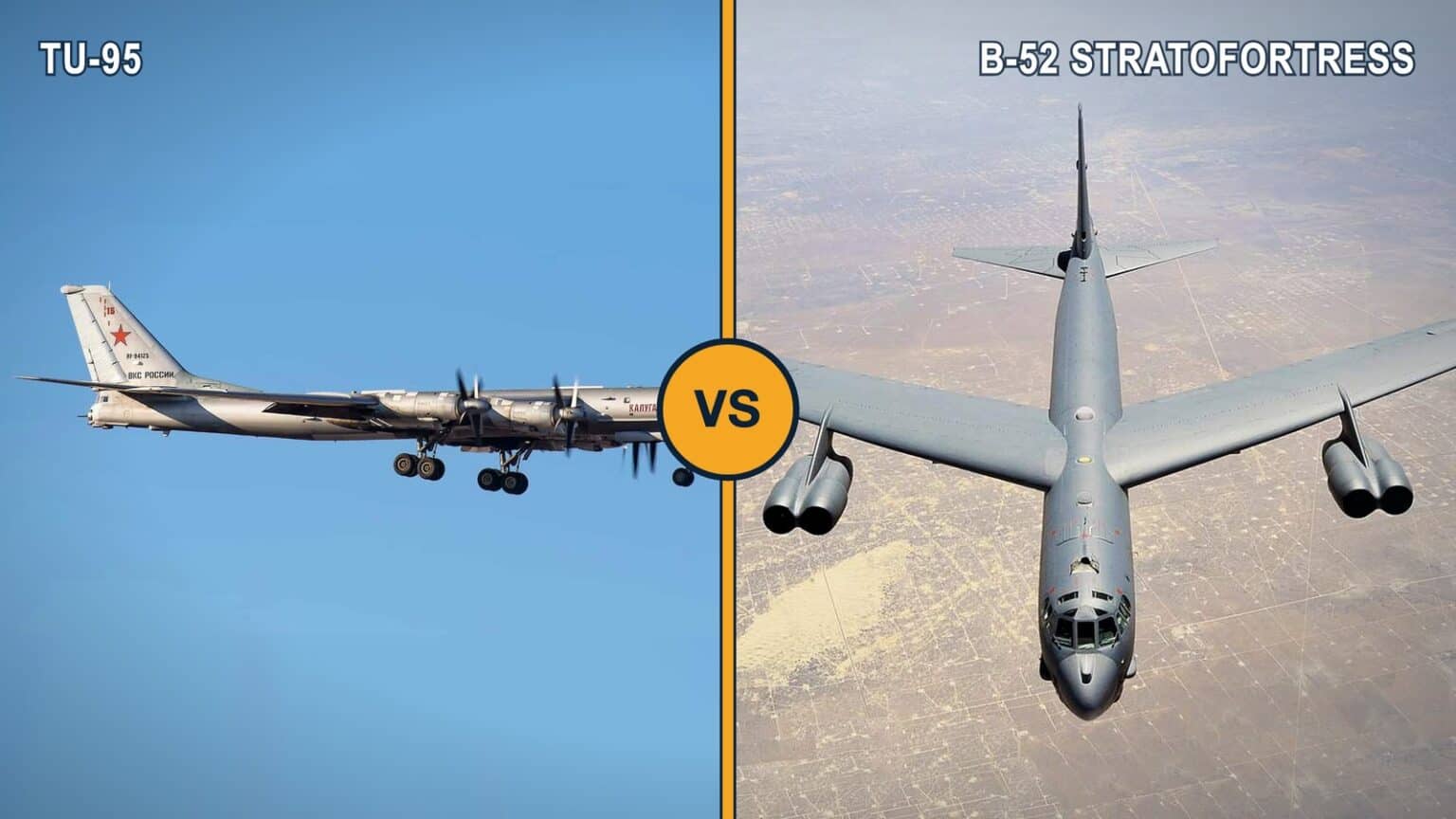

The Boeing B-52H is the more capable bomber. It carries a bigger bomb load, has a long conventional combat record and is getting new engines and a new radar.
The Tupolev Tu-95MS is the Russian answer: four turboprops, a rotary launcher of cruise missiles, and a design that first flew in 1952. Both are about 70 years old, and both are still flying.
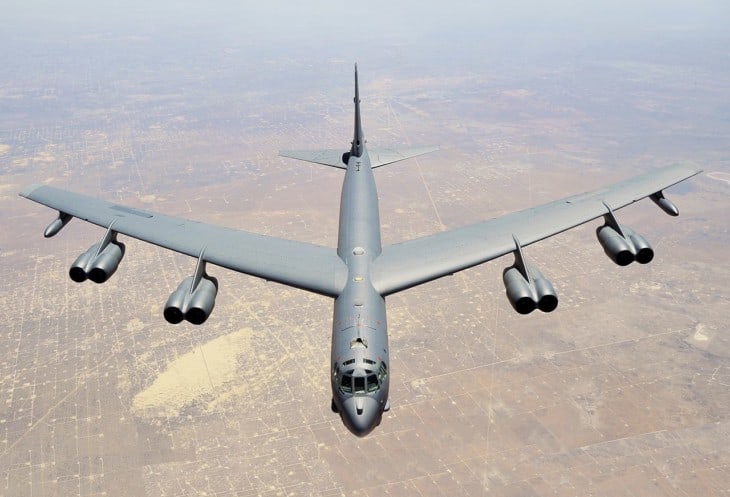
General
Tupolev Tu-95
Manufacturer
Tupolev
ICAO code
TU95
Military code
—
Produced
1956–1993
Price
$26.3 million (1900)
Engine
4 × Kuznetsov NK-12MV turboprops
Engine type
Turboprop
Power
4 × 15,000 shp · 11,186 kW
Avionics
—
Wing tips
No winglets
Seats
7
Boeing B-52 Stratofortress
Manufacturer
Boeing
ICAO code
B52
Military code
B-52H
Produced
1952–1962
Price
$84 million (2012)
Engine
8 × Pratt & Whitney TF33-P-3/103
Engine type
Turbofan
Power
8 × 17,000 lbf · 76 kN
Avionics
AN/ASQ-151 EVS, Sniper Advanced Targeting Pod, IBM AP-101
Wing tips
No winglets
Seats
5
Dimensions
Tupolev Tu-95
Exterior length
161 ft 1 in
49.10 m
161 ft 1 in
49.10 m
+1%
Tail height
44 ft 0 in
13.40 m
44 ft 0 in
13.40 m
+8%
Fuselage diameter
9 ft 6 in
2.90 m
9 ft 6 in
2.90 m
+4%
Wing span
164 ft 4 in
50.10 m
164 ft 4 in
50.10 m
-11%
Baggage volume
0 ft 0 in
0.00 m
0 ft 0 in
0.00 m
Boeing B-52 Stratofortress
Exterior length
159 ft 1 in
48.50 m
159 ft 1 in
48.50 m
-1%
Tail height
40 ft 8 in
12.40 m
40 ft 8 in
12.40 m
-7%
Fuselage diameter
9 ft 2 in
2.80 m
9 ft 2 in
2.80 m
-3%
Wing span
185 ft 0 in
56.40 m
185 ft 0 in
56.40 m
+13%
Baggage volume
—
—
—
Weights
Tupolev Tu-95
Empty weight
198,416 lb
90,000 kg
198,416 lb
90,000 kg
+7%
Max payload
33,100 lb
15,000 kg
33,100 lb
15,000 kg
-53%
Fuel capacity
29,100 gal
110,155 L
29,100 gal
110,155 L
-39%
Max takeoff weight
414,500 lb
188,000 kg
414,500 lb
188,000 kg
-15%
Boeing B-52 Stratofortress
Empty weight
185,000 lb
83,915 kg
185,000 lb
83,915 kg
-7%
Max payload
70,000 lb
31,800 kg
70,000 lb
31,800 kg
+112%
Fuel capacity
47,975 gal
181,605 L
47,975 gal
181,605 L
+65%
Max takeoff weight
488,000 lb
221,500 kg
488,000 lb
221,500 kg
+18%
Performance
Tupolev Tu-95
Max cruise speed
499 kt · 574 mph
924 km/h
499 kt
574 mph
924 km/h
-12%
Max speed
499 kt · 574 mph
924 km/h
499 kt
574 mph
924 km/h
-12%
Cruise speed
383 kt · 441 mph
709 km/h
383 kt
441 mph
709 km/h
-13%
Rate of climb
2,000 ft/min
10 m/s
2,000 ft/min
10 m/s
-68%
Range
8,100 nm · 9,320 mi
15,000 km
8,100 nm
9,320 mi
15,000 km
+6%
Service ceiling
45,000 ft
13,700 m
45,000 ft
13,700 m
-10%
Takeoff distance
0 ft
0 m
0 ft
0 m
Landing distance
0 ft
0 m
0 ft
0 m
Boeing B-52 Stratofortress
Max cruise speed
565 kt · 650 mph
1,046 km/h
565 kt
650 mph
1,046 km/h
+13%
Max speed
565 kt · 650 mph
1,046 km/h
565 kt
650 mph
1,046 km/h
+13%
Cruise speed
442 kt · 509 mph
819 km/h
442 kt
509 mph
819 km/h
+15%
Rate of climb
6,270 ft/min
32 m/s
6,270 ft/min
32 m/s
+213%
Range
7,652 nm · 8,810 mi
14,170 km
7,652 nm
8,810 mi
14,170 km
-6%
Service ceiling
50,000 ft
15,200 m
50,000 ft
15,200 m
+11%
Takeoff distance
—
—
—
Landing distance
—
—
—
Tupolev Tu-95 comparisons
No other comparisons yet.
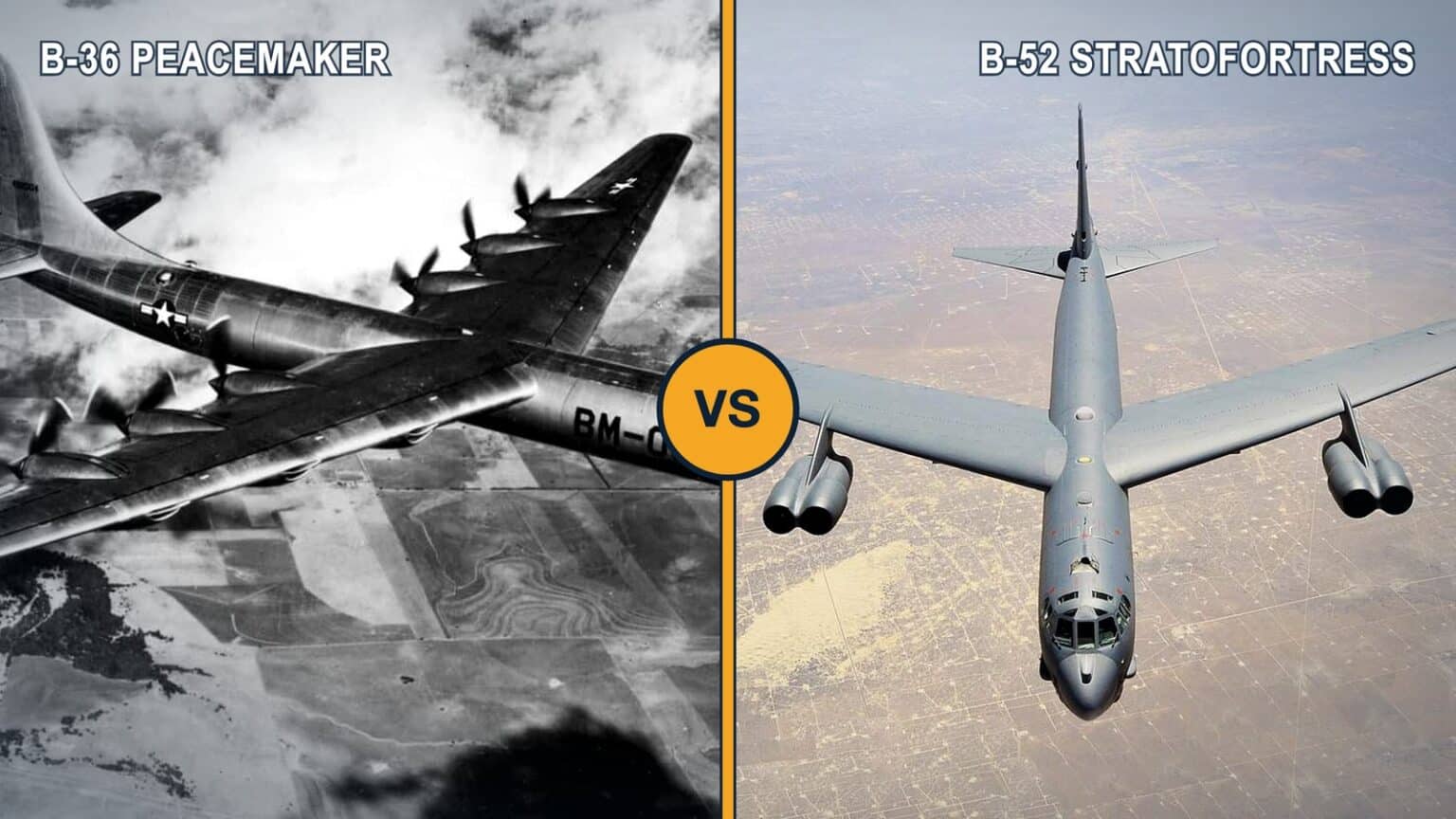
Table of Contents
| Tupolev Tu-95MS | Boeing B-52H | |
|---|---|---|
| Role | Cruise-missile carrier, nuclear-capable | Heavy bomber, nuclear-capable |
| First flight | November 1952 | April 15, 1952 (the YB-52 prototype) |
| Entered service | 1956 (Tu-95 family) | February 1955 (B-52B) |
| Number built | More than 500 (all Tu-95 versions) | 744 (all B-52 versions) |
| Weapons bay load | Six Kh-55 cruise missiles on a rotary launcher (Tu-95MS6) | Bombs, JDAM kits and cruise missiles; AGM-86B for the nuclear role |
| Combat debut | November 2015, over Syria | Vietnam War, 1965 |
| Current user | Russian Aerospace Forces | US Air Force |
| Latest upgrade | Tu-95MSM: new radar and engines | B-52J: new engines and radar |
Which variants this page compares
The panel above compares the base Tupolev Tu-95 with the Boeing B-52 Stratofortress. This page looks at the versions that fly today: the Tu-95MS Bear-H cruise-missile carrier and the B-52H, the only model the US Air Force still operates.
Which is better, the Tu-95 or the B-52?
The B-52H is the more capable bomber. It carries a larger conventional load, has been used in far more wars and is being rebuilt with new engines and a new radar.
The Tu-95MS is a different tool. Russia uses it as a launch platform for long-range cruise missiles, so it rarely needs to fly over a target.
Both aircraft first flew in 1952, and both are still flying in the 2020s. That is a remarkable run for two designs from the early Cold War.
Where the Tu-95 wins
The Tu-95 is the only turboprop-powered strategic bomber still in operational use. Its swept wing is also unique: it is the only propeller aircraft with swept wings built in large numbers.


Each of its four engines turns a pair of contra-rotating propellers. Wikipedia lists the Tu-95 among the loudest military aircraft.
It also holds a record. In July 2010 two Tu-95MS bombers stayed airborne for more than 43 hours, covering more than 18,600 miles (30,000 km) with four mid-air refuelings.
Its missile load is the other strength. The Tu-95MS6 carries six Kh-55 cruise missiles on a rotary launcher in the weapons bay, and the Tu-95MS16 adds four underwing pylons for up to 16 Kh-55 missiles.
Where the B-52 wins
The B-52 carries more. Wikipedia, citing a US Air Force fact sheet, says the bomber can lift up to 70,000 lb (31,800 kg) of weapons, which matches the figure in the panel above. The panel gives the Tu-95 33,100 lb (15,000 kg).
Airforce Technology quotes a higher figure for the Tu-95MS specifically, 20,000 kg (44,100 lb). The sources disagree, so treat the Tu-95 number as a range, not a fixed value.


The B-52 is also more flexible. In its nuclear role the B-52H is assigned only the AGM-86B cruise missile. Conventionally it can use JDAM-guided bombs, the AGM-158 JASSM, Harpoon anti-ship missiles and Quickstrike naval mines.
That mix is why the Air Force still uses it against enemies with weak air defenses. It can loiter over a battlefield for hours and drop precision weapons on request.
Does a propeller bomber fly much slower?
It is a common assumption that a turboprop bomber must be far slower than a jet. The gap is smaller than most people expect. The panel above lists a cruise speed of 441 mph (709 km/h) for the Tu-95 and 509 mph (819 km/h) for the B-52. The swept wing and powerful NK-12 engines are why the Bear keeps close to a jet bomber’s pace.
How each bomber came to be
Both designs were shaped by the same problem: how to reach the other superpower. Tupolev considered piston engines too weak and early jet engines too thirsty for the range the Soviet Union needed, so it chose turboprops.
Boeing’s B-52 began as a straight-wing aircraft with six turboprops. It ended up with swept wings and eight jet engines by the time the YB-52 prototype flew in April 1952.
The B-52 replaced the Convair B-36 Peacemaker and flew under Strategic Air Command until that command was disestablished in 1992. Since 2010 all B-52s have belonged to Air Force Global Strike Command.
The Tu-95 entered Soviet Long-Range Aviation in 1956. Crews flew long patrols without nuclear weapons until 1991, and Russia resumed similar patrols from 2007. Early versions had no toilet or galley, so the long missions were uncomfortable.
Weapons and missions
The two bombers were built for the same job, delivering nuclear weapons across an ocean. They now do it in different ways.
The Tu-95MS is a missile truck, one of the Russian bombers in service today. Its Kh-55 family of cruise missiles can be launched from far outside enemy air defenses. Upgraded aircraft can also carry up to eight Kh-101 or Kh-102 missiles under the wings, in addition to six Kh-55 family missiles inside.
The B-52 flies both ways. It can launch cruise missiles from a distance or fly low over a target with bombs. Its tail gun was removed from all operational aircraft in 1991.
The Tu-95 has a quirky history too. Test versions dropped Soviet nuclear weapons in the 1950s and 1960s, including the Tsar Bomba, and another variant was used to research nuclear-powered aircraft.
Combat record
The B-52 has the far longer combat record, which helps explain its place among the best bombers in the world. It flew over Vietnam from 1965. In Operation Linebacker II, from December 18 to 29, 1972, B-52s flew 729 sorties and dropped 15,237 tons of bombs on Hanoi, Haiphong and other targets.
In January 1991 seven B-52Gs flew from Barksdale Air Force Base, Louisiana, and fired AGM-86C cruise missiles on the first night of the Gulf War. The round trip took 35 hours and covered 14,000 miles (22,500 km).
The B-52 is also the largest aircraft credited with air-to-air kills. Its tail gunners were credited with two MiG-21s over Vietnam, though Vietnamese records confirm fewer.
The Tu-95 saw no combat for almost 60 years after it entered service. It first fired in anger in November 2015, over Syria, and has fired cruise missiles at Ukraine since 2022.
Ukraine’s Operation Spiderweb drone attack on June 1, 2025 destroyed seven to eight Tu-95MS bombers on the ground at the Belaya and Olenya air bases, according to Wikipedia.
Upgrades and the future
The Tu-95MS is being rebuilt as the Tu-95MSM. It has a new Novella radar, a new navigation and display system, upgraded NK-12MPM engines and new propellers that reduce vibration by 50 percent, according to Wikipedia. The tail turret is removed.

The first Tu-95MSM flew on August 22, 2020. Wikipedia says the Tu-95 is expected to serve Russia until at least 2040.
The B-52 is getting a bigger overhaul. In September 2021 the Air Force chose the Rolls-Royce F130 as its new engine, and the plan adds an AN/APQ-188 active electronically scanned array radar. Wikipedia says the new engines will improve fuel efficiency by 30 percent.
The Air Force has 76 B-52s in service, with 58 in active units and 18 in the reserve, as of 2024. Wikipedia reports plans to keep the youngest airframes flying until 2050.
The upgrade is not smooth. In July 2026 a Government Accountability Office report said the engine replacement program was running $3 billion over budget. Once complete, the B-52H is due to become the B-52J, scheduled by 2030.
Tu-95 vs B-52: the verdict
The B-52 wins on payload, versatility and combat experience. It is also the bomber with the clearer future, because the Air Force is paying to rebuild it.

The Tu-95 wins on endurance and distinctiveness. Its 2010 record flight lasted more than 43 hours, and no other country flies a turboprop strategic bomber.
Wikipedia says the Air Force keeps the B-52 because it is an effective and economical heavy bomber against enemies with limited air defenses, and because no reliable replacement has arrived. The Tu-95’s long life has a similar logic: it still does a job Russia has no newer aircraft doing in the same numbers.
FAQ
The B-52H carries a larger weapon load, has a much longer combat record and is being modernized with new engines and a radar. The Tu-95MS is a cruise-missile carrier built to fire from long range. The B-52 is the more capable bomber, but the two do slightly different jobs.
No, but the gap is small. The specification panel lists a cruise speed of 441 mph (709 km/h) for the Tu-95 and 509 mph (819 km/h) for the B-52. The Tu-95’s swept wing and engines let a propeller aircraft keep close to a jet bomber.
Yes. It has four Kuznetsov NK-12 turboprop engines, each driving a pair of contra-rotating propellers. It is the only turboprop strategic bomber still in operational use.
Yes, but only recently. It was first used in combat in November 2015 during the Russian intervention in Syria. It has fired cruise missiles in the war in Ukraine since 2022.
The US Air Force plans to modernize the B-52 with new engines and a new radar, and Wikipedia reports plans to keep the youngest airframes flying until 2050. The plan is not guaranteed, because budgets and a replacement bomber could change it.
As of 2024 the US Air Force had 76 B-52s in service: 58 in active units and 18 in the reserve. About 12 more were in long-term storage. Boeing built 744 B-52s in total.
Sources and references used for research and fact-checking.
About the Author

Tim is the owner and lead editor of AeroCorner since 2019, overseeing aviation content covering aircraft, airlines, airports, and the broader aviation industry. Through years of researching, writing, editing, and publishing aviation-focused content, he has developed extensive practical knowledge of commercial aviation and air travel. Based in Asia and a frequent traveler himself, Tim also brings firsthand passenger experience to AeroCorner’s coverage. Outside of publishing, he has also explored aviation firsthand through hands-on flight training in New Zealand.