

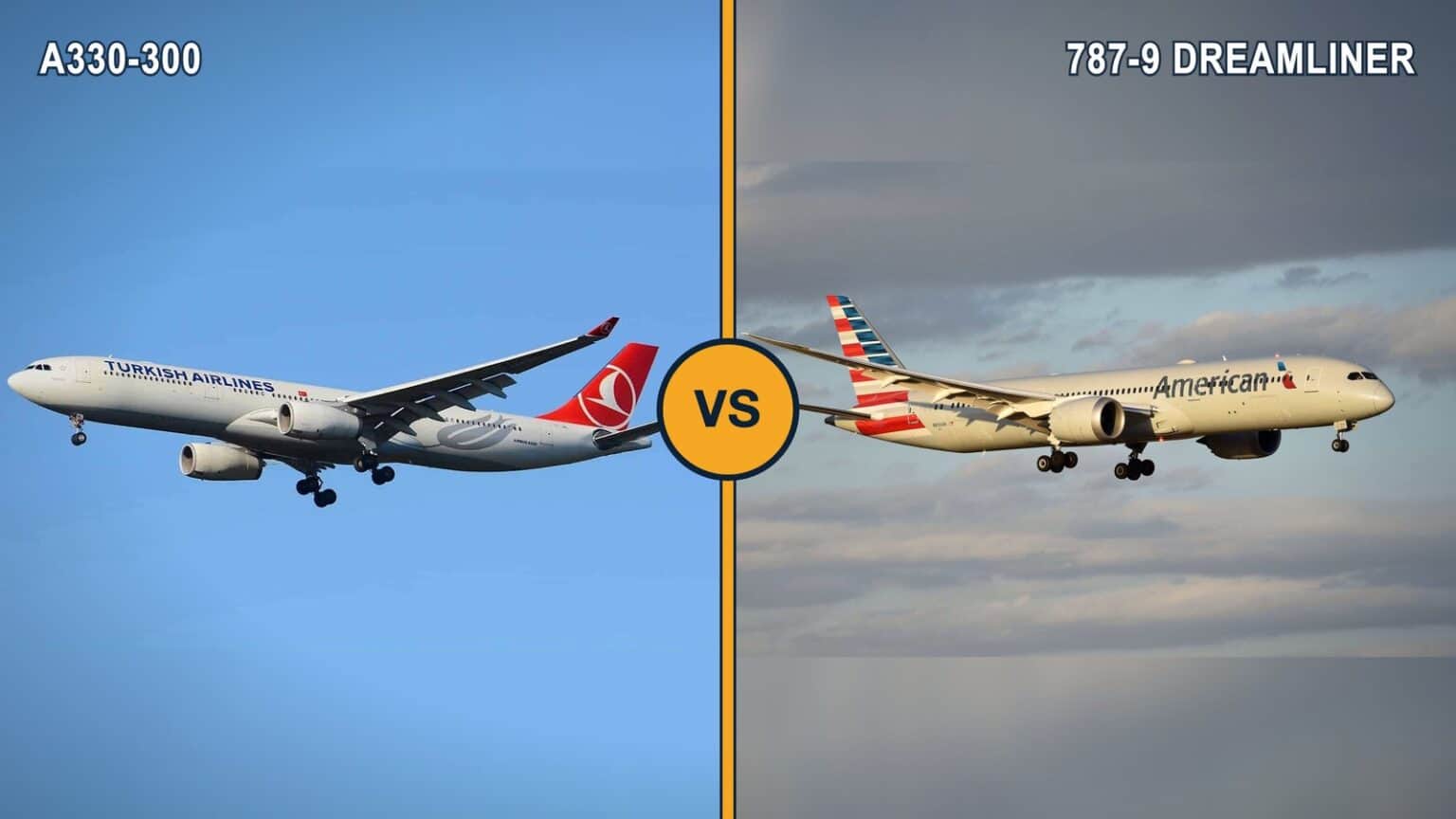

The Boeing 787-9 is the newer aircraft and flies more than 2,000 miles farther. The Airbus A330-300 is the older twinjet, with a narrower cabin and a layout many passengers like.
This page compares the A330-300, the standard A330, with the 787-9, the best-known stretch of the Dreamliner.
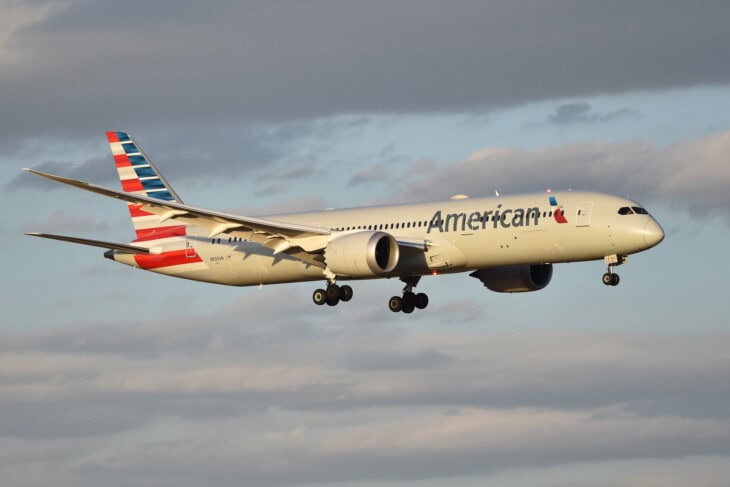
General
Airbus A330-300
Manufacturer
Airbus
ICAO code
A333
IATA code
—
Produced
1993–2020
Price
$264.2 million (2015)
Engine
2 × General Electric CF6 / Pratt & Whitney PW4000 / Rolls-Royce Trent 700
Engine type
Turbofan
Thrust
2 × 71,100 lbf · 316 kN
+0% (total)
Avionics
Rockwell Collins Avionics
Wing tips
No winglets
Seats
335 economy · 295 business
Crew
—
Boeing 787-9 Dreamliner
Manufacturer
Boeing
ICAO code
B789
IATA code
789
Produced
2013–Present
Price
$292.5 million (2020)
Engine
2 × General Electric GEnx-1B or Rolls-Royce Trent 1000
Engine type
Turbofan
Thrust
2 × 71,000 lbf · 316 kN
0% (total)
Avionics
Honeywell and Rockwell Collins avionics
Wing tips
Raked wingtips
Seats
420 economy · 250 business
Crew
2
Dimensions
Airbus A330-300
Cabin width
17 ft 3 in
5.26 m
17 ft 3 in
5.26 m
-4%
Cabin height
8 ft 4 in
2.54 m
8 ft 4 in
2.54 m
+2%
Cabin length
165 ft 3 in
50.36 m
165 ft 3 in
50.36 m
-10%
Exterior length
208 ft 10 in
63.66 m
208 ft 10 in
63.66 m
+1%
Tail height
55 ft 1 in
16.79 m
55 ft 1 in
16.79 m
-1%
Fuselage diameter
18 ft 6 in
5.64 m
18 ft 6 in
5.64 m
-2%
Wing span
197 ft 10 in
60.30 m
197 ft 10 in
60.30 m
+0%
Baggage volume
519 ft 8 in
158.40 m
519 ft 8 in
158.40 m
-8%
Boeing 787-9 Dreamliner
Cabin width
18 ft 0 in
5.49 m
18 ft 0 in
5.49 m
+4%
Cabin height
8 ft 2 in
2.50 m
8 ft 2 in
2.50 m
-2%
Cabin length
183 ft 9 in
56.00 m
183 ft 9 in
56.00 m
+11%
Exterior length
206 ft 1 in
62.81 m
206 ft 1 in
62.81 m
-1%
Tail height
55 ft 10 in
17.02 m
55 ft 10 in
17.02 m
+1%
Fuselage diameter
18 ft 10 in
5.75 m
18 ft 10 in
5.75 m
+2%
Wing span
197 ft 3 in
60.12 m
197 ft 3 in
60.12 m
0%
Baggage volume
565 ft 7 in
172.40 m
565 ft 7 in
172.40 m
+9%
Weights
Airbus A330-300
Max payload
101,000 lb
45,900 kg
101,000 lb
45,900 kg
-28%
Fuel capacity
36,750 gal
139,114 L
36,750 gal
139,114 L
+10%
Max takeoff weight
534,000 lb
242,000 kg
534,000 lb
242,000 kg
-7%
Max landing weight
412,500 lb
187,000 kg
412,500 lb
187,000 kg
-3%
Boeing 787-9 Dreamliner
Max payload
141,000 lb
64,000 kg
141,000 lb
64,000 kg
+39%
Fuel capacity
33,380 gal
126,357 L
33,380 gal
126,357 L
-9%
Max takeoff weight
571,000 lb
259,000 kg
571,000 lb
259,000 kg
+7%
Max landing weight
425,000 lb
193,000 kg
425,000 lb
193,000 kg
+3%
Performance
Airbus A330-300
Max cruise speed
470 kt · 541 mph
870 km/h
470 kt
541 mph
870 km/h
-9%
Max speed
—
—
—
Cruise speed
—
—
—
Approach speed
—
—
—
Rate of climb
—
—
—
Range
6,350 nm · 7,310 mi
11,760 km
6,350 nm
7,310 mi
11,760 km
-23%
Service ceiling
41,100 ft
12,500 m
41,100 ft
12,500 m
-5%
Takeoff distance
9,100 ft
2,770 m
9,100 ft
2,770 m
-1%
Landing distance
5,700 ft
1,730 m
5,700 ft
1,730 m
+14%
Boeing 787-9 Dreamliner
Max cruise speed
516 kt · 594 mph
956 km/h
516 kt
594 mph
956 km/h
+10%
Max speed
516 kt · 594 mph
956 km/h
516 kt
594 mph
956 km/h
Cruise speed
488 kt · 562 mph
904 km/h
488 kt
562 mph
904 km/h
Approach speed
140 kt · 161 mph
259 km/h
140 kt
161 mph
259 km/h
Rate of climb
3,000 ft/min
15 m/s
3,000 ft/min
15 m/s
Range
8,300 nm · 9,550 mi
15,370 km
8,300 nm
9,550 mi
15,370 km
+31%
Service ceiling
43,100 ft
13,100 m
43,100 ft
13,100 m
+5%
Takeoff distance
9,200 ft
2,800 m
9,200 ft
2,800 m
+1%
Landing distance
5,000 ft
1,520 m
5,000 ft
1,520 m
-12%
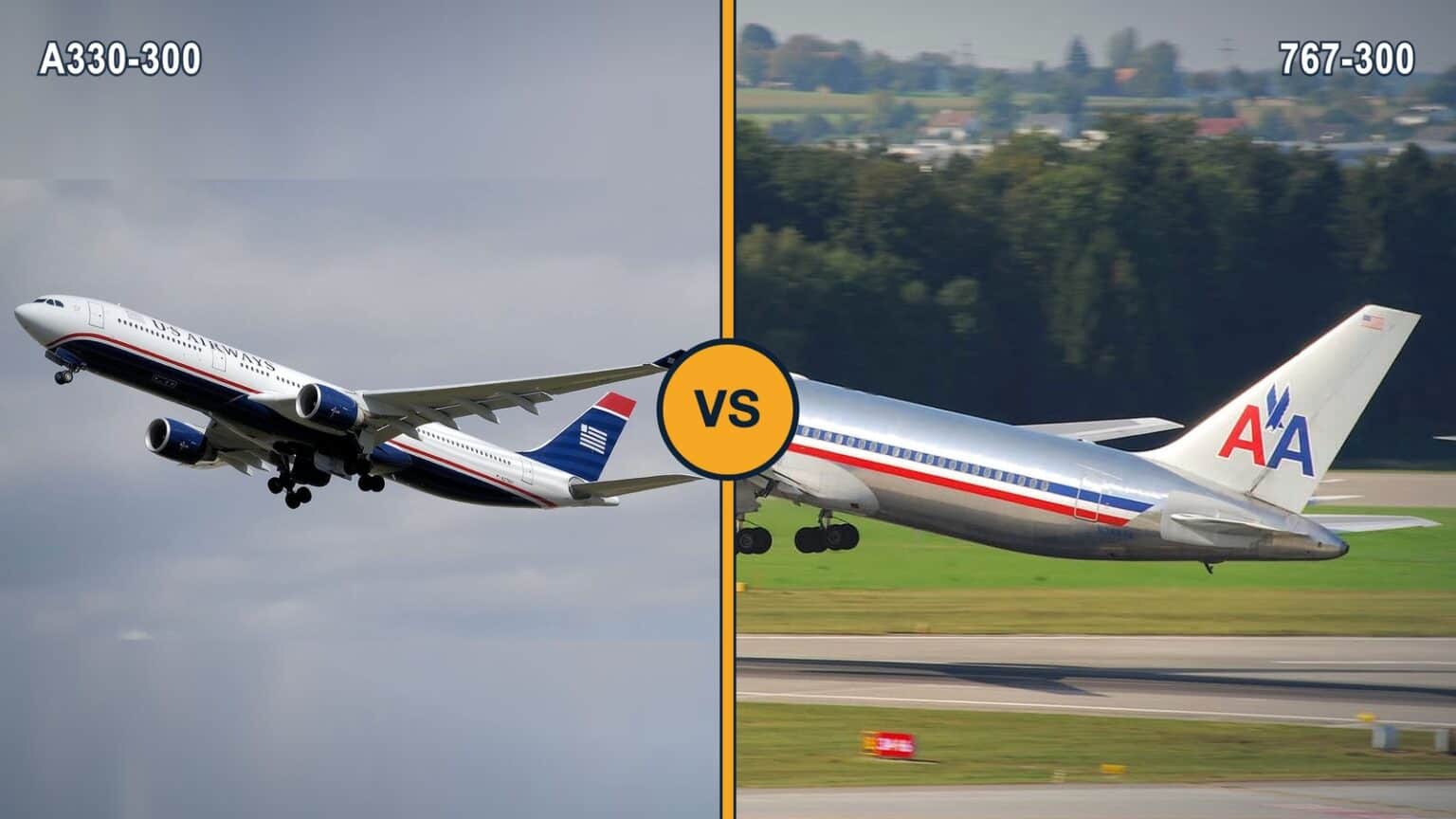
Airbus A330-300 comparisons
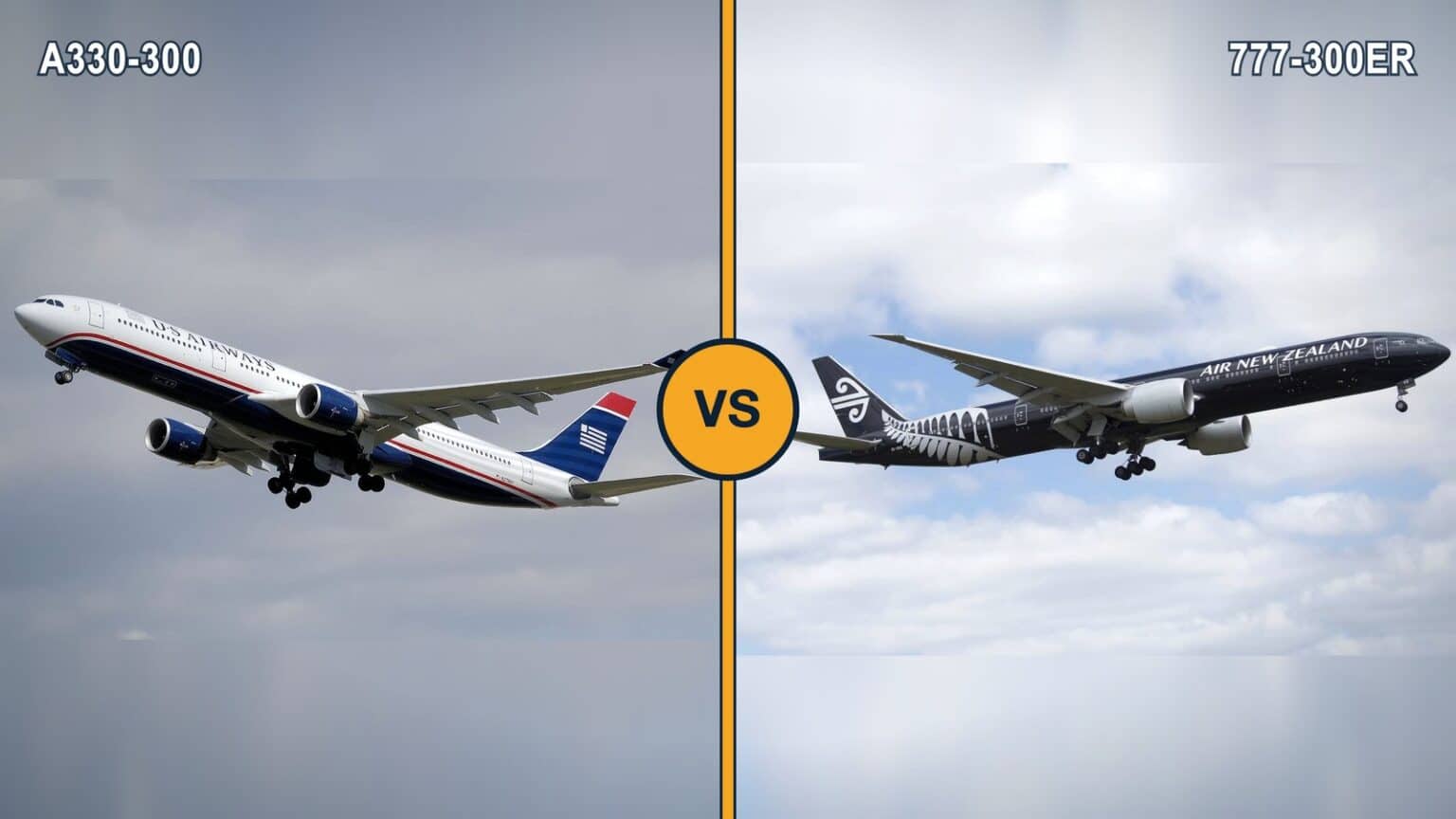
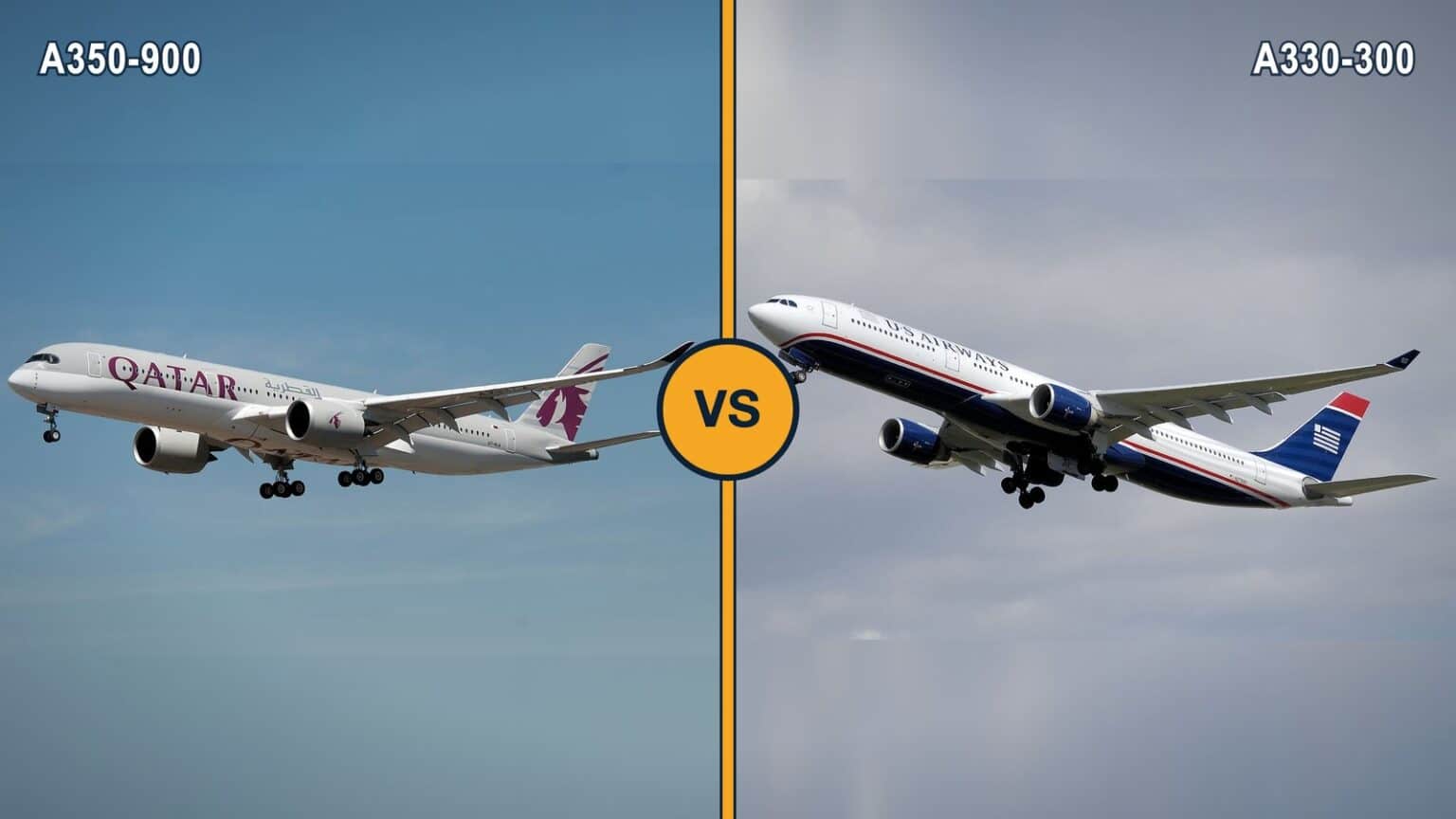
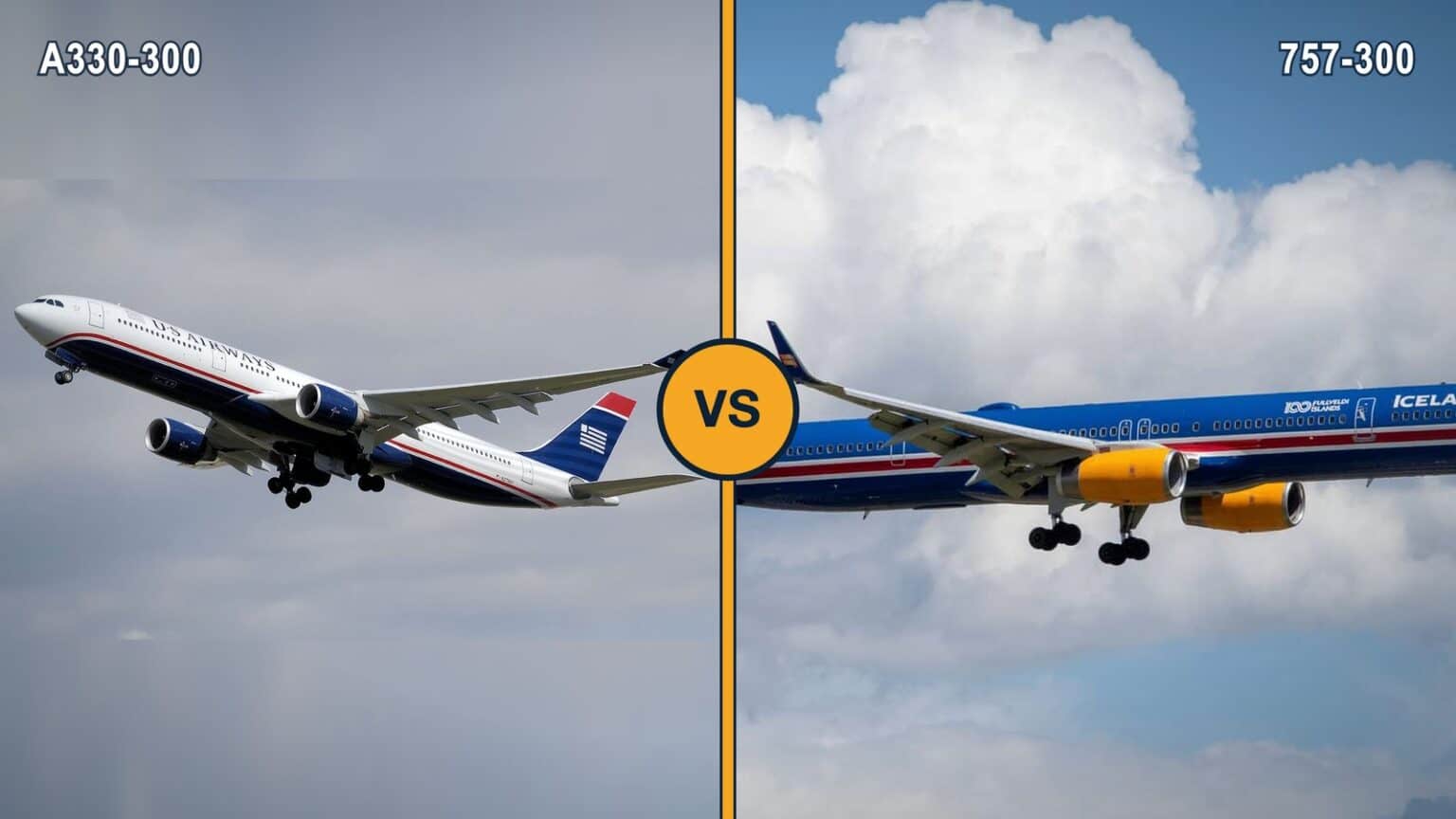
Boeing 787-9 Dreamliner comparisons
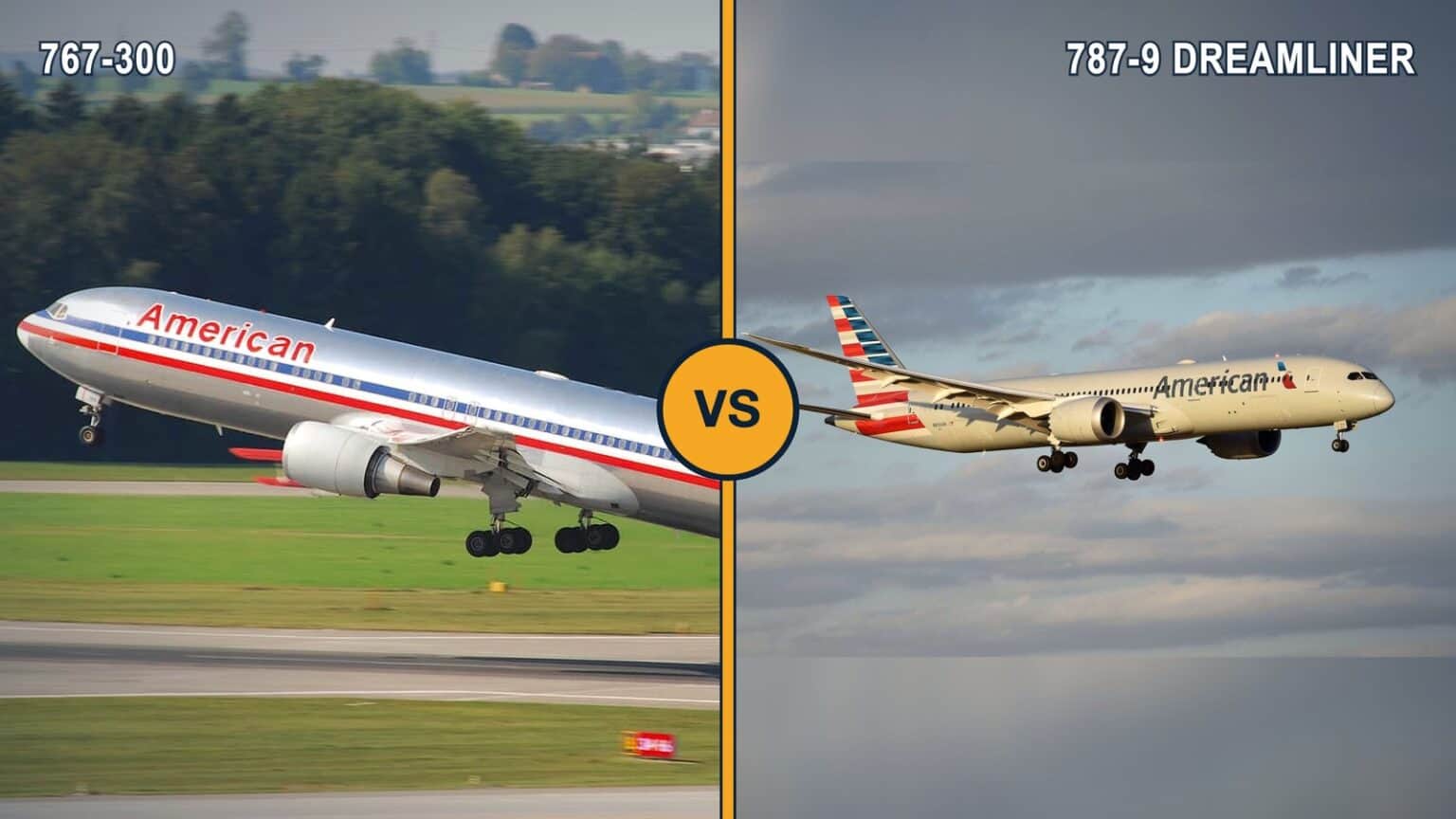
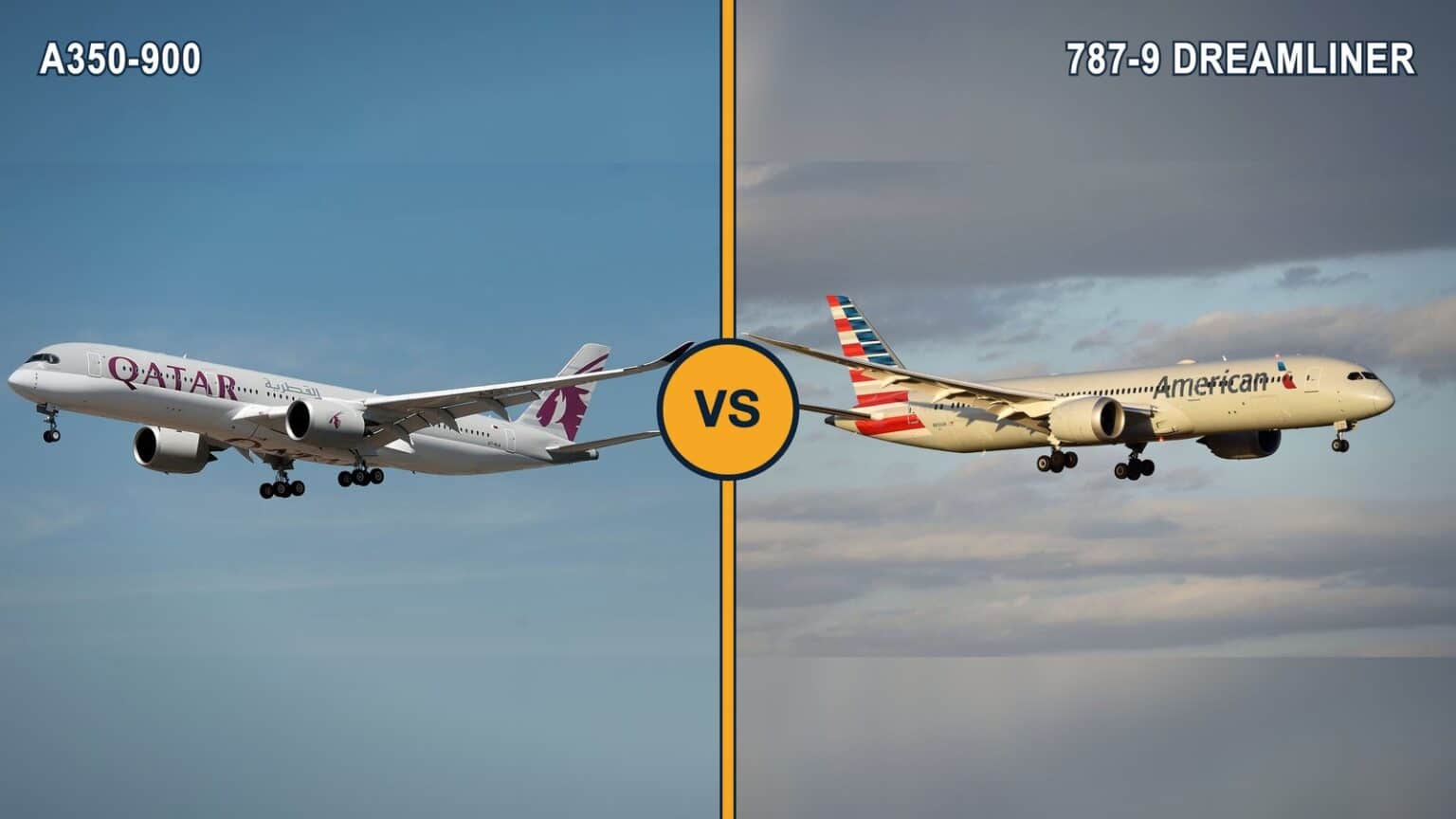
Table of Contents
Put the Airbus A330-300 next to the Boeing 787-9 and the Dreamliner wins on range, ceiling and payload. The A330 is a generation older and has a narrower cabin, yet the two are close in length and wingspan.
This comparison uses the A330-300 and the 787-9. The specification table above this text shows them side by side, and the sections below cover what that table cannot.
| Milestone | Airbus A330-300 | Boeing 787-9 |
|---|---|---|
| First flight | November 1992 | September 17, 2013 |
| Entered service | January 1994, Air Inter | August 7, 2014, All Nippon Airways |
| Typical economy layout | 2-4-2, eight across | 3-3-3, nine across |
| Production status | Ended in 2020 (771 delivered of 779 ordered, December 2020) | Still in production |
| Newer version | A330-900 (A330neo) | 787-10 stretch |
Size and Capacity: Longer Outside, Roomier Inside
The A330-300 is 208 ft 10 in (63.66 m) long. The 787-9 is shorter at 206 ft 1 in (62.81 m), so the A330 is actually the longer of the two by about 3 feet.
The wingspans are almost identical: 197 ft 10 in (60.30 m) for the A330-300 and 197 ft 3 in (60.12 m) for the 787-9. The Dreamliner’s fuselage is wider, at 18 ft 10 in (5.75 m) against 18 ft 6 in (5.64 m).
That extra width shows inside. The 787-9 cabin is 18 ft 0 in (5.49 m) wide and 183 ft 9 in (56.00 m) long. The A330-300 cabin is 17 ft 3 in (5.26 m) wide and 165 ft 3 in (50.36 m) long.

Below the floor, the 787-9 has 6,088 ft³ (172.4 m³) of baggage volume and the A330-300 has 5,594 ft³ (158.4 m³). Max payload is 141,000 lb (64,000 kg) on the Dreamliner and 101,000 lb (45,900 kg) on the A330.
The size surprise
The A330-300 is about 3 feet longer than the 787-9. The Dreamliner wins inside, with a wider and longer cabin and a payload about 40,000 lb (18,100 kg) higher.
Range and Performance: Where the Dreamliner Pulls Away
The 787-9 is rated for 8,300 nm (9,550 mi, 15,370 km). The A330-300 is rated for 6,350 nm (7,310 mi, 11,760 km). That is a gap of about 2,240 miles.
A range figure depends on the passenger load and the fuel reserves, so a full aircraft flies shorter than its headline number. Still, the Dreamliner can serve city pairs that sit at the edge of what an A330-300 can fly.
The 787-9 also flies higher, with a ceiling of 43,100 ft (13,100 m) against 41,100 ft (12,500 m). Its cruise speed is 488 kt (562 mph, 904 km/h).
Weight is where the A330 stays competitive. Its max takeoff weight is 534,000 lb (242,000 kg), against 571,000 lb (259,000 kg) for the 787-9. Both aircraft use two engines with about the same thrust, 71,100 lbf (316 kN) on the A330 and 71,000 lbf (316 kN) on the Dreamliner.
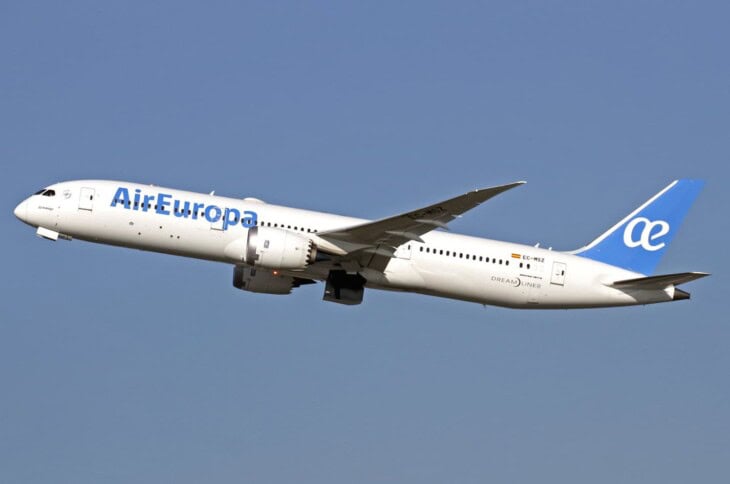
Runways and Approach: Closer Than the Range Gap
Runway needs are close. The A330-300 lists a takeoff distance of 9,100 ft (2,770 m) and the 787-9 lists 9,200 ft (2,800 m). Neither aircraft has a clear edge when the runway is long.
Landing is where the Dreamliner is better. It lists 5,000 ft (1,520 m) against 5,700 ft (1,730 m) for the A330-300, and an approach speed of 140 kt (161 mph, 259 km/h).
Boeing intended the 787-8 and 787-9 to have 330-minute ETOPS approval but they entered service with 180 minutes, Wikipedia reports. That figure limits how far from a diversion airport a twin can fly over water.
Cabin and Comfort: 2-4-2 Against 3-3-3
Wikipedia describes the typical A330 economy layout as 2-4-2, eight across. That means no seat is more than one seat from an aisle.
On the 787, most airlines choose nine across in a 3-3-3 pattern, according to Wikipedia. It says that arrangement gives passengers less space across the hips and shoulders than any other jet airliner, although eight across is also an option.
So the wider Dreamliner cabin does not guarantee a roomier seat. Airlines set their own layout, so check the seat map for your flight rather than trusting the type alone.
Age, Production and Replacements
The A330-300 first flew in November 1992 and entered service with Air Inter on January 16, 1994. Airbus built it until 2020. Wikipedia reports 779 ordered and 771 delivered as of December 2020.
The 787-9 first flew on September 17, 2013 and entered service with All Nippon Airways on August 7, 2014. Boeing still builds it.

Airbus answered the Dreamliner with the A330neo, which has new engines. The A330-900 entered service with TAP Air Portugal in December 2018. Wikipedia says 11 operators of at least five A330s had ordered 787-8 or 787-9 aircraft, and 13 had ordered both those and A350-900s.
The 787 has had a rougher start. In January 2013 the FAA grounded all 787s until the revised battery design was approved in April 2013, the first time it had grounded an airliner type since 1979.
Who Flies Them
Delta Air Lines is the largest A330 family operator, with 81 aircraft as of October 2026, according to Wikipedia. Turkish Airlines, China Eastern, Air China and Cathay Pacific follow.
The Dreamliner’s biggest early customers were All Nippon Airways, United, Japan Airlines and American Airlines, per Wikipedia’s August 2019 count. Many A330 operators have ordered the 787 as a replacement.

Verdict: Which One Is Better?
The 787-9 is the better aircraft on paper. It flies farther, higher and with more payload, and it is still in production.
The A330-300 is the better pick for a passenger who wants an eight-across economy cabin. Its listed price is lower too, $264.2 million (2015) against $292.5 million (2020), though the price years differ.
Check the seat map
The cabin you sit in depends on the airline. A 2-4-2 A330 can feel roomier than a 3-3-3 Dreamliner, even though the 787 has the wider fuselage.
FAQ
Slightly longer, but not bigger overall. The A330-300 is 208 ft 10 in (63.66 m) long against 206 ft 1 in (62.81 m) for the 787-9. The 787-9 has the wider fuselage and cabin, and a higher max payload of 141,000 lb (64,000 kg) against 101,000 lb (45,900 kg).
On the numbers the 787-9 wins: 8,300 nm (9,550 mi) of range against 6,350 nm (7,310 mi), and a 43,100 ft ceiling against 41,100 ft. The A330-300 offers a 2-4-2 economy layout and a lower listed price.
It can be. Its typical economy cabin is eight across in a 2-4-2 pattern, so no seat is more than one seat from an aisle. Comfort still depends on how the airline sets seat width and pitch.
It offers long range and a high ceiling in a twinjet, with an 8,300 nm (9,550 mi) range for the 787-9. Wikipedia reports that 11 operators of at least five A330s had ordered 787-8 or 787-9 aircraft as replacements, and 13 had ordered both those and A350-900s.
The A330-300 is not. Airbus built 771 of the 779 ordered by December 2020. The A330neo followed, with the A330-900 entering service in December 2018.
Sources and references used for research and fact-checking.
About the Author

Tim is the owner and lead editor of AeroCorner since 2019, overseeing aviation content covering aircraft, airlines, airports, and the broader aviation industry. Through years of researching, writing, editing, and publishing aviation-focused content, he has developed extensive practical knowledge of commercial aviation and air travel. Based in Asia and a frequent traveler himself, Tim also brings firsthand passenger experience to AeroCorner’s coverage. Outside of publishing, he has also explored aviation firsthand through hands-on flight training in New Zealand.