

Table of Contents
Find a fare you actually paid two summers ago, then price the same trip today. On a lot of US routes the number has moved in a way that does not feel like ordinary inflation.
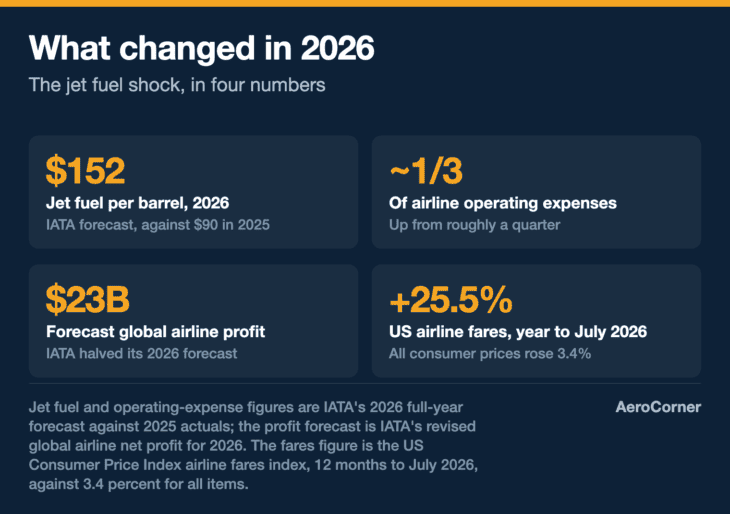
It is not your memory playing tricks. In July 2026, the airline fares index inside the US Consumer Price Index was up 25.5 percent over the year, while prices across the whole economy rose 3.4 percent.
Something specific happened in 2026, and it was not a switch flipping from cheap to greedy. Here is what actually moved, and why the half of it that matters most is not going to move back.
Why Are Flights So Expensive Right Now?
Two separate things happened at once. A conflict in the Middle East pushed jet fuel to four-year highs in the spring of 2026, and an airline industry with four large US players and no spare aircraft chose to pass that cost to passengers rather than absorb it.
Those are different kinds of cause, and mixing them up is why the question feels unanswerable. A fuel spike is a shock, and shocks fade. The market structure that decided who paid for the shock is permanent.
The two-part answer
A jet fuel shock raised the cost of operating every flight in 2026. A concentrated airline market with no spare aircraft and a higher wage base decided who paid for it. The first half is temporary. The second half is the reason fares ratchet up quickly and drift down slowly.
The Fuel Shock That Started It
IATA expects jet fuel to average $152 per barrel across 2026, against $90 in 2025. That single change lifts fuel from roughly a quarter of industry operating expenses to nearly a third.
The trade body responded by halving its forecast for global airline net profit for the year, to $23 billion. Prices eased after peaking in April, but jet fuel was still running about 75 percent above year-ago levels through the summer.
The numbers at individual carriers explain the panic better than the industry average does. In spring guidance, American told investors that sustained fuel prices could add more than $4 billion to its 2026 fuel bill, and Delta guided to about $4.30 a gallon all-in for the second quarter, with fuel expense up by more than $2 billion.
An airline cannot hedge its way out of a move that size, and it cannot cut its way out either. Fuel burn is set by the flight, not by the finance department.
Why Airlines Raised Fares Instead of Absorbing the Cost
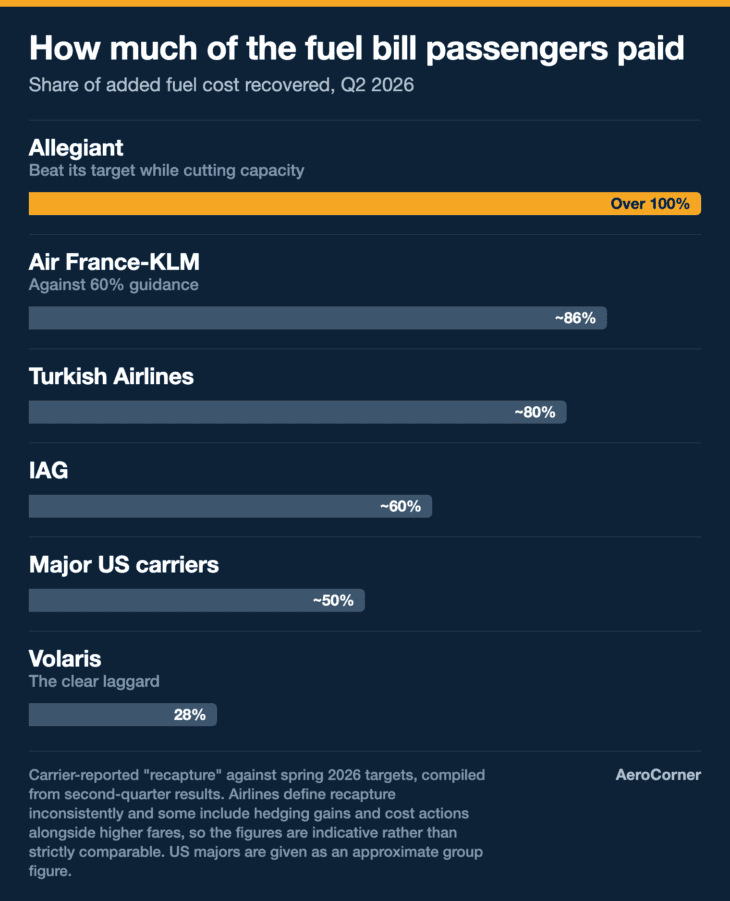
The industry has a word for the share of an extra fuel bill it wins back from customers: recapture. It is a polite term for charging more, and in 2026 airlines reported it to investors like a scoreboard.
Second-quarter results showed Allegiant clearing more than 100 percent of its added fuel cost while shrinking its flying, Air France-KLM at roughly 86 percent, Turkish around 80 percent, IAG near 60 percent and the big US carriers around half. Volaris, at 28 percent, was the clear laggard.
The second lever is quieter and more effective: flying less. Delta held its second-quarter capacity flat against the prior year rather than grow into an expensive quarter, and Air France-KLM cut its 2026 capacity growth plan from 3 to 5 percent down to 2 to 4 percent.
Fewer seats against steady demand is a fare increase by another route. Revenue management already prices every seat on a flight separately, which is a different question from why one seat costs more than the one beside it; pulling supply simply lifts the whole curve.
It works because aircraft already leave close to full. Airlines model no-shows so tightly that they deliberately sell more seats than the cabin holds, which leaves almost no slack to soak up a cost increase.
They went into the shock earning more, not less
Oliver Wyman’s first-quarter 2026 analysis found global airline capacity up 3.7 percent, revenue up 11.4 percent and operating margins improved by about two percentage points, even as fuel costs jumped. Fares rose from a position of strength, not distress.
Four Airlines, and Nowhere Near Enough Airplanes
Normally a fare spike invites a competitor to add flights and undercut it. In the United States in 2026, there are very few competitors left to do that, and almost no aircraft for them to do it with.
US airlines scheduled 741 million departing seats for summer 2026, according to OAG. American, Delta, Southwest and United held 562 million of them, or 76 percent, and the top ten carriers accounted for 92 percent.
| Airline | Scheduled seats, summer 2026 | Share of US capacity |
|---|---|---|
| American Airlines | 160.5 million | 21.7% |
| Delta Air Lines | 140.4 million | 18.9% |
| Southwest Airlines | 133.4 million | 18.0% |
| United Airlines | 127.7 million | 17.2% |
| Alaska Airlines | 43.1 million | 5.8% |
The national share understates the problem, because you do not buy a ticket nationally. You buy it on one route.
Marc Remer, a Swarthmore economist who analysed airline mergers at the Department of Justice, put it bluntly to NPR in July 2026: essentially every nonstop route is a monopoly or a duopoly. Hubs have got what he called hubbier, with a fortress hub meaning one airline running more than 70 percent of the flights there.
The discount end of the market shrank rather than filled the gap. Spirit cut scheduled seats from 23.3 million in summer 2025 to 10.7 million in summer 2026, a 54 percent contraction, and the majors rather than smaller rivals absorbed what it dropped. That matters because the ultra-low-cost model is what drags fares down on a route when it shows up.
Even a willing challenger runs into the same wall: there are no aircraft. A July 2026 Bain & Company review of 15 aerospace programmes found 87 percent citing supplier bottlenecks as a core obstacle to clearing order backlogs.
The gaps sit in exactly the parts that matter for short-haul flying. CFM’s LEAP engine programme, which powers much of the narrowbody fleet, needs to run at 1.4 times its recent output to reach target rate, the Airbus A320 line at 1.5 times, and the Boeing 737 MAX at 1.2 times.
Boeing’s order backlog now stands at $695 billion, and the FAA caps MAX production at 42 aircraft a month. Slots are booked out for years, which means nobody can flood a route with cheap seats even if they want to.
The Cost Base Moved Up Before Fuel Did
The fuel spike landed on a cost structure that had already stepped up and stayed there. Between 2023 and 2024, pilots at every major US airline signed contracts that permanently reset the wage base.
American’s agreement, ratified in August 2023, was worth an incremental $9.6 billion over four years. It gave pilots an average immediate raise of 21 percent and lifted compensation rates by more than 46 percent across the contract, with Delta, United and Southwest landing in similar territory.
Those were correcting two decades of concessions rather than inventing a windfall, and the career economics behind them are genuinely brutal at the entry end. But from a fare perspective the direction only goes one way.
Airline contracts do not expire downward. American’s becomes amendable in August 2027 with bargaining able to open as early as November 2026, and the next round starts from the new floor, not the old one.
The Myth: Flying Has Never Been This Expensive
The claim that does not survive the data
“Airfare has never been higher.” In plain dollars, that is close to true. Adjusted for inflation, it is not remotely true, and the gap between those two statements is the most useful thing in this article.
The Bureau of Transportation Statistics put the average US domestic itinerary fare at $428 in the first quarter of 2026. That is the highest first-quarter figure ever recorded in plain dollars, and it is 35.1 percent below the inflation-adjusted record of $660 set in the first quarter of 1999.
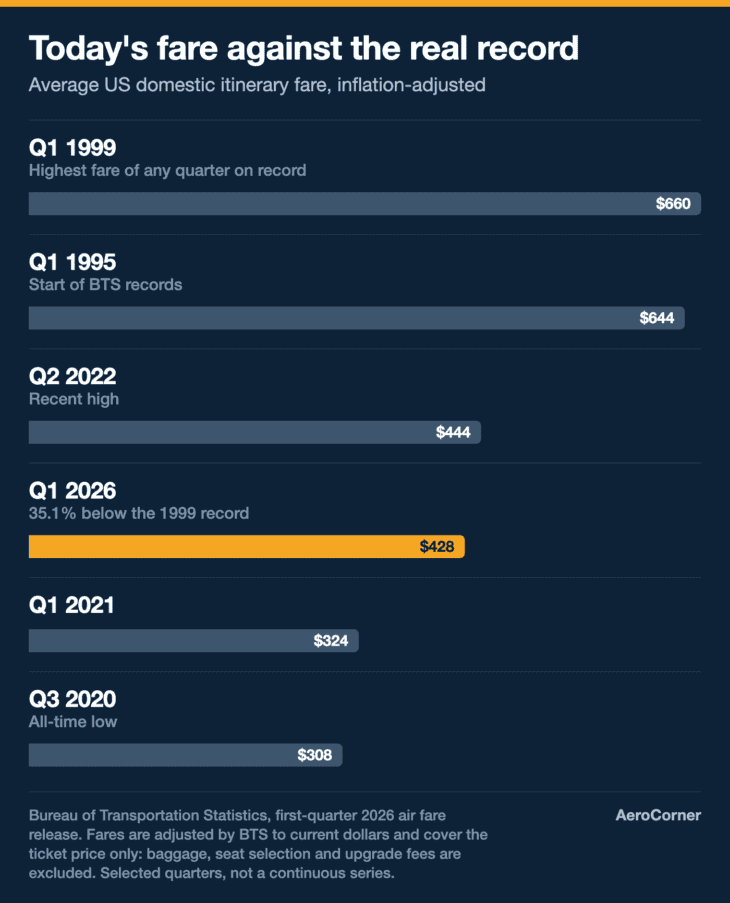
Put another way, and this is the number worth repeating: the average first-quarter fare has risen 44.1 percent since 1995, while consumer prices over the same span rose 117 percent. Measured against everything else you buy, flying got substantially cheaper and then gave a slice of it back in one year.
There is a catch, and it is not a small one. The fare is a shrinking share of what the airline collects from you.
US passenger airlines took 71.8 percent of their $45.9 billion in first-quarter 2026 operating revenue from passenger fares, down from 88.5 percent in 1990. The BTS fare figure explicitly excludes baggage fees, seat selection and upgrades, so roughly the fastest-growing part of your bill is invisible in the headline statistic.
Globally, IdeaWorksCompany put airline ancillary revenue at a record $157 billion in 2025, up from $148.4 billion in 2024 and $67.4 billion in 2016. That is 15.7 percent of all airline revenue, against 9.1 percent nine years earlier.
Even counting the extras, the same analysis found the total cost of an average one-way trip down about 40 percent since 2016 in real terms. Unbundling moved money out of the fare and into the add-ons; it did not, on the whole, raise the total.
One last honest wrinkle about those two headline numbers. The 25.5 percent CPI jump covers the summer of 2026, while the BTS quarter closed before fuel peaked in April, which is why one looks alarming and the other looks calm. Both are correct, and they are measuring different windows.
Ticket structure adds one more twist. BTS found 55 percent of first-quarter itineraries were round trips averaging $522, against 45 percent one-way at $305, a split that only makes sense once you know the round-trip discount has quietly disappeared.
So the next time a fare looks wrong, separate the two halves of it. The fuel component is a spike, and spikes come down, though airlines are famously slower to hand back a cost than to pass one on.
The other half is a market with four large carriers, most routes served by one or two of them, delivery slots booked out for years, and a wage base that reset upward and locked. None of that unwinds because oil does, which is why waiting for a single fare to drop is a different and far smaller question than waiting for fares in general to.
Sources and references used for research and fact-checking.
- U.S. Bureau of Labor Statistics, Consumer Price Index Summary, July 2026
- Bureau of Transportation Statistics, First Quarter 2026 Average Air Fare Increases 4.7% from Fourth Quarter 2025
- Skift, A Dozen Airlines Put a Number on the Fuel Spike. Here's How Much They Clawed Back
- Oliver Wyman, Global airlines navigate fuel costs and geopolitical risks: Airline Economic Analysis, Q1 2026
- OAG, The Biggest US Airlines in Summer 2026: Seats, Routes, and the Shifting Order
- NPR, Airline consolidation now rules the skies. Has it been good for passengers?
Get the Newsletter
The latest aviation news and stories sent to your inbox.
About the Author

Tim is the owner and lead editor of AeroCorner since 2019, overseeing aviation content covering aircraft, airlines, airports, and the broader aviation industry. Through years of researching, writing, editing, and publishing aviation-focused content, he has developed extensive practical knowledge of commercial aviation and air travel. Based in Asia and a frequent traveler himself, Tim also brings firsthand passenger experience to AeroCorner’s coverage. Outside of publishing, he has also explored aviation firsthand through hands-on flight training in New Zealand.