

Table of Contents
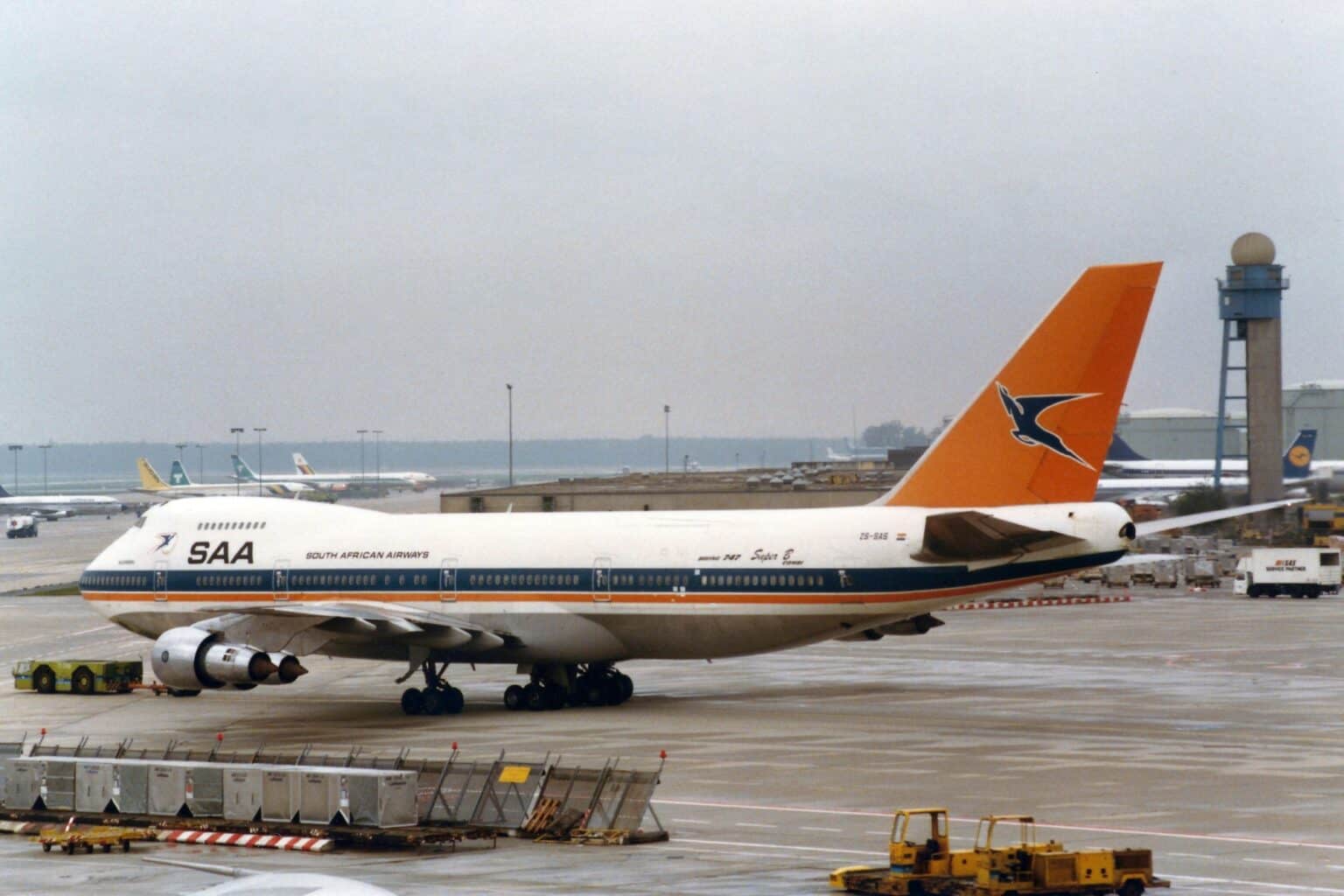
South African Airways Flight 295, a Boeing 747-244B Combi named Helderberg, crashed into the Indian Ocean about 154 miles (248 km) northeast of Mauritius on November 28, 1987. A fire had broken out in a cargo pallet on the aircraft’s main deck, the same deck the passengers sat on. All 159 people aboard died.
The crash led the FAA to rule that main-deck cargo holds like the Helderberg‘s were not safe enough. An airworthiness directive forced US operators of these “combi” jets to add fire protection, convert the hold or carry cargo in fire-resistant containers, and in 2016 the lessons became a certification rule for new designs.
The South African Board of Inquiry, chaired by Justice Cecil Margo, reported on May 14, 1990. It found the fire began in the right-hand front pallet, but that “the actual source of ignition cannot be determined.” That gap is where the rocket-fuel stories that still follow this flight took root.
Nov 27, 1987, 14:23 UTC
Departure from Taipei. ZS-SAS leaves for Mauritius with 140 passengers, 19 crew and six pallets of cargo on the rear of the main deck.
23:14 UTC
A routine call. The last HF position report to Mauritius, at 35,000 feet, gives no sign of trouble.
Before 23:49 UTC
Fire warning. The cockpit voice recorder captures the master fire warning from the main deck cargo and the captain calling for the checklist. Soon after, the recorder stops as fire damages its wiring.
23:49 UTC
Smoke reported. Captain Dawid Uys tells Mauritius approach of a smoke problem and an emergency descent to flight level 140.
23:51 UTC
Electrics lost. Asked for a position, the captain replies that they have lost a lot of electrics.
Nov 28, 00:04 UTC
Last transmission. The crew acknowledges a clearance toward Plaisance. About three minutes later the aircraft strikes the sea. There are no survivors.
Jan 28, 1988
Wreckage found. Side-scan sonar locates the main debris field about 14,400 feet (4,400 m) down.
May 3, 1990
FAA directive in force. Operators of main-deck Class B cargo holds must add fire protection, convert the hold, or use fire-resistant containers.
May 14, 1990
Board of Inquiry report. It finds an uncontrolled fire in the forward right pallet led to a loss of control, and recommends prohibiting the combi layout.
June 1998
TRC hearing. The Truth and Reconciliation Commission hears claims of illegal cargo and says further investigation is needed.
Apr 18, 2016
New certification rule. FAA Amendment 25-141 tightens Class B holds and creates a new Class F hold for new designs.
A night flight from Taipei with cargo behind the cabin
The Helderberg, registration ZS-SAS, was a Boeing 747-200 built as a Combi. Passengers sat in the front of the main deck, and the rear was a cargo hold behind a partition, loaded through a side door. The report records seven pallet positions in that hold, six of them in use.
Flight SA 295 left Taipei’s Chiang Kai-shek Airport at 14:23 UTC on November 27, delayed by weather and a late connection. It carried 140 passengers and 19 crew, including an extra co-pilot and an extra flight engineer for the 10-hour trip to Mauritius.
The captain, Dawid Uys, had 13,843 flying hours, 3,884 of them on the 747. The Board found the whole crew properly licensed, experienced on the route and rested, and the aircraft serviceable and correctly loaded.
For nine hours the flight was routine. The last HF position report, at 23:14 UTC, placed it at flight level 350 over the Indian Ocean, with no hint of distress.
The cockpit voice recorder, which kept only the last 30 minutes, held mostly personal conversation until the master fire warning sounded. Someone asked where it came from and was told the main deck cargo. The captain asked for the checklist, and within about a minute and a half the recording turned into a test tone and ended, its wiring affected by the fire.
At 23:48:51 UTC the captain called Mauritius approach. He reported a smoke problem, began an emergency descent to flight level 140 and asked for full emergency services.
Two minutes later he said they had “lost a lot of electrics.” The crew kept talking to the controller until 00:04:02 UTC, when the captain acknowledged a clearance toward the airport. The aircraft struck the sea at about 00:07 UTC, 04:07 local time, in darkness.
What the Helderberg Board of Inquiry found
Because the crash happened outside any state’s territory, South Africa, as the state of registry, ran the investigation under ICAO Annex 13. Its Board of Inquiry had members from South Africa, Mauritius, Japan, Taiwan, the UK and the US.
Its causal finding reads: “The accident followed an uncontrolled fire in the forward right pallet on the main deck cargo compartment. The aircraft crashed into the sea at high speed following a loss of control consequent on the fire.”
The fire burned plastic and cardboard packing material. The Board judged it “virtually certain that there was no sabotage,” found no explosion, and despite what it called intensive investigation could not find that fireworks or any other illegal cargo were aboard.
It could not say exactly why control was lost. It named two possibilities: a crew overcome or disoriented by carbon monoxide, carbon dioxide and smoke, or fire damage to the structure or flight controls. Either way, it found a strong possibility that the gases had already overcome some or all of the people aboard.
The Board also found the hold’s smoke detection and its firefighting provisions inadequate, and said the old Class B certification tests had not properly shown that smoke would stay out of the cabin. It declined to assign responsibility to any person or body.
One more finding addressed a lasting rumor. The airline’s Johannesburg base had missed a scheduled radio call to the flight, and that tape was later lost or wiped. The Board found no connection between either fact and the accident.
What most accounts get wrong
Two claims follow Flight 295. The first is that a fire started in the cargo hold beneath the passengers. It did not: the Board placed it on the main deck, in the forward pallet of a hold just behind the passenger cabin, on the same floor, which is why smoke reached the people aboard. The second is that the jet was secretly carrying rocket fuel for South Africa’s weapons program. The Board found sabotage virtually certainly excluded and could not find any illegal cargo, though it never identified what ignited the fire. In 1998 the Truth and Reconciliation Commission heard these allegations, criticized the original inquiry and said further investigation was necessary, but it made no finding that illegal cargo was on board.
Why a Class B cargo hold could not stop the fire
Cargo holds on airliners are certified by class. The rear of the Helderberg‘s main deck was Class B: a hold with a smoke detector but no built-in extinguishing system, approved on the basis that a crew member could walk in and reach a fire with a handheld extinguisher.
The Board tested that idea. On March 1, 1988, on a parked Combi with no passengers in the way, a fully trained cabin attendant took 5 minutes 15 seconds to be ready to locate a fire and start fighting it, and the attendant’s portable oxygen bottle snagged in the cargo nets several times.
FAA test data, cited in the agency’s later directive, showed why that was too slow. A flash fire could occur in as little as two to three minutes after cardboard packing caught fire.
The FAA’s own review team, reporting on June 1, 1988, reached the same view the Board later adopted. Not all cargo on a loaded pallet could be reached, the extinguishers held too little agent, a smoke-filled hold left too little visibility, and “the reliance on crew members to fight a cargo fire must be discontinued.”
The fire also explained what the recorders could not tell investigators. The flight data recorder was never found, and the voice recorder sat in the same burning hold. Heat damaged the wiring to it, which is why its recording ended long before the crash.
Finding even that recorder took a pioneering salvage effort. Operation Resolve worked from the ship Stena Workhorse with a remotely operated vehicle on a fiber-optic cable, at depths the Board put on the order of 2.8 miles (4.5 km). The voice recorder was the only recorder recovered.
Fire in a cargo hold returned as a cause less than a decade later, when ValuJet Flight 592 crashed in the Everglades after oxygen generators burned in a Class D hold below the cabin. That accident reshaped the rules for underfloor holds the way Helderberg reshaped them for the main deck.
The cargo fire rules that came from Flight 295
The first response came before the Board had reported. On May 16, 1988, the NTSB, which took part as the representative of the state of manufacture, issued recommendations A-88-61 to A-88-63: carry all Class B cargo in fire-resistant containers, research better detection and suppression, and give Class B liners the fire resistance already required in Class C and D holds.
The FAA proposed an airworthiness directive on July 8, 1988, covering Boeing 707, 727, 737, 747 and 757 and McDonnell Douglas DC-8, DC-9 and DC-10 airplanes with main-deck Class B holds. As proposed, operators would convert those holds to Class C, with built-in extinguishing, or carry cargo there only in flame penetration-resistant containers.
Airlines pushed back on cost, and the final directive, issued August 10, 1989 and in force from May 3, 1990, gave them a choice. Within a year they could add equipment and procedures to find and fight a fire, or within three years convert the hold to Class C, restrict it to approved containers, or add further detection and suppression systems on top of the first set.
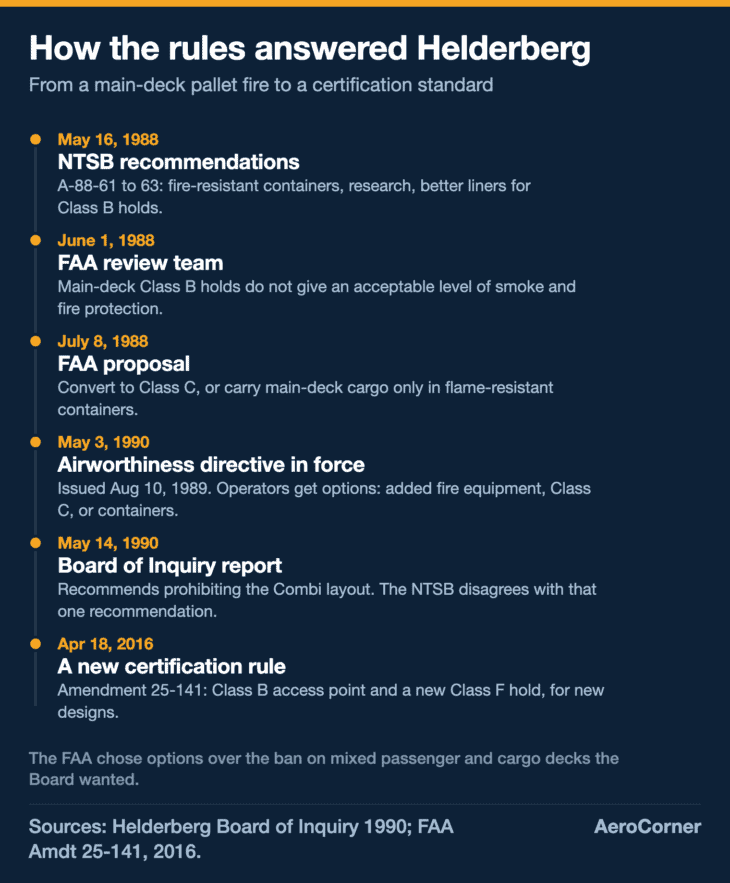
The Margo Board thought that did not go far enough. Its first recommendation was that the combi layout, passengers and cargo on one deck with crew firefighting, “should be prohibited as creating an unacceptable risk to life and property,” at least until detection, equipment and procedures were fixed.
The NTSB agreed with every other finding and recommendation but not that one. In a letter appended to the report, its accredited representative said the FAA directive already upgraded Class B fire protection well beyond the standard of 1987, and asked for the ban to be revised.
The Board also made recorder recommendations: voice recorders keeping the last hour instead of 30 minutes, a “hot mic” that records all cockpit sound, fire protection and backup power for both recorders and their wiring, and a second underwater locator that starts when the first goes quiet.
The lasting change came 28 years later. FAA Amendment 25-141, effective April 18, 2016, says its standards “stem from actions following a 1987 accident,” the South African Airways crash. It requires Class B holds to have a firefighting access point a crew member can use without stepping inside, and creates a new main-deck Class F hold with stronger detection and suppression.
The 2016 rule harmonized the FAA’s standards with EASA’s and applies to new airplane designs only. The airplanes already flying were covered by the directives the FAA and France’s DGAC had issued after the crash.
What changed because of this accident
NTSB recommendations A-88-61 to 63, May 1988: fire-resistant containers, research and better liners for Class B holds (recommendations). FAA airworthiness directive on main-deck Class B holds, issued August 1989, in force May 3, 1990: added fire protection, conversion to Class C, or approved containers (binding for US operators). Board of Inquiry, May 1990: prohibit the combi layout, longer and better-protected cockpit voice recorders (recommendations; the ban was not adopted by the FAA). FAA Amendment 25-141, April 18, 2016: Class B firefighting access point and a new Class F hold (binding for new designs).
The questions the inquiry left open
An undetermined ignition source, on a state airline during the apartheid-era arms embargo, invited suspicion. In June 1998 the Truth and Reconciliation Commission held a closed hearing in Cape Town at which forensic scientist David Klatzow argued that the jet had carried ammonium perchlorate, a rocket fuel oxidizer, for the arms agency Armscor.
Armscor witnesses denied any knowledge of such shipments, and the former head of SAA denied any improper link with Armscor. The TRC’s final report did not find that illegal cargo was aboard, but it questioned the Board’s timing of the fire and the original investigators’ procedures.
It concluded that the case raised significant questions, that the Gauteng Attorney-General’s special investigation team was still looking at it, and that “further investigation is necessary before this matter can be laid to rest.” We found no later official report that replaces the Margo Board’s finding.
What is settled is the mechanism. A fire nobody could reach, in a hold that relied on people to fight it, spread smoke into an occupied cabin over the open ocean. That is the problem the directive and the 2016 rule were written to remove.
Helderberg belongs among the flights that changed aviation because its lesson was about design rather than the people aboard: a certification standard that assumed a crew could fight what it could not reach. TWA Flight 800 taught a similar lesson about fuel tank design a decade later.
FAQ
Sources and references used for research and fact-checking.
- Board of Inquiry (Justice C. S. Margo, chairman), Republic of South Africa, Report of the Board of Inquiry into the Helderberg Air Disaster (final report, May 14, 1990)
- Wikisource, Report of the Board of Inquiry into the Helderberg air disaster (transcription)
- Federal Aviation Administration, Federal Register, February 16, 2016, Harmonization of Airworthiness Standards: Fire Extinguishers and Class B and F Cargo Compartments (Amendment 25-141), 81 FR 7698
- Truth and Reconciliation Commission (SABC TRC archive), Truth and Reconciliation Commission of South Africa Report, Volume 2, Chapter 6: the Helderberg
- South African Government (gov.za), Special Hearing on Helderberg Flight: Summary Report
Get the Newsletter
The latest aviation news and stories sent to your inbox.
About the Author

Tim is the owner and lead editor of AeroCorner since 2019, overseeing aviation content covering aircraft, airlines, airports, and the broader aviation industry. Through years of researching, writing, editing, and publishing aviation-focused content, he has developed extensive practical knowledge of commercial aviation and air travel. Based in Asia and a frequent traveler himself, Tim also brings firsthand passenger experience to AeroCorner’s coverage. Outside of publishing, he has also explored aviation firsthand through hands-on flight training in New Zealand.