

Table of Contents
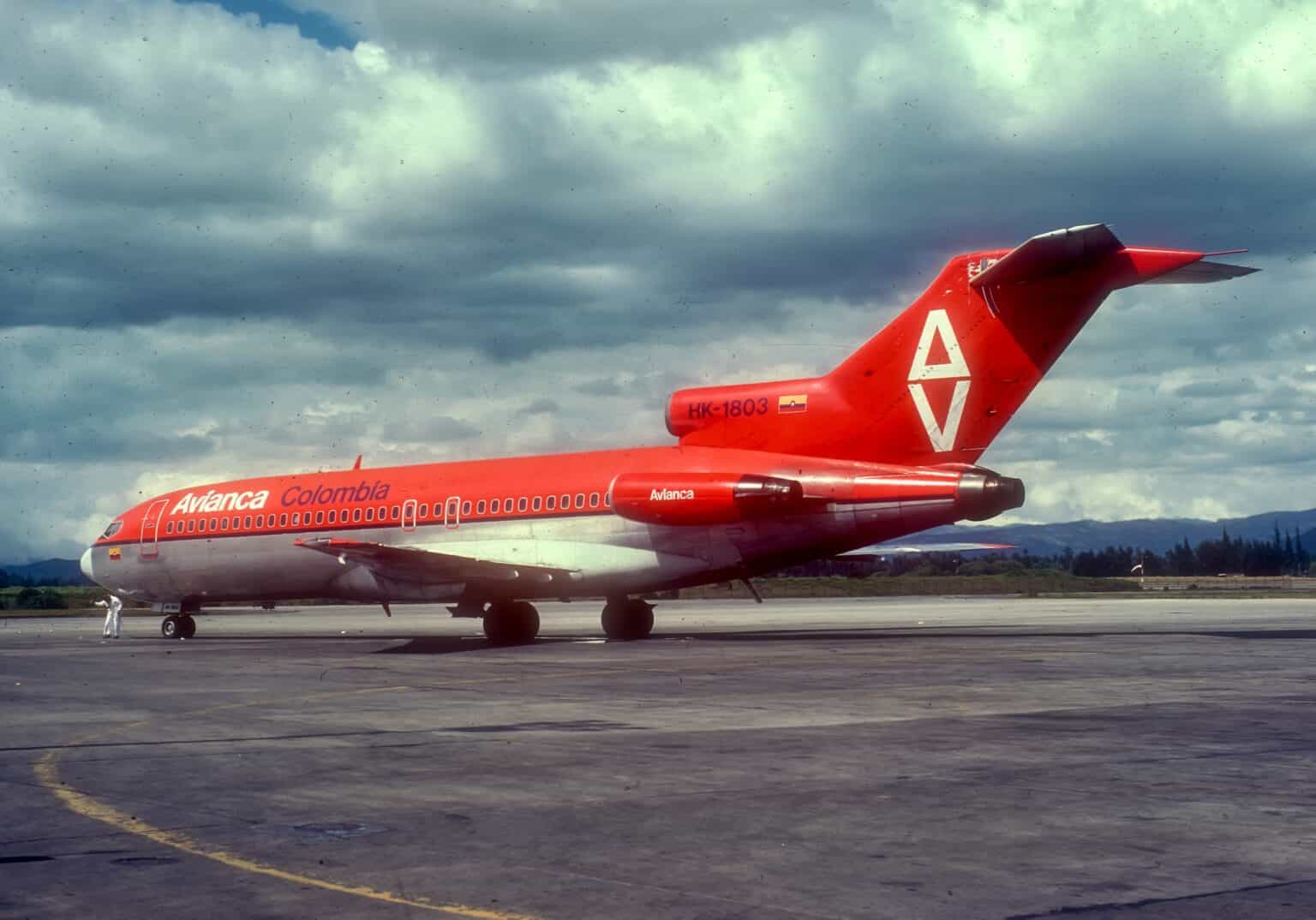
Avianca Flight 203 exploded over Soacha, just outside Bogotá, on the morning of November 27, 1989, four minutes after taking off for Cali. The Boeing 727-21, registration HK-1803, carried 101 passengers and 6 crew. All 107 people aboard died.
Colombia’s investigators found that a bomb under a cabin seat punctured the center fuel tank, and that the fuel vapor inside it then exploded and broke the airplane apart. Nineteen years later, the FAA named Flight 203 in the rule that made fuel tank inerting mandatory on US airliners.
This account is built from the accident report of Colombia’s Departamento Administrativo de Aeronáutica Civil (DAAC), dated December 28, 1989, with the NTSB’s TWA 800 report and the FAA’s 2008 rule. The public copy of the Colombian report is missing its last pages, so its formal probable cause and recommendations do not survive in it.
Nov 27, 1989, 06:59
Pushback. HK-1803 leaves Avianca’s Puente Aéreo ramp at El Dorado for an instrument flight to Cali.
Nov 27, 1989, 07:11
Takeoff. The 727 begins its takeoff roll at 07:11:42 and climbs out on the Girardot 1 departure.
Nov 27, 1989, 07:15
Last position report. The crew reports crossing the Techo fix at 10,500 feet and turns toward Girardot.
Nov 27, 1989, 07:16:39
Recording ends. The cockpit voice recorder stops abruptly over Soacha. Wreckage falls along a path about 3 miles (5 km) long.
Dec 3, 1989
Recorders opened in Washington. At the NTSB, the voice recorder tape is found intact. The flight data recorder is burned through and cannot be read.
Dec 28, 1989
Colombia’s report. The DAAC investigating board, assisted by the NTSB, FAA, FBI, Boeing and Pratt & Whitney, traces the breakup to a bomb and a center tank explosion.
May 5, 1995
Sentence in the US. A US federal judge sentences a Medellín cartel figure convicted in the case to 10 life terms.
Aug 2000
The NTSB cites it. The TWA 800 report uses the Avianca 727 as evidence that a center tank explosion can destroy an airliner.
Sept 19, 2008
The FAA rule. The fuel tank flammability rule, which names Flight 203, takes effect.
Four minutes from El Dorado: how Flight 203 unfolded
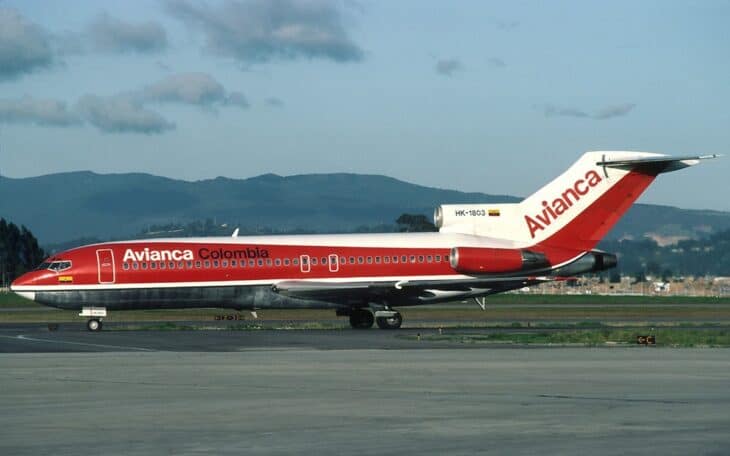
Flight 203 was a routine Monday shuttle from Bogotá’s El Dorado airport to Alfonso Bonilla Aragón airport at Cali. The aircraft was a Boeing 727-21, serial number 19035, built in 1966 and operated by Aerovías Nacionales de Colombia, Avianca.

The crew started cockpit preparations at 06:43:47 local time. The report finds that the captain, first officer and flight engineer met every fitness and experience requirement for the flight, and the captain’s last simulator check, that May, had been signed off as satisfactory.
The 727 lifted off runway 12 about 43 seconds into its takeoff roll and climbed southwest. At 07:15:00 the crew reported crossing Techo at 10,500 feet (3,200 m), cleared to continue climbing toward Girardot.
One minute and 39 seconds later, at 07:16:39, the aircraft exploded over the Compartir district on the edge of Soacha, about 12 miles (20 km) from El Dorado. The cockpit voice recorder, read later in Washington, captures an ordinary cockpit until the sound cuts off.
The airplane came down in four large sections across ground about 3 miles (5 km) long and 0.6 miles (1 km) wide, near the El Muña reservoir at 8,419 feet (2,566 m) above sea level. The report records the 107 deaths aboard; contemporary press reports put the total at 110, counting three people killed on the ground.
What Colombia’s DAAC investigation found
The DAAC’s Air Safety Division formed an investigating board and asked the US government for help. Investigators from the NTSB, the FAA and the FBI joined it, with observers from Boeing and engine maker Pratt & Whitney.
The board’s analysis states that the crew, the aircraft, the weather and air traffic control had no bearing at all on what happened. Everything that followed came down to two explosions in flight, and which one caused the other.
Its answer, in section 2.0: the first explosion was a device on the cabin floor at fuselage station 783, which perforated the floor and the top of the center fuel tank below. The fuel ignited, and that second explosion tore apart the center wing section, separated both wings and released the forward and rear fuselage.
The FBI laboratory found the high explosives RDX and PETN on a piece of the center fuel tank’s right side. The two are the components of Semtex, the Czechoslovak plastic explosive identified the year before in the bombing of Pan Am Flight 103.
What most accounts get wrong
Most accounts say a bomb blew Flight 203 apart. The investigation found something narrower: a relatively small device holed the cabin floor and the center fuel tank, and the explosion of the fuel vapor in that tank broke the airplane up. The NTSB summarised the Colombian report in 2000: the bomb explosion did not compromise the structural integrity of the airplane, the tank explosion did. The fuel pump theory a Colombian newspaper revived in 2016 is not new either. The 1989 board examined the No. 3 tank boost pump’s repeated circuit breaker trips that November, and following that lead is how it found the explosive evidence.
How a small bomb became a fuel tank explosion
The board did not start with a bomb. It first looked at a main wheel rim cracked along its outer flange, suspecting a tyre burst from overheated brakes, and dropped the idea after Avianca’s hydraulic shop confirmed the tyres had been filled with nitrogen, not air.
It then turned to the aircraft’s maintenance log. In November 1989 alone, the circuit breaker for the aft boost pump in fuel tank No. 3 had tripped and been reset or repaired several times, and the board treated that pump as a possible ignition source for a fuel/air explosion.
Searching that part of the wreckage, investigators found soot and fine striation marks on the inside of the right rear of the center wing box. Rebuilding the fuselage between stations 680 and 790, they then found hot-gas pitting craters in the skin near the forward right overwing exit, which the report calls the first absolute and positive evidence of an explosive device.
The pattern pointed to the area under seat 14F, at station 783, directly above the center tank. Popular histories of the case put the people involved in other rows; the report places the device at 14F.
The 727’s center tank sits inside the wing box beneath the cabin floor, holding fuel and, when it is not full, a space of vapor above it. That vapor space, the ullage, is what investigators in Bogotá found had exploded. It is the same failure the NTSB would trace, from an unknown spark rather than a bomb, on TWA Flight 800 in 1996.
The fuel tank rules that came after Flight 203
No safety rule anywhere is named after Flight 203, and the surviving copy of Colombia’s report ends before its recommendations. Its lasting effect came through the center tank finding, which US investigators carried into the long fight over fuel tank explosions.
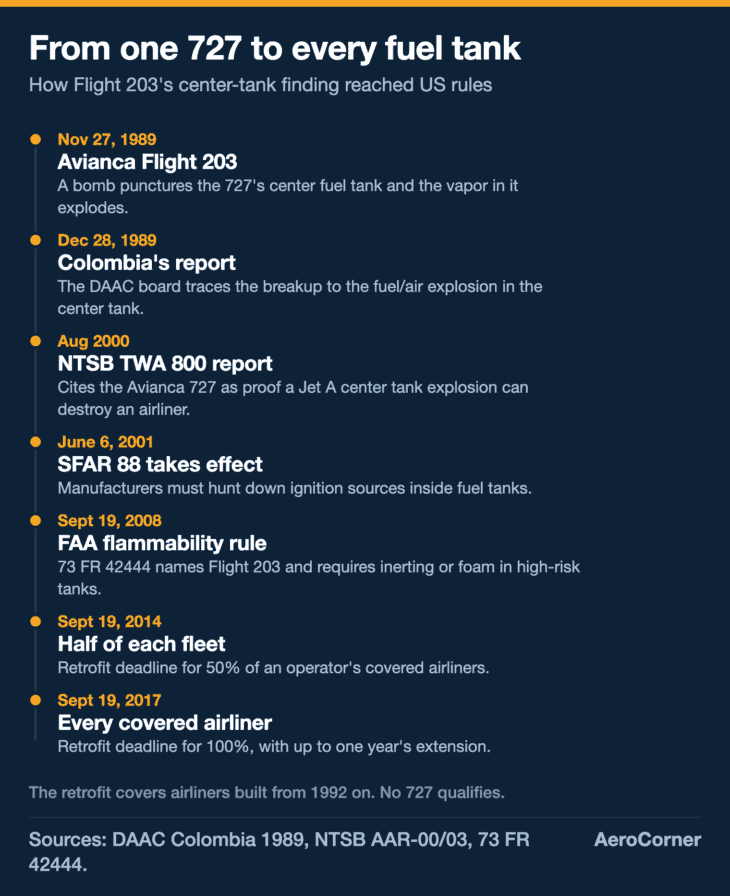
The NTSB’s report on TWA Flight 800, AAR-00/03, adopted in August 2000, lists the Avianca 727 among earlier center tank explosions. It cites it, with a 1990 Philippine Airlines 737, as proof that a Jet A fuel/air explosion “can break apart the fuel tank and lead to the destruction of an airplane.”
Special Federal Aviation Regulation 88, effective June 6, 2001, was the first binding answer: manufacturers had to find and remove ignition sources inside fuel tanks. It treated the spark, not the vapor.
The vapor came next. The FAA’s final rule “Reduction of Fuel Tank Flammability in Transport Category Airplanes,” 73 FR 42444, published July 21, 2008 and effective September 19, 2008, opens its statement of the problem with two in-flight explosions: TWA 800 and “a Boeing 727 terrorist-initiated explosion (Avianca Flight 203)”.
The rule states that a system to reduce tank flammability “would have prevented these four fuel tank explosions,” counting Avianca, TWA, Philippine Airlines and a 2001 Thai Airways explosion. It requires nitrogen inerting or a foam-type ignition mitigation system in high-flammability tanks, under 14 CFR parts 25, 26, 121, 125 and 129.
Inerting works on the vapor itself. An onboard system separates nitrogen-enriched air and feeds it into the tank’s empty space, holding the oxygen below the level a spark or flame needs to ignite fuel vapor.
That matters for the Avianca case because of what the board found in Bogotá. The cabin floor was holed and the fuselage skin breached, but the airplane came apart only when the tank exploded under the seat row.
Not everyone accepted the citation. In the rule’s comment record, the Air Transport Association and FedEx objected that a bomb placed above the tank would not have been stopped by the rule, and the FAA answered that it had not counted any benefit against bombs or missiles.
Operators had to retrofit half of their covered fleet by September 19, 2014 and all of it by September 19, 2017, each with up to a year’s extension. The retrofit applies only to airplanes that received their first certificate of airworthiness on or after January 1, 1992, so no 727 was ever covered.
The explosive itself became the subject of a treaty. The Convention on the Marking of Plastic Explosives for the Purpose of Detection, signed in Montreal on March 1, 1991 after an Anglo-Czechoslovak initiative that followed Lockerbie, binds its parties to add detection agents to explosives like Semtex. It entered into force on June 21, 1998.
What changed because of this accident
NTSB TWA 800 report AAR-00/03: cites the Avianca 727 as evidence of center tank explosion risk, August 2000 (investigation finding, not a rule). SFAR 88: binding ignition-source reviews for fuel tanks, June 2001. FAA fuel tank flammability rule, 73 FR 42444: binding, names Flight 203, effective September 2008, retrofits due 2014 and 2017 for airliners built from 1992. Plastic explosives marking convention: binding treaty, signed 1991 after Lockerbie, in force 1998. Colombia’s own recommendations: lost with the report’s missing final pages.
In 1991 US prosecutors indicted Dandeny Muñoz Mosquera, a Medellín cartel gunman already in prison on other charges, over the bombing; two Americans were among the dead. A US federal court convicted him in 1994 and sentenced him to 10 life terms in May 1995, though Westword later reported that Colombia’s attorney general had written to the judge saying Colombian prosecutors had no evidence tying him to it.
Flight 203 is remembered as a cartel bombing, and it was one. Its place among the flights that changed aviation comes from the tank underneath the seat, the same vulnerability that brought down TWA 800. Unlike Metrojet Flight 9268, another bombing whose investigation never finished, Colombia’s board reached its finding within a month.
FAQ
Sources and references used for research and fact-checking.
- Departamento Administrativo de Aeronáutica Civil (Colombia), División de Seguridad Aérea, Informe de Accidente de Aviación, Boeing 727-21 HK-1803, Avianca, Hacienda Canoas, El Charquito, Soacha, 27 de noviembre de 1989 (report dated 28 December 1989; final pages missing)
- National Transportation Safety Board, Aircraft Accident Report NTSB/AAR-00/03: In-flight Breakup Over the Atlantic Ocean, Trans World Airlines Flight 800
- Federal Aviation Administration, Federal Register, Reduction of Fuel Tank Flammability in Transport Category Airplanes, final rule, 73 FR 42444
- eCFR, 14 CFR Part 21, Special Federal Aviation Regulation No. 88
- UNODC SHERLOC, Convention on the Marking of Plastic Explosives for the Purpose of Detection (Montreal, 1 March 1991)
- UK Parliament, Hansard, Plastic Explosives Detection (ICAO), written answer, 21 March 1991
- The Spokesman-Review (Associated Press), 'Narco-Terrorist' Sentenced For Bombing Colombian Jetliner
- The New York Times, Drug Trafficker Convicted Of Blowing Up Jetliner
- Westword, The Hit Man Nobody Knows
- El Espectador, Avianca 203, la historia que nunca nos contaron
- Wikipedia, Avianca Flight 203
Get the Newsletter
The latest aviation news and stories sent to your inbox.
About the Author

Tim is the owner and lead editor of AeroCorner since 2019, overseeing aviation content covering aircraft, airlines, airports, and the broader aviation industry. Through years of researching, writing, editing, and publishing aviation-focused content, he has developed extensive practical knowledge of commercial aviation and air travel. Based in Asia and a frequent traveler himself, Tim also brings firsthand passenger experience to AeroCorner’s coverage. Outside of publishing, he has also explored aviation firsthand through hands-on flight training in New Zealand.