

Table of Contents
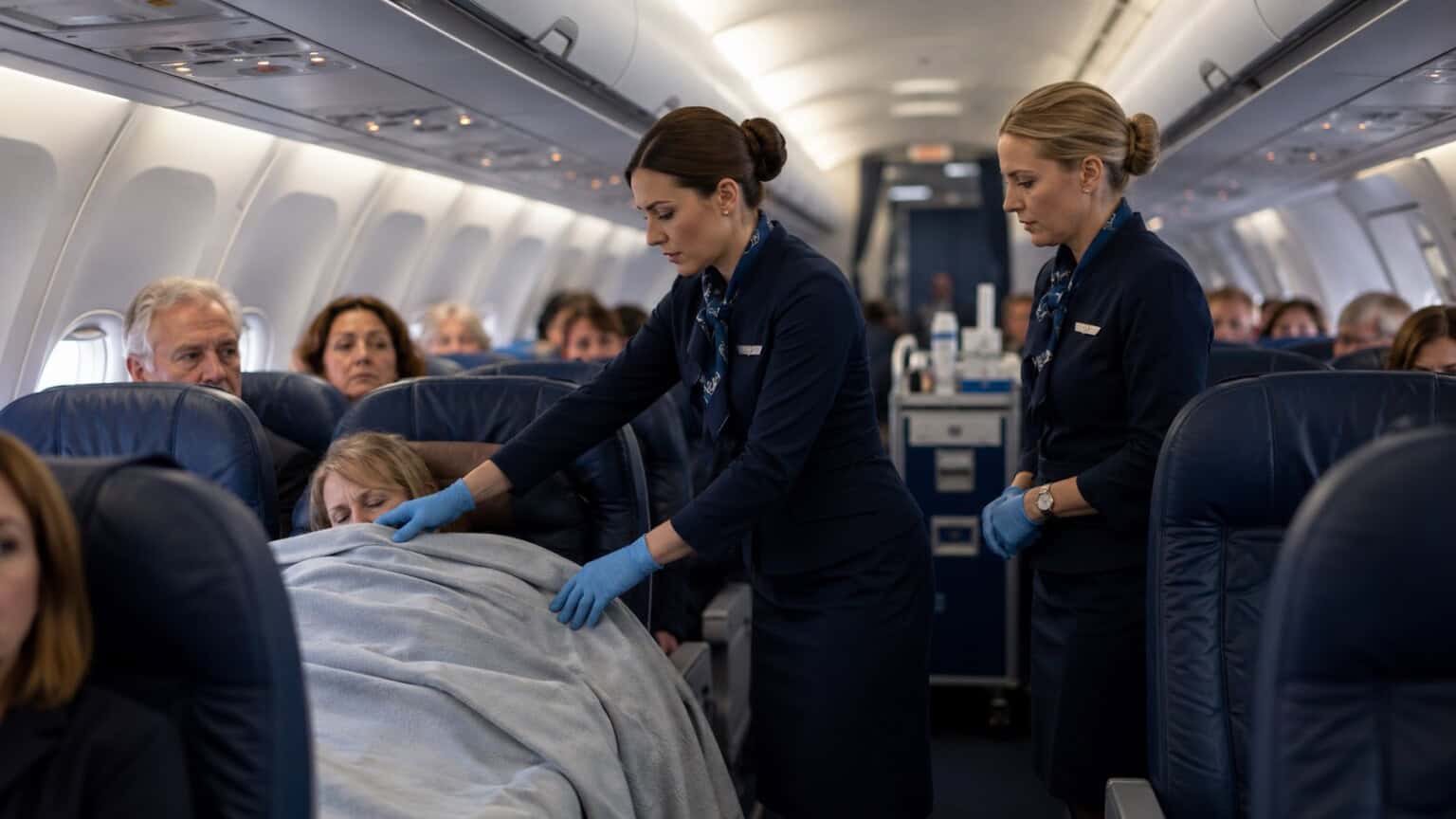
Six hours into a night flight, a cabin crew member notices that the passenger in 34C has not touched his meal tray and has not shifted position in a long time. She says his name. She touches his shoulder. Nothing.
What happens over the next few hours is one of the most carefully rehearsed procedures in commercial aviation, and almost none of it looks like what passengers imagine.
Airlines train for this, there is a written protocol, and it begins from a position most people find surprising: as far as the crew are concerned, nobody on board has died. Here is what actually happens, and why.
The short answer
Cabin crew treat the event as a medical emergency and keep treating it as one. They are not authorised to pronounce anybody dead, anywhere in the world, so the passenger’s status stays medical rather than legal for the rest of the flight.
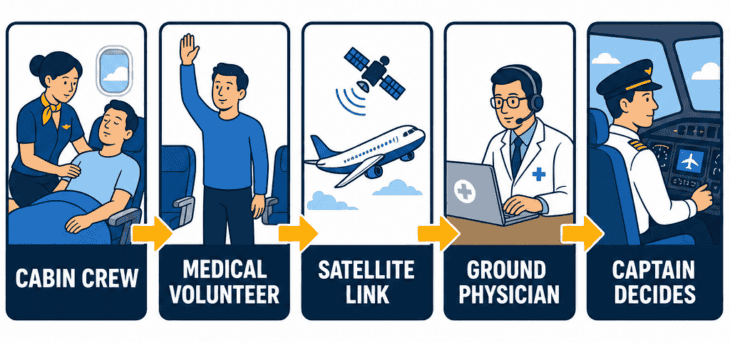
They start resuscitation, call over the PA for a doctor or nurse, and put a physician on the ground on the line by satellite. If that physician advises stopping, they stop. The passenger is then “presumed dead”, secured in a seat with a belt and covered with a blanket, and the aircraft usually carries on to its planned destination.
At a glance
Cabin crew cannot legally declare death. They run a medical emergency, consult a ground-based physician by satellite, and only then stop resuscitation. The body is secured in a seat, belted and covered. The flight most often continues to its destination, and the death is formally certified in whichever country the aircraft lands in.
How often a passenger actually dies in flight
Rarely, but not never. The largest study of the subject ever run, published in JAMA Network Open in September 2025, looked at 77,790 in-flight medical events reported to a single global ground-support service by 84 airlines across 2022 and 2023.
Those airlines carried about 3.1 billion passengers over that period. Some kind of medical event happened on roughly one flight in 212. Of the 77,790 events, 312 ended in a death on board.
Work that back and the odds are stark in the other direction: roughly one death for every 53,000 flights, or one for every ten million passengers carried. A long-haul purser can fly an entire career and never see one.
| Measure | Figure (2022 to 2023) |
|---|---|
| Flights with a medical event | About 1 in 212 |
| Medical events recorded | 77,790 |
| Events ending in a death on board | 312 (0.4%) |
| Events causing a diversion | 1,333 (1.7%) |
| Passengers taken to hospital after landing | 5,959 (7.7%) |
| Events with a volunteer physician on board | 20.1% |
The same dataset logged 293 cardiac arrests. That is the shape of the problem in one line: cardiac arrest is a tiny fraction of all in-flight medical events, and very nearly all of the deaths.
The first ten minutes: a medical emergency, not a death
The crew response is the same one they would run for a faint or a seizure, because at that moment they have no way of knowing which it is. One crew member stays with the passenger, another fetches the equipment, a third briefs the flight deck.
On any US airliner with a flight attendant, that equipment is mandated by regulation. Under 14 CFR 121.803 and its appendix, the aircraft must carry a first aid kit, an approved emergency medical kit with a stethoscope, a blood pressure cuff, IV equipment and cardiac drugs, and at least one automated external defibrillator.
Then comes the PA announcement asking for a medical professional. In the JAMA data, a volunteer physician was on board and involved in about one event in five. In the United States, the Aviation Medical Assistance Act of 1998 shields those volunteers from liability unless they are grossly negligent, which is the reason so many step forward.
The most important call, though, is the one the passengers never see. Most large airlines subscribe to a ground-based medical service such as MedAire’s MedLink or STAT-MD, which puts an emergency physician on a satellite link to the aircraft within minutes, around the clock.
That doctor, sitting in an operations room thousands of miles away, is the person with the authority the crew lack. Everything that follows runs through them.
Why cabin crew are not allowed to say the word
Declaring death is a legal act, not an observation, and the rules for who may perform it vary from country to country. A flight attendant does not qualify in any of them, and neither, in most jurisdictions, does a doctor who happens to be travelling in seat 12A.
Guidance published by the Aerospace Medical Association handles this with a careful piece of language. Resuscitation can be stopped once the passenger is at least “presumed dead”, and a medical professional can advise the crew to that effect, but the formal declaration waits for the ground.
A doctor who assists is also told to stay in their lane once that point is reached. Their job becomes advising the crew, and it is the captain who communicates with the company and the authorities on the ground.
This is why crew accounts of these events so often describe continuing CPR long past the point of any realistic hope. It is not denial. It is the only posture the rules leave them.
Where the body goes
This is the part everyone wants to know, and the real answer is far more ordinary than the rumours. IATA’s medical guidance to airlines is built around two principles: dignity for the deceased, and as little distress as possible for everyone else.
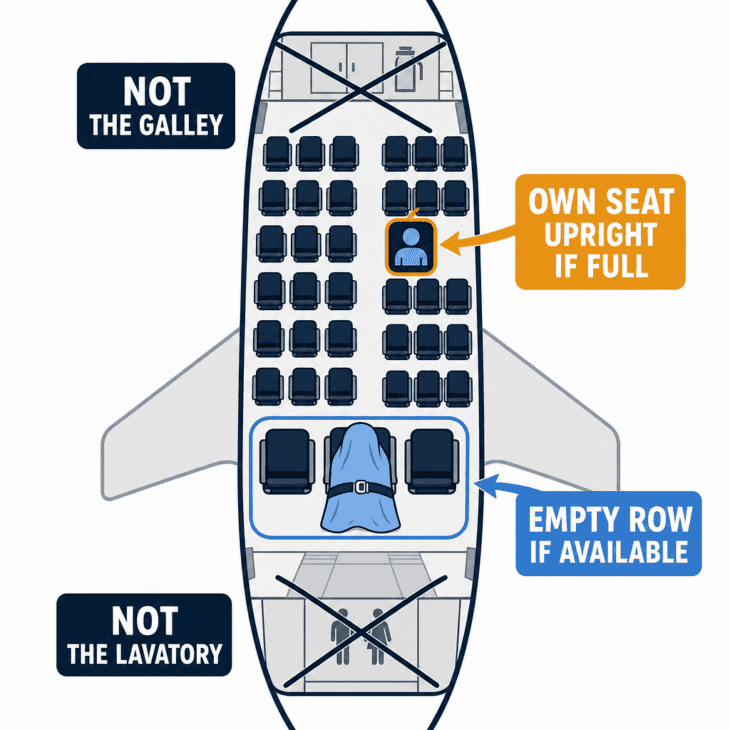
If there is a row of empty seats with few passengers nearby, the crew move the body there, lay it out, and secure it with a seatbelt. The eyes are closed and a blanket is drawn up to the neck. A few airlines carry a body bag, and it is used if one is available.
On a full flight, and most flights are full, there is nowhere to move to. In that case the passenger is returned to their own seat, upright, with the belt fastened to hold them in place for the rest of the cruise and the landing.
What crew do not do is put the body in a galley, a lavatory or a crew rest area. Those spaces are working areas and emergency egress routes, and blocking them is both undignified and unsafe.
One airline did once build a dedicated space for this. When Singapore Airlines took delivery of its Airbus A340-500s for the ultra-long-haul runs to New York and Los Angeles in 2004, the cabins included a discreet locker near an exit door, sized for an average adult and fitted with straps.
The compartment that was never used
Singapore Airlines fitted a body-sized stowage locker to its Airbus A340-500 fleet, the aircraft that flew its record-length nonstops to the United States. Crew were told to use it only if no free row of seats was available. The airline has said it was never used before the type left the fleet between late 2013 and early 2014.
Divert or carry on: the call the captain has to make
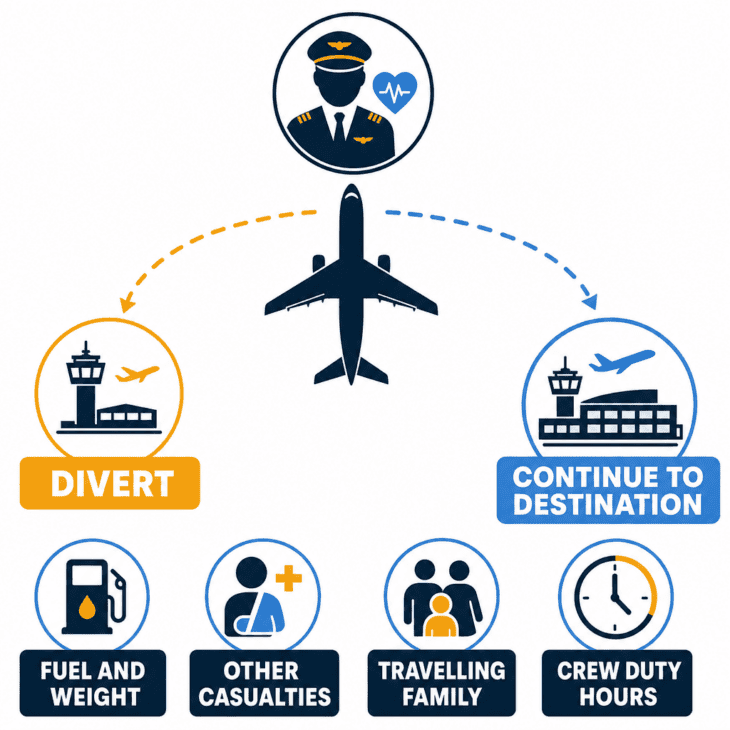
Here is the counterintuitive part. A death on board removes the strongest argument for diverting, because the reason to divert is to get a patient to a hospital faster, and there is no longer a patient to save.
Diversions are rare in general. Across the whole JAMA dataset, only 1.7% of medical events sent an aircraft to an unplanned airport, and the leading causes were suspected strokes, seizures and chest pain, which are the cases where minutes still matter.
The cost weighs on the decision too. MedAire puts the price of an unplanned diversion at anywhere from $15,000 to $200,000 once fuel, landing fees, crew duty limits and knock-on delays are counted. Our explainer on what actually happens when a flight diverts walks through the mechanics.
There are also practical reasons to keep going. Landing at an unplanned airport means the deceased, and any family travelling with them, are handed to an unfamiliar country’s authorities, with repatriation to arrange from there.
Crew duty hours are another constraint. A long diversion can push the crew past their legal limits, at which point the aircraft and everyone on it is stuck until a fresh crew arrives, which is one of the quieter reasons that one delay tends to create more across the network.
None of that makes diversion automatic or forbidden. When Singapore Airlines flight SQ321 hit severe turbulence over Myanmar in May 2024 and a 73-year-old British passenger died, the Boeing 777 diverted to Bangkok, because dozens of other passengers were badly injured and needed hospitals.
Which country’s law applies at 38,000 feet
This is the wrinkle that catches people out. If a passenger dies over the middle of the Atlantic, the question of where the death legally occurred has a surprisingly tidy answer.
Because nobody on board can certify the death, it is not formally a death until a qualified person on the ground says so. In practice that means the death is treated as having occurred in whichever country the aircraft next lands in, and that country issues the death certificate under its own law.
So a British passenger who dies over the ocean on a flight from London to Dubai is, on paper, a death registered in the United Arab Emirates. The family then deals with that country’s authorities to repatriate the body.
Criminal jurisdiction works differently. Under the 1963 Tokyo Convention, offences committed on board an aircraft in flight fall to the country the aircraft is registered in, the aviation equivalent of the law of the flag at sea. That only matters in the rare case where a death looks suspicious.
There is a public health layer as well. Under 42 CFR 71.21, the commander of any aircraft bound for a United States airport from abroad must report a death on board to the CDC quarantine station before arrival, with a matching rule covering domestic flights.
The myth: an emergency landing and a scene
Most people assume a death on board triggers a dramatic descent, a runway lined with emergency vehicles, and an aircraft full of passengers who all know exactly what has happened. Usually none of that is true.
What people get wrong
The three most common assumptions are that the aircraft always diverts, that the crew declare the death, and that the body is stored somewhere out of sight in a hold or galley. In reality most flights continue as planned, no one on board is legally able to pronounce death, and the deceased stays in a passenger seat with a belt fastened.
The reality is quieter and stranger. The flight continues at cruise for hours, the service resumes, and most of the cabin never learns what happened three rows back.
On arrival there is one visible break from routine. Everyone else disembarks first, while the deceased and any travelling companions stay on board until police, a coroner’s officer or airport medical staff come up the airbridge to take over.
For the crew, that gap between the last chest compression and the arrival gate is the hard part. They have hours of normal service to run, in front of a cabin they are not going to alarm, with a duty period that the same rest and duty rules keep ticking regardless.
Which brings it back to the passenger in 34C. Long before any of this, the cabin has been quietly working on all of us: dry, cold, pressurised to the equivalent of a mountainside, and harder on the body over a long flight than most passengers realise.
That is not a reason to be nervous. One death per ten million passengers is a vanishingly small number, and the far more common outcome, by an enormous margin, is a faint, a call for a doctor, and a passenger who walks off at the gate.
But the next time a PA announcement asks whether there is a doctor on board, you will know what is already happening: a satellite call to a physician on the ground, a kit coming out of a locker, and a crew running a protocol they hope never to finish.
Sources and references used for research and fact-checking.
- JAMA Network Open, In-Flight Medical Events on Commercial Airline Flights
- Aerospace Medical Association, Medical Emergencies: Managing In-flight Medical Events
- IATA, Medical Manual for Aviation
- US Electronic Code of Federal Regulations, 14 CFR 121.803 Emergency medical equipment
- US Electronic Code of Federal Regulations, 42 CFR 71.21 Report of death or illness
- MedAire, MedAire Annual Facts and Figures
Get the Newsletter
The latest aviation news and stories sent to your inbox.
About the Author

Tim is the owner and lead editor of AeroCorner since 2019, overseeing aviation content covering aircraft, airlines, airports, and the broader aviation industry. Through years of researching, writing, editing, and publishing aviation-focused content, he has developed extensive practical knowledge of commercial aviation and air travel. Based in Asia and a frequent traveler himself, Tim also brings firsthand passenger experience to AeroCorner’s coverage. Outside of publishing, he has also explored aviation firsthand through hands-on flight training in New Zealand.